AI Reality Show Simulator: Direct Casts, Alliances & Votes
2026-08-30
Roleplay Game Master helps you run a reality show simulator by keeping a full cast in character — every alliance, challenge, and blindside included — with memory that does not reset when you leave. In August 2026, unscripted TV still dominates watch parties, but most so-called simulators are recap blogs or board-game clones with a fixed finale. This AI gives you the house, the votes, and a season that only exists because of how you played.
✅ Cast custom contestants with jobs, secrets, tells, and shifting loyalties ✅ Challenges, confessionals, and live votes that follow from what actually happened ✅ Persistent memory so last night’s whisper stays a secret — until someone spills it ✅ Play on web, iOS, or Android with the same house and the same unfinished business
To understand why this matters, look at the gap between watching a season and living inside one. Reality TV still pulls huge streaming minutes, and fans already treat the off-season like a second job. What they rarely get is a house that talks back — a reality show simulator where the edit is not locked and the vote is yours.
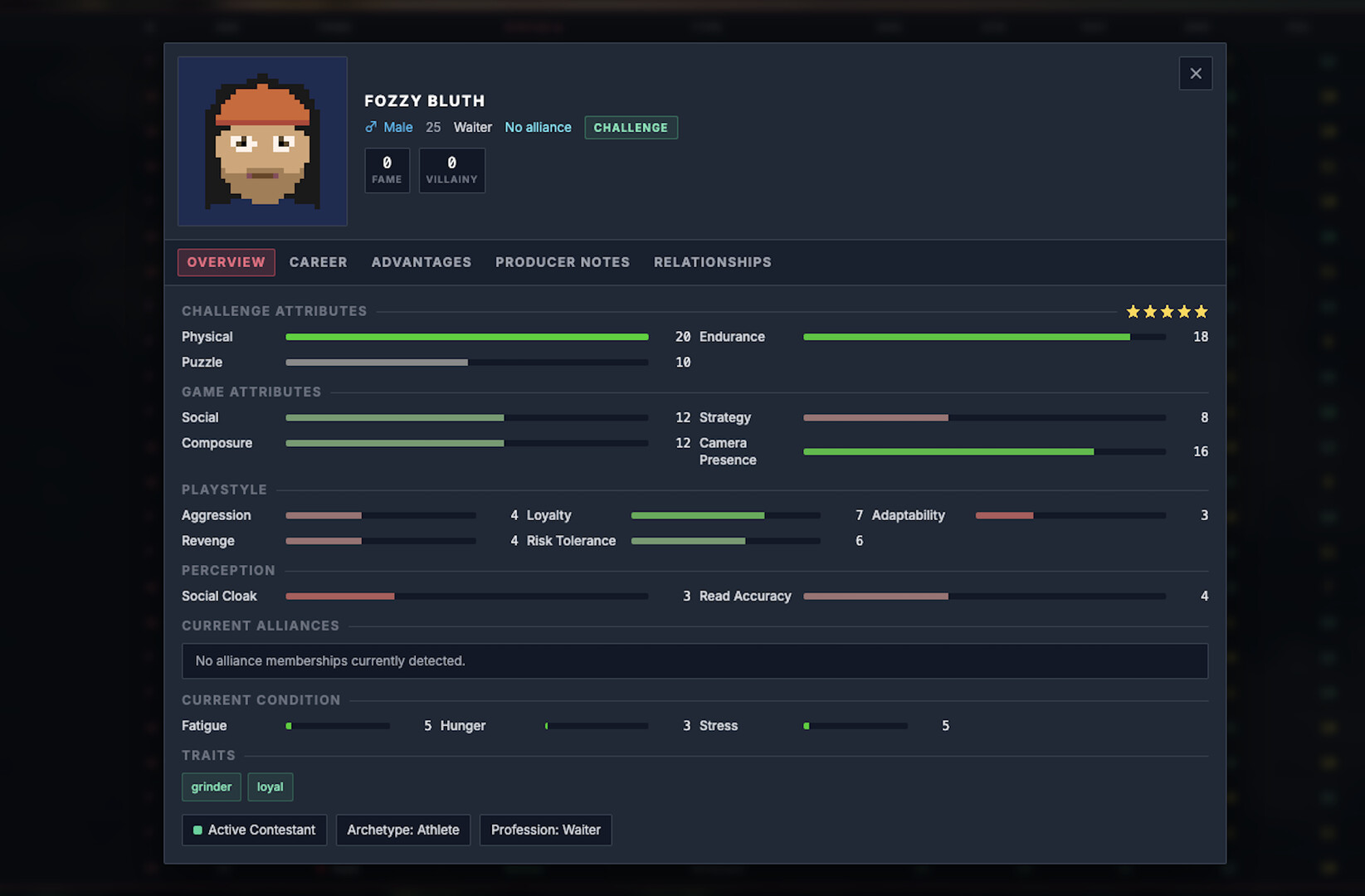
Quick Answer: What Is a Reality Show Simulator?
Roleplay Game Master is an AI roleplay engine that runs a reality show simulator — you cast the house, and alliances, challenges, and votes unfold from your choices. Nothing is locked to a predetermined boot order. The cast reacts.
Key capabilities:
- Custom formats: survival, competition, dating, or a hybrid you invent
- Contestants who remember history — deals, grudges, and public slights included
- Challenges, tribal-style votes, and fallout that carry into the next day
- A season you can pause and resume without the house forgetting who flipped
Why Most Reality Show Simulators Fall Flat
Unscripted television is not shrinking. It is fragmenting across streamers and still commanding attention. Nielsen’s mid-year streaming check found The Traitors at 7.7 billion minutes, with Love Island USA up 2.2 billion minutes versus the prior year and Survivor landing on the acquired top 20. Networks are also doubling down on character-driven formats rather than pure stunt shows.
Fans already behave like players. Deloitte’s Digital Media Trends work found that about 80% of consumers self-identify as fans, that fans spend more time with media than nonfans, and that 75% of fans are gamers compared with 52% of nonfans. The games side of that appetite is large: the life simulation market was valued at $7.4 billion**](https://dataintelo.com/report/life-simulation-game-market) in 2025, and [**online simulation games were estimated at $10.53 billion the following year.
7.7 billion minutes — The Traitors’ first-half streaming total among Nielsen’s tracked originals
75% vs 52% — Share of fans who game, compared with nonfans
But turning “I want a reality show simulator” into a house that actually breathes is frustratingly difficult:
- Watching a season gives you the edit, never the vote
- Party games need a full table and still run on thin character sheets
- Scripted “reality” titles lock the boot order before you sit down
- Generic chatbots forget last night’s alliance and break the illusion by morning
The research on why simulations work is blunt. Classic work on games and learning describes simulations as systems with rules and strategies that allow flexible, variable outcomes — not a DVD menu of endings. Studies on game-based learning also find effects on engagement and social or soft skills, which is the whole point of a social house. A simulator that cannot socialize is just a quiz with confessionals.
This is exactly what this AI was built for.
Why Roleplay Game Master
Roleplay Game Master is a standalone roleplay product with unlimited memory and character consistency — which is what a reality show simulator actually needs. You are not picking ending C. You are living in a house that keeps score.
| Traditional Approach | Roleplay Game Master |
|---|---|
| Recaps, live tweets, and a locked edit | You are in the house when names get read |
| Party games that need eight friends on a Saturday | A full cast available on demand |
| Scripted boot order and a handful of finales | Emergent votes — the group reacts to what you did today |
| Chatbots that reset when you close the tab | Persistent memory across sessions, grudges included |
A house that remembers
The fantasy dies the moment a contestant forgets you already flipped, or greets you like a stranger after a blow-up. Stateless chat is cheap to run and expensive to believe. Persistent memory is the difference between a season and a goldfish. Refer to a junk-food deal, a fake idol read, or a whispered plan, and the house should not need a recap.
That matches how fans already live. More than half of fans (55%) say being a fan leads them across platforms — streaming, social, merch, live events. They want continuity. A reality show simulator that forgets Tuesday’s tribal is not continuity. It is a clip.
Casts with motives, not costumes
Twelve people is enough for alliances, triangles, and a goat problem. It is also small enough that you learn tells: who jokes to hide nerves, who performs for the camera, who is actually here for a win. You can play it as pure chaos or as a social puzzle. Either way, the house does not pause while you decide.
Nearly 40% of fans say they would accept clearly labeled AI-created content in video games and other media. The bar is not “it is AI.” The bar is that the cast stays in character and the consequences stick.
Prompts that start the season
You do not need a tutorial tree. You need a first beach landing.
"Cast twelve contestants for a survival season. Give each a job, a secret, and a tell. I am player one — a quiet strategist. Don't narrate like a recap. Live the first beach landing."
"It's night four. My alliance of four is leaking. Stay in character: one of you is loyal, one of you is shopping a resume. Nobody breaks the fourth wall."
"Challenge day. Endurance test, then a live vote. Play the hour before tribal — whispering, paranoia, fake-idol energy if someone earned that read — then read the votes."
Those are playable scenes, not settings menus. The simulator’s job is to keep the room alive after you send them.
Related Agents You'll Also Find Useful
If the house is where you go for votes and blindsides, these sit next to it in a normal week — same social-strategy reader, different job.
Love Island is the dating-show cousin: eight singles on a private island, open-world romance, recoupling instead of tribal. If you want grafting and public pairing more than immunity wins, this is the next map.
- Emergent couplings rather than a single love-interest track
- Private chats that can blow up the house the next morning
- The same “your choices stick” feeling in a villa instead of a camp
K-Pop Producer puts you in the producer chair of a survival format: pick trainees, navigate power dynamics, and shape careers across 60 intense days. It is closer to a competition series than a beach hang.
- Casting and cuts with real social fallout
- Power maps inside the company, not just inside a tribe
- A season clock that forces decisions you cannot postpone
College Life is the campus sandbox: friendships, heartbreak, and status games that unfold from your choices. Use it when you want social dynamics without challenges or a host.
- Open-world social play rather than a weekly elimination
- Friend groups and rivalries that shift when you do
- A softer (or messier) map after a high-drama season
Try it free — no credit card required.
How a Reality Show Simulator Works
You do not install a game engine. You set the format, talk, and let the house move.
Step 1: Name the format and the stakes Open the simulator and state the show in plain language — survival, competition, dating, or a hybrid. One tight brief beats a vague “let’s play reality TV.”
"Run a 12-person survival season. Tribes, camp life, weekly challenges, and a live vote. I want slow strategy, public blindsides, and confessionals that actually contradict what people said at tribal."
Step 2: Cast the house and pick a posture Let contestants introduce themselves. Notice who performs, who watches, who already has a favorite. Decide whether you are a player, a host, or a producer sitting above the edit — the house will read it either way.
"Have each contestant introduce themselves in character. Then, as the group, tell me who already seems aligned in all but name."
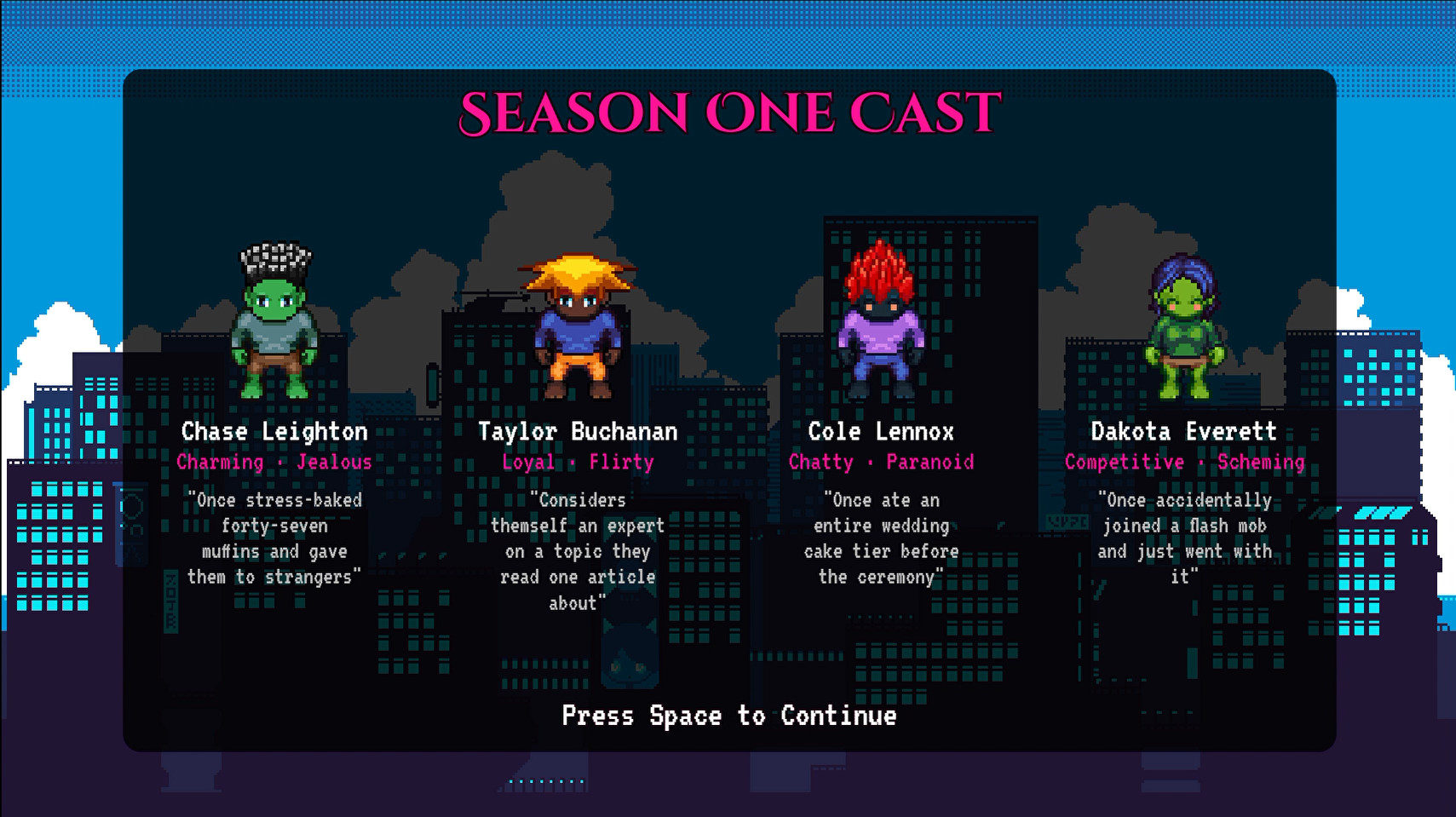
Step 3: Play the day, not the recap Spend time in small scenes: rice, a walk, a dare, a late-night deal. Every aside is social evidence. Memory is the point — you should not have to re-explain a fight you already had.
"I joked too hard at someone's expense after the challenge. Stay in character overnight: some people thought it was funny, one person didn't. Don't reset in the morning."
Step 4: Survive the vote When names get read, play the hour before and the hour after. Comfort someone. Defend a choice. Sit with the quiet that follows a public snub. This is the scene people search a reality show simulator for.
"It's tribal. I've been loyal to a four, but one of them has been grafting a new pair in private. Play the vote, then the fallout back at camp."
Step 5: Keep the season going across sessions Come back tomorrow. Ask what the house remembers. Push a new twist or let a slow alliance cook. Persistent memory is what separates a season from a one-shot chatbot.
"It's the next morning. Don't recap like a narrator — just live it. Who is avoiding me, and who wants a word away from the others?"
Results & Use Cases
🎬 Produce a full season on your terms
- Scenario: You finished another unscripted finale at 1 a.m. and you are not ready for the group chat to go quiet.
- Traditional Approach: Recaps, fantasy drafts, and a board game that needs seven friends who can stay until midnight.
- Roleplay Game Master: You set a format, cast twelve people, and stay until the vote feels personal.
- You control the pace: one charged night or a week of camp politics
- The drama is social, not a narrator dumping plot
- Replays stay interesting because the house is not on rails
🗳️ Play as a contestant and survive the vote
- Scenario: You want to notice when someone is performing versus connecting — useful in a house, and not useless in real rooms.
- Traditional Approach: Overthinking texts, or arguing with friends who were not in the conversation.
- This AI: Run the same night twice. Play loyal once. Flip once. Compare who still sits next to you.
- Safe rehearsal for timing, tone, and when to shut up
- Clear cause and effect: your move, the house’s weather
- A natural handoff to K-Pop Producer if you want the same power map from the producer chair
📱 Run tribal on the commute
- Scenario: Train, lunch break, or a couch with one earbud in — you still want the fire, not a watered-down mobile fork.
- Traditional Approach: Download a choice app, burn currency on the charged scenes, lose the thread when you switch devices.
- The simulator: Same house on web, iOS, and Android; pick up the fight you started this morning.
- Sessions that fit a ride without flattening the story
- No “mobile version” with half the cast
- Memory that survives closing the app mid-whisper
🏝️ Switch formats when you want a different kind of heat
- Scenario: The survival season was perfect for public votes. Now you want recoupling, grafting, and a romance that has to survive a firepit.
- Traditional Approach: Start a new dating sim with a fresh tutorial and the same three archetypes.
- Love Island: The same “your choices stick” rule in a villa instead of a camp. For hallways and friend groups without a host, College Life is the campus map.
- A second format for the same player, not a reskin of last season
- Dating pressure instead of immunity math
- Room to play a softer or more chaotic social game after a high-drama boot
FAQ
What is a reality show simulator?
A reality show simulator is a playable season: you join (or produce) a house of contestants and the social story — alliances, challenges, jealousy, votes — changes because of what you do. On Jenova, that means an AI roleplay house with memory and character consistency, not a recap blog or a flowchart with two finales. If you can close the tab and the cast still remembers the slight, you are in a simulator rather than a script.
Is Roleplay Game Master free to play?
Yes. You can start on the free tier with core features and limited usage. If you are running long season days, extra sessions, or heavier model use, paid plans raise the monthly allowance. There is no credit-card wall to walk into the house and meet the cast.
How is a reality show simulator different from watching TV or a typical dating sim?
The show is edited for you. Most dating sims are routed for you. This format is closer to a social sandbox: a cast, public pressure, private chats, and outcomes that are not waiting in a menu. The global reality show market is still projected to grow, and narrative adventure games reached $5.1 billion as players look for stories they can affect. You will not get a producer in your ear — you will get contestants who react. For a villa instead of a tribe, Love Island is the dating-show version of that same idea.
Does a reality show simulator work on mobile?
Yes. Play on the web or in the iOS and Android apps with the same house and the same memory. That matters because fans already move across formats and devices to stay inside a fandom. A simulator that only works at a desk is a weekend toy. This one is built to survive a commute vote.
Can the contestants remember previous conversations?
They are meant to. Persistent, cross-session memory is the difference between a season and a goldfish. Refer to a joke from yesterday, a loyalty test, or a whispered plan and the house should not need a recap. If you want a clean slate, start a new run. If you want continuity, keep talking.
Can I simulate Survivor-style votes, dating shows, or a custom format?
Yes. Set the rules in the first message: tribes, a villa, a producer chair, or a hybrid. Survival and competition play well here; dating pressure plays well in Love Island; trainee cuts and company politics play well in K-Pop Producer. The constraint is the brief you write, not a locked genre menu.
Play the House, Don't Just Watch the Edit
A reality show simulator should not be a recap, a gem store, or a chatbot that forgets your name. It should be a house: a cast, public votes, private consequences, and a story that only exists because you showed up a certain way. Roleplay Game Master is built for that — immersive roleplay with memory that lasts past tribal.
When you want recoupling instead of a boot, Love Island is waiting on the beach. When you want the producer chair, the survival format above is in the same library.
Try Roleplay Game Master now. Explore more at Jenova.
For Developers: Roleplay Game Master is available programmatically via the Jenova API — integrate persistent, in-character reality-show roleplay into your application with a single API call. Full documentation →