AI Random Encounter Generator: Balanced Combats for Any Party
2026-09-05
Game Designer Assistant helps you generate a balanced random encounter by matching monsters, terrain, and treasure to your party's level and composition. While most Dungeon Masters still flip static tables or do XP math mid-session, this AI produces CR-aware combat setups with environmental complications and story hooks.
✅ CR-balanced monster groups for any party size and level ✅ Terrain, weather, and treasure calibrated to the scene ✅ Fast re-rolls when the table's energy — or the map — changes ✅ Works on web, iOS, and Android, at the table or between sessions
As of September 2026, tabletop role-playing is a growing hobby with millions of players sitting down each year — and every one of those tables needs fights that feel fair, surprising, and tied to the story. To understand why a dedicated random encounter generator matters, it helps to look at what DMs actually face when the party leaves the prepared path.
Quick Answer: What Is an AI Random Encounter Generator?
Game Designer Assistant is an AI game design partner that generates random encounters balanced to party level, terrain, and story in one conversation. You describe the table; it returns monsters, complications, and treasure you can run immediately.
Key capabilities:
- Party-aware encounter building using current D&D difficulty and XP-budget logic
- Mixed monster groups, elevation, and reasons to move — not just a single stat block
- Wilderness, dungeon, urban, and planar travel encounters on demand
- Names, lore, and session-ready writeups when you pair it with related agents
Why Random Encounters Are So Hard to Get Right
Random encounters are supposed to make the world feel alive. In practice they are one of the most failure-prone parts of running a game. The global tabletop RPG market is valued at $2.41 billion in 2026 and is projected to keep expanding — which means more new DMs, more virtual tabletops, and more sessions that go off-script.
3.4 million — U.S. adults who participated in tabletop role-playing games in 2023, according to figures cited from the National Endowment for the Arts
That growth does not make encounter math easier. The 2024 Dungeons & Dragons rules replaced the old Easy/Medium/Hard/Deadly ladder with Low, Moderate, and High difficulties and an XP budget per character. A moderate fight for four 5th-level characters is 3,000 XP. A high-difficulty version of the same table is 4,400 XP. Miss the budget, ignore action economy, or drop a creature whose CR is above the party's level, and a "random" fight becomes a TPK — or a boring round of mop-up.
But building a good random encounter on the fly is frustratingly difficult:
- Static wilderness tables ignore your wizard's remaining spell slots and last night's attrition
- XP budgets, creature counts, and mixed-group advice live in different chapters of the DMG
- VTT plugins ask for biome, level, and loot, then return stat blocks with no story
- Published modules go stale the moment the party turns left instead of right
XP Budgets Do Not Equal a Fun Fight
The 2024 guidelines are clearer than 2014, but they still ask you to cross-reference a table, multiply by party size, then spend that budget without going over. Analyses of the new math note that higher-level "hard" fights got tougher, while the old Deadly band disappeared. A generator that only dumps monsters by CR still misses the part DMs feel at the table: how many creatures act before the paladin, whether anyone can fly, and whether the fight has a reason to move.
Action Economy Punishes "One Big Monster"
Official guidance warns that a creature whose CR is higher than the party's level can drop a character in one action — an ogre can kill a 1st-level wizard in a single blow. It also warns that more than two creatures per character raises the risk of a lucky damage spike. Those two constraints pull in opposite directions. A useful random encounter generator has to respect both, not just hit an XP number.
Filters Are Not Context
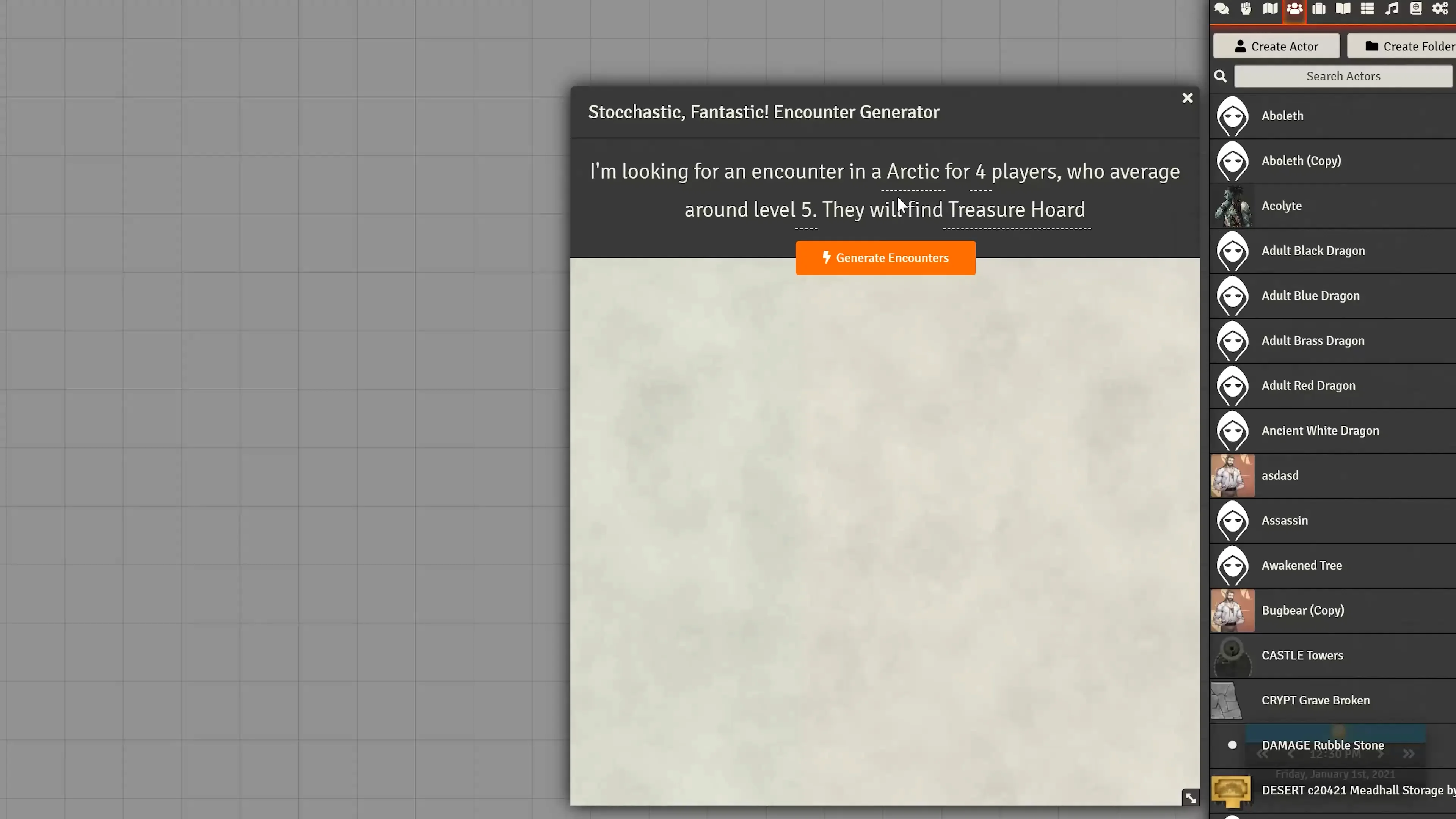
Biome + party size + level is a good start. It is not a campaign. Your Arctic travel scene might need a treasure hoard, a blizzard, and a reason the white dragon wyrmling is there. A dropdown cannot remember that the party already burned two 3rd-level slots and promised a truce to the local tribe.
Prep Time Collides With Real Life
42% — Share of new players deterred by complex rules and expensive starter kits
New DMs are already overloaded. Asking them to also master encounter-building tables between work and a Thursday night game is how random encounters get skipped — and how the world starts feeling like a hallway of planned set pieces.
This is exactly what Game Designer Assistant was built for.
Why Game Designer Assistant
This AI is a standalone game design partner — not a chat window that vaguely "helps with D&D." You brief it the way you would brief a co-DM: party level, composition, terrain, tone, and how deadly you want the scene. It returns a run-ready encounter: creatures, XP spend, terrain features, treasure, and a hook that ties the fight to the world.
| Traditional Approach | Game Designer Assistant |
|---|---|
| Flip a d12 on a biome table and hope the CR is close | Party level, size, and class mix inform the creature list |
| Manually spend a 2024 XP budget from the DMG table | Difficulty (low / moderate / high) translated into a concrete fight |
| One monster type, no terrain, no reason to move | Mixed groups, elevation, weather, and battlefield toys |
| Generic loot from a hoard table | Treasure that matches the story you described |
| 20–40 minutes of prep for a "random" fight | A first draft in one message; a revision in the next |
Party-Aware Balance, Not Just a CR Number
You can specify four 5th-level characters, a glass-cannon sorcerer, and a tank that is already down two Hit Dice. The design partner treats that as systems analysis: action economy, damage types, and whether a single high-CR creature is a bad idea. That maps to how the 2024 rules actually tell you to build combats — choose a difficulty, set an XP budget, spend it on creatures — without making you do the arithmetic while players wait.
Terrain, Mixed Groups, and Reasons to Move
The 2024 basic rules call out elevation, defensive positions, mixed monster groups, and features that force movement as the difference between a slog and a scene. Ask for an Arctic ridge at dusk with a treasure hoard and you get more than "2 winter wolves." You get high ground, whiteout, a reason the pack is here, and a second stat block that combines with the first.
"Build a moderate random encounter for 4 level 5 characters in Arctic wilderness. They are hunting a stolen relic. Include mixed creatures, elevation, and a treasure hoard — no single monster above CR 5."
Documentation You Can Run, Not a Stat Dump
Brainstorming is only half the job. The other half is a writeup you can glance at: creature names and roles, round-one tactics, morale, and what the survivors know if the party talks instead of stabs. That is game design documentation, not a random number.
"Turn this encounter into a one-page run sheet: setup, three tactics, two complications, morale, and interrogation intel."
Genre Fluency Beyond One System
Fantasy TTRPGs hold about 52% of the TTRPG market, but your table might be running Pathfinder 2e, OSR, or a horror one-shot. Because the assistant is trained as a game designer across genres — not a single-system calculator — you can ask for the same scene in a different rules language and get a fight that respects that system's math.
While a dedicated VTT module or a site like an online 2024 encounter maker is excellent at filtering monsters by CR and environment, this AI specializes in the layer those tools leave to you: story, attrition, and the specific party sitting at the table.
Related Agents You'll Also Find Useful
If you are building encounters every week, a few other agents sit naturally in the same workflow.
Roleplay Game Master
If you also need to run the scene — voices, rulings, and perfect character consistency — the Roleplay Game Master picks up where the writeup ends. Hand it the encounter document and play the fight, the parley, or the chase without losing NPC voices between sessions.
- Unlimited memory across the campaign
- Consistent NPCs and factions
- Any scenario, from a roadside ambush to a planar court
Name Generator
A random encounter lands harder when the bandit captain, the frozen hamlet, and the relic in the hoard have names that sound like they belong. Name Generator is a naming consultant with cultural and linguistic range — useful for NPCs, places, ships, and magic items the party will repeat for months.
- Names for people, places, creatures, and loot
- Tone matching (grimdark, mythic, comedic, folkloric)
- Batch lists when you need a whole warband
Deep Research
When the encounter needs to feel researched — Ice Age megafauna, historical caravan routes, or published-setting lore — Deep Research pulls sources and synthesizes them with citations. Use it before you generate the fight if you want the ecology to hold up to a player who actually reads.
- Multi-source briefs with inline citations
- Monster ecology, faction politics, and travel hazards
- Campaign bibles you can attach as context
Try the design assistant free — no credit card required.
How to Generate a Random Encounter in Minutes
Step 1: Brief the Party Tell the assistant who is at the table. Level, count, and a one-line read on resources matter more than a full character sheet. Four 5th-levels who just finished a hard fight should not get the same moderate budget as a fresh party.
"Party of 4, average level 5. Open Paladin, Wizard, Rogue, Cleric. Wizard is down both 3rd-level slots. Want a moderate fight, not a near-TPK."
Step 2: Set Terrain, Stakes, and Tone Biome is the minimum. Better briefs include time of day, weather, what the party is doing, and whether you want loot. This is the same information a good VTT generator asks for — environment, player count, level, treasure — plus the story those dropdowns cannot capture.
"Arctic coastal cliffs at night, high wind. They are tracking smugglers and will find a treasure hoard if they win. Grim, not goofy. Include a reason to negotiate."
Step 3: Generate, Then Stress-Test Ask for the encounter, then poke the weak points: "Is this over budget for 2024 moderate?" "Swap the flyer for something the Rogue can sneak past." "Add a third complication that is environmental, not another monster." Iteration is the point of a conversational generator.
"Rebuild this to 2024 moderate XP for 4 level 5s. Max two stat blocks. No creature CR above 5. Add elevation and a crumbling ice bridge."
Step 4: Package It for the Table Request a run sheet: map sketch in words, initiative notes, morale, treasure with weights and values, and what surviving enemies will say. If you need names, pull in the naming consultant. If you want to play it out solo or between sessions, hand the sheet to the roleplay GM.
"Give me a one-page DM run sheet: boxed text, creature roles, round-1 tactics, morale, hoard, and three rumors the smugglers know."
Results & Use Cases
🧭 Off-Map Wilderness Travel
Scenario: Your 5th-level party ignores the road and cuts across the tundra. You have nothing prepped for Arctic travel.
Traditional Approach: Roll on a wilderness table, get "1d4 winter wolves," then spend ten minutes checking whether that is a moderate fight and whether anyone remembered cold weather gear.
Game Designer Assistant: You describe the shortcut, the remaining resources, and the relic they are chasing. You get a mixed group, a blizzard as a reason to move, and a hoard that actually belongs to someone.
- Difficulty matched to a 2024 moderate budget
- Treasure and intel that push the main plot
- A second version ready if they try to parley
🎲 Last-Minute One-Shot Prep
Scenario: Three players dropped. You have two hours to turn a dungeon crawl into a four-encounter one-shot.
Traditional Approach: Steal rooms from a module, guess at CR, and pray the boss is not a one-shot machine. Encounter-balance debates after the 2024 DMG exist because this guesswork still fails in both directions.
This AI: You ask for a low–moderate–high–moderate sequence for three 3rd-level characters, one rest in the middle, and a unique boss with a named lieutenant. Pair the lieutenant with Name Generator so the table remembers who stabbed them.
- Four encounters, one rest, one boss
- Stat-block count kept to two or three per fight
- Names and motives, not anonymous rooms
📱 Generating Tonight's Dungeon on Mobile
Scenario: You are on a train with a phone and a session in three hours. The party said they would "check the sewers."
Traditional Approach: Laptop, PDFs, and a calculator, or you improvise and the action economy gets away from you.
The encounter generator on Jenova: Same agent on iOS or Android. Voice or type the brief, screenshot the run sheet, sit down ready. Digital TTRPG platforms already account for a large share of how people play; a generator that travels with you is the missing piece, not another tab of monster filters.
- Full feature parity on phone and web
- Iterate while you commute
- Paste the run sheet into your VTT notes
🐉 Named Villain, Not a Random Stat Block
Scenario: The "random" encounter should secretly be the campaign villain's scouting party.
Traditional Approach: Recolor bandits and hope someone asks a name.
Game Designer Assistant + naming + research: Design the fight as a moderate ambush with a fleeing lieutenant. Name the lieutenant and the warband. If you want the faction's methods to match a real-world or published analogue, run a short Deep Research brief first, then feed the findings into the encounter prompt.
- Combat that reveals a faction, not just XP
- Names the table will repeat
- Lore that survives a curious player
FAQ
What is a random encounter generator?
A random encounter generator is a tool that produces a combat or exploration scene from inputs like party level, environment, and difficulty. An AI version, such as Game Designer Assistant, also takes story, attrition, and tone into account, then writes a run-ready setup instead of only listing monsters by CR.
Is Game Designer Assistant free?
Yes. Jenova offers a free tier with core features and limited monthly usage, so you can generate encounters without a credit card. Higher tiers increase usage if you are prepping a full campaign. Check current plans on the site when you subscribe.
How is this different from a VTT plugin or an encounter calculator?
Calculators and VTT modules are strong at filters: Arctic, four players, level 5, treasure hoard. They do not know your wizard is out of fireballs or that the wolves are scouts for a named villain. This AI is a design partner. Use a calculator for raw CR lists; use the assistant when the fight has to fit this party and this session.
Can it build encounters for D&D 2024 and other systems?
Yes. You can specify 2024 Low/Moderate/High XP budgets, 2014 deadly-style pacing, Pathfinder 2e encounter building, or OSR reaction rolls. State the system in the first message. The more precise you are about difficulty and creature count, the closer the first draft will be.
Does a random encounter generator work on mobile?
Jenova runs on web, iOS, and Android with the same agents and history. That matters for DMs who prep on a phone between work and game night, or who need a replacement fight when the party jumps off the map.
Are AI-generated encounters accurate enough to run?
Treat the first output as a strong draft, not scripture. Check that creature CRs and counts match your intended difficulty, especially at levels 1–2 and when a monster's CR exceeds party level. Official guidance still applies: mixed groups are stronger, and too many attackers spike damage. Ask the assistant to show its XP spend so you can verify.
Conclusion
Random encounters fail when they are either a spreadsheet exercise or a flavorless roll on a biome table. A good random encounter generator has to do both jobs: hit the 2024 (or Pathfinder, or OSR) math, and still feel like the world noticed the party.
Game Designer Assistant is the AI that sits in that gap — party-aware combats, terrain that matters, treasure that belongs, and a run sheet you can use tonight. When you also need names, lore, or someone to play the scene, the related agents above stay in the same campaign.
Try the AI encounter designer for your next off-map hex. Explore more at Jenova.
For Developers: Game Designer Assistant is available programmatically via the Jenova API — integrate CR-aware encounter generation into your VTT or campaign app with a single API call. Full documentation →