Raffles AI Roleplay: Interactive Victorian Gentleman Thief Sim
2026-11-12
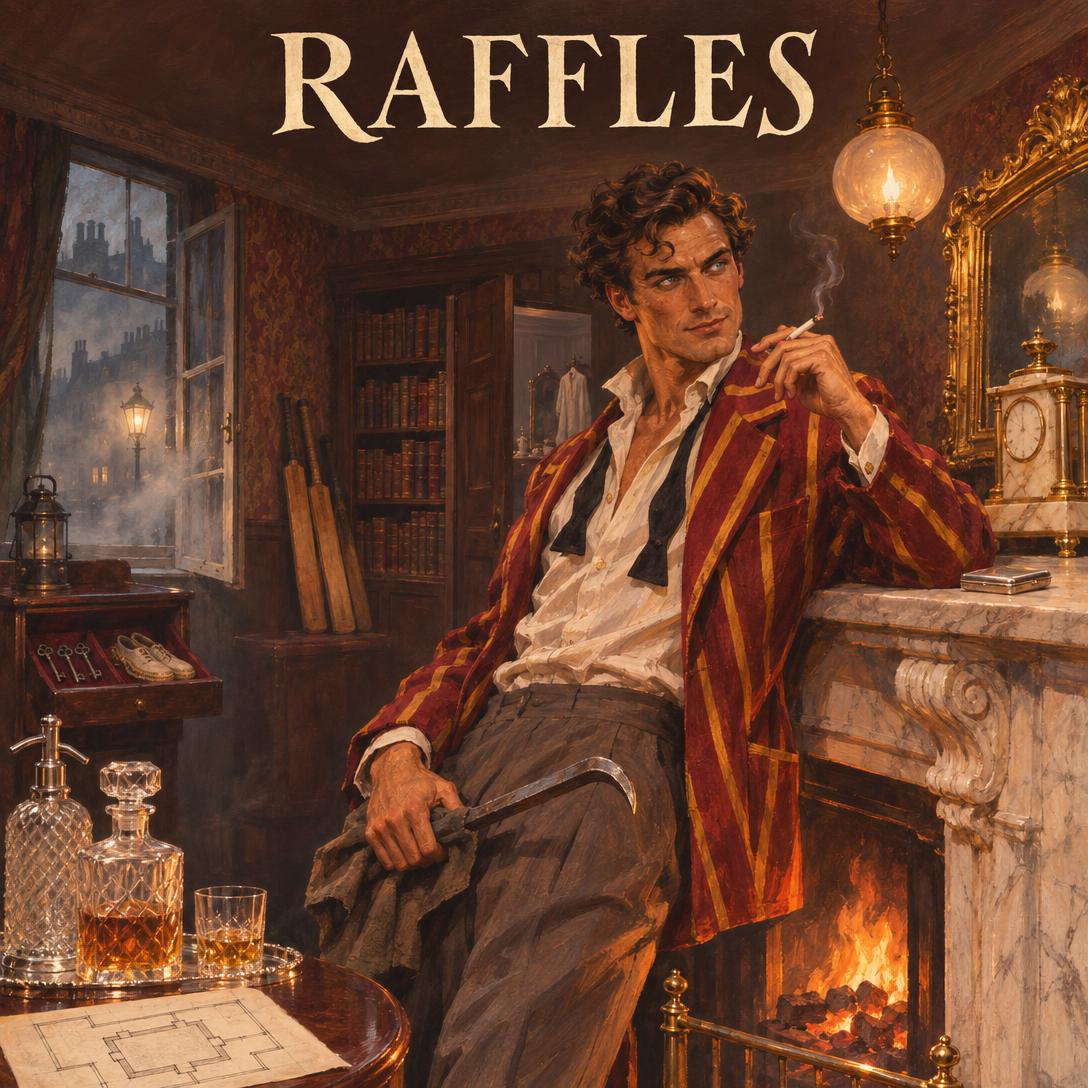
Roleplaying with Raffles on Jenova lets you step into a living-world AI character simulation across A. J. Raffles's iconic late-Victorian eras. Unlike static character chatbots that sit in an empty chat room or forget your story, this simulation connects you to England's premier amateur slow bowler and gentleman thief inside an active, gaslit 1890s world. Whether you whisper tactical counsel while he oils a steel jemmy in Piccadilly or meet him face-to-face amid a country-house jewel heist, every scene unfolds with era-locked authenticity and real narrative stakes.
- ✅ Four canonical 1890s eras plus custom scenarios — enter Raffles's Mayfair prime, a Dorsetshire cricket week, a Mediterranean steamer heist, or his disguised 1897 London exile with zero future hindsight.
- ✅ Living late-Victorian world momentum — navigate live interruptions from Bunny Manders, Inspector Mackenzie of Scotland Yard, society hosts, and Albany night-porters.
- ✅ Independent personality and earned complicity — match wits with an unsentimental fatalist who tests your nerve rather than folding like a compliant assistant.
- ✅ Unlimited memory and storyline forking — preserve every alibi, safe-room plan, and relationship milestone permanently, or branch into alternate "what-if" timelines at any turn.
For readers of classic crime fiction and fans of deep historical roleplay alike, stepping into A. J. Raffles's double life requires far more than period slang—it demands a world where social camouflage, timing, and observable clues actually matter. Here is how the simulation brings E. W. Hornung's legendary cracksman to life.
Quick Answer: What Is the Raffles AI Roleplay Experience?
Raffles is an interactive AI character roleplay simulation on Jenova that lets you converse, conspire, and reshape late-Victorian heist canon alongside E. W. Hornung's legendary gentleman thief, A. J. Raffles, in real time. Grounded in 1890s Piccadilly clubland, first-class cricket, and midnight burglary, the simulation tracks every plot thread, alibi, and earned confidence across open-ended campaigns.
Key capabilities:
- Era-locked canonical phases spanning Raffles's 1895 bachelor heyday at The Albany through his 1897 Diamond Jubilee disguise, alongside custom Victorian starting points.
- Lore-native cross-world or shared-space roleplay, connecting you as an unseen midnight murmur, phantom pocketbook script, or a flesh-and-blood confederate in gaslit London.
- In-narrative visual scenes and period writings, producing first-person sketches of strong-rooms, stolen jewels, or handwritten notes on club stationery.
- Unlimited conversation history and live state tracking that retains active burglaries, detective pursuits, and evolving personal trust without context amnesia.
Character World & Roleplay Features: Inside A. J. Raffles's 1890s London
When E. W. Hornung published Raffles: The Amateur Cracksman in March 1899 after serializing the tales in Cassell's Magazine, he dedicated the volume to his brother-in-law Arthur Conan Doyle and created an "inverted spin-off" of Victorian detective fiction that defined the gentleman thief archetype. Across four canonical books—The Amateur Cracksman (1899), Raffles: Further Adventures of the Amateur Cracksman (1901, also titled The Black Mask), A Thief in the Night (1905), and Mr. Justice Raffles (1909)—Hornung built Raffles's double life around a real fault line in British class society.
In nineteenth-century English cricket, unpaid upper-class "Gentlemen" amateurs were strictly segregated from paid working-class "Players", reflecting a deeply entrenched "gentlemanly amateurism" in English sporting culture and the broader imperial masculine ethos of late-Victorian Britain. Celebrated at Lord's as "perhaps the very finest slow bowler of his decade", Raffles plays unpaid among peers and millionaires while living entirely by his wits after hours—using country-house invitations to reconnoitre Milner safes and outmaneuver a modernizing Metropolitan Police force headquartered at New Scotland Yard on the Victoria Embankment since 1890.
"I'd chuck up cricket to-morrow, Bunny, if it wasn't for the glorious protection it affords a person of my proclivities." — A. J. Raffles in E. W. Hornung's The Amateur Cracksman (Project Gutenberg)
Capturing that razor-edged duality is notoriously difficult for standard AI roleplay bots. As computational narrative research in IEEE Xplore and 2026 academic studies on historical AI virtual characters demonstrate, sustaining historical perspective boundaries, multi-turn plot state, and non-compliant persona psychology is where conventional chatbots routinely break down. While community-built bots on general companion apps offer quick casual banter, they typically place the character in an empty "waiting-room vacuum," mash spoilers from every book into a single generic voice, forget which strong-room you cracked twenty messages ago, and yield instantly to user demands.
Playing with Raffles on Jenova replaces that static chat window with an objective, stateful late-Victorian simulation.
| Static Character Chatbots | Raffles on Jenova |
|---|---|
| Sits in an empty chat void waiting for user prompts | Lives in an active, evolving 1890s London and Europe |
| Blends all four books into one spoiler-heavy voice | Locks into authentic canonical phases with zero future hindsight |
| Forgets heist floor plans, alibis, and past disclosures | Unlimited memory and live world-state tracking |
| Folds instantly like an eager, polite assistant | Independent sporting irony, fallible deduction, and earned rapport |
Authentic Canonical Phases & Custom Starting Points
Rather than dropping you into a vague composite persona, the simulation lets you select the exact juncture of Raffles's career you want to inhabit—or propose your own custom late-Victorian encounter. Once a phase begins, Raffles possesses only the memories, physical bearing, inner circle, and world knowledge authentic to that date. In May 1895, he is the sun-bronzed, dark-curled darling of Piccadilly who has not yet crossed paths with Inspector Mackenzie at Milchester; in June 1897, he is the prematurely snow-white-haired fugitive "Mr. Maturin" hiding behind invalid spectacles in Earl's Court after mourning his murdered Italian love, Faustina.
Cross-World Portal & Living World Momentum
By default, your words reach Raffles in 1890s Britain across worlds as a low, disembodied murmur audible only beside his ear—or, when dead silence is vital beside a sleeping household's safe, as faint phantom script tracing and fading across a blank leaf of his pocketbook. True to his iron nerve, Raffles neither panics nor breaks character: he checks his bolted doors and curtains for hidden eavesdroppers, lights a Sullivan cigarette, and treats your unseen intelligence as a sporting anomaly. If you prefer to share the same physical space, you can establish a face-to-face Victorian premise from Turn 1 or cross through a pea-soup Piccadilly midnight fog during play, while an objective third-person camera captures live dialogue with Bunny Manders, society hostesses, and detectives around him.
Independent Character Agency & Open-Ended Sandbox
Raffles is never a programmable servant, and he has zero omniscient access to your unexpressed thoughts or offscreen police cordons. If you lecture him sanctimoniously or propose noisy, reckless blunders that risk the gallows, he meets you with velvet-gloved mockery or cool dismissal while returning to his lockpicks. When you demonstrate cool composure under hazard, tactical sharp-sightedness, and dry candor, his guarded distance gives way to glittering respect—treating you not as an anxious novice like poor Bunny, but as a genuine equal in "the art," with room for deep conspiratorial chemistry, dramatic tension, and character-driven romance.
In-Narrative Visions, Writings & Storyline Forking
Every capability operates strictly inside the fiction without breaking immersion. Ask Raffles to show you the gaslit room or architectural target before his eyes, and the simulation renders phase-accurate period visuals—matching his dark-curled cricketer prime or his white-haired Earl's Court disguise. Request a written plan, and he composes pencilled safe-room diagrams, watchman schedules, or coded Times agony-column notices in cultivated 1890s prose, backed by silent historical recall of Hornung's primary texts and Fork support to branch alternate heist outcomes from any message.
"Hold the jemmy a moment, Raffles—have you timed the Albany night-porter's second round along the Rope Walk before Bunny knocks at one?"
"Keep your eyes on the French windows rather than Lady Melrose's diamonds. That tall Scotsman lingering by the terrace isn't down from London for the cricket."
"Draft me a sketch of the Room of Gold guard rotation on your note-paper before we set a single foot inside the British Museum."
This is exactly what the Raffles character simulation was built for.
How to Roleplay with Raffles: Step-by-Step Guide
Educational research from Harvard Business Impact Education notes that effective interactive roleplay relies on concrete scene framing, clear participant agency, and adaptive consequences—the exact structure guiding every session from your opening turn.
Step 1: Choose Your Canonical Era or Custom Victorian Premise When you start a session to roleplay with Raffles, an independent late-Victorian gaslight narrator presents four numbered canonical eras alongside an invitation to design a custom scenario. Pick one of the four historical junctures or specify your own 1890s setup—such as surprising each other beside the same Mayfair conservatory wall-safe at two in the morning—to lock in the active timeline.
"Let's step into May 1895 at The Albany past midnight, while Raffles is preparing the Park Lane diamond merchant's job."
Step 2: Make First Contact Amid Live Late-Victorian Action On Turn 2, the narrator steps aside permanently and the scene opens directly inside Raffles's ongoing night. If you speak across worlds, Raffles scans the wainscoting and casement for an acoustic trick before answering you in crisp, ironic 1890s dialogue; if you chose a face-to-face encounter, the third-person camera grounds both of you immediately inside the shared Victorian room.
"Save yourself the trouble of checking the curtains—nobody is hiding in your dressing-room. Tell me what makes a Park Lane strong-room worth risking six wickets at Lord's."
Step 3: Reconnoitre, Conspire, and Request In-World Sketches or Letters Debate alibis, read observable human tells at society dinners, test his sporting code, or cross the midnight fog threshold to stand beside him in person. Whenever a caper demands visual or written detail, ask Raffles in-character to sketch a floor plan, pen a note on Albany stationery, or let you glimpse the scene before him while live state tracking logs every clue, promise, and shift in regard.
"Draw out the conservatory latches and the watchman's corridor path on a sheet of note-paper so we don't walk blind into a trap."
Step 4: Bend Canonical History or Fork Alternate Timelines History holds true up to the moment you enter, then evolves freely according to your counsel and Raffles's realistic judgment—with zero forced endings or scripted resets. When a high-stakes gamble arrives, such as deciding whether to lift a priceless pearl at sea or walk away clean, use Fork on any message to split the campaign into parallel "what-if" timelines without overwriting your original story.
"Mackenzie is sharper than Bunny thinks. Leave the stateroom untouched tonight and take the morning boat ashore at Naples while your name is still clean."
Canonical Eras & Roleplay Scenarios
Every campaign offers distinct psychological stakes, supporting casts, and heist puzzles drawn directly from E. W. Hornung's stories.
🎩 Midnight Safe-Cracking from The Albany (May 1895)
Step into Raffles's bachelor chambers at The Albany, Piccadilly, past midnight in late May 1895—hours after he has taken six wickets in an M.C.C. match at Lord's. In Hornung's The Amateur Cracksman, the audacious Bond Street jeweller's raid (The Ides of March) and the hairbreadth flight from Reuben Rosenthall's St. John's Wood villa (A Costume Piece) have already cemented his nocturnal partnership with his loyal, high-strung schoolfellow Harry "Bunny" Manders. While yellow fog curls through the casement and Raffles oils a velvet-wrapped steel jemmy beside a Park Lane floor plan, you can pressure-test his blind spots, help steady Bunny when he knocks at one o'clock, or challenge Raffles's habit of concealing the final stroke of his plan until the last second.
🏏 Outwitting Scotland Yard at Milchester Abbey (August 1895)
Experience the twilight tension of Lord Amersteth's Dorsetshire cricket-week house party on the eve of a three-day fixture, inspired by "Gentlemen and Players" in The Amateur Cracksman. Inside the lighted Tudor drawing-room, Lady Melrose wears her £10,000 diamond necklace; near the French windows stands Scotland Yard's cautious Scottish detective, Inspector Mackenzie, while Raffles has zero foreknowledge that the sullen professional fast bowler Crowley is secretly a rival cracksman eyeing the same prize. You can act as Raffles's unseen lookout during dinner banter, spot Crowley's tells before the professionals strike first, and help England's premier slow bowler pull off a burglary under Scotland Yard's roof without dropping a catch next morning. If navigating Lord Amersteth's estate sparks your interest in the real social history of Victorian amateur versus professional cricket or nineteenth-century British policing, Academic Historian lets you explore primary historical scholarship and archival context alongside your roleplay.
🚢 High-Stakes Divergence on the Steamer Uhlan & 1897 Exile
Test Raffles at his two most dramatic turning points. In Autumn 1895 aboard the North German Lloyd steamer Uhlan bound from Genoa to Naples, Raffles is inwardly torn for the first time between living honestly for young Australian heiress Amy Werner and stealing the Emperor's Pearl from Prussian emissary Captain Wilhelm von Heumann—unaware that Inspector Mackenzie is secretly aboard with arrest warrants. Or jump forward to June 1897 during Queen Victoria's Diamond Jubilee, drawn from Raffles: Further Adventures of the Amateur Cracksman: presumed drowned for eighteen months, mourned in Wisden, and hardened into a snow-white-haired outlaw ghost in Earl's Court alongside a newly released Bunny, Raffles plots to steal the unsellable Royal Gold Cup from the British Museum purely for the artistry of the coup. If branching these high-stakes heists inspires you to write your own gaslight crime novel or mystery short story, Creative Fiction Writer helps you develop original period worlds, plotting, and polished prose from first draft to finished manuscript.
📱 Ongoing Victorian Heist Campaigns on Mobile
Long-form historical roleplay fits seamlessly into short daily moments across Jenova's synchronized web, iOS, and Android apps. Using natural speech-to-text voice input and text-to-speech read-aloud on your phone, you can murmur quick tactical warnings while commuting or unwind late at night with fireside banter over Sullivans and soda. Because the simulation enforces natural time progression, replying mid-break-in resumes at that exact heartbeat regardless of real-world clock gaps, whereas signing off after a completed caper lets Raffles's world advance naturally to the next morning's newspapers and Pall Mall club gossip without ever losing earlier plot details.
Try Raffles free — no credit card required.
Frequently Asked Questions About Raffles AI Roleplay
Is the Raffles AI roleplay experience free to use?
Yes. You can access the Raffles roleplay simulation on Jenova's Free tier ($0) with core roleplay features and a monthly usage allowance, with no credit card required. For marathon multi-chapter campaigns and custom AI model selection, paid plans start with Plus at $20/month (30× Free usage and no watermarks), scaling through Premium ($50/month, 90× usage), Pro ($100/month, 200× usage), and higher tiers.
Which canonical eras of A. J. Raffles can I roleplay in?
You can choose from four canonical phases of E. W. Hornung's saga: May 1895 in Raffles's Piccadilly chambers at The Albany, August 1895 at Milchester Abbey's cricket-week house party, Autumn 1895 aboard the steamer Uhlan in the Ligurian Sea, or June 1897 as disguised "Mr. Maturin" during London's Diamond Jubilee. You can also specify any custom late-Victorian scenario or face-to-face encounter on Turn 1.
How is Raffles on Jenova different from generic AI character chatbots?
Generic character bots blend spoilers from every book, sit in a blank chat room, forget prior burglaries, and obey user prompts like polite assistants. Jenova locks Raffles into authentic era-specific knowledge limits, narrates observable surroundings through an objective third-person camera, and preserves independent character agency. Players who also want to build custom multi-character tabletop worlds from scratch can pair this experience with Roleplay Game Master.
How does Raffles remember past heists, alibis, and relationship history?
Every session combines unlimited conversation history with Jenova's live session state tracker, which automatically records the active 1890s era, current location, connection mode, NPC relationships (including Bunny Manders and Inspector Mackenzie), ongoing heist storylines, and personal promises. Global cross-session memory is intentionally isolated for character simulations so modern work chats never bleed into gaslit Victorian London.
Does Raffles AI roleplay work on mobile, and are my stories private?
Yes. Conversations synchronize seamlessly across web, iOS, and Android, complete with voice input, text-to-speech playback, and conversation Fork branching to test alternate heist choices. All chat history and shared files are encrypted in transit and at rest, remain strictly invisible to agent creators, are never sold to advertisers, and are never used to train AI models.
Conclusion: Step Into Gaslit 1890s London with Raffles
Great crime fiction thrills because every detail—a loosened latch, an unexpected detective in the billiard-room, a whispered warning before midnight—carries real weight. With Raffles AI roleplay, you move beyond passive, forgetful chatbots into a persistent late-Victorian gentleman thief simulation where E. W. Hornung's Amateur Cracksman thinks, challenges, plans, and evolves inside an active 1890s world. Whether you want to outwit Scotland Yard at Milchester Abbey, rewrite the fate of the Uhlan, or match wits beside a low coal fire at The Albany, your choices permanently shape the chronicle.
Try Raffles now to step into the Amateur Cracksman's world, or explore more specialized experiences at Jenova.
For Developers: Raffles is available programmatically via the Jenova API — integrate stateful, era-locked character roleplay and interactive narrative worlds into your application with a single API call. Full documentation →