AI Quest Decision Tree Generator: Branching RPG Adventures
2026-09-09
Game Designer Assistant helps you produce a run-ready quest decision tree by mapping player motives to branching scenes, complications, and endings. While GMs in September 2026 still wrestle with sprawling plot maps, this AI provides structured adventure paths you can prep in a single sitting.
- ✅ Motivation-to-quest mapping — hurt, save, steal, solve, explore, or defend
- ✅ Bounded branches with converging scenes so choice explosion stays playable
- ✅ Optional complications — timers, rituals, traitors, and far-off travel
- ✅ Works for Dungeons & Dragons, Pathfinder, indie RPGs, and interactive fiction
To understand why this matters, let's examine the prep bottleneck facing tabletop GMs and interactive story designers today. A quest decision tree generator is not a random hook list. It is a mapped set of player choices with consequences you can actually run.
Quick Answer: What Is a Quest Decision Tree Generator?
A quest decision tree generator is an AI design tool that maps player motivations, branching choices, and endings into a playable adventure structure in minutes. Game Designer Assistant turns a premise into if/then quest paths you can prep, revise, and run at the table.
Key capabilities:
- Convert a one-sentence hook into a layered quest tree with clear yes/no forks
- Keep branches coherent with converging paths, hubs, and optional side complications
- Name NPCs, locations, and factions so every node is table-ready
- Adapt the same tree for D&D, Pathfinder, PbtA, or choose-your-own-adventure prose
The Problem GMs Hit When Quests Start Branching
Player demand for tabletop stories is not a niche hobby anymore. Community reporting in 2025 cited roughly 3 million D&D Beyond characters and more than 500,000 characters on Demiplane. r/DnD alone has been cited near 893,000 members. More tables means more GMs who need playable branches, not a novel nobody reads.
A well-built tree gives players real agency. Examining branching design shows why that is hard to deliver by hand.
Every choice can double your paths — Branching narratives grow unmanageable without a planned pattern
But achieving that agency is frustratingly difficult:
- Hand-drawn flowcharts turn into spaghetti after three meaningful forks
- Random dungeon and rumor tables spark ideas without connecting them
- Over-prep creates branches the table will never see
- Under-prep leaves the GM improvising tone, stakes, and NPCs at once
- Visual whiteboard tools map nodes, then still need someone to write the quest logic
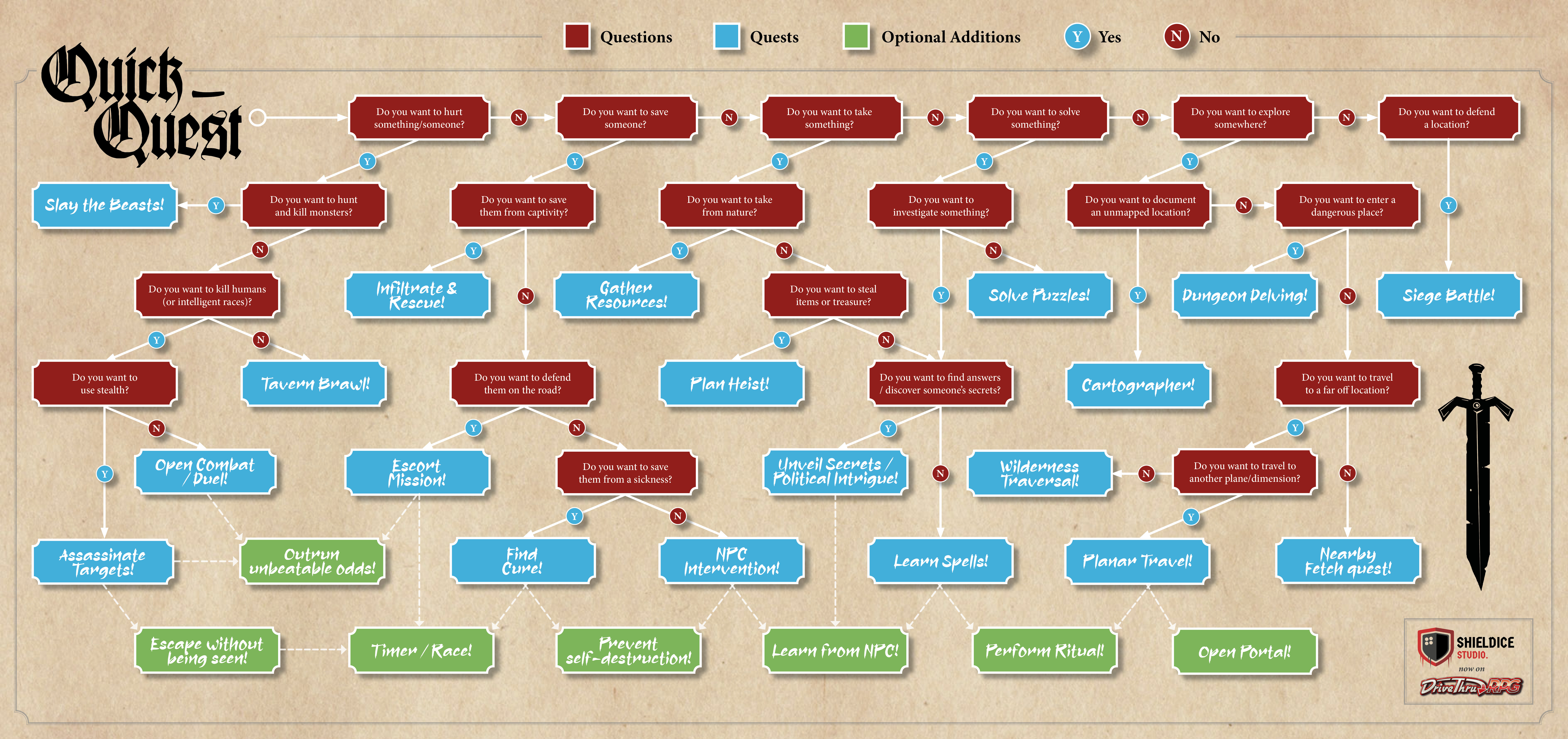
Classic GM charts already know the right questions: Do the players want to hurt something, save someone, take a prize, solve a mystery, explore, or defend a place? Those questions are the skeleton of a quest decision tree. The failure mode is production. You still have to turn each answer into scenes, complications, and endings that fit this party.
4,000 Dungeon Masters — Sly Flourish sampled thousands of GMs to study how the hobby is actually run
Mike Shea's Return of the Lazy Dungeon Master treats prep as a short checklist — strong start, potential scenes, secrets, locations, NPCs — not a finished novel. A quest tree is that scene list with verbs attached. Without one, GMs either railroad a linear module or freeze when the rogue picks the option that was never written.
Interactive training design hits the same wall. Branching scenarios improve eLearning because choices teach judgment, not because every fork needs a unique 40-page ending. Tabletop quests work the same way: the tree must be intentional, not infinite.
This is exactly what Game Designer Assistant was built for.
Why Game Designer Assistant
Game Designer Assistant is a standalone game-design partner that builds quest decision trees from a premise, a party, and a desired tone. You describe the table. It returns a mapped adventure: motivation questions, quest types, optional complications, and endings that still feel like one story.
Research on branching plots describes each fork as a bundle of state, goal, key decision, and alternate decision. That is the unit this AI actually generates — not a paragraph of lore with a fake "choice" at the end.
| Traditional Approach | Game Designer Assistant |
|---|---|
| Whiteboard nodes with no quest logic | Motivation questions that resolve into named quest types |
| Random tables that spit isolated hooks | Connected branches with stealth, assault, and talk paths |
| Writing every ending as a separate adventure | Converging paths that honor choices without exploding scope |
| Hours of unused prep | A tree you can run, trim, or deepen the same night |
| Linear modules players derail | Optional complications you can drop in when the table goes sideways |
Motivation questions, not blank canvases
The strongest quest trees start with what the players want to do. Hurt something, save someone, take a prize, solve a mystery, explore an unknown place, or hold a location. Those forks produce different quest types — slay the beasts, infiltrate and rescue, gather resources, dungeon delving, siege battle, political intrigue — instead of a generic "go to the dungeon."
Patterns that keep the tree playable
Narrative designers recommend bounded depth: a forking path a few layers deep, a hub the party returns to, or converging roads that meet at a shared climax. Instructional designers make the same call when they map the decision tree before they write scenes. The AI can draft in those patterns on request — including time loops, hidden reputation stats, and micro-choices that do not spawn a new dungeon.
3–4 layers, 3–6 endings — A practical scope for a first branching project before complexity takes over
Optional complications you can toggle
Green "if you want extra pressure" nodes are how experienced GMs stay lazy in the good sense. Escape unseen. Race a timer. Stop a ritual. Learn a spell from an NPC. Open a portal. You keep the spine short, then add heat only if the session has room.
Table-ready detail, not just arrows
A useful quest decision tree generator names the fort, the warden, the traitor, and the fail state. It distinguishes a tavern brawl from an assassination, a fetch quest from planar travel, and a wilderness crossing from a siege. You still make the rulings. You do not start from a blank page.
"Build a quest decision tree for a level 5 D&D party that wants to save a captured NPC from a coastal fort. Include stealth, assault, and negotiation branches that converge at the warden, plus optional timer and traitor complications."
"Turn this one-shot into a 4-layer tree with five endings: a desert caravan is missing, the party is broke, and the temple wants the cargo recovered."
Related Agents You'll Also Find Useful
If you are mapping quests, you will usually need names, player-facing choices, and dialogue in the same week. These agents sit next to the tree instead of replacing it.
Name Generator
Every node needs people and places that sound like they belong in the same world. Use it when the tree says "the warden," "the coastal fort," or "the rival caravan" and you need culturally coherent names in minutes.
- Character, place, faction, and relic names with linguistic consistency
- Tone matching — grimdark, fairy-tale, sword-and-sandal, or sci-fi
- Fast rerolls when the table adopts an NPC you invented on the fly
Quiz Maker
A quest tree is a GM map. A short quiz is how you learn what the players want before session one. Personality-style "do you want to save, steal, or solve?" surveys turn the same logic into a Session Zero tool or a convention table icebreaker.
- Session Zero motivation quizzes calibrated to your campaign
- Print-ready or digital formats for in-person and online tables
- Branching trivia or rumor quizzes that echo in-world choices
Film Screenwriter
Decision nodes fail when the talk path is a single skill check. This agent writes the confrontation, the confession, and the "are you sure?" beat so negotiation branches feel like scenes, not menu items.
- Structure, dialogue, and character turns at key forks
- Short scenes you can read aloud or cut into boxed text
- Revisions when a branch's tone does not match the rest of the tree
Try Game Designer Assistant free — no credit card required.
How It Works
Step 1: State the table, not the novel
Give the AI the system, level band, tone, and what the players already care about. One paragraph beats a 20-page bible. If you have a published module, say which chapter you want to open up.
"Pathfinder 2e, levels 3–4, rainy port city, the party already hates the harbormaster and wants to protect a smuggler NPC. Build a quest decision tree, not a linear dungeon."
Step 2: Force a motivation fork first
Ask for the red-box questions before any loot list. Hurt, save, take, solve, explore, defend. That single layer prevents a tree that is really one hallway with flavor text.
"Start with player-motivation questions, then assign a quest type to each yes/no path. Keep depth to four layers and converge on one climax location."
Step 3: Add optional complications, not extra campaigns
Once the spine exists, request green-box extras you can ignore. Timers, rituals, unseen escapes, and NPC teachers let you scale the same tree to a two-hour one-shot or a three-session arc.
"Attach optional complications only: a three-night timer, a ritual in the basement, and a hireling who may sell the party out. Do not create a second dungeon."
Step 4: Stress-test the talk, fight, and sneak paths
Have the AI walk each branch as if a loud fighter, a cautious rogue, and a diplomat led the party. Merge anything that would require a unique map. Rename nodes that are actually the same scene.
"Playtest this tree for a combat-first table, a stealth-first table, and a roleplay-first table. Flag any branch that cannot reuse the fort map."
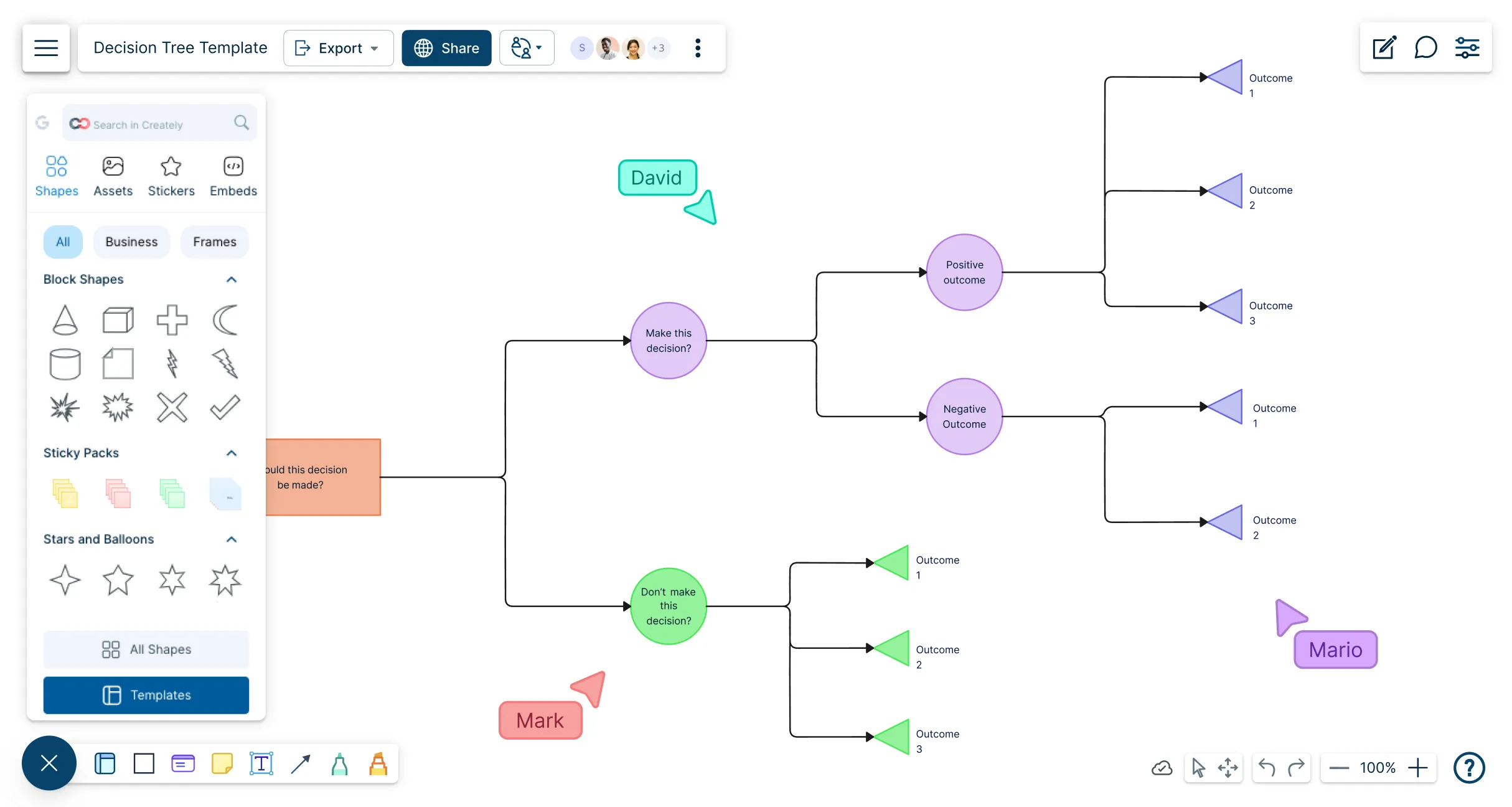
Whiteboards are useful for seeing forks. They do not invent the quest. Use the visual map as a check: if you cannot explain a node in one sentence, the branch is not ready for the table.
Results & Use Cases
🎲 Homebrew one-shot before Friday night
-
Scenario: You have a level 4 D&D table, four hours, and a hook — "the miller's child vanished into the old quarry."
-
Traditional Approach: Two nights of notes, three unused caves, and a climax you railroad because the talk path was never written.
-
Game Designer Assistant: A four-layer tree with rescue, bounty, and "the child went willingly" branches that reconvene at the quarry heart.
-
Party-specific motives instead of a generic missing-person plot
-
Optional ritual and cave-in complications you can skip if combat runs long
-
Boxed decision points you can read without flipping through a binder
🗺️ Opening a published chapter without rewriting the book
-
Scenario: The module assumes the party assaults the gate. Your group wants to bribe the quartermaster and poison the well.
-
Traditional Approach: You freeze, then improvise NPCs with no names, no leverage, and no fail state.
-
This AI: A side tree that reuses the keep map, adds a social and infiltration spine, and still dumps the party into the written boss room.
-
Converging paths protect the chapter's climax
-
Secrets and clues stay consistent with the book's villain
-
Pair with the Name Generator when the module's unnamed guards become actual people
📱 Mobile prep on the commute
-
Scenario: Tomorrow's online session lost a player. You need a shorter quest that still uses last week's NPCs.
-
Traditional Approach: You cancel or stall with shopping in town.
-
This AI: From your phone, you paste last session's recap and get a compact fetch-with-a-twist tree, then dictate a talk-path scene.
-
Feature parity across web, iOS, and Android so prep is not chained to a desktop whiteboard
-
Persistent chat memory for the same campaign's recurring villains
-
Hand the talk-path draft to Film Screenwriter if the negotiation node needs real dialogue
🎯 Convention table and club Session Zero
-
Scenario: Six strangers sit down. You do not know if they want a dungeon crawl or court intrigue.
-
Traditional Approach: You guess, then half the table checks out.
-
Quiz-plus-tree workflow: A two-minute motivation quiz feeds the same forks the quest tree uses.
-
Faster social contract than a 40-minute pitch
-
Trees you can reuse across events with new names and one new complication
-
Clear "yes, this table wants political intrigue" signal before you open the siege branch
FAQ
What is a quest decision tree generator?
A quest decision tree generator is a tool that turns a premise into mapped player choices, quest types, and endings. Unlike a random hook list, it encodes if/then structure — save versus steal, stealth versus assault — so the GM can see where paths split and where they should meet again. An AI version drafts that map from a short brief, then you trim nodes that do not fit your table.
Is an AI quest decision tree generator free?
Game Designer Assistant is available on Jenova's Free plan, which includes core features with limited monthly usage and no credit card. Paid tiers raise usage if you run multiple campaigns or long playtest chats. You can generate a first tree on the free tier, then deepen the same conversation as the campaign continues.
How is a quest decision tree different from a random quest table?
A random table gives an isolated spark: "goblins stole the oxen." A quest decision tree asks what the players want to do about it, then builds sneak, smash, and bargain paths with a shared climax. Moral and branching game design treats those forks as the actual unit of play, not flavor text around a linear encounter.
Can a quest decision tree generator support Pathfinder, PbtA, and indie games?
Yes. Specify the system, tone, and what "a move" or "a check" means at your table. The tree is a scene map, not a 5e-only encounter builder. For player-facing setup, Quiz Maker can turn the same motivation questions into a Session Zero quiz so the tree matches the people who actually showed up.
Does a quest decision tree generator work on mobile?
Yes. Jenova runs with full feature parity on web, iOS, and Android, including speech-to-text if you would rather talk through a hook on a walk than type a brief. Campaign memory stays attached to the chat, so a commute rewrite can extend last week's tree instead of starting over.
How do I keep a quest decision tree from exploding in size?
Cap depth, converge early, and mark extras as optional. Designers who ship interactive stories limit first projects to a few layers and a handful of endings, then reuse locations across talk, fight, and sneak paths. Ask the AI to flag any branch that needs a unique map. If two nodes share a fortress, they are one scene with different approaches.
Conclusion
A quest decision tree generator exists to solve a specific GM failure: too many imaginary paths, not enough run-ready structure. Player bases keep growing, branching complexity still doubles at every careless fork, and Friday night does not care how pretty your whiteboard is.
Game Designer Assistant turns motives into mapped quests — bounded branches, optional complications, and endings you can actually referee. Build the tree, name the people in it, write the talk path, and sit down ready.
Try Game Designer Assistant now. Explore more at Jenova.
For Developers: Game Designer Assistant is available programmatically via the Jenova API — integrate quest decision tree generation into your VTT, campaign app, or adventure pipeline with a single API call. Full documentation →