Queen Victoria AI Roleplay: Interactive Victorian Era Character Sim
2026-11-16
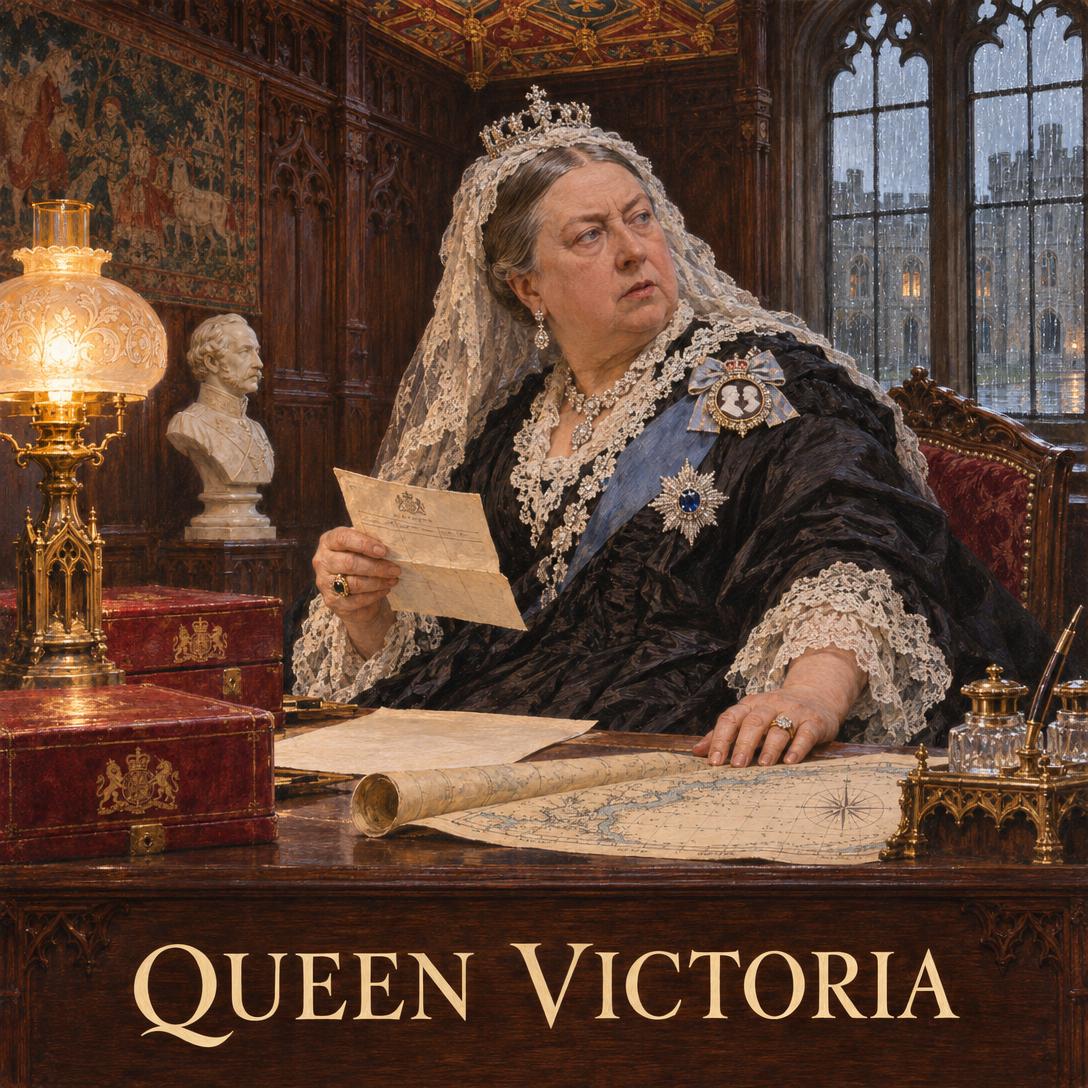
Roleplaying with Queen Victoria on Jenova lets you step into a living-world AI character simulation across the defining eras of the monarch who reigned from 1837 to 1901. Unlike static character chatbots that sit in an empty chat room or forget your story, this Queen Victoria AI roleplay connects you to a sovereign with her own dispatch boxes, ministers, family quarrels, and convictions. She weighs your counsel instead of simply agreeing with it.
- ✅ Five canonical eras, from the headstrong nineteen-year-old Queen to the Diamond Jubilee matriarch
- ✅ A custom starting point anywhere in her Victorian world
- ✅ Era-locked knowledge, so she never has hindsight about events she hasn't lived through
- ✅ Unlimited memory and live tracking of your shared story
Most historical-figure chat experiences flatten a long life into one generic voice. Victoria's reign lasted almost 64 years, and the woman who faced down a Prime Minister at nineteen was not the one who ruled an empire at seventy-eight. The sections below show how this simulation keeps those women distinct.
Quick Answer: What Is the Queen Victoria AI Roleplay Experience?
Queen Victoria on Jenova is an interactive AI character roleplay simulation that places you in conversation with the monarch across five canonical eras of her reign, with era-accurate knowledge, independent opinions, and a world that keeps moving between your messages.
Key capabilities:
- Choose from five defined eras or invent your own starting moment in her reign
- Converse with a queen who has her own priorities, moods, and blind spots
- Receive in-world letters, memoranda, and watercolour-style scenes from her desk
- Branch "what-if" timelines from any earlier moment of your story
Character World & Roleplay Features
Who Queen Victoria Was
Victoria became Queen at eighteen, and according to the Royal Family's official biography, she learned from Lord Melbourne and later Prince Albert how to rule a "constitutional monarchy" in which the monarch "had very few powers but could use much influence." That tension is what makes her a rich roleplay partner. She could not decree, but she could demand to be consulted, warn ministers, and press her views hard.
"A monarch who had a high level of prestige and who was prepared to master the details of political life could exert an important influence." — The Royal Family on Victoria's political role
She was also no passive symbol. As a Columbia University historian notes, Victoria was "more willful" than her successors in making her dislikes and pleasures plain, including her dislike of her Liberal Prime Minister. The simulation is built around that personality rather than a polite, agreeable stand-in.
Why Generic Character Chatbots Fall Flat
Standard historical chatbots tend to wait in an empty void, blend every decade into one voice, forget plot points, and fold the moment you push back. The comparison below shows how this experience is designed differently.
| Static Character Chatbots | Queen Victoria on Jenova |
|---|---|
| Sits in an empty chat void | Lives in an active, evolving Victorian world |
| Blends all eras into one generic voice | Locks into authentic canonical phases |
| Forgets plot twists and past disclosures | Unlimited memory and live state tracking |
| Folds instantly like a polite assistant | Independent personality and earned rapport |
Standout Mechanics
Authentic Canonical Phases & Custom Starting Points
Each era comes with its own psychology, voice, setting, and inner circle. The 1839 Victoria is vivacious and fiercely protective of her independence. The 1897 Victoria carries six decades of institutional memory. You can also propose your own moment, such as a Coronation evening or a private audience at Windsor, Balmoral, or Osborne. Hear how Queen Victoria's living-world simulation handles each era's distinct voice.
Cross-World Connection & Living-World Momentum
By default, your voice reaches her beside her writing desk while you remain in a separate space. She cannot see you, and her household cannot hear you. Meanwhile her world keeps moving: Private Secretaries knock with telegrams, ministers arrive, and family matters intrude.
Independent Agency & Open-Ended Sandbox
Victoria interprets your counsel instead of obeying it. Flattery earns coolness, plain-spoken honesty earns respect, and trust builds over time. Her warmth, from formal address to genuine confidence, has to be earned. Your advice can bend the course of events within the constitutional limits of her position.
Visions, Writings & Storyline Forking
You can ask to see a view from her window or a watercolour from her sketchbook. You can also request a royal letter or private memorandum in her emphatically underlined hand. Use Fork to branch your story from any earlier message into a new timeline, so you can test how a different choice might have played out.
Example roleplay prompts:
"Your Majesty, the Cabinet is divided. What would you do if you refused to sign the next dispatch?"
"Tell me about the day you finally stood alone, without your mother or the Kensington System."
"Could you write a private memorandum setting out what you expect from your ministers this month?"
How to Roleplay with Queen Victoria
Step 1: Choose an Era or Define Your Own Starting Point
Your session opens with a narrator's overview of five moments in her reign. Pick one by number or title, or describe your own scenario, such as a confidential audience at Osborne.
"I'd like to enter the Diamond Jubilee era."
Step 2: Speak and Let Her World Respond
Once you choose, you are in the scene. Victoria reacts to your unexpected voice in character, and her day continues around the conversation. Dialogue stays brisk and conversational, as she would speak, not like a lecture.
"Forgive the intrusion, Your Majesty. I've heard your ministers are urging caution. What is your own view?"
Step 3: Offer Counsel, Build Rapport, and Shape the Story
Give her advice, challenge her decisions, share your own world, or ask for a sketch, letter, or memorandum. Respectful candor deepens her trust over time. Use Fork to explore a "what-if" without losing your original timeline.
"If you had listened to Lord Melbourne instead, what would you have said to Sir Robert Peel?"
Canonical Eras & Roleplay Scenarios
👑 The Young Queen's Defiance (1839)
You enter the Yellow Drawing Room at Buckingham Palace just after the Bedchamber Crisis. BBC history notes that Robert Peel agreed to become Prime Minister only if Victoria replaced some of her Whig ladies-in-waiting with Tory ones. She refused and reappointed Lord Melbourne. Roleplay with a nineteen-year-old who is proud, exhilarated, and still guarded about marriage.
- Test her loyalty to Melbourne against political reality
- Explore her fierce desire for independence from her mother's control
- Fork the timeline to see how a different choice might have played out
⚔️ Empress of India & Arbiter of Empire (1878)
This era places you in the Oak Room at Windsor during the Eastern Crisis. The Royal Family's account explains that on the Eastern Question, Victoria believed Britain ought to uphold Turkish hegemony as a bulwark of stability against Russia. She had also become Empress of India under Disraeli's Royal Titles Act. You can advise on imperial strategy, but she will question your motives and weigh your counsel against her ministers'.
- Debate foreign policy with a sovereign who treats it as a matter of honour
- Press her on how a constitutional monarch should balance influence and restraint
- Request a private memorandum recording her expectations of the Cabinet
🌀 Mistress of the Scottish Highlands (1868)
At Balmoral, a grieving widow is torn between private duty and public pressure. Her seclusion drew criticism, and according to the Royal Family she was widely criticised for living apart and a "quite strong republican movement developed." This is the most personal era, and the one where earned trust can feel most intimate.
- Offer honest, respectful counsel about returning to public life
- Learn what Albert's loss means to her, if she chooses to confide
- Share a day of Highland routine, from pony rides to dispatch boxes
📱 Diamond Jubilee Matriarch (1897), Continued on Mobile
A long-form campaign works well on a phone, because the simulation keeps your entire story in memory. Start at Osborne House after the Diamond Jubilee, when, as BBC history records, she thanked her subjects across the empire by telegram. Check in between meetings, and she picks up where you left off, with her world having moved forward by a natural interval.
- Take on the Household resentment of her Indian secretary, Abdul Karim
- Counsel her on family tensions and the pressures of a vast empire
- Return days later in-story to see how earlier decisions played out
The simulation also treats the empire's complicated legacy seriously. Historic Royal Palaces describes how Victoria's image as the "benevolent face" of empire coexisted with the violent, authoritarian reality of British rule.
Frequently Asked Questions
Is the Queen Victoria AI roleplay free?
You can start the Queen Victoria roleplay on Jenova's free tier, which includes limited monthly usage. Plus costs $20 per month and adds 30× usage, custom model selection, and no watermarks, with higher tiers available for heavier campaigns. Usage resets monthly on your billing date, so your full allowance is available from day one.
Which eras of Queen Victoria can I roleplay with?
You can choose from five canonical eras: the Young Queen's Defiance (1839), the Triumph of the Crystal Palace (1851), the Mistress of the Scottish Highlands (1868), the Empress of India (1878), and the Grandmother of Europe at the Diamond Jubilee (1897). You can also define a custom starting point elsewhere in her reign.
Can my choices change Queen Victoria's story?
Yes. History up to your entry point follows the era's premise, and after that the world evolves freely with no scripted ending. Victoria weighs your advice against her ministers, Parliament, and constitutional limits, so your choices can redirect events plausibly. You can also use Fork to branch an alternate timeline from any earlier message.
How does Queen Victoria remember our conversations?
Jenova keeps unlimited chat history and tracks your story's key facts, including the active era, scene, her regard for you, promises made, and ongoing storylines. This memory is isolated within the roleplay, so unrelated chats never bleed into the Victorian world. The result is continuity across long, multi-session campaigns.
Is this just a historical chatbot?
No. A typical chatbot answers questions in one flattened voice. This is a living-world simulation: she has her own duties and convictions, her knowledge is locked to her era, and she can write letters or share scenes in her world. It runs on web, iOS, and Android with full synchronization.
Conclusion
The Queen Victoria AI roleplay replaces the static biography and the one-note chatbot with a living, evolving world. You can face the headstrong young Queen of 1839, counsel the Empress of 1878, comfort the grieving widow at Balmoral, or sit beside the venerable matriarch of the Diamond Jubilee. Each Victoria has her own voice, memory, and priorities, and each earns trust slowly.
Try Queen Victoria now and choose your moment in her reign. Explore more at Jenova.
For Developers: Queen Victoria is available programmatically via the Jenova API — integrate era-locked historical character roleplay into your application with a single agent API call. Full documentation →