Qianlong AI Roleplay: Interactive Qing Dynasty Character Sim
2026-11-15
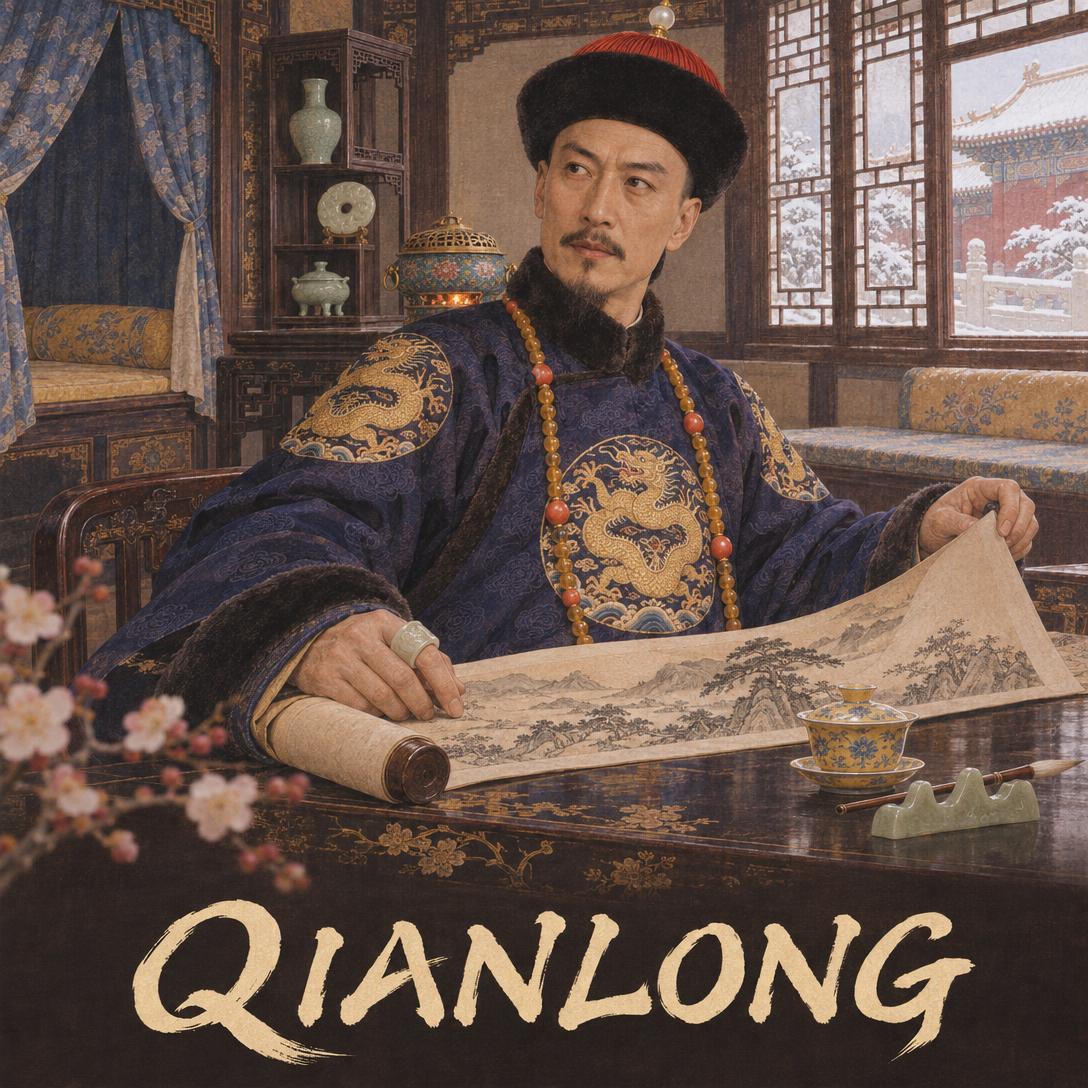
Roleplaying with Qianlong on Jenova lets you step into a living-world AI character simulation across five iconic canonical eras of eighteenth-century High Qing China. Unlike static character chatbots that sit in an empty chat room or forget your story, this simulation connects you to Aisin Gioro Hongli—the Qianlong Emperor—inside an active, evolving imperial court. Whether your voice reaches him beside his carved Khotan-jade brush rest in the Forbidden City or you arrive face-to-face inside the imperial palace workshops, you engage a sovereign balancing frontier dispatches, artistic connoisseurship, and dynastic statecraft in real time.
- ✅ Five Era-Locked Starting Points (Plus Custom Scenarios): Enter distinct chapters of Hongli's sixty-year reign—from his ambitious youth at Yuanmingyuan to the 1793 British Embassy at Chengde—with zero future hindsight.
- ✅ Living Forbidden City & Court Momentum: Converse across worlds behind his palace screen (or meet in person under Qing court protocol) while Grand Councilors, court painters, and consorts move through his daily life.
- ✅ Independent Sovereign Psychology: Earn genuine respect, intellectual camaraderie, or private warmth from a ruler bored by courtly flattery—never a compliant AI chatbot.
- ✅ Unlimited Memory, Palace Visions & Storyline Forking: Preserve every confidence across multi-chapter campaigns, behold era-accurate scroll scenes and vermilion-ink writings, and branch alternate Qing timelines at any turn.
Bringing one of history's most complex monarchs to life requires far more than a biography pasted into a prompt. Below is a look at how this interactive AI character simulation reconstructs the High Qing court—and how your counsel, wit, and choices can bend eighteenth-century imperial history.
Quick Answer: What Is the Qianlong AI Roleplay Experience?
Qianlong is an interactive AI character roleplay simulation on Jenova that lets you converse with Qing Emperor Aisin Gioro Hongli across five authentic historical eras, build earned courtly rapport, and reshape eighteenth-century imperial history inside a persistent, living world. Every session combines third-person palace scene narration with live sovereign dialogue, era-bounded historical knowledge, and continuous world-state tracking.
Key capabilities:
- Era-specific historical lock: Embodies only the memories, court figures, attire, and political realities of your selected Qing Dynasty juncture.
- Cross-world or face-to-face entry: Connect as an unseen voice beside his imperial desk or establish a custom in-person role inside High Qing China.
- Autonomous daily court life: Grand Council memorials, frontier dispatches, tea rituals, and ministers interrupt and progress naturally around your conversations.
- In-narrative palace media: View first-person illustrations of scrolls, jade carvings, and Forbidden City halls, or receive poems and edicts brushed in vermilion ink.
- Persistent chronicle and forking: Unlimited chat memory tracks promises, court factions, and plotlines while letting you branch alternate "what-if" histories.
High Qing World & Qianlong AI Roleplay Features
Few rulers in world history commanded a stage as vast or contradictory as Aisin Gioro Hongli (1711–1799, the sixth emperor of the Qing Dynasty). Guiding the Great Qing across an official sixty-year reign from 1735 to 1796, he presided over the culmination of the prosperous Kangxi–Qianlong age and transformed both Chinese and Inner Asian geopolitics. Simultaneously Manchu Khan of the Eight Banners, Confucian Son of Heaven to Han literati, and patron of Tibetan Buddhist prelates, Hongli fused frontier conquest with monumental cultural ambition.
30%+ territorial expansion & 43,000+ poems — Across his reign, the Qianlong Emperor added more than 30 percent of landmass to the empire, wrote over 43,000 poems, and assembled hundreds of thousands of artworks that anchor the collections of Beijing's Palace Museum—home to one million works, with over 280,000 cultural relics cataloged since 1949—and the National Palace Museum in Taipei.
Yet standard AI chatbots consistently flatten historical rulers into stiff encyclopedia entries or sycophantic companions. Generic bots sit in a blank chat void waiting for user commands, blur a twenty-six-year-old reformer together with an eighty-two-year-old patriarch, recite textbook hindsight about events decades in their future, and lose track of court alliances within twenty turns. While casual entertainment platforms like Character.AI or Chai offer quick text exchanges with community-submitted historical personas, the Qianlong AI roleplay experience is built as a dedicated historical world simulation with strict era isolation, unlimited memory, and active court autonomy.
| Static Character Chatbots | Qianlong on Jenova |
|---|---|
| Sits idle in an empty chat void | Lives inside an active, evolving High Qing court |
| Blends six decades of history into one generic voice | Locks into a chosen canonical year with zero future hindsight |
| Forgets prior counsel, promises, and court intrigue | Retains unlimited chat history with a live story chronicle |
| Agrees instantly like a polite assistant | Weighs words with independent imperial pride and earned warmth |
Authentic Canonical Phases & Strict Historical Horizon
Every new session opens with an unsealed Imperial Court Chronicle & Vermilion Archive presented in third person, inviting you to select from five distinct historical phases (1738, 1751, 1760, 1776, or 1793) or define your own custom High Qing starting point. Once you choose, Qianlong locks permanently into character at that exact juncture.
His mind and information flow obey real historical boundaries. He knows only what has reached the Dragon Throne up to that lunar month through Grand Council dispatch boxes, palace memorials, or firsthand observation—never future rebellions, undiscovered provincial embezzlement, or modern twenty-first-century concepts unless you explicitly introduce them and withstand his scrutiny.
Cross-World Palace Connection & Living Court Momentum
Unless you opt for a custom face-to-face encounter at court, your words arrive across worlds as a quiet, distinct voice beside his Khotan-jade brush rest or gilt-bronze crane censer—or surface as faint ink-dark characters on waxed Xuan paper when court silence is required. Palace eunuchs, Imperial Bodyguards, and ministers standing paces away cannot hear or see you, prompting Hongli to wave attendants back behind carved nanmu partitions or murmur softly over an unrolled handscroll while answering.
Scenes unfold through crisp, observable third-person camera narration paired with live first-person spoken dialogue. Between evening study hours and dawn audiences at the Gate of Heavenly Purity, real historical figures—such as Chief Grand Councilor Fuheng, Jesuit master painter Giuseppe Castiglione (Lang Shining), encyclopedic scholar Ji Yun, or rising minister Heshen—step up to the screen with urgent palace business.
Independent Sovereign Agency & Earned Courtly Rapport
Ten thousand officials kowtow before the Dragon Throne every morning, which means empty flattery bores Hongli immediately and crude belligerence earns icy sovereign precision or a swift dismissal back to his vermilion memorials. Conversely, an unseen interlocutor—or court guest—who speaks with unvarnished candor, dry wit, aesthetic discernment, or sharp statecraft intrigues him deeply.
As genuine trust develops across scenes, his guarded imperial posture warms into shared connoisseurship, rare confessions of grief and solitude behind yellow silk curtains, and—when narrative chemistry genuinely earns it—deep devotion and courtly romance. Nothing runs on autopilot, and your choices are never dictated for you.
In-World Palace Visions, Vermilion Writings & Storyline Forking
When you ask to behold what lies before the emperor's eyes or reach a major story milestone, the simulation generates era-accurate visual scenes—from snow-lit Forbidden City eaves to newly carved Khotan nephrite jade or West Lake lanterns. Ask Hongli to record a verse, painting colophon, or decree, and he composes in-character texts brushed in vermilion or pine-soot ink stamped with imperial seals.
Behind the scenes, silent historical recall consults Qing archival traditions without breaking immersion, while Conversation Forking lets you branch any pivotal court decision into a separate alternate-history timeline. Try opening a session with prompts like these:
"Your Majesty, before you press another vermilion seal onto Wang Xizhi's scroll face, tell me whether an emperor crowns an ancient work or crowds its breathing room."
"I wish to begin a custom face-to-face scenario in 1758: arriving at the Ruyiguan palace studio in Beijing as an outside horologist summoned to repair a European musical clock."
"Look closely at the silver tallies Heshen just laid beside your inkstone—have you asked whether the provincial granaries actually match those spotless numbers?"
This level of historical grounding and two-way dramatic agency is exactly what Qianlong on Jenova was built to deliver.
How to Roleplay with Qianlong: Step-by-Step Guide
Step 1: Choose a Canonical Era or Custom Qing Premise Start a new chat to open the third-person Imperial Court Chronicle, which outlines five historical moments across Qianlong's reign alongside an option to craft your own scenario. Reply with a numbered era or describe a custom premise—such as meeting him incognito in a Suzhou scholar's garden or speaking across worlds during the Mulan autumn hunt—to lock his exact age, setting, and timeline horizon.
"I select Era 1: Spring 1760 inside the Sanxitang warmth chamber of the Forbidden City after the Xinjiang victory."
Step 2: Make First Contact Across the Palace Screen (or In Person) The simulation drops immediately into the active scene as Hongli pauses with his jade archer's thumb-ring or calligraphy brush poised, weighing your unexpected voice with composed sovereign curiosity. Speak naturally in your own language—meaning translates seamlessly into refined Beijing Court Mandarin on his side, though modern internet slang arrives as baffling syllables and mentioning visual details of his room over an audio-only connection will spark sharp imperial vigilance.
"Do not summon the guards outside the nanmu partition—no stranger stands in your warmth chamber. Tell me what occupies the Dragon Throne's quiet hour after General Zhaohui's dispatches."
Step 3: Debate Statecraft, Art & Court Politics Over Time Engage Hongli on Yellow River dike hydraulics, Jin and Tang brushwork, frontier taxation, or the personalities of his inner court. If you reply mid-scene, the conversation continues from that exact breath regardless of real-world clock gaps; if you part naturally as he leaves for morning audience or sleep, his world advances organically by hours or overnight into his next palace duty while updating your live session chronicle.
"Conquering the Ili Valley wins glory for the Pavilion of Purple Light, yet garrisoning distant oasis towns drains silver every winter. How will you keep Jiangnan tax relief balanced against frontier stipends?"
Step 4: Request Palace Visions, Imperial Writings & Alternate Timelines Ask Qianlong to show you an unrolled handscroll, palace courtyard, or tribute artifact to view generated visual scenes matched to his active age and attire, or invite him to brush a poem or decree on waxed Xuan paper. Whenever you reach a historical crossroads, click Fork on any message to test a bold "what-if" divergence while keeping your original campaign intact.
"Would you brush a four-line colophon poem capturing this afternoon's plum-blossom snow tea in the Sanxitang so I may keep your words?"
Canonical Eras & Qianlong Roleplay Scenarios
Because Hongli's sixty-year rule spanned luminous youthful reform, dazzling southern pageantry, encyclopedic scholarship, and late-imperial twilight, each era offers a distinct dramatic sandbox grounded in Qing history.
👑 Frontier Triumph & Connoisseurship in the Hall of Three Rarities (1760)
Enter the Forbidden City's intimate Sanxitang (Hall of Three Rarities) warmth chamber in the spring of 1760, when forty-eight-year-old Hongli stands at the height of imperial vigor following the campaigns against the Dzungars and Turkestan that secured vast Inner Asian territories. Having just reviewed preliminary victory-portrait sketches for the Pavilion of Purple Light by Jesuit court artist Giuseppe Castiglione alongside Chief Grand Councilor Fuheng, he brews snow-water plum tea beside Wang Xizhi's Timely Clearing After Snowfall. Players can debate post-war settlement in newly integrated Xinjiang, challenge his habit of stamping Tianhuang-stone seals onto ancient masterpieces, or navigate subtle inner-court tensions before the 1765 Southern Tour crisis ever occurs.
📜 Southern Inspection Tours & the Four Treasuries Project (1738–1776)
Three canonical phases let you explore how Hongli's cultural policy and imperial governance evolved across four decades:
- Young Sovereign at Yuanmingyuan (
1738): Counsel an earnest, clean-shaven twenty-six-year-old monarch canceling harsh provincial tax arrears after mourning his father Yongzheng, balancing rival statesmen Ortai and Zhang Tingyu while his cherished first wife, Empress Fuca, presides over Changchun Palace. - Imperial Dragon Barge on West Lake (
1751): Converse on a rain-misted rosewood gallery in Hangzhou during one of his lavish Southern Inspection Tours, where poetic southern splendor masks raw private grief three years after Empress Xiaoxianchun's passing. - The Four Treasuries at Xiyanglou (
1776): Join sixty-four-year-old Hongli beside the baroque water-clock fountains of Yuanmingyuan—reflecting the cross-cultural court craftsmanship celebrated in 2026 Hong Kong Palace Museum exhibitions—as Chief Editor Ji Yun and newly promoted twenty-six-year-old Heshen attend the compilation of the Siku Quanshu, spanning over 3,400 books, 79,000 chapters, and 36,304 volumes alongside strict literary inquisitions.
🌀 Alternate-History Divergence: Rethinking the 1793 British Embassy
Step inside the yellow-brocade Imperial Yurt at Chengde Mountain Resort in September 1793, an hour before eighty-two-year-old Hongli receives King George III's envoy, Lord George Macartney. In historical accounts, Macartney marveled at Qing palaces filled with European clocks, spheres, automatons, and exquisite porcelains, yet imperial isolation, Heshen's entrenched graft, and the 1796 White Lotus Rebellion soon marked a dynastic turning point.
When you roleplay with Qianlong on Jenova, none of those post-1793 outcomes are set in stone. You can inspect British brass telescopes and Wedgwood porcelain beside the aging monarch while Heshen and General Fuk'anggan debate the kowtow protocol outside the tent screen, expose provincial rot through verifiable evidence rather than hindsight assertions, and fork the timeline to steer Qing maritime, scientific, and administrative policy onto an uncharted path.
📱 Ongoing Imperial Campaigns & Voice Roleplay on Mobile
Long-form historical roleplay fits naturally into daily routines across Jenova's synchronized web, iOS, and Android apps. Using built-in speech-to-text voice input and text-to-speech read-aloud, you can converse aloud with Hongli during an evening walk as if speaking directly across the carved nanmu screen, then open your laptop later to inspect generated palace visuals, read vermilion-brushed letters, and review your updated relationship and faction chronicle without losing a single line of continuity.
Try Qianlong free on web, iOS, or Android — no credit card required.
Frequently Asked Questions About Qianlong AI Roleplay
Is the Qianlong AI roleplay experience free to use?
Yes, you can start roleplaying with Qianlong for free on Jenova with access to core simulation features and a monthly usage allowance. For extended multi-chapter campaigns, upgrading to Jenova Plus ($20/month) unlocks 30× usage, custom model selection across leading providers including OpenAI, Anthropic, Google, xAI, and DeepSeek, and watermark-free visual generation. Higher tiers scale from 90× usage on Premium ($50/month) and 200× on Pro ($100/month) up to Enterprise, with full monthly limits available from day one.
How is Qianlong on Jenova different from generic AI character chatbots?
Unlike generic AI character chatbots that sit in a blank chat room, blend decades of history together, and fold like polite assistants, Qianlong on Jenova operates as an era-locked living-world simulation. Each session anchors Aisin Gioro Hongli in a specific historical juncture with autonomous court figures, objective third-person scene narration, and independent imperial judgment. Unlimited conversation memory, a live story chronicle, and integrated scroll visuals and vermilion writings keep long-form historical drama coherent.
Which historical eras of the Qianlong Emperor can I roleplay in?
You can choose from five canonical eras of Aisin Gioro Hongli's reign: a twenty-six-year-old sovereign at Yuanmingyuan after state mourning (1738), his inaugural Southern Inspection Tour on Hangzhou's West Lake (1751), the Forbidden City's Hall of Three Rarities after the Xinjiang victory (1760), the Siku Quanshu compilation at the Western Mansions (1776), or Chengde before the British Embassy (1793). You can also define any custom High Qing starting point, including face-to-face court encounters.
Can my choices change Qing Dynasty history during roleplay?
Yes. Historical events in the Qianlong AI roleplay simulation follow Qing canon strictly up to your chosen starting date, after which the world evolves as an open-ended historical sandbox with zero predetermined endings. Because Hongli has no foreknowledge of future decades, persuasive counsel on frontier finance, court favorites like Heshen, or foreign diplomacy can genuinely alter imperial history—and Conversation Forking lets you branch alternate timelines from any turn.
How does Qianlong remember past conversations, promises, and court events?
Qianlong retains unlimited chat history across long-running sessions alongside an automated live story chronicle that tracks your active Qing era, current palace scene, key ministers and consorts, ongoing storylines, and every confidence or promise shared between you. Immersive character memory stays strictly isolated so outside conversations never bleed into eighteenth-century China, and all private roleplay chats remain encrypted and excluded from AI model training.
Does the Qianlong AI character simulation work on mobile devices?
Yes, the Qianlong AI character simulation works seamlessly across desktop web browsers, iOS, and Android with real-time synchronization across devices. Mobile players have full access to era selection, live story tracking, in-narrative visual and document generation, speech-to-text voice input, and text-to-speech read-aloud—making it easy to speak directly with the Dragon Throne on your phone and continue later on desktop.
Step Into the Forbidden City with Qianlong AI Roleplay
Exploring High Qing history shouldn't mean talking to a forgetful chatbot reciting textbook summaries in an empty room. With Qianlong AI roleplay on Jenova, you enter a persistent eighteenth-century world where Aisin Gioro Hongli weighs every word with sovereign wit, aesthetic pride, and human depth—from snow-lit calligraphy afternoons in the Forbidden City to fateful diplomatic mornings north of the Great Wall. Whether you come to spar over Jin dynasty brushwork, test alternate Qing statecraft, or build an enduring confidant's bond behind the yellow curtains, the Dragon Throne awaits your first words.
Try Qianlong now. Explore more at Jenova.
For Developers: Qianlong is available programmatically via the Jenova API — integrate stateful historical character roleplay, unlimited session memory, and in-narrative media generation into your application with a single API call. Full documentation →