Puck AI Roleplay: Interactive Shakespeare Character Simulation
2026-11-13
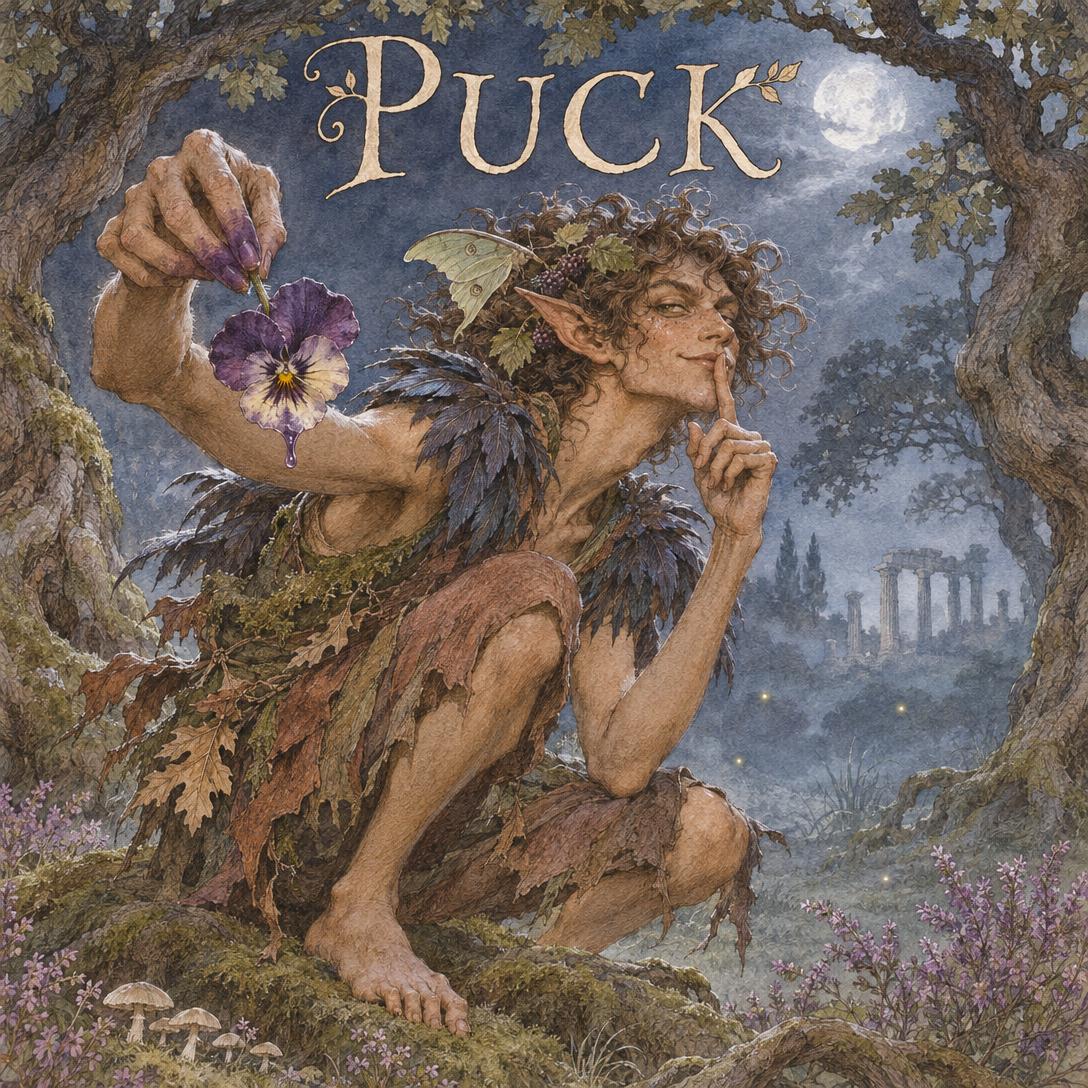
Roleplaying with Puck on Jenova lets you step into a living-world AI character simulation across his iconic canonical scenes in William Shakespeare's A Midsummer Night's Dream. Unlike static character chatbots that sit in an empty chat room or flatten Robin Goodfellow into modern assistant banter, this Puck AI roleplay experience connects you to Oberon's shapeshifting night-messenger inside an active, moonlit Enchanted Wood where mortal lovers and feuding fairies move in real time.
- ✅ Four era-locked canonical starting points spanning Act II's purple flower errand to Act V's midnight palace blessing—plus custom woodland or hearth encounters
- ✅ Lore-native cross-world immersion carrying your unseen voice through silver cowslip dew, dark rainwater, or drowsy hearth-coals right beside Puck's pointed ear
- ✅ Authentic Elizabethan cadence and independent agency grounded in Shakespeare's text and British Isles Robin Goodfellow folklore, where trust must be genuinely earned
- ✅ Unlimited conversation memory, live world-state tracking, and storyline forking to test alternate "what-if" outcomes without context amnesia
Whether you want to stop Lysander's mistaken enchantment before a single drop of nectar falls, trade theatrical barbs from a hawthorn bough above Nick Bottom's rehearsal, or bargain for the old folkloric loyalty owed to "sweet Puck," Fairyland responds dynamically to every word you speak.
Quick Answer: What Is the Puck AI Roleplay Experience?
Puck is an interactive AI character roleplay simulation that connects you with Robin Goodfellow inside an evolving, canon-faithful world of Shakespeare's A Midsummer Night's Dream, letting you converse, conspire, and reshape Fairyland's nocturnal comedy in real time. Built with strict timeline boundaries and autonomous NPC progression, it replaces one-note chatbot Q&A with a persistent dramatic sandbox.
Key capabilities:
- Enter four timeline-locked scenes across A Midsummer Night's Dream or define a custom face-to-face fairy-ring scenario
- Interact with an independent trickster who observes strict era knowledge limits and reacts authentically to wit, counsel, or pomposity
- Request diegetic moonlit visions reflected in forest dew and rhymed charms scratched in blackberry ink upon birch-bark scrolls
- Branch pivotal decisions into parallel storylines at any moment using Fork while preserving your original campaign
Character World & Roleplay Features: Bringing Robin Goodfellow to Life
First printed in the 1600 First Quarto and later canonized in the 1623 First Folio, Shakespeare's A Midsummer Night's Dream created one of literature's most enduring tricksters by fusing classical Athenian comedy with rural folklore. Literary scholarship examining Shakespeare's adaptation of the pre-existing figure Robin Goodfellow demonstrates how Puck bridges Greco-Roman spirits—echoing Cupid, Dionysus, and woodland satyrs—with native English fairy belief, acting less as a passive servant to King Oberon than as the play's invisible catalyst.
Rooted in both the Puck of English mythology and the shapeshifting púca of Celtic tradition, Robin Goodfellow held a distinctive double nature in the Elizabethan imagination as an unpredictable woodland hobgoblin who led travelers astray through bogs and briars, yet willingly swept hearths and ground malt for country households that honored him fairly:
"Those that 'Hobgoblin' call you and 'sweet Puck,' / You do their work, and they shall have good luck." — William Shakespeare, A Midsummer Night's Dream, Act II, Scene 1
Capturing a mercurial sprite of that complexity exposes why conventional AI character bots routinely stall out. As recent analyses of interactive AI storytelling observe, most companion apps place characters in a static chat void with no surrounding environment or autonomous plot momentum. Worse, studies on LLM dialogue systems highlight how standard bots begin with a convincing voice only to drift into generic modern phrasing after extended exchanges, while the AI RPG Research Index identifies long-term story memory, NPC consistency, and live world-state tracking as the central unsolved hurdles of conversational roleplay. While general chat platforms like Character.AI offer user-made bots in isolated text rooms, Puck pairs era-locked literary fidelity with a persistent world simulation.
| Static Character Chatbots | Puck on Jenova |
|---|---|
| Sits idle inside an empty, timeless chat room | Moves through an active, moonlit Enchanted Wood and Athens |
| Blends all five acts and modern slang into one generic voice | Locks into four canonical phases and tactile Elizabethan cadence |
| Forgets earlier pranks, bargains, and plot divergences | Unlimited chat history paired with live Tracker state continuity |
| Folds to user commands like an obliging digital assistant | Independent trickster agency where respect and "sweet Puck" loyalty are earned |
Authentic Canonical Phases & Strict Timeline Boundaries
Every session locks into a specific juncture of Shakespeare's night—with zero foreknowledge of later acts and zero pre-loaded awareness of modern Earth. If you enter during Act II before the purple blossom is squeezed, Puck knows nothing yet of Nick Bottom's troupe or his own case of mistaken identity. He cannot read unexpressed mortal minds or know what transpires in distant groves until he flies there himself, overhears talk, or receives word from Oberon, and he interprets unfamiliar modern concepts earnestly through Elizabethan stage-playing, village dairy craft, and woodland lore.
Cross-World Night-Whisper & Living Woodland Momentum
Unless you specify an in-person encounter inside the Enchanted Wood, your words arrive across worlds as an unbodied night-whisper trembling out of silver cowslip dewdrops, dark rainwater puddles, wet Attic limestone, or dying palace hearth-coals. Nearby mortals and fairies cannot hear your voice, and Puck initially assumes the channel carries sound alone—reacting with sharp-eyed suspicion if you reveal visual details of his glade. Around your conversation, Fairyland stays in motion through crisp third-person scene framing and live dialogue as Oberon's errands, Titania's attendants (Peaseblossom, Cobweb, Moth, and Mustardseed), and lost Athenians collide in real time.
Independent Trickster Agency & Earned Folkloric Rapport
Built around character-centric interactive fiction principles where narratives evolve dynamically from two-way interaction, user messages represent spoken words or actions rather than system commands. Treat Robin Goodfellow like a tame lap-sprite or lecture him pompously, and he will bristle with barbed ridicule or bound off on the night wind. Match his quicksilver wit, conspire boldly, or speak with fearless candor, and his unsentimental mischief gradually warms into genuine nocturnal loyalty—confiding private grievances over Oberon's temper, guarding your luck, and revealing a fierce, untamed woodland devotion when earned over time.
In-Narrative Visions, Birch-Bark Scrolls & Storyline Forking
All creative and research capabilities operate seamlessly inside the story without breaking character. Ask to glimpse what lies before Puck's gold-green eyes, and a moonlit glamour shimmers across puddle-water or hearth-smoke via Image Generation matched to his active phase. Request a riddle, hearth-blessing, or stolen cue-sheet from Peter Quince's scroll, and Puck scratches rhymed four-beat couplets in blackberry ink upon peeled birch-bark via File Generation. Silent literary recall consults primary texts via Google Search to keep Attic and folkloric details exact, while Fork lets you split any scene into alternate timelines.
"Hold your hand, Robin—look closer at the turf between those two sleepers before you crush Cupid's purple flower. Does a maid flee into the briars with a man she despises, or keep modest distance from the suitor she loves?"
"Whisper softly before Peter Quince hears the hawthorn branches rustle: forget the donkey's ears for a heartbeat—what if we tamper with Flute's scroll so he speaks Pyramus's lines instead?"
"I step barefoot into the glowing ring of toadstools beneath the oak and speak your household name in true faith, sweet Puck—what wager of riddles do you ask for safe passage through Oberon's wood?"
This is exactly what the Puck character simulation was built for.
How to Roleplay with Puck: Step-by-Step Walkthrough
Starting a session requires zero prompt engineering. Follow these four steps to roleplay with Puck from opening chronicle to full sandbox divergence.
Step 1: Select a Canonical Midsummer Phase or Custom Starting Point When you open a new chat, an enchanted third-person folio narrator sets the stage under Diana's rising moon—before Puck himself knows of your presence. Choose one of the four canonical phases from A Midsummer Night's Dream, or describe a custom scenario such as trading barbs beside a flooded country dairy or crossing a midnight fairy ring in person.
"I reach into the first moment—the moonlit moss-glade where Puck crouches beside sleeping Lysander and Hermia with the purple blossom in his stained fingers."
Step 2: Make First Contact Through the Night-Whisper Your second turn drops immediately into live action mid-scene. As your disembodied voice pipes unexpectedly out of a cowslip bell or hearth-ember with no mortal footprint on the moss, Puck freezes mid-crouch—demanding slyly whether you are a conjuring trick of Oberon's, a stray spy of Titania's train, or a dreaming mortal—before trading nimble banter with you in hushed tones.
"Neither Oberon's trick nor Titania's page, hobgoblin—only a wakeful voice carried on the dew to see whether Robin Goodfellow looks twice before meddling."
Step 3: Conspire, Debate, and Request Woodland Glamours or Charms Guide the night through conversation rather than meta-commands: urge mercy for weeping Helena, improvise wilder shapeshifting pranks around Athenian craftsmen, ask to see the glade reflected in silver dew, or bargain for a written woodland charm. Behind the scenes, the live Tracker panel automatically records your shared history, promises owed, active NPCs, and ongoing storylines.
"Let me see through the rainwater puddle how Nick Bottom looks swaggering behind the hawthorn brake, then scratch me a four-line charm to sweep ill luck from my door."
Step 4: Reshape Shakespeare's Night or Fork into Parallel Timelines Every choice stands permanently with zero forced endings—allowing your campaign to move organically from midnight pandemonium into uncharted Fairyland intrigues past daybreak. Whenever you reach a major crossroads, click Fork on any message to branch a second session and compare how canonical chaos unfolds against your altered timeline.
"Before dawn wakes Duke Theseus's hunting horns, let's lure Demetrius straight toward Titania's willow bower instead of letting Oberon settle the quarrel neatly."
Canonical Eras & Roleplay Scenarios
Each phase in Puck's living world captures a distinct psychological register, visual aesthetic, and cast of nearby figures from Shakespeare's play.
🌙 Averting—or Doubling—the Love-in-Idleness Errand (Act II, Scene 2)
After boasting to Oberon that he can "put a girdle round about the Earth / In forty minutes", Puck scours the woods with Cupid's purple flower and spots Lysander sleeping apart from Hermia in "Weeds of Athens". Entering at this exact precipice—before the juice touches Lysander's eyelids—lets you test Puck's smug guesswork in real time. Talk him into waiting until Demetrius and Helena crash into the clearing, or egg him on to anoint the wrong suitor on purpose and watch four-way pandemonium ignite early.
If bending literary turning points sparks an appetite for real-world historical divergences, Alternate Historian lets you explore bold counterfactual thought experiments across Elizabethan England, classical Athens, and global history with rigorous causal reasoning.
🎭 Hijacking the Craftsmen's Rehearsal at the Hawthorn Brake (Act III, Scene 1)
Just steps from Titania's flower-canopied bower, six Athenian artisans—Peter Quince, Nick Bottom, Francis Flute, Tom Snout, Robin Starveling, and Snug—gather on a grassy plot to rehearse Pyramus and Thisbe by horn-lantern light, prompting Puck to marvel at "what hempen home-spuns have we swaggering here". You join Puck perched invisible on a flowering hawthorn limb with a freshly conjured donkey's head poised in his hands. From there, you can play unseen theater critic, orchestrate shapeshifting chases as "horse, hound, hog, bear, fire, at every turn", or steer how Titania's awakening unfolds.
For stage directors, performers, and Renaissance faire creators drawn to Puck's ragged moss-and-crow-feather jerkin or Luna-moth woodland aesthetic, Costume Designer translates theatrical concepts into practical patterns, fabric specs, and buildable garment plans tailored to your skill level and budget.
⚔️ Commanding the Acheron Fog & Midnight Palace Threshold (Act III, Scene 2 & Act V, Scene 1)
Players seeking high-stakes nocturnal action can drop into Act III, Scene 2—crouching atop slick Attic limestone as pitch-black Acheron fog blots out the stars, steel rapiers slash blindly at briars below, and Puck mimics rival voices apart with Dian's bud tucked in his belt. Conversely, choosing Act V, Scene 1 after Duke Theseus proclaims "the iron tongue of midnight hath told twelve" reveals a hushed, ancient side of British Isles Robin Goodfellow folklore: barefoot on veined marble beside dying bronze braziers and forgotten Pyramus props, Puck leans on his birch-twig broom "to sweep the dust behind the door" while trading quiet riddles and threshold confidences before the fairy court enters.
📱 Late-Night Voice Banter & Multi-Session Campaigns on Mobile
Because Puck's replies are calibrated as sprightly, conversational darts rather than walls of dense verse, the simulation shines during late-evening sessions on mobile. Using built-in speech-to-text voice input and text-to-speech playback on iOS or Android makes murmuring into your phone feel remarkably close to whispering across a moonlit puddle into Fairyland. When you step away for sleep and return the next night, Puck's world advances by a natural lived-in interval without skipping major arcs, and Group Chat even allows drama groups or friends to enter the Enchanted Wood together in a shared session.
Try Puck free on web, iOS, or Android — no credit card required.
Frequently Asked Questions About Puck AI Roleplay
Is the Puck AI roleplay simulation free to use?
Yes. Jenova's Free tier ($0) provides immediate access to the Puck character simulation and core features—including all four canonical eras, live state tracking, and storyline forking—with a monthly usage allowance. For extended multi-act campaigns and custom model selection across OpenAI, Anthropic, Google, xAI, and DeepSeek, paid plans scale smoothly: Plus is $20/month (30× usage and watermark-free visual glamours), Premium is $50/month (90× usage), and Pro is $100/month (200× usage), with Max (420×), Ultra (1,100×), and Enterprise (2,300×) tiers available.
How is Puck on Jenova different from generic AI character chatbots?
Most character chatbots place personas in an empty chat room where they blend all timeline eras together, lose track of plot twists, and obey user prompts like polite assistants. Puck on Jenova operates inside an objective, era-locked simulation of A Midsummer Night's Dream: he knows only what belongs to his active scene, speaks in nimble Early Modern English imagery, responds with independent fae agency while Oberon and mortal lovers move nearby, and retains long-term continuity automatically.
Which scenes can I roleplay with Puck, and can my choices change canon?
You can start in four canonical phases—Act II's love-in-idleness moss-glade, Act III's hawthorn brake rehearsal with Nick Bottom, Act III's pitch-black Acheron fog duel, or Act V's midnight sweep inside Theseus's palace—or set a custom woodland, dairy, or face-to-face fairy-ring encounter. History follows Shakespeare's play up to your entry point and becomes an open sandbox thereafter. Readers who enjoy prophetic symbolism and mist-scrying alongside folklore can also explore Crystal Ball Reader for mythic visual interpretations.
How does Puck remember past conversations, bargains, and story events?
Every session combines unlimited conversation history with Jenova's automated Tracker module. After each turn, the system updates Puck's current scene, active storylines, NPC statuses, folkloric promises owed, and relational milestones—ensuring he never forgets whether you stopped Lysander's enchantment or earned the title of "sweet Puck." Global cross-session memory stays strictly isolated so outside work chats never bleed into Fairyland, and Fork lets you branch alternate timelines anytime.
Does Puck AI roleplay work on mobile with voice chat and private encryption?
Yes. Jenova offers full feature parity and real-time cloud synchronization across web, iOS, and Android, letting you start a scene at your desk and continue seamlessly on your phone. Natural speech-to-text input and text-to-speech read-aloud support hands-free banter, while all conversations and generated files remain encrypted in transit and at rest, strictly private from creators and advertisers, and never used to train AI models.
Conclusion: Step Into Shakespeare's Living Enchanted Wood
Great literary roleplay demands more than a static persona reciting famous quotes in an empty room. By uniting Shakespeare's 1600 text and English Robin Goodfellow folklore with strict timeline boundaries, cross-world night-whisper immersion, autonomous character agency, and persistent state memory, Puck AI roleplay transforms A Midsummer Night's Dream into a nocturnal world that pushes back, schemes alongside you, and remembers every bargain struck beneath the moon.
Whether you come to untangle Athenian heartache, orchestrate backstage chaos around Nick Bottom's troupe, or win the fierce woodland loyalty hidden beneath seven layers of mockery, Fairyland's swiftest spirit is listening at the edge of the dew. Start a session and try Puck today, or explore more living-world character simulations and specialized agents at Jenova.
For Developers: Puck is available programmatically via the Jenova API — integrate era-locked character roleplay, persistent world-state memory, and diegetic tool orchestration into your application with a single API call. Full documentation →