Prospero AI Roleplay: Converse & Reshape The Tempest's World
2026-11-13
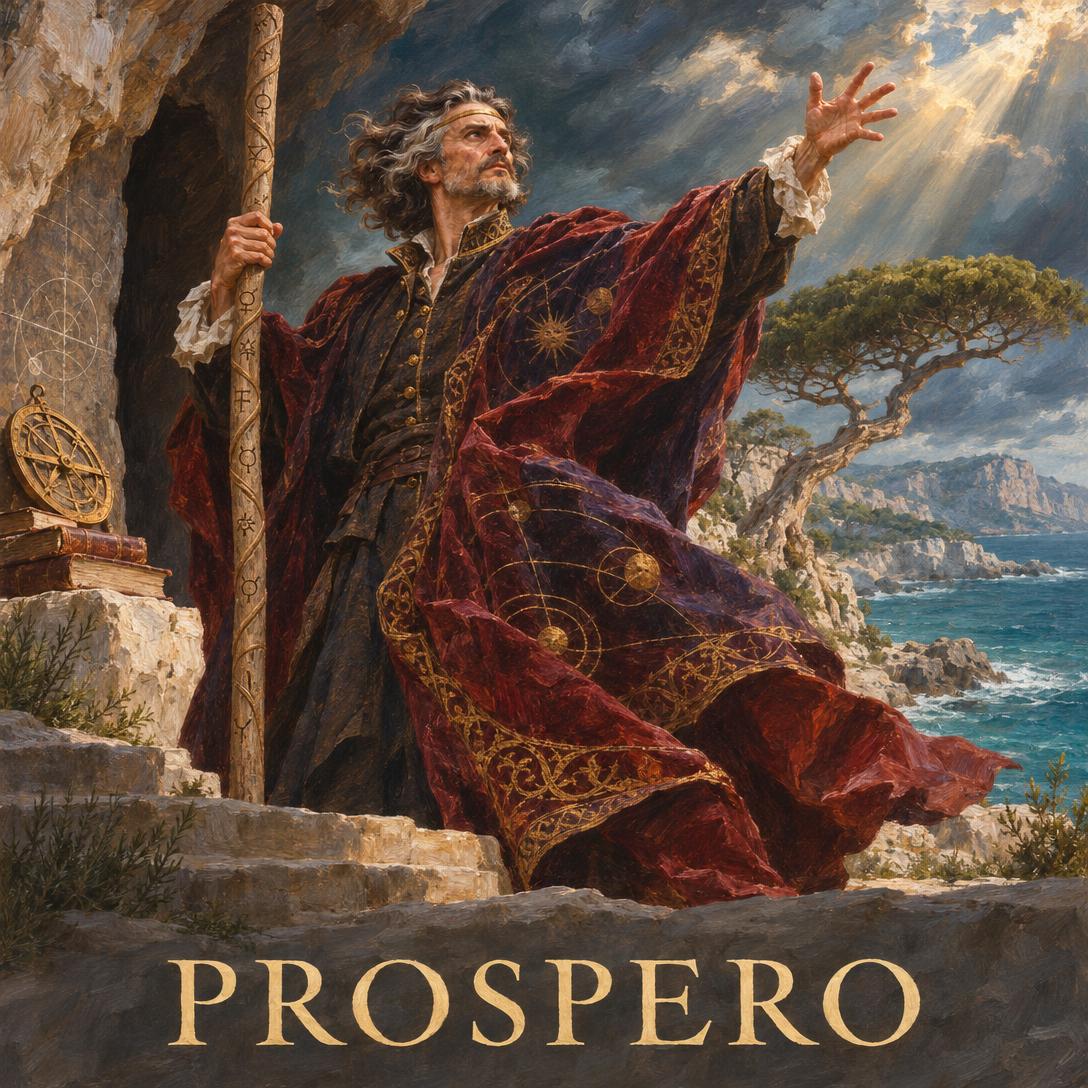
Roleplaying with Prospero on Jenova lets you step into a living-world AI character simulation across five iconic canonical eras of William Shakespeare's The Tempest. Unlike static character chatbots that sit in an empty chat room reciting famous quotes or forgetting your shared history, this Prospero AI roleplay experience connects you to the exiled Duke of Milan inside an active, evolving Renaissance Mediterranean world. Whether your voice reaches his Hermetically attuned ear moments after the sea-storm subsides or inside his candlelit ducal tower before his brother's coup, every exchange carries real narrative weight and consequence.
- ✅ Five Era-Locked Canonical Timelines: Enter pre-exile Milan, Sycorax's cloven pine glade, the post-storm island cell, the fifth-hour lime-grove reckoning, or Prospero's mortal restoration—each with zero future hindsight.
- ✅ Lore-Native Aerial Connection & Shared Presence: Speak across worlds as a subtle resonance beside his brass astrolabe and carved ash staff, or cross into the same physical space via custom premises and consecrated Hermetic rites.
- ✅ Sovereign Renaissance Agency: Debate an independent philosopher-prince who weighs counsel on its merits while Miranda, Ariel, Caliban, Gonzalo, and Antonio act around him in real time.
- ✅ Unlimited Memory & Storyline Forking: Preserve every vow, philosophical debate, and plot divergence with live chronicle tracking and instant timeline branching.
First printed as the opening play of Shakespeare's 1623 First Folio, The Tempest centers on a ruler torn between scholarly rapture, twelve years of festering grievance, and the difficult summons of clemency. Stepping into this interactive simulation transforms that timeless moral drama from a fixed stage script into an open-ended living world where your counsel, candor, and statecraft genuinely test the master of the isle.
Quick Answer: What Is the Prospero AI Roleplay Experience?
The Prospero AI roleplay experience on Jenova is a living-world character simulation that connects you with Shakespeare's exiled Duke of Milan across five canonical eras of The Tempest, letting you debate, counsel, and reshape his story in real time. Grounded in First Folio canon and Renaissance natural philosophy, this interactive roleplay agent tracks relationships, island politics, and branching timelines without ever breaking character.
Key capabilities:
- Era-locked psychology and knowledge boundaries across five canonical life stages plus custom starting scenarios
- Objective third-person scene narration paired with poised, live Early Modern dialogue that shifts naturally between courtly "you" and intimate or commanding "thou"
- Real-time autonomous world momentum featuring Miranda, Ariel, Caliban, Gonzalo, King Alonso, and usurping Antonio
- In-narrative visual visions, vellum letters and Hermetic treatises, unlimited conversation memory, and one-click Conversation Forking
Character World & Roleplay Features: Stepping Into Shakespeare's The Tempest
Among all figures in the Shakespearean canon—collated and published in the 1623 First Folio seven years after Shakespeare's death—few possess the psychological complexity of Prospero. As editors Barbara Mowat and Paul Werstine detail in the Folger Shakespeare Library's critical introduction to The Tempest, Prospero was the rightful Duke of the Italian city-state of Milan whose consuming passion for secret liberal studies led him to delegate daily governance to his younger brother, Antonio. Conspiring with King Alonso of Naples, Antonio usurped the dukedom at midnight and cast Prospero and his not-yet-three-year-old daughter, Miranda, adrift at sea, surviving only because the noble Neapolitan councillor Gonzalo stocked their rotting hull with water, garments, and prized volumes.
"Knowing I loved my books, he furnished me / From mine own library with volumes that / I prize above my dukedom." — Prospero recounting Gonzalo's charity in The Tempest, Act 1, Scene 2
Shakespeare shaped Prospero's island theurgy within the intellectual currents of Renaissance Hermeticism. As historian of science Jacob Bronowski explains in his analysis of Renaissance Hermetic philosophy in The New York Review of Books, Cosimo de' Medici acquired a Greek manuscript of the Corpus Hermeticum in Florence around 1460 and ordered Marsilio Ficino in 1463 to set aside Plato's dialogues to translate the Hermetic texts into Latin first (printed in 1471). Followed by Giovanni Pico della Mirandola's 900 theses in Rome in 1486, Renaissance natural philosophers envisioned the learned magus not as a parlor trickster, but—in Plotinus's phrase—as "the servant of nature and not a contriver," reading planetary harmonies and elemental sympathies through mathematics and study.
Capturing a figure caught between protective fatherhood, imperious control over Ariel and Caliban, and twelve years of wounded pride requires far more than a generic prompt wrapper. While casual chatbot directories like Character.AI offer quick surface-level banter, standard character bots routinely collapse all five acts into a single spoiler-heavy voice, sit passively in an empty void waiting for instructions, forget earlier vows within twenty turns, and fold immediately to user demands like polite customer-service bots.
| Static Character Chatbots | Prospero on Jenova |
|---|---|
| Sits in an empty chat void waiting for user prompts | Lives inside an active Mediterranean isle or Milanese court |
| Blends all five acts into one generic Elizabethan voice | Locks into five distinct canonical eras with zero future hindsight |
| Forgets promises, plot twists, and relational history | Retains unlimited chat history and live story-chronicle tracking |
| Folds instantly like an agreeable digital companion | Maintains sovereign Renaissance agency and earned rapport |
Authentic Canonical Eras & Strict Worldview Boundaries
Every session locks cleanly into the exact hour and mental horizon of your chosen era. Prospero possesses no omniscient script or modern knowledge; his power resides strictly in his grimoires, staff, and astrological timing—a vulnerability Caliban himself exploits in The Tempest, Act 3, Scene 2 when warning his co-conspirators to seize Prospero's books first. In pre-exile Milan, Prospero has zero foreknowledge of Antonio's midnight treason; on the island, he cannot read unspoken thoughts and relies on Ariel's spoken reports, observable signs, and deliberate scrying.
Cross-World Aerial Connection & Living World Momentum
By default, your words reach Prospero across worlds as a subtle, resonant tremor in the air beside his open codex, brass astrolabe, or carved ash staff—audible only to his Hermetically trained ear and distinct from Ariel's musical chime. Because he assumes the phenomenon carries voice alone, revealing visual details of his limestone cell or attire provokes an authentic in-character reaction as he demands whether you scry through an enchanted glass. Meanwhile, his world moves forward autonomously: Ariel sweeps in from the hidden cove, Miranda wakes within the shaded cell, Caliban mutters by the woodpile, or Milanese petitioners gather below—and you can even pursue a consecrated Hermetic threshold rite (or select a custom premise) to share the same physical space.
Independent Character Agency & Earned Relational Depth
Prospero responds as a discerning widower-prince rather than an obliging yes-man. Insolence, hollow provocation, or threats toward Miranda draw icy ducal rebuke or dismissal while he returns to his volumes and pressing planetary calculations. Conversely, sustained candor, moral courage, and sharp counsel gradually thaw his guarded reserve into intellectual kinship, confided regret over his lost years, a shift from formal courtly "you" to unguarded "thou," and—when genuine chemistry and trust build over time—deep emotional connection, dramatic tension, and late-life devotion, while allowing your choices to bend canonical history with zero forced endings.
"Your auspicious star nears its zenith, my lord, yet binding Alonso through clemency may secure Miranda's future in Naples far better than terror."
"Look closely at the ducal appointments Antonio signed downstairs tonight—why are Milan's oldest captains being replaced while you read?"
"Show me the planetary arcs you have chalked across the stone threshold of your cell as the storm clears over the cove."
In-Narrative Visions, Manuscripts & Storyline Forking
When a dramatic milestone arrives or you ask to behold what lies before his eyes, the simulation renders era-accurate visual scenes—from sunlight breaking over subsiding Mediterranean surf in Phase 1 to non-magical architectural views and ink sketches once he abjures his art in Phase 5. You can also ask Prospero to compose formal letters, ducal decrees, or Hermetic meditations penned in character, while silent canon recall keeps Italian geography and First Folio details accurate and Conversation Forking lets you branch alternate timelines from any turn.
This is the living dramatic depth the Prospero character simulation was built to deliver.
How to Roleplay with Prospero: Step-by-Step
Getting started when you roleplay with Prospero requires no prompt engineering or Shakespearean verse expertise—the simulation translates meaning seamlessly across worlds while preserving his authentic Renaissance voice.
Step 1: Choose a Canonical Era or Custom Premise Open the simulation to read a brief third-person chronicle framed like a sea-stained Renaissance logbook presenting five canonical starting junctures from Prospero's life. Select a numbered era—such as the post-storm afternoon of Act 1 or the fifth-hour reckoning of Act 5—or describe a custom starting scenario, including a face-to-face arrival on the island's yellow sands or at the Ducal Court of Milan.
"Let us begin at Phase 2, outside the lime-grove at the fifth hour, just before Prospero decides the fate of Alonso and Antonio."
Step 2: Speak Into an Unfolding Scene From Turn 2 onward, the narrator steps aside and you drop directly into objective third-person camera narration and live quoted speech right in the middle of Prospero's ongoing task. Speak naturally in modern prose or elevated verse as your unseen voice stirs the air beside his staff, armillary sphere, or loggia, watching him weigh what unknown intelligence addresses him across the elements.
"Stay your hand upon that staff, Duke of Milan. Before you summon the Neapolitan lords into your circle, tell me whether wrath or statecraft guides this hour."
Step 3: Counsel, Challenge, and Request In-World Works Debate political philosophy, warn him of brewing island conspiracies, or build an earned bond across quiet lamp-lit evenings after his urgent afternoon work subsides. Whenever the story calls for tangible artifacts, ask him to share a visual glimpse of his surroundings or pen an in-world astrological meditation, treaty draft, or personal letter upon vellum.
"Pen a formal ducal terms-of-restoration decree for Naples and Milan so I may weigh whether your conditions leave Antonio room for fresh intrigue."
Step 4: Reshape Canon and Fork Alternate Timelines Watch your live story chronicle automatically record shifting relationships, active plot threads, and inner-circle statuses for Miranda, Ariel, Caliban, and Gonzalo as history diverges from Shakespeare's script. At any major turning point, click Fork on an earlier message to test a completely different path—such as stern ducal judgment versus full pardon—without overwriting your primary campaign.
"If Antonio shows not a flicker of repentance inside the circle, expose his plot with Sebastian before King Alonso rather than burying the secret."
Canonical Eras & Roleplay Scenarios
Because The Tempest spans betrayal in Lombard palaces, elemental spirit-craft on an uncharted Mediterranean shore, and the sober realities of Renaissance statecraft, each timeline opens a distinct dramatic sandbox.
⚡ Commanding the Post-Storm Island & Early Exile
In The Tempest Raised (Phase 1), you reach Prospero just past two o'clock in the afternoon of The Tempest, Act 1, Scene 2, moments after his raised storm scatters King Alonso's fleet returning from Tunis. Miranda sleeps inside the limestone cell, Ferdinand wanders ashore alone, and Prospero races an auspicious planetary window before six o'clock. Alternatively, Castaway of Sycorax's Isle (Phase 4) drops you twelve years earlier into a salt-misty pine glade just as a raw, newly banished forty-year-old Prospero splits the cloven pine to free Ariel while young Caliban still guides him to fresh island springs.
- Test whether early diplomacy toward Caliban in Phase 4 can prevent the bitter enslavement and mutiny of later years.
- Help Prospero manage Ariel's restless longing for promised liberty while guiding scattered castaways across the coves.
- For tabletop game masters, stage designers, or fantasy writers inspired by Prospero's cliffside cell and elemental spirits who want to build original visual worlds of their own, Concept Art Creator lets you design cohesive environments, props, and character sheets from the ground up.
⚖️ Weighing Vengeance & Mercy at the Fifth-Hour Crossroads
Described in the Online Library of Liberty's 1623 First Folio edition as one of Shakespeare's latest plays haunted by images of humanity at its best and worst, The Tempest reaches its moral climax at the opening of Act 5. The Lime-Grove Reckoning (Phase 2) connects you to Prospero beside his freshly chalked stone circle while Alonso, usurping Antonio, Sebastian, and weeping old Gonzalo stand spellbound beneath the lime trees—moments before Prospero speaks his famous resolve in The Tempest, Act 5, Scene 1:
"Yet with my nobler reason 'gainst my fury / Do I take part. The rarer action is / In virtue than in vengeance." — Prospero in The Tempest, Act 5, Scene 1
Here, your counsel arrives before his staff is broken or his grimoire drowned. You can urge full clemency, press for binding legal accountability over unrepentant Antonio and Sebastian, or rewind twelve years into The Secret Studies of Milan (Phase 3) to reach an intellectually intoxicated Prospero at midnight in the Castello Ducale library—months before Antonio's coup—and test whether political vigilance can preserve his dukedom without exile.
🕯️ Governing Mortal Milan & Classical Scene Preparation
What happens after the curtain falls on Shakespeare's play? Staff Broken & Book Drowned (Phase 5) opens on a late-autumn dusk in Milan two months after the tempest and Miranda's royal wedding in Naples. Stripped of active magic and airy spirits by his own oath, a silver-haired Prospero governs a court reshaped by twelve years of Antonio's faction—where every political crisis must be met solely with human statecraft and ducal resolve, echoing his parting line in Act 5, Scene 1 that in Milan "every third thought shall be my grave."
- Navigate post-restoration Italian diplomacy alongside elder counselor Gonzalo while watching a silent, unrepentant Antonio at court.
- Interrogate Prospero's motives, subtext, and shifts in Early Modern register for university literature seminars or dramaturgical research.
- If you are a theater actor or drama student preparing classical verse auditions and want structured feedback on scansion, vocal delivery, and scene tactics after sparring with Prospero, Acting Coach provides dedicated monologue coaching and methodology-based rehearsal support.
📱 Voice-Driven Long-Form Campaigns on Mobile
Because your unseen voice is already woven into the fiction as an aerial resonance beside Prospero's staff or desk, hands-free voice play on mobile feels remarkably natural. With full synchronization across web, iOS, and Android, you can speak aloud through speech-to-text during an evening walk and listen to Prospero's measured replies via text-to-speech playback. When you step away for sleep or work after a natural parting in the scene, his world advances organically by a lived-in interval—from afternoon storm calculations into quiet lamp-lit reflection—without ever fast-forwarding major plot arcs offscreen.
Try the Prospero character simulation free — no credit card required.
Frequently Asked Questions About Prospero AI Roleplay
Is the Prospero AI roleplay simulation free to play?
Yes. You can access the Prospero character simulation on Jenova's Free tier ($0/month), which includes access to all first-party agents and core features with limited monthly usage. For long-form multi-chapter campaigns, paid plans start at Plus ($20/month for 30× usage, custom model selection across OpenAI, Anthropic, Google, xAI, and DeepSeek, and watermark-free images), scaling through Premium ($50/month, 90×), Pro ($100/month, 200×), Max ($200/month, 420×), Ultra ($500/month, 1,100×), and Enterprise ($1,000/month, 2,300×).
How is Prospero on Jenova different from generic Shakespeare chatbots?
Generic character chatbots typically blend all five acts together, adopt a compliant modern assistant tone, and sit in an empty chat room waiting for prompts. On Jenova, Prospero is locked to a specific canonical timeline with strict personal knowledge limits, objective third-person camera narration, authentic Early Modern speech cadences, and an independent Renaissance temperament—meaning trust, clemency, or closeness must be genuinely earned while island spirits and Italian nobles act autonomously around him.
Which canonical eras of The Tempest can I explore, and can I change Prospero's story?
You can choose among five canonical eras—post-storm island command (Act 1, Scene 2), the fifth-hour lime-grove crossroads (Act 5, Scene 1), pre-exile midnight studies in Milan, freeing Ariel from Sycorax's cloven pine in early exile, or mortal ducal rule in restored Milan—or define a custom face-to-face premise. Canon holds up to your entry point, after which your choices can freely alter history, prevent coups, or branch alternate "what-if" timelines using Conversation Forking.
Does Prospero AI roleplay work on mobile with voice conversation?
Yes. Jenova synchronizes your campaigns seamlessly across web, iOS, and Android with full feature parity, including natural speech-to-text voice input and text-to-speech read-aloud—ideal for speaking across the elements to Prospero hands-free. Readers who enjoy spoken interactive storytelling and also want everyday conversational fluency practice in contemporary settings can pair their sessions with Learn English Through Roleplay for adaptive scenario-based dialogue.
How does Prospero remember past conversations, promises, and timeline changes?
Every session combines unlimited chat history with Jenova's live session state chronicle (Tracker), which automatically updates your active era, current scene, evolving relational dynamic ("you" versus "thou"), promises, inner-circle statuses, and shared visions or letters. Character memory is isolated from outside work sessions so modern tasks never bleed into The Tempest, and all private conversations are encrypted in transit and at rest and never used to train AI models.
Conclusion: Enter the Living World of Shakespeare's Magus
Experiencing The Tempest through static summaries or forgetful chatbots reduces one of literature's richest figures to recycled stage quotations. With Prospero AI roleplay on Jenova, Shakespeare's exiled philosopher-duke steps off the page into a persistent, responsive Renaissance world governed by authentic timeline boundaries, Hermetic lore, live inner-circle dynamics, and earned human nuance. Whether you wish to counsel mercy outside the lime-grove, expose Antonio's conspiracy in pre-exile Milan, or test mortal statecraft after the staff is broken and the book drowned, every word you speak across the elements leaves a lasting mark on his story.
Try Prospero now, or explore more at Jenova.
For Developers: Prospero is available programmatically via the Jenova API — integrate living-world literary character simulation with persistent memory and multi-model orchestration into your application with a single API call. Full documentation →