AI Prophecy Generator: Layered Lore for Fantasy Campaigns
2026-09-04
Jenova helps you generate mysterious, layered prophecies by pairing specialized creative agents with persistent memory and precise control over tone, clarity, and setting. While generic chatbots and random tables produce a single cryptic sentence that falls apart at the table, this AI provides oracles with multiple interpretations, culturally grounded diction, and plot hooks you can actually use. In September 2026, that gap still costs GMs and novelists hours of prep every time a seer opens their mouth. A usable prophecy has to sound older than the scene, survive two readings, and still leave the characters room to choose.
- ✅ Layered oracles with more than one valid reading
- ✅ Control over tone, clarity, and setting (cryptic, liturgical, folk, high fantasy, and more)
- ✅ Campaign continuity through persistent memory across sessions and drafts
- ✅ The same workspace for novels, screenplays, comics, lyrics, and TTRPG lore
A prophecy is not flavor text. It is a plot device, a worldbuilding artifact, and a promise to the audience that the story knows where it is going. To understand why most generators fail that test, it helps to look at how writers and game masters actually use oracles today.
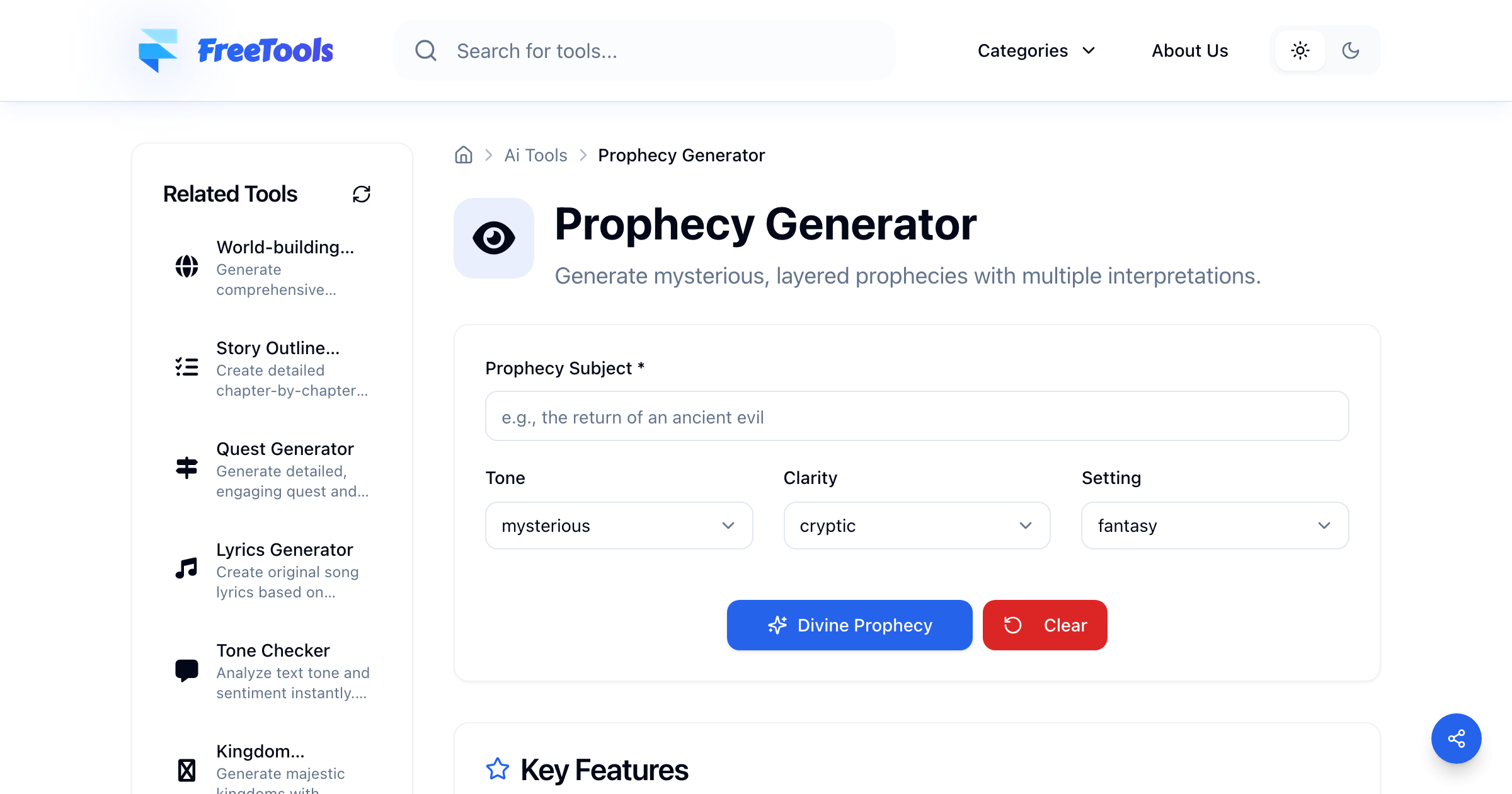
Quick Answer: What Is an AI Prophecy Generator?
An AI prophecy generator is a creative writing tool that produces mysterious, layered oracles with multiple interpretations for fantasy stories and tabletop campaigns. The useful ones do more than shuffle archaic adjectives. They fit the world's mythology, leave room for player choice, and still pay off later.
Key capabilities:
- Campaign-ready oracles and session hooks with Game Designer Assistant
- Names for seers, relics, and cursed places with Name Generator
- Narrative structure so the prophecy can land in a novel or screenplay
- Mystical register — tarot, omen, and dream language — without collapsing into cliché
Why Most Prophecy Generators Fail Writers and GMs
A good prophecy does three jobs at once. It sounds like it belongs to a culture. It can be misread. It still comes true in a way that feels inevitable in hindsight. That is a high bar for a one-click tool, and it is exactly why so much generated lore reads like a fortune cookie in a fake-medieval font.
The demand for this kind of content is not a niche hobby. The global tabletop role-playing game market is already measured in billions, and researchers tracking the category project continued expansion through the next decade. Broader tabletop games sit in an even larger entertainment market. Every one of those tables needs lore that can survive contact with players.
But producing that lore by hand is frustratingly difficult:
- Random tables spit out a single image with no second reading
- General-purpose AI writers optimize for marketing copy, not oracular voice
- GMs run out of prep time before the seer even enters the scene
- Novelists bury the plot in encyclopedia worldbuilding
- Continuity breaks when last month's omen is forgotten by chapter twelve
$2.41 billion — Estimated global TTRPG market size in 2026
8.7% CAGR — Projected TTRPG market growth from 2025 to 2033
One-Line Oracles That Collapse on Contact
"A darkness will rise in the east" is not a prophecy. It is a weather report. Players and readers immediately ask who, which east, and why anyone would carve that into a temple wall. A working oracle needs concrete images — a river that forgets its name, a saint with the wrong hand, a hymn only the flock still knows — and at least two ways those images could resolve. Without that second reading, the scene has nowhere to go except the obvious.
Tone Deaf to Your World's Mythology
High-court astrology does not sound like a peat-bog grandmother. Desert omen-readers do not talk like Northern kennings. When a generator ignores setting, every setting starts to sound like the same Renaissance-fair mystic. Science Fiction and Fantasy Writers Association guidance on story as worldbuilding is blunt on this point: world, plot, and character have to intersect, or the lore sits on the page like an appendix. Prophecy is one of the few devices that can carry all three at once — if the diction matches the culture that supposedly spoke it.
Prep Time Versus Payoff
Tabletop groups are not a trivial audience. A Harrisburg University study found TTRPG play can support social skills and reduce anxiety symptoms, and a National Institutes of Health scoping review describes cognitive and psychosocial benefits. Educators have even argued that TTRPGs can transform learning. None of that helps the GM who has forty minutes on a Sunday and still needs a temple inscription, an unreliable priest, and a payoff three sessions out. Prep time is the real constraint, not imagination.
Continuity, Railroading, and the Forgotten Prophecy
The other failure mode is the oracle that only works if the party follows a script. If the only valid reading is the plot you already wrote, players feel the rails. If every reading is valid, the prophecy never meant anything. The craft is in writing an omen that can be misinterpreted now and still feel true later — which requires memory of the campaign, not a fresh random roll every week.
Archaic Voice Without the Homework
Writers know the sound they want: compressed, slightly wrong grammar, images that feel older than the narrator. Getting there usually means rereading the Poetic Edda, the Book of Daniel, or a stack of folk riddles. Most AI writing tools are built for blogs, ads, and SEO drafts. A few creative platforms help with fiction prose. Almost none are built to hold a campaign bible, a magic system's limits, and an oracular register at the same time.
This is exactly what Jenova was built for.
The Jenova Solution
Jenova is not a random-table app. It is a workspace of specialist agents you can point at a single lore problem: the prophecy itself, the culture that produced it, the NPC who misreads it, and the scene where it finally lands. You keep the same conversation, the same documents, and the same memory as the campaign or manuscript grows.
| Traditional Approach | Jenova |
|---|---|
| d100 tables and one-line riddles | Layered oracles with two or more valid readings |
| Generic chatbot with no campaign memory | Persistent memory across sessions, drafts, and retcons |
| Hours of archaic diction by hand | Tone, clarity, and setting control in the prompt |
| Lore that never touches character or plot | Agents for game design, screenwriting, naming, and mystical voice |
| A different tool for comics, lyrics, and novels | One workspace that follows the story into every medium |
Campaign Lore for Game Masters
Game Designer Assistant treats the prophecy as a system, not a poem. You can ask for a cryptic inscription, then immediately turn it into a session hook, an NPC who believes the wrong interpretation, and a fail-forward outcome if the party ignores it. That is the difference between a generator and a design partner: the oracle has to survive play. Tabletop research has long noted that these games boost creativity when players have room to interpret. Your prophecy should give them that room on purpose.
Narrative Prophecy for Writers and Screenwriters
Film Screenwriter places the omen inside structure — setup, false payoff, true payoff — so you do not drop a gorgeous riddle in act one and forget it in act three. For a novel, that might mean a temple fragment in chapter two whose second meaning only appears when a character changes. For a script, it might mean a visual image (three crowns in the river, a left-handed saint) that can be shot, not just narrated. The SFWA worldbuilding triangle is the right test here: if the prophecy does not change what a character wants, it is decoration.
Oracular Voice, Symbol, and Mystical Register
When you need the sound of divination rather than a quest outline, Mystic Tarot Reader is the right register. Card language — inverted cups, a broken tower, a silent moon — gives you a symbolic vocabulary that readers already feel in their bones. You can steal the cadence for fiction without pretending the output is a real-world reading. Pair that with dream logic from Dream Interpreter when the prophecy arrives as a nightmare rather than a carved tablet.
Names, Verses, and Visual Story Beats
An oracle is only half-done if the seer is named "Mysterious Prophet #3." Name Generator builds culturally fluent names for oracles, relics, and the places where the omen was first spoken. Lyric Writer turns the same material into a hymn, a curse-song, or a children's rhyme the villagers still sing. Comic Creator can stage the prophecy as a vision sequence — panel rhythm, silent beats, a symbol that recurs three issues later.
You can also build a custom agent with your own instructions: house style for oracles, forbidden clichés, the limits of foresight in your magic system. Jenova keeps that agent, its knowledge base, and its tool configuration so the next prophecy matches the last one.
Specialized AI Agents for Prophecy and Worldbuilding
A prophecy rarely lives alone. It needs a speaker, a misreader, a relic, and a later scene that makes the audience feel clever. These agents cover the adjacent work you will do within a month of generating the first omen.
Game Designer Assistant
If you run a table, start with Game Designer Assistant. Ask for the prophecy, then keep going: faction reactions, a dungeon that literalizes the wrong reading, a clock that advances whether or not the party investigates.
- Systems-aware brainstorming across genres and platforms
- Documentation you can paste into a campaign bible
- Hooks that assume players will improvise
Film Screenwriter
Film Screenwriter is the partner for anyone who has to show the omen. A prophecy that only works as a paragraph of italic lore will die in a screenplay. This agent keeps you honest about image, dialogue, and the page count you actually have.
- Structure from concept through revision
- Visual storytelling, not just world dump
- Character development tied to what the omen costs them
Name Generator
Name Generator is easy to underestimate until you have named twelve seers "Elara." Linguistic and cultural fluency matters when the prophecy is supposed to feel native to a language you invented yesterday.
- Names for people, places, relics, and houses
- Constraints by culture, phonology, and meaning
- Variants so siblings and rival cults sound related
Mystic Tarot Reader
Mystic Tarot Reader supplies the ritual texture: a draw, an inversion, a card that refuses to be read the same way twice. Use it as a fiction engine. The cards become the world's own symbol set.
- Spread-based structure for multi-part oracles
- Visual, archetypal language that audiences already know
- A tone that feels ceremonial rather than sarcastic
Comic Creator and Lyric Writer
Comic Creator and Lyric Writer catch two formats GMs and novelists often skip. A two-page vision sequence can do more than a page of boxed text. A four-line hymn can outlive the NPC who sang it.
- Sequential art and recurring visual motifs
- Singable, memorable verse for in-world scripture
- Format-native drafts instead of prose you have to convert later
Try Jenova free — no credit card required.
How to Generate a Prophecy That Actually Pays Off
Step 1: Name the Subject and the Stakes Do not start with "write a prophecy." Start with the event the world thinks it is about, and the thing that breaks if the reading is wrong. Concrete stakes force concrete images.
"The subject is the return of an ancient evil. The stakes: if the church reads it as a call to crusade, they will burn the only library that holds the counterspell."
Step 2: Lock Tone, Clarity, and Setting Mysterious is not the same as cryptic. Mysterious can still be grammatical. Cryptic should feel like a translation of a translation. Setting decides the metaphor stock — ice, sand, court etiquette, deep forest.
"Tone: liturgical. Clarity: cryptic. Setting: a salt-coast theocracy that treats tides as scripture. Avoid 'darkness,' 'chosen one,' and 'the east.'"
Step 3: Demand Multiple Interpretations On Purpose Ask for two readings that both fit the text, plus the political faction that prefers each one. That single instruction is what separates an AI prophecy generator from a slogan machine. Then run the same text through Game Designer Assistant if you need play consequences, or through a screenwriter if you need a scene.
"Give me a four-line oracle, then Interpretation A (the crown's reading), Interpretation B (the fishermen's reading), and one image that will look like proof for both."
Step 4: Plant the Payoff Without Closing the Door Decide what must remain true no matter what the characters do. Maybe the river really will forget its name. Maybe the saint really is left-handed. Leave the meaning open. Write the later scene now, in the same thread, so you do not invent a contradiction six weeks later.
"Write the chapter-twelve scene where the prophecy comes true in the fishermen's sense, and show why the crown still thinks they were right."
Step 5: Carry It Across Mediums and Sessions Turn the oracle into a hymn, a comic vision, a relic name, a rumor. Persistent memory means you can say "use last week's inscription" instead of pasting a document back in. On a phone between work and game night, the same thread is still there.

Results and Use Cases
🎲 Sunday-Night Campaign Prep
Scenario: You have a level 5 party arriving at a cliff temple in four hours. You need an inscription, a priest who is sure he understands it, and a consequence if they smash the altar.
Traditional Approach: Flip through random tables, rewrite clichés, hope the players do not ask follow-up questions.
Jenova: One thread produces the inscription, both readings, the priest's sermon, and a fail-forward if the altar breaks. Game Designer Assistant keeps the encounter playable instead of purely literary.
- Two interpretations ready before anyone rolls insight
- An NPC motive that is not "because the plot said so"
- A leftover image you can reuse three sessions later
📖 A Novel Prophecy That Must Survive Book Three
Scenario: Your epic opens with a dying queen's last sentence. It cannot telegraph the ending, and it cannot be filler.
Traditional Approach: Write a pretty riddle, then spend a year hoping future-you remembers what it meant.
Jenova: Film Screenwriter stress-tests the line against structure. You generate the false payoff and the true payoff in the same sitting, then store both in the manuscript thread.
- The omen changes what a character wants, not just the weather
- Continuity you can query months later
- Diction that matches the court that supposedly spoke it
📱 Oracle on the Train Before Game Night
Scenario: Your group chat just asked "what's the seer going to say?" You are on a phone, fifteen minutes out.
Traditional Approach: Panic-Google "fantasy prophecy generator," paste something you will regret.
Jenova: Open the same agent on iOS or Android, dictate the subject, and get a cryptic quatrain with two readings before you sit down. Feature parity across web and mobile means the campaign memory is already there.
- Voice-to-text for messy, last-minute prompts
- No laptop required for a table-ready omen
- The result still matches last month's tone
🎬 Vision Sequence for a Comic or Manga
Scenario: Issue four needs a two-page prophecy-dream that will echo in issue twelve. Prose will not storyboard itself.
Traditional Approach: Write a paragraph, then discover in layout that it is un-drawable.
Jenova: Manga Creator or Comic Creator turns the oracle into panel flow — recurring symbols, a silent beat, a color shift. Chinese Fortune Teller can lend calendrical and elemental imagery if your world runs on stems, branches, or auspicious hours rather than tarot.
- Images first, captions second
- A symbol the artist can repeat without new explanation
- Cultural texture that is not generic "mystic smoke"
FAQ
What is an AI prophecy generator?
An AI prophecy generator is a tool that drafts oracles for stories and games — usually with controls for subject, tone, clarity, and setting. The difference that matters is whether the output has more than one valid reading and whether it can remember your world's rules. Jenova does that work through specialist agents rather than a single generic prompt box.
Is Jenova free to use as a prophecy generator?
Yes. Jenova has a free tier with core features and limited monthly usage, and paid plans increase that usage. You can generate oracles, keep memory, and switch agents without a credit card on the free plan. Heavier campaign bibles and long manuscripts are easier on a paid tier, but you can test the workflow immediately.
How is this different from ChatGPT or a random prophecy table?
A random table gives you one image and no second meaning. A general chatbot can mimic archaic English, but it will not hold your magic system's limits, your last session's NPC, and your house ban on "chosen one" language unless you paste all of that in every time. Jenova keeps specialized agents, documents, and cross-session memory in one place, which is what continuity actually requires.
Can it write prophecies for TTRPG campaigns?
Yes. That is one of the highest-intent uses. Ask Game Designer Assistant for the oracle, then for the encounter, the wrong reading, and the clock that advances if the party walks away. You get playable structure, not just a poem to read in a funny voice.
Does an AI prophecy generator work on mobile?
Jenova runs with full feature parity on web, iOS, and Android. Settings sync. You can dictate a prompt on a phone, generate a cryptic quatrain, and still have the thread waiting on your laptop when you write the payoff scene. For last-minute session prep, that is the difference between using the tool and skipping the omen.
Can I control how cryptic the oracle is?
Yes. Specify tone (mysterious, liturgical, folk, sardonic), clarity (plain, veiled, cryptic), and setting. You can also forbid clichés and require two interpretations. If you want a more ceremonial register, route the same subject through Personal Astrologer or Mystic Tarot Reader and then translate the symbols back into your world's idiom.
Generate Prophecies Your World Can Keep
Most prophecy generators fail for the same reason most worldbuilding fails: they produce text that never has to answer to a character, a session, or a later chapter. An AI prophecy generator is only worth using if the oracle can be misread tonight and still feel true later.
Jenova gives you that loop in one workspace — campaign design, screenwriting structure, names, hymns, and mystical register — with memory that does not reset when the seer leaves the scene. Generate the inscription. Name the relic. Write the wrong sermon. Plant the image that will look like proof for both sides.
Try the workflow at Jenova. Explore the full agent library, build a custom oracle agent for your setting, and keep every reading in the same thread until the story is ready to cash it in.
For Developers: The creative and game-design agents in this article are available programmatically via the Jenova API — integrate prophecy generation and campaign lore into your application with a single API call. Full documentation →