AI Procurement Consultant: Strategic Sourcing and Category Management
2026-09-09
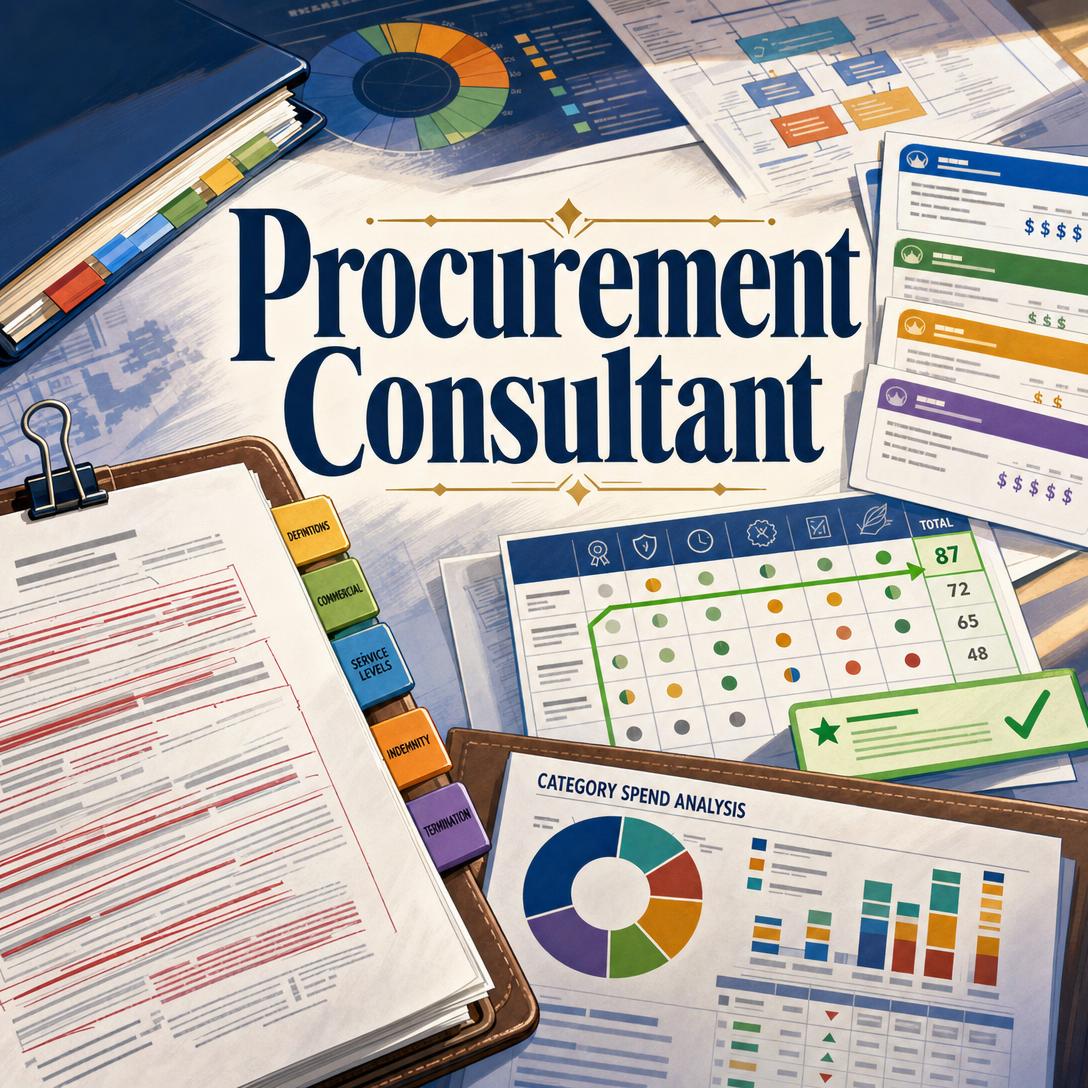
Procurement Consultant helps you run the full procurement lifecycle — needs definition, market analysis, sourcing strategy, supplier selection, contracting, and performance management — with the judgment of a senior advisor. While most teams are drowning in tenders, maverick spend, and last-minute sole-source requests, this AI gives clear recommendations tied to cost, risk, quality, and speed.
✅ Diagnoses spend, supply markets, and category risk before you go to market ✅ Builds TCO and should-cost models that hold up in negotiation ✅ Designs evaluation criteria, SLAs, and contract protections that survive award ✅ Calibrates advice from junior buyer fundamentals to CPO-level operating models
Procurement is no longer a back-office paperwork function. It is being asked to protect continuity, absorb tariff shocks, and still deliver savings — with fewer people and almost no extra budget. To understand why specialized advice matters, look at the constraints facing buyers and CPOs today.
Quick Answer: What Is Procurement Consultant?
Procurement Consultant is a senior procurement advisor that diagnoses spend, designs sourcing strategy, and guides supplier selection and contracting across the full source-to-contract cycle. It serves private and public sector teams on goods, services, works, and technology.
Key capabilities:
- Category strategy using Kraljic segmentation, spend analysis, and supply-market mapping
- Sourcing method selection — open tender, restricted, negotiated, RFQ, frameworks, e-auctions, and sole source
- Total cost of ownership, should-cost modeling, and a finance-credible savings taxonomy
- Supplier evaluation, relationship segmentation, KPI/SLA design, and negotiation preparation
The Hidden Cost of Underpowered Procurement
Procurement teams are managing more spend with less capacity. McKinsey’s GPE360 benchmarking found that spend managed per procurement employee is 50% higher than it was five years ago. The Hackett Group’s 2025 research, reported in the same analysis, shows the gap widening further:
+9.8% workload vs. +0.9% budget — Procurement teams expected more work with almost no extra funding in 2025
That squeeze shows up as late engagement, price-only evaluations, and sole-sourcing by default. Meanwhile the job itself has expanded. In a 2025 Economist Impact survey of C-suite executives, 46% said procurement reports to the COO — up from 26% in 2023 — while only 23% still report to the CFO. The function is being judged on continuity, resilience, and growth contribution, not just unit price.
External shocks make the old playbook even weaker. At the 2025 EY CPO Summit, over half of CPOs said tariffs were directly affecting their organizations. Supplier data gaps, especially beyond tier one, made it hard to trace origin, model total cost, or switch sources in time.
Public-sector buyers face a different version of the same bottleneck. U.S. federal contracts exceeded $750 billion in FY24, and GSA evaluators flagged market research as a primary drag on contracting officers. Automation alone did not fix award patterns — which is the point. Tools without judgment still leave the strategy, specification, and evaluation design unsolved.
But getting senior help is frustratingly difficult:
- Consulting is expensive and episodic. A three-week category review arrives after the specification is already locked and the preferred supplier is already chosen.
- Generic AI lacks procurement craft. It will draft an RFP, but it will not tell you the specification is over-engineered, the weighting invites a protest, or the “savings” are cost avoidance that finance will never credit.
- The same process is applied to every category. Strategic items get a quick RFQ; routine items get a six-month tender. Value leaks in both directions.
- Evidence does not travel with the decision. Scorecards, BATNAs, and should-cost assumptions live in inboxes, so renewals start from zero.
This is exactly what a dedicated procurement advisor was built to prevent.
Why Procurement Consultant
Procurement Consultant treats sourcing as a diagnostic problem, not a document factory. It walks the CIPS procurement and supply cycle — from defining the need through award, contract performance, and renewal — and it will challenge you when the current path destroys value.
| Traditional Approach | Procurement Consultant |
|---|---|
| Stakeholders pick a supplier; procurement “does the paperwork” | Early diagnosis of need, market, and make-or-buy before documents go out |
| Award on lowest compliant price | TCO-based evaluation with weighted quality, delivery, risk, and ESG |
| One process for every category | Kraljic segmentation: compete, partner, secure supply, or simplify |
| Savings claimed; finance never sees them | Hard savings vs. soft savings vs. cost avoidance, with evidence standards |
| Sole source because “we’ve always used them” | Justify every single source; build alternatives on strategic categories |
| Generic chatbot or a $400/hour advisor for a week | Persistent advisor that remembers categories, suppliers, and decisions |
Economist Impact research cited by Cambridge Management Consulting found AI tools already helping procurement professionals at 64% of firms. McKinsey has reported roughly a 10% reduction in procurement costs where AI is adopted, and 30% faster supplier selection when analytics actually drive the shortlist. Those gains only stick if the underlying strategy, criteria, and commercial terms are sound.
Diagnose before you source
The consultant starts with context: sector, spend, incumbent landscape, constraints, and political reality inside the business. It will not hand you a five-option menu and walk away. If volume consolidation is the real lever, it says so. If the specification is the problem, it says that too.
"We spend about $4.2M a year on medical supplies across 23 vendors. Clinical stakeholders refuse to change suppliers. Build a category strategy I can take to steerco."
Match effort to risk and value
Using the Kraljic lens, high-profit, low-risk leverage items get competitive tension. High-risk, high-impact strategic items get partnerships, not reverse auctions. Bottleneck items get supply security and specification review. Routine items get catalogs, P-cards, and fewer transactions. Treating all spend the same is how strategic categories get under-managed and tail spend eats the team.
Put a number on “should cost”
Price is not cost. Acquisition, ownership, and exit — freight, duties, installation, downtime, switching, disposal — belong in the model. Should-cost work turns “we want 10% off” into a bottom-up anchor built from materials, labor, overhead, logistics, and margin. That is what survives a skilled seller.
Design the commercial outcome, not just the tender
Sourcing method, evaluation weighting, SLAs, indexation, liability, termination, and exit assistance are one system. The consultant will push output specifications over input laundry lists, insist on a documented BATNA, and treat every sole-source request as a risk decision — not a formality.
Nearly 70% of executives in the Economist Impact study saw lack of vision and business alignment as a major barrier to procurement’s next step. Opinionated, outcome-tied advice is the antidote to process theater.
How It Works
You describe a live buying problem. The consultant diagnoses, recommends, and then produces the artifacts — strategy, evaluation design, commercial terms, or negotiation brief — without making you fill out an intake questionnaire first.
Step 1: Brief the live situation Share the category, spend, incumbents, deadline, and the political constraints that never appear in the policy manual. A messy paragraph is enough. The advisor infers sector, maturity, and whether you are a junior buyer, a category manager, or a CPO.
"Facilities management contract expires March 2026, $1.8M a year, incumbent underperforming. We need a competitive tender and a six-month transition. Public hospital, EU procurement rules."
Step 2: Get the diagnosis, not a template Expect a Kraljic placement, a supply-market read, demand-side questions, and a clear recommendation on method: open tender, restricted, negotiated, RFQ, framework, e-auction, or a justified single source. If you are over-specifying or arriving after the decision, you will hear it.
"Place this category on the Kraljic matrix, flag concentration risk, and tell me whether we should run a restricted tender or a negotiated procedure — and why."
Step 3: Lock evaluation design before anyone writes a bid Weightings, must-haves vs. scored criteria, TCO vs. price, and pass/fail gates get set while you can still change them. This is also where protest risk, SME participation, and social-value requirements get designed in rather than bolted on.
"Draft a weighted evaluation model for an IT managed-services deal. Quality and data sovereignty must beat price. Show me how a low-cost remote bidder could still lose."
When the strategy is set and you need a full, evaluation-ready tender pack — requirements, compliance matrix, and scoring narrative — RFP Generator extends the same workflow into protest-resistant RFP/ITT documents.
Step 4: Build the commercial artifacts Use the conversation to produce category strategies, should-cost or TCO models, supplier scorecards, risk registers, and negotiation briefs. Assumptions stay visible so finance and legal can challenge them.
"Build a TCO model for three shortlisted MSPs over three years, including transition, exit, and lock-in. I want a walk-away price."
Step 5: Negotiate, award, and manage what you bought Preparation covers BATNA, tradeables, concession sequence, and the clauses that actually change behavior after signature — service credits, indexation, benchmarking, open-book, and termination assistance. After award, the same thread can design QBRs, relationship segmentation, and the renewal test so you are not trapped with the incumbent.
"Incumbent is our only qualified source and knows it. Build a should-cost negotiation brief and a credible switching story we can use without bluffing."
Try Procurement Consultant free — no credit card required.
Results & Use Cases
📊 Category strategy for fragmented indirect spend
Scenario: A 2,500-employee healthcare group spends $4.2M a year on medical supplies across 23 vendors. Quality is non-negotiable; clinicians block every consolidation attempt.
Traditional Approach: A consulting wave, a six-week spend cleanse, and a strategy deck that dies in steerco because clinical risk was never designed into the recommendation.
Procurement Consultant: Spend is cleansed and Pareto-sliced, the category is placed as strategic/leverage hybrid, and a phased move from 23 to a small panel is sequenced around clinical sign-off, dual-source on critical SKUs, and hard-savings tracking finance will accept.
- Separates must-have clinical specs from habit-based brand lock-in
- Puts dual-source and buffer stock on true bottleneck items instead of everything
- Gives steerco a recommendation with trade-offs, not a menu of options
💼 IT and professional services re-tender
Scenario: A $2.1M managed-services renewal is 90 days out. The board wants a two-year minimum. Data sovereignty is critical. Three of eight expressions of interest look credible.
Traditional Approach: Recycle last year’s ITT, score on day-rate, and discover lock-in, IP, and exit gaps in legal review after preferred bidder.
This AI consultant: Restricted tender, sovereignty as a pass/fail, TCO over three years, and commercial mechanisms — liability, step-in, transition assistance — designed before presentations.
- Stops a remote-first low bidder from winning on rate card alone
- Documents why restricted procedure is the right method, not a shortcut
- Hands legal a issues list instead of a 80-page unmarked draft
If you also need clause-level risk reads on indemnity caps, limitation of liability, or termination for convenience, Legal & Contract Advisor can unpack the language while the commercial strategy stays in this thread.
📱 Tariff shock on a phone in an airport
Scenario: A category manager lands to news that a key import line just took a new duty. Domestic suppliers are already repricing to the tariff-adjusted ceiling — the pattern EY documented among CPOs in 2025.
Traditional Approach: Wait until Monday, pull a data extract, and lose a week while inventory and quotes move.
Procurement Consultant on mobile: From the phone, you get a same-day playbook — which SKUs to dual-source, which contracts to reopen, where a “buy now” buffer is rational vs. working-capital waste, and how to talk to suppliers who are passing through costs they have not actually incurred.
- Works on iOS and Android with the same conversation history as desktop
- Turns a tariff headline into SKU-level actions, not a war-room slide
- Keeps the category memory so the next shock does not start from a blank chat
If you also need geopolitics, commodity, and multi-tier disruption scenarios around that same supply base, Supply Chain Analyst can pressure-test routes, concentration, and alternative geographies while you hold the commercial line.
🎯 Public-sector market engagement without theater
Scenario: A contracting officer must evidence market research, consider small-business participation, and still award on value for money. Federal research showed that sending automated vendor lists did not, by itself, change award patterns — timing and judgment still decide outcomes.
Traditional Approach: A sources-sought notice, a thin market report, and a specification copied from the last contract.
The consultant: Early market engagement questions, output-based specs, evaluation that can survive challenge, and a written justification trail for any departure from open competition.
- Treats standstill, transparency, and SME access as design constraints, not afterthoughts
- Distinguishes genuine single-source from convenience
- Produces a file an auditor can follow
Frequently Asked Questions
Is Procurement Consultant free?
Yes. Procurement Consultant is available on a free plan with core features and limited monthly usage. Paid plans start at $20/month for substantially higher usage, custom model selection, and no watermarks, with higher tiers if your team runs concurrent category programs. Usage resets on the billing date, with no daily caps. You can work a live category on the free tier before committing budget.
How is an AI procurement consultant different from ChatGPT or a Big Four advisor?
General chatbots draft text. They do not own the CIPS cycle, Kraljic segmentation, savings taxonomy, or public-sector procedure choice, and they will not remember your panel, BATNA, or steerco constraints next month. Human advisors bring seniority, but they are episodic and costly. This product sits in between: opinionated, persistent, and built to challenge late engagement, price-only scoring, and sole-sourcing by default — then turn the recommendation into evaluation models and negotiation briefs.
Can Procurement Consultant write RFPs and score suppliers?
It can structure requirements, evaluation criteria, SLAs, and scoring logic, and it will tell you when the specification or weighting is the real problem. For a complete tender pack — compliance matrices, section drafting, and protest-aware narrative — pair it with RFP Generator. Supplier scoring still needs your evidence; the advisor designs the model and stress-tests it so a cheap, non-compliant bid cannot win on arithmetic.
Does this AI procurement consultant work on mobile?
Yes. Web, iOS, and Android have full feature parity, including speech-to-text and synced history. That matters for site visits, supplier days, and disruption response, when the question is “do we dual-source tonight?” rather than “can someone open the category strategy on a laptop?” Attach spend extracts, contracts, and specs from either desktop or phone; the same thread continues.
Is the advice accurate enough for real awards and negotiations?
It is trained on established procurement practice — TCO, should-cost, relationship segmentation, and regulated processes — and it will research current thresholds, markets, and technology when those facts move. It is not licensed legal, financial, or public-procurement counsel. Use it to prepare, stress-test, and document decisions; have qualified advisors sign off where statute, protest risk, or material contract exposure requires it. Hackett-linked research estimates a large share of procurement activity can be automated over the next several years; judgment on specification, market, and commercial risk remains the scarce skill.
Can it handle ESG, Scope 3, and supplier risk — not just savings?
Yes. Sustainable procurement, modern slavery due diligence, and supplier risk sit inside category strategy rather than as a separate ethics appendix. That matches where the market already is: EcoVadis reports $2.5 trillion in global spend now governed through sustainability risk insights as companies move from checkbox compliance to resilience. The consultant will still insist that hard savings stay honest — finance credits P&L impact, not a slide about avoided harm — while putting dual-source, financial monitoring, and audit rights on the categories that actually need them.
Conclusion
Procurement is being asked to cut cost, keep supply moving, and contribute to strategy while workloads rise and budgets barely move. Price-only tenders, late engagement, and undocumented sole-sources are not a capacity problem. They are a method problem.
Procurement Consultant gives category managers, buyers, and CPOs a senior advisor on demand: diagnose the need, pick the method, design TCO-based evaluation, and walk into negotiation with a BATNA and a should-cost — then manage the contract you actually awarded. Whether you are consolidating a fragmented panel, re-tendering IT, or answering a tariff shock from your phone, the work stays tied to measurable outcomes.
Try Procurement Consultant now. Explore more at Jenova.
For Developers: Procurement Consultant is available programmatically via the Jenova API — integrate category strategy, sourcing diagnosis, and supplier-evaluation workflows into your application with a single API call. Full documentation →