AI Prison Escape Game: Plot Tunnels, Bribe Guards & Break Out Your Way
2026-10-16
Roleplay Game Master lets you play an AI prison escape game where the prison responds to your plan. You describe what you want to try, and an AI narrator plays the guards, cellmates, and warden. Most prison break titles rely on scripted patrols and a set number of designed exits. This AI instead reacts to whatever you attempt, including forged transfer papers, a laundry-cart switch, or a three-week tunnel behind your bunk.
As of October 2026, players are moving past fixed escape routes and toward open-ended stories where every decision has consequences.
- ✅ Unlimited memory: Every bribe, betrayal, and hidden spoon is remembered across sessions
- ✅ Consistent characters: Guards, informants, and cellmates keep their personalities and grudges
- ✅ Any setting: Choose an island fortress, a 1970s federal penitentiary, or an orbital detention block
- ✅ Available everywhere: Plays on web, iOS, and Android with progress synced across devices
To see why an AI-run prison plays so differently, it helps to look at the limits of the traditional prison escape game and why scripted design tends to cap replay value.
Quick Answer: What Is an AI Prison Escape Game?
An AI prison escape game is an interactive story in which an AI game master runs the prison, including its guards, inmates, schedules, and consequences, and responds to any escape plan you describe instead of limiting you to pre-built routes.
Key capabilities:
- Guards and inmates who react to your reputation, history, and past actions
- Freeform escape planning covering tunnels, disguises, bribery, riots, or legal appeals
- Persistent memory that carries your progress across days of in-game time and real-world sessions
- Settings and difficulty you define, from a gritty historical realism to pulpy sci-fi
The Problem: Scripted Prisons Run Out of Surprises
Prison stories have long drawn audiences. Prison Break, Orange Is the New Black, and The Shawshank Redemption inspired a whole category of games, from The Escapists and A Way Out to Prison Simulator and Prison Architect 2. The genre has also produced stealth classics like The Chronicles of Riddick: Escape from Butcher Bay, where players break out of the titular prison.
Studios are now bringing AI into development quickly:
~20% of new Steam games — disclosed AI use as of mid-2025, roughly double the share from a year earlier
40% of game developers — report using AI tools for NPC behavior, and 44% for writing and narrative design
**$5.8 billion** — [projected size of the AI in gaming market in 2026, growing toward $51.3 billion by 2033](https://www.grandviewresearch.com/industry-analysis/ai-gaming-market-report)
Even so, most AI in these games is still used behind the scenes. For players, a fully reactive escape remains hard to find:
- Patrols become patterns. Once you memorize a guard's route, the tension is gone. IGN described the guard AI in one stealth classic as bouncing "between utterly oblivious and powerfully psychic". That kind of inconsistency breaks immersion.
- Escape routes are finite. Every exit was built by a designer. If your idea wasn't anticipated, the game usually can't support it.
- Social play is reduced to meters. Persuading a guard, earning a cellmate's trust, or turning an informant typically comes down to a menu choice or a favor bar.
- Consequences reset. A failed attempt often means reloading a save, not dealing with a warden who now watches you more closely.
Why Roleplay Game Master
This is what Roleplay Game Master was built for. It is an immersive roleplay engine with unlimited memory and consistent characters. You can build any scenario you want, and that includes a full prison escape campaign. There are no coded routes, so the prison is shaped by logic, character motives, and the consequences of your choices.
| Traditional Prison Escape Game | Roleplay Game Master |
|---|---|
| Guards follow fixed patrol loops | Guards have personalities, moods, and memories of you |
| A limited set of designer-built escape routes | Any plausible plan can be attempted and resolved |
| Persuasion handled by dialogue menus | Free-text negotiation, bribery, bluffing, and manipulation |
| Failure means reloading a save | Failure changes the story, with lockdowns, transfers, and new enemies |
| One fixed prison per game | Any era, security level, or fictional world you describe |
Guards Who Remember You
The guard you insulted on day two may "lose" your mail on day nine. The night-shift officer you've been slipping cigarettes to could look away at the right moment, or report you if the warden puts pressure on him. Because the AI keeps characters consistent, reputation works the way it would in a real social system.
Escape Plans Limited Only by Logic
You can dig, disguise yourself, start a riot as cover, fake an illness to get sent to the infirmary, or file a legitimate appeal. The narrator judges whether each plan makes sense given your tools, timing, and allies, then describes what happens.
"I've been saving mashed potatoes from dinner. Tonight I mold a fake head, stuff my blanket, and start widening the vent with the spoon I stole from the kitchen."
Characters With Real Motives
Your cellmate could be a loyal partner, a paid informant, or a lifer who wants in on the plan. Inmates and staff act on their own interests, so alliances can change as your escape gets closer.
"Ask Marcus if he wants in. Don't mention the tunnel yet. Just hint that I'm not planning to be here for Christmas."
Any Prison, Any Era
You can set the game in a Victorian hulk ship, a Cold War gulag, a modern supermax, or a dystopian corporate labor colony. You decide the tone, the realism, and how hard the guards are to beat.
"Start a hardcore escape campaign in a 1962 island penitentiary. Realistic tools only, strict guard rotations, and no plot armor."
Related Agents You'll Also Find Useful
If you enjoy the tension of planning a breakout, these agents provide similar escape-and-discovery experiences or help you design your own.
The Mansion
You wake in a mansion with no memory of how you got there, and every room hides secrets. Fans of escape scenarios will find the same mix of exploration, deduction, and getting out alive.
- Room-by-room exploration with hidden clues
- Survival tension where wrong moves have consequences
- A central mystery to solve before you escape
The Asylum
You play an investigator sent into a shuttered psychiatric institution, and something has gone wrong. Like a prison break, it focuses on confined spaces, locked wards, and figuring out the hidden story so you can find your way out.
- Ward-by-ward investigation of a sealed institution
- A layered narrative revealed through your choices
- Atmospheric horror-mystery tone
Game Designer Assistant
If you're building your own prison escape game, this design partner can help you brainstorm mechanics, analyze systems, and document your ideas across genres and platforms.
- Systems analysis for stealth, heat, and guard-alert mechanics
- Game design documentation and brainstorming
- Concept art support for prison environments
All three agents, along with the AI game master, are available on the Free tier, which includes all core features.
How to Play an AI Prison Escape Game
Step 1: Set the Prison and the Rules
Open the AI game master and describe your setting, era, and realism level. Specific details give the narrator more to work with.
"Maximum-security prison, present day, Nevada desert. Cameras everywhere, guard rotations every four hours. Make escape genuinely difficult."
Step 2: Create Your Inmate
Choose who you are, why you're inside, and what skills you have. A former electrician will have different options than a con artist or an ex-military medic.
"I'm Elena Voss, 34, ex-locksmith, serving eight years for a crime I didn't commit. I'm quiet, observant, and terrible in a fistfight."
Step 3: Scout, Gather, and Recruit
Spend in-game days watching shift changes, collecting contraband, and building trust. Ask the narrator what you can observe from the yard, the kitchen, or the laundry room.
"During yard time, I watch the east tower. How long between the guard's rounds, and does he ever check his phone?"
Step 4: Execute and Adapt
Carry out your plan and deal with whatever goes wrong. If a guard shows up early or your partner hesitates, the story keeps going without resetting.
"The guard's flashlight is coming down the corridor. I freeze in the laundry cart and hold my breath."
Step 5: Continue Across Sessions
Close the app and pick up the game days later. The AI remembers your stash, your alliances, and the warden's suspicions, so a long campaign stays consistent.
Results & Use Cases
🕳️ The Long Tunnel Job

Scenario: You want to dig out of your cell over several weeks, managing noise, dirt disposal, and inspections, as in the conventional tunneling game shown above.
Traditional Approach: Tunneling games usually give you a depth meter, a guard timer, and a fixed exit point. Once you learn the timer, the challenge is mostly solved.
AI game master: Every week brings new complications. A cellmate notices dirt on your shoes, a surprise shakedown happens, or the tunnel hits a pipe that wasn't on any map.
- Dirt disposal becomes a puzzle you solve in your own words
- Inspections depend on how suspicious guards are of you
- The tunnel's route can change because of obstacles you discover
🤝 The Social Engineering Breakout
Scenario: You want to walk out the front gate by manipulating staff instead of fighting.
Traditional Approach: Persuasion in most games comes down to dialogue trees with a few preset outcomes.
AI game master: You can forge a friendship with a guard over weeks, gather leverage on a corrupt administrator, and time your move to a staff shortage. Characters respond to what you actually say.
- Free-text negotiation and bluffing
- Long-term relationship building with lasting effects
- Betrayal risk that makes trust meaningful
📱 The Lunch-Break Breakout
Scenario: You want to move your campaign forward in short sessions on your phone during the workday.
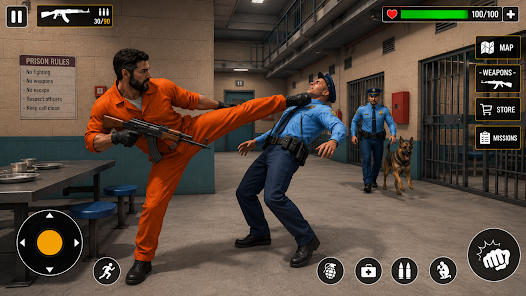
Traditional Approach: Mobile action prison games focus on reflexes and joystick combat, and they're hard to play with one hand on a quick break.
AI game master: Type or speak a single move, such as "I trade my dessert for the guard schedule," and read the outcome. Your progress syncs across web, iOS, and Android.
- Speech-to-text input for hands-free play
- Short turns that fit into five-minute breaks
- Full campaign continuity across devices
✍️ Prototyping Your Own Prison Escape Game
Scenario: You're an indie developer testing whether a "guard suspicion" mechanic is fun before you code it.
Traditional Approach: You would need to build a playable prototype, which takes weeks of scripting.
AI game master: Run the mechanic as a roleplay ruleset to stress-test it in conversation, then work through the systems design with a game design assistant. This fits a broader industry shift: 52% of developers say they're focusing on smaller, more manageable projects.
- Playtest mechanics before writing code
- Find exploits through creative player behavior
- Iterate on rules in minutes
Frequently Asked Questions
Is there an AI prison escape game where guards react to your plans?
Yes. With this roleplay engine, you describe a prison scenario and the AI plays every guard, inmate, and official. Characters keep consistent personalities and remember your past actions, so bribes, threats, and failed attempts affect how they treat you later. Your escape plan isn't limited to designer-built routes. The narrator judges any plausible approach based on your tools, timing, and allies.
Is Roleplay Game Master free to play?
Yes. The Free tier includes all core features with limited usage. For longer campaigns, the Plus plan costs $20 per month and provides 30× the Free tier's usage, along with custom model selection. Higher tiers are available for heavy users. Usage resets monthly on your billing date, there are no daily caps, and your full limit is available from day one.
How is an AI prison escape game different from The Escapists or Prison Architect?
Titles like The Escapists and Prison Architect are graphical adventure, simulation, and strategy games built around designed maps and systems. An AI prison escape game is text-driven. It trades visuals and real-time action for open-ended responses, letting you try plans the designers never anticipated. Many players enjoy both styles for different reasons.
Can I play an AI prison escape game on my phone?
Yes. The experience works the same on web, iOS, and Android, and your campaign syncs across devices. Built-in speech-to-text lets you speak your moves instead of typing, which helps with quick sessions on a commute or break. Because play is turn-based, you can step away mid-escape and pick it up later without losing your progress.
What other AI escape games can I play?
If you enjoy escape scenarios, The Mansion puts you in a mysterious estate with no memory of how you arrived and challenges you to uncover the truth and escape. The Asylum offers a horror-mystery investigation inside a shuttered psychiatric institution. Both focus on confined spaces, hidden secrets, and choices with consequences.
Does the AI remember my escape progress between sessions?
Yes. Memory is unlimited and persistent across sessions, so the AI keeps track of your contraband stash, tunnel progress, alliances, enemies, and the warden's level of suspicion. You can return days or weeks later and continue with full continuity. This makes multi-week campaigns practical, which is difficult with AI tools that forget context after a long conversation.
Conclusion: Your Prison, Your Breakout
Traditional prison escape games deliver well-crafted experiences, but they're limited by what designers could script ahead of time. Once you've memorized patrols and found every exit, the challenge fades. An AI prison escape game removes that limit by giving you a prison full of characters who remember, adapt, and respond to whatever you try.
If you want an AI prison break story you can replay endlessly, play on any device, and shape through your own choices, an AI game master gives you the most freedom. You can run a tunnel campaign, a con-artist heist, or a tense survival story inside the walls.
Try Roleplay Game Master now and start planning your escape. Explore more at Jenova.
For Developers: Roleplay Game Master is available programmatically via the Jenova API, so you can add persistent, character-consistent interactive storytelling to your game or app with a single API call. Full documentation →