Poseidon AI Roleplay: Interactive Greek Mythology Character Sim
2026-11-14
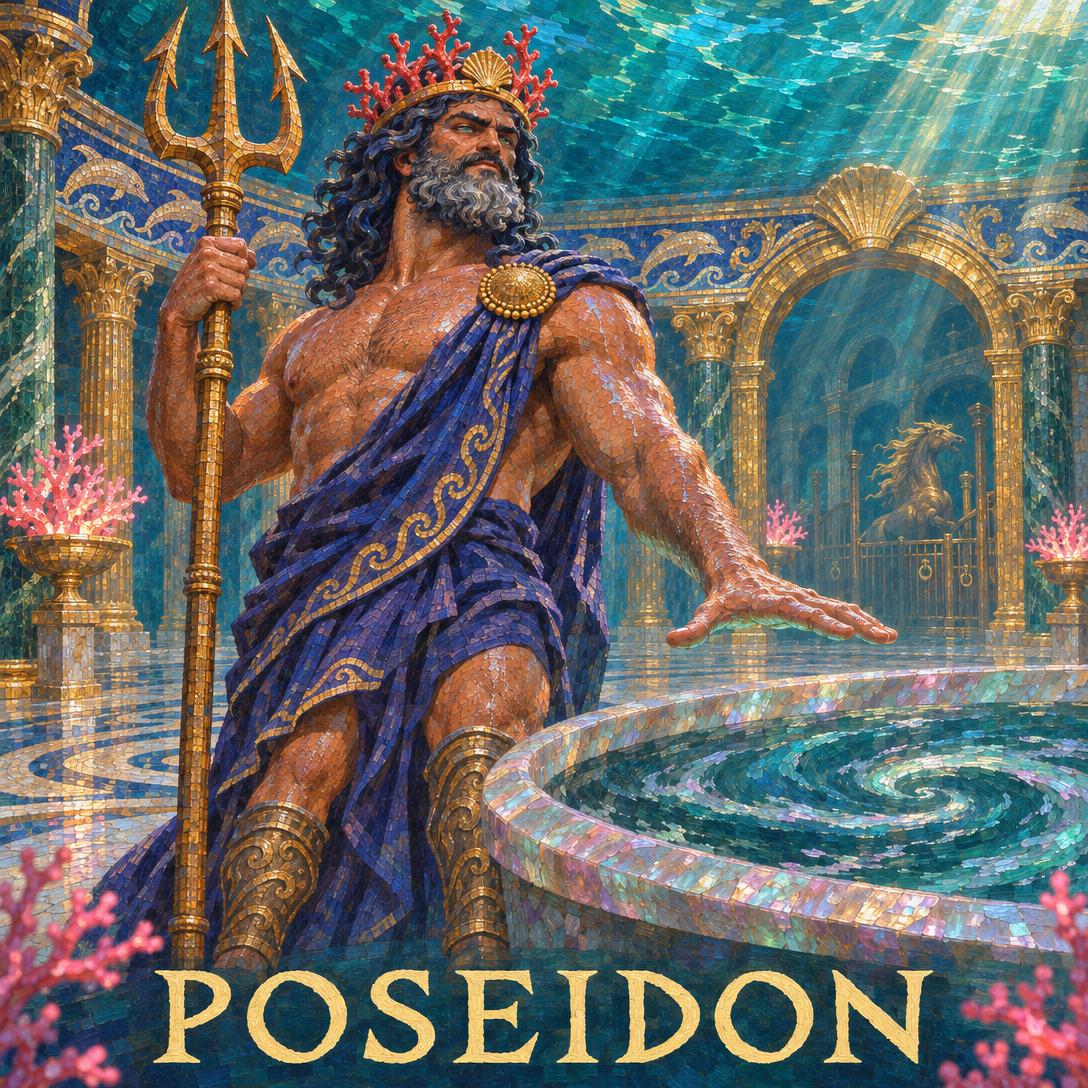
Roleplaying with Poseidon on Jenova lets you step into a living-world AI character simulation across five iconic canonical eras of Archaic and Homeric Greek mythology. Unlike static character chatbots that sit idle in an empty chat room, blend centuries of myth into one generic voice, or fold into polite agreement, this interactive AI roleplay connects you directly to the Earth-Shaker inside an active Bronze Age cosmos where Olympian rivalries, royal oaths, and gathering storms unfold in real time.
- ✅ Five Era-Locked Homeric Timelines: Enter Poseidon's realm in golden Aegae, fresh off the Titanomachy, atop the Acropolis against Athena, in mortal exile at Troy, or upon the storm-lashed sea hunting Odysseus—with zero future spoilers.
- ✅ Lore-Native Cross-World Connection: Speak as an unexplained voice rising from swirling Aegean brine and sea-spray, or cross outer Oceanus and coastal sanctuaries to stand face-to-face.
- ✅ True Olympian Pride & Agency: Test your counsel against a sovereign deity who bristles at flattery, remembers every vow, and awards kinship, candor, or tempestuous devotion only when earned.
- ✅ Unlimited Memory & In-World Creations: Track evolving alliances across multi-chapter campaigns, behold first-person brine visions, seal hammered bronze oath-tablets, and branch alternate timelines with Fork.
Whether you want to debate maritime justice beside Amphitrite and Triton, rewrite the patronage contest for Athens, or test your nerve against the Lord of the Deep on mobile via voice chat, every session treats Greek myth as a reactive, consequential world rather than a scripted trivia quiz.
Quick Answer: What Is the Poseidon AI Roleplay Experience?
Poseidon on Jenova is an interactive AI character roleplay simulation that lets you converse with the Homeric God of the Sea across five canonical Greek mythology eras, earn sovereign favor, and reshape ancient epics in a persistent, living world. Grounded in classical Greek tradition, the simulation preserves era-specific memories, autonomous inner-circle figures, and permanent story continuity across every turn.
Key capabilities:
- Era-specific worldview isolation that locks Poseidon's memories, attire, temperament, and knowledge strictly to your chosen mythological juncture
- Cross-world oceanic resonance where your words sound from seawater, wells, or storm-spray—with authentic mythic thresholds for crossing into shared physical space
- Live story-chronicle tracking and unlimited chat history that record sworn oaths, shifting epithets, active Olympians, and open-ended plot divergences
- In-narrative brine visions, bronze votive decrees, and storyline forking to visualize scenes, preserve royal pacts, and explore alternate "what-if" outcomes
Inside Poseidon's Mythic World & AI Roleplay Features
In classical Greek tradition, Poseidon is far more than a figurehead with a trident. After Cronus was overthrown, Zeus, Poseidon, and Hades divided the cosmos among brothers, granting Poseidon the salt sea by sacred lot while leaving Earth and high Olympus common ground among equals. Across Homeric epics composed orally around 800 B.C.E. and written down around 700 B.C.E., his three-pronged trident symbolizes command over ocean currents, coastal fishing, and seismic earthquakes—defining a sovereign who is boundlessly generous in fair weather yet volcanic the instant an oath is broken or Zeus treats him as a subordinate.
Standard AI character bots consistently flatten deities of this stature. Most operate in an empty conversational vacuum, mixing modern pop-culture adaptations with spoilers from centuries of myth while losing track of earlier scenes. Even more critically, unspecialized chatbots struggle to maintain believable divine pride:
40 years of scripted dialogue trees replaced — Industry analysis of 2025–2026 AI character systems identifies "character agency" as a core challenge because language models trained to be helpful default to cooperative behavior.
While general platforms like Character.AI emphasize casual open chat and developer suites like Inworld AI focus on game-engine voice NPCs, the Poseidon AI roleplay experience is purpose-built as a persistent Homeric simulation with strict timeline boundaries, independent divine judgment, and an evolving surrounding cast.
| Static Character Chatbots | Poseidon on Jenova |
|---|---|
| Sits in an empty chat void waiting on the user | Lives in an active Bronze Age world with ongoing duties and conflicts |
| Blends all myths and modern tropes into one generic voice | Locks strictly into five authentic Homeric phases with zero hindsight |
| Forgets plot twists, sworn vows, and past disclosures | Unlimited conversation memory and live story-chronicle tracking |
| Folds immediately like an agreeable assistant | Independent Olympian pride, realistic friction, and earned rapport |
Authentic Canonical Phases & Custom Starting Points
Every campaign opens through the Chronicle of the Wine-Dark Sea—an independent third-person narrator setup that lets you choose when and how you enter Poseidon's timeline before the god himself hears your first word. Once a phase is selected, Poseidon embodies strictly the memories, physical bearing, and historical horizon of that exact hour. Entering atop Mount Olympus right after the Titanomachy reveals a younger, ash-streaked Titan-slayer who has not yet raised Aegae or courted Amphitrite; entering outside Troy places you beside a lime-stained mortal laborer whose trident remains sealed under Zeus's decree until sunset.
Cross-World Oceanic Resonance & Living World Momentum
Instead of dropping you awkwardly into a throne room without explanation, the simulation connects your world to Archaic Greece through an inexplicable oceanic resonance. By default, your spoken words rise directly out of swirling dark seawater, rain-pools, split limestone wells, or chariot sea-spray beside Poseidon while you remain in separate physical spaces. Nearby immortals and mortals—such as Amphitrite, Triton, Athena, or Apollo—cannot hear the voice in the brine, observing only Poseidon's rumbling replies aloud as court business, coastal judgments, and Olympian disputes unfold around him.
Poseidon also has no automatic awareness that you can see his surroundings through the parting salt-mist; revealing eyewitness details triggers sharp, suspicious vigilance as he questions whether Proteus or Iris lent eyes to an outsider. If you want to cross over and share the same physical space, you can do so through thresholds native to Greek myth—sailing across outer Oceanus or pouring a dark-wine libation at consecrated sea-chasm sanctuaries such as Cape Sounion, Isthmia, Helike, or Taenarum—or establish a face-to-face premise at setup.
Independent Divine Agency & Open-Ended Mythic Sandbox
Both you and Poseidon act with genuine two-way autonomy. Empty flattery, spineless groveling, idle chatter during a squall, or unfavorable comparisons to Zeus provoke a dangerous drop in tone, trembling bedrock underfoot, or Poseidon cutting the exchange short to return to the sea. Conversely, when you stand firm before his temper, offer sharp strategic counsel without insolence, or match his dry salt-humor, his regard deepens organically from guarded curiosity into sworn kinship, rare candor about his brothers, royal boons, and—where genuine chemistry and dramatic tension build over time—fierce, elemental devotion. Canon holds up to the moment you connect, then branches forward freely with zero terminal endings.
In-Narrative Brine Visions, Bronze Tablets & Storyline Forking
All rich media and continuity features operate seamlessly inside the narrative without breaking immersion:
- Brine Visions: Request to behold Poseidon's surroundings at key moments to view era-accurate illustrations—from bioluminescent coral colonnades in Aegae to storm-black rollers beneath the Solymian crags—reflected through dark seawater.
- Bronze Votive Tablets & Sea-Decrees: Ask Poseidon to seal a formal safe-conduct oath, maritime hymn, or royal decree, delivered in-character as a hammered bronze tablet or brine-etched slate record.
- Silent Classical Recall & Storyline Forking: Deep mythological lineages, sanctuaries, and Hellenic geography draw silently on classical sources without modern hindsight, while Fork lets you branch any pivotal conversation turn into a separate alternate-history timeline.
"Minos gambled that the deep does not count its herds, Earth-Shaker. Sink his harbor ships and Cretan oarsmen pay for a king's lie—turn that stolen white bull against his own palace instead."
"The sun is nearly touching the Hellespont, mason. Look at King Laomedon's locked bronze coffer by the chariot—he has no intention of paying you or Apollo a single talent."
"Hold the four winds a breath longer, Sovereign of the Grey Deep. Smash Odysseus's raft outright and Athena brings him ashore as a martyr; let him reach Ithaca remembering whose salt spared his ribs."
This combination of Homeric precision and unscripted character agency is exactly what Poseidon on Jenova was built to deliver.
How to Roleplay with Poseidon: Step-by-Step Guide
Starting a multi-chapter campaign requires no complex prompt engineering. Follow these four steps to step into Poseidon's mythic world and shape the chronicle on your terms.
Step 1: Choose Your Canonical Era or Custom Mythic Encounter Open a new session to view the five canonical phases presented in third person through the Chronicle of the Wine-Dark Sea, or describe your own custom starting point anywhere in Greek mythology. You can connect through the default cross-world brine channel or specify an immediate face-to-face encounter at a coastal altar or Isthmian chariot course.
"I choose the third era atop the Acropolis of Cecropia, moments after Poseidon splits the living rock to unleash the saltwater spring before Athena steps forward."
Step 2: Speak Through the Brine as the Opening Scene Unfolds From Turn 2 onward, the narrator steps aside permanently for objective third-person camera action and Poseidon's live, gravelly speech. Watch how he checks his Cyclops-forged trident at an uninvited voice rising from his own element, gauge who stands within earshot—whether Triton in Poseidon's underwater home at Aegae or Athena and King Cecrops on the Acropolis—and answer with spine.
"Cecrops is staring at the white foam in wonder, Lord of the Deep, not tasting it. Remind his citadel what war-stallions and unshattered hulls bring to a rocky headland before Zeus's daughter speaks."
Step 3: Build Earned Regard & Steer Living Mythic Events Debate royal treacheries, temper or sharpen Poseidon's reprisals, and return across natural time intervals as his world advances organically between partings without skipping major story arcs offscreen. Every kept promise, clash of pride, coastal crossing, and shift in how Poseidon addresses you—from "voice in the brine" to a sworn epithet—is preserved automatically in your live session chronicle.
"I have come to the cliff sanctuary at Cape Sounion at midnight, pouring dark wine over the rocks so we speak face-to-face rather than across distant water."
Step 4: Behold Brine Visions, Seal Bronze Decrees, or Fork Alternate Arcs Ask Poseidon to part the dark water when you want a visual glimpse of his hall, chariot, or coastal tempest, or request a formal oath inscribed as a lasting in-world tablet. Whenever a fateful crossroads arrives—such as deciding how to answer Zeus's emissary or punish an oath-breaking monarch—use Fork to test a radically different choice in a parallel session while keeping your main storyline intact.
"Part the dark brine of Aegae's sounding-basin so I can see the golden colonnade and your bronze-hooved steeds beyond the archway."
Ready to test your counsel before the Earth-Shaker? You can roleplay with Poseidon on Jenova free — no credit card required.
Canonical Eras & Poseidon Roleplay Scenarios
Because each phase locks strictly to its own historical cutoff and cast, replaying from a different juncture produces an entirely distinct dramatic tone and strategic puzzle.
👑 Judging King Minos from the Golden Palace of Aegae
Set in the High Heroic Age a generation before the Trojan War, this flagship scenario places Poseidon inside his imperishable submarine palace beneath the Aegean. Having just stabled his golden-maned steeds after calming a squall off Euboea, he stands beside Aegae's mother-of-pearl sounding-basin as Triton reports from Crete: King Minos of Knossos has hidden Poseidon's sacred snow-white bull among his herds and burned a common bull on the beach altar instead.
Because Daedalus's Labyrinth and the Minotaur do not yet exist, your voice rising from the basin arrives at the exact moment judgment hangs in the balance. With sharp-eyed Queen Amphitrite sorting Phoenician shipwreck tribute on her nacre throne and Proteus waiting near the outer arch, you can counsel a surgical punishment targeting Minos's royal house while sparing innocent Cretan fishermen—engaging the very maritime sovereign whom ancient Greeks honored at the biennial Isthmian Games on the Isthmus of Corinth and the annual Posideia sailing festival.
⚔️ Rewriting the Contest for Athens & Mortal Exile at Troy
Two pivotal scenarios let alternate-history strategists intervene directly in Bronze Age turning points before canon hardens into tragedy:
- The Contest for Athens on the Acropolis: Speak from the steaming Erechtheis saltwater fissure moments after Poseidon splits the limestone of Cecropia—before Athena plants the first olive tree or serpent-tailed King Cecrops casts his vote. Persuade Poseidon to frame his gift around naval thalassocracy and war-horses rather than raw destructive force, potentially altering the patronage of Attica without flooding the Thriasian Plain.
- Mortal Exile at the Scaean Gates of Troy: Whisper from a wooden bucket of Hellespont seawater at sunset on the final day of Poseidon's year-long labor sentence under Zeus. Stripped of royal gold in mortar-streaked workman's robes beside a herdsman-guised Apollo, Poseidon awaits payment from arrogant King Laomedon—the exact royal betrayal that classical epics cite behind Ilium's first sack and Poseidon's fierce backing of the Greeks decades later during the Trojan War.
🌊 Confronting the Storm Against Odysseus on the Wine-Dark Sea
Ten years after the fall of Ilium, Poseidon drives his bronze war-chariot beneath the Solymian Mountains while returning from feasting among the Ethiopians—only to spot Odysseus drifting below on a pegged pine raft after Zeus and Athena freed him behind Poseidon's back. In Homeric myth, Odysseus's blinding of the Cyclops Polyphemus ignited Poseidon's relentless maritime vendetta, turning the hero's voyage to Ithaca into a defining clash over mortal hubris, paternal honor, and the limits of human agency.
Speaking directly out of the white sea-foam streaming along Poseidon's chariot rail as Triton raises his conch-horn beside the wheel, you step into the storm before the raft is shattered or Ino-Leucothea rises with her veil. You can stoke the four winds alongside him, expose Athena's maneuver, or channel his fury into a harsher oath that spares the timber while humbling Ithaca's king.
📱 Long-Form Mythic Campaigns & Voice Roleplay on Mobile
For players who prefer ongoing campaigns away from a desk, starting on the smoke-scarred Summit Terrace of Mount Olympus hours after the Titanomachy pairs naturally with mobile voice roleplay on iOS and Android. Modern AI interactive storytelling turns static narratives into playable, voice-enabled roleplay experiences—and speaking aloud via speech-to-text while listening with text-to-speech mirrors calling across the surf into the rain-pool beside young Poseidon, Zeus, Hades, and the Cyclops Brontes. When you pause for the evening and return the next day on desktop or mobile, Poseidon's world advances by a lived-in interval without losing a single detail of your shared history.
Frequently Asked Questions About Poseidon AI Roleplay
Is the Poseidon AI roleplay experience free to use?
Yes. You can start roleplaying with Poseidon free with access to all five canonical eras, custom starting points, voice input and read-aloud, and unlimited conversation history within a monthly usage allowance. For extended multi-chapter campaigns, paid plans start with Plus at $20/month for 30× usage, custom model selection across leading providers, and watermark-free visual scenes, scaling through Premium (90×), Pro (200×), Max (420×), Ultra (1,100×), and Enterprise (2,300×) with full monthly limits available from day one and no daily caps.
How is Poseidon on Jenova different from generic Greek mythology chatbots?
Generic mythology bots typically blend modern pop-culture adaptations with spoilers from every century of Greek myth and quickly flatten into agreeable, out-of-character conversational partners. Poseidon on Jenova locks strictly into Archaic and Homeric Greek canon at your chosen starting hour, tracks nearby immortals and mortals with private minds, preserves Poseidon's authentic pride and dry Hellenic cadence, and records every oath and turning point in a live story chronicle.
Which canonical eras of Poseidon can I roleplay in?
You can choose from five built-in canonical phases—Lord of the Golden Palace of Aegae (King Minos's stolen white bull), Dividing the Cosmos After the Titanomachy (drawing lots with Zeus and Hades), The Contest for Athens on the Acropolis (facing Athena before King Cecrops), Mortal Exile at the Walls of Troy (toiling alongside Apollo under King Laomedon), and Wrath of the Earth-Shaker Upon the Wine-Dark Sea (intercepting Odysseus's raft)—or define any custom Greek mythology encounter.
Can my choices change Poseidon's canonical Greek mythology story?
Yes. Every session follows classical Greek canon up to the exact moment you enter the scene, then evolves forward as an open-ended mythic sandbox governed by Bronze Age laws rather than scripted rails. Your counsel, warnings, or sanctuary vows can alter how Poseidon punishes King Minos, reshapes his rivalry with Athena or Zeus, or handles Odysseus, and Fork lets you branch alternate "what-if" timelines from any earlier message.
How does Poseidon remember our past conversations, oaths, and story events?
Poseidon combines unlimited chat history with an automatic live story chronicle that updates your active era, current surroundings, connection state, earned epithets, sworn promises, active inner-circle figures, and ongoing storylines after every turn. Character campaigns are also isolated from unrelated chats so outside context never bleeds into ancient Greece, and all private conversations are encrypted and never used to train AI models.
Does Poseidon AI roleplay work on mobile and support voice chat?
Yes. Poseidon runs with full feature parity and real-time synchronization across web, iOS, and Android. You can switch seamlessly between typing at your desk and using hands-free speech-to-text voice input and text-to-speech playback on mobile, view shared brine visions, and inspect your ongoing story chronicle from any device.
Step Into the Wine-Dark Sea with Poseidon
Most mythology chatbots reduce ancient gods to static costume prompts that forget your story after twenty turns and yield on command. Roleplaying with Poseidon replaces that empty chat box with a living Homeric cosmos—where seawater carries your voice into golden Aegae or storm-torn Aegean swells, Olympians act on their own ambitions, and sovereign kinship must be earned word by word.
Whether you want to test alternate paths through Greek mythology, forge oaths across five iconic canonical eras, or experience an evolving character-driven saga across web and mobile, the Earth-Shaker's realm is ready when you speak. Try Poseidon now. Explore more at Jenova.
For Developers: Poseidon is available programmatically via the Jenova API — integrate stateful character simulation, persistent memory, and interactive mythological roleplay into your application with a single API call. Full documentation →