AI Portfolio Analyzer: Institutional-Grade Allocation & Risk Analysis
2026-08-18
Portfolio Management Strategist helps you understand exactly what your portfolio is doing — and what it will do under stress — by applying institutional allocation analysis, drift detection, and scenario testing to your actual holdings. Most investors track returns but never audit concentration, factor overlap, or correlation breakdown. This AI portfolio analyzer closes that gap with the same analytical rigor professional allocators use.
✅ Allocation analysis across asset class, sector, geography, and factor exposure ✅ Drift detection that flags how far your portfolio has moved from target weights ✅ Scenario stress tests modeling rate shocks, drawdowns, and correlation regime shifts ✅ Rebalancing recommendations with specific, actionable trade logic
To understand why this matters, consider what most retail and semi-professional investors are actually working with: a brokerage screen showing total return, a pie chart of holdings, and no mechanism for identifying the risks buried inside that allocation. That gap is where portfolios quietly become far more fragile than their owners realize.

Quick Answer: What Is an AI Portfolio Analyzer?
An AI portfolio analyzer is a tool that examines your holdings across allocation, concentration, risk, and correlation dimensions to identify drift, hidden exposures, and structural vulnerabilities, then recommends specific rebalancing actions. It replaces static performance tracking with continuous, forward-looking portfolio diagnostics.
Key capabilities:
- Allocation analysis — breaks down exposure by asset class, sector, geography, market cap, and factor tilt
- Drift detection — quantifies how far current weights have moved from your stated targets
- Risk assessment — surfaces concentration risk, correlation clustering, and single-name dependency
- Scenario stress testing — models portfolio behavior under rate shocks, equity drawdowns, and regime changes
- Rebalancing recommendations — converts diagnostics into specific, prioritized trade decisions
The Problem: Why Portfolio Analysis Breaks Down for Most Investors
Your brokerage account shows you what you own and what it's worth. It does not tell you whether you're accidentally running a 40% technology bet, whether three of your "diversified" holdings move as one asset in a selloff, or how much your allocation has drifted since you last rebalanced.
This is not a niche problem. Professional institutions have spent the last two years aggressively building AI capabilities precisely because portfolio analysis at scale is hard, and doing it manually is expensive and slow.
95% of wealth and asset management firms have scaled generative AI adoption to multiple use cases, with 78% already exploring agentic AI — EY GenAI in Wealth & Asset Management Survey 2025
75% of surveyed firms are budgeting AI investments exceeding $11 million, with one-third planning significant resource increases within two years — EY GenAI in Wealth & Asset Management Survey 2025
The portfolio management software market was valued at $3.7 billion in 2025**, projected to reach **$8.3 billion by 2033 at an 11.3% CAGR — Grand View Research
But accessing that level of analysis as an individual investor is frustratingly difficult:
- Professional portfolio analytics platforms are priced for institutions, not individuals
- Brokerage dashboards report performance, not risk structure
- Correlation and factor analysis requires data and modeling most investors don't have
- Rebalancing decisions get deferred indefinitely because the analysis feels overwhelming
- Human advisors charge ongoing fees for periodic reviews you can't request on demand
Hidden Concentration Masquerading as Diversification
Owning twelve stocks feels diversified. Owning twelve stocks where eight derive revenue from enterprise software spending is a single macro bet wearing a costume. Sector labels obscure this — a payments processor, a cloud infrastructure firm, and a design software company sit in different GICS sectors while sharing the same underlying demand driver.
Traditional portfolio views reinforce the illusion. A pie chart with twelve slices looks balanced. A factor-adjusted view of the same portfolio often reveals a single dominant exposure.
Allocation Drift Nobody Notices
Portfolios drift. A position that doubles while the rest of the portfolio is flat quietly becomes an oversized concentration. Research on portfolio management practice notes that static annual planning has become inadequate given the pace of market shocks — yet most individual investors rebalance less frequently than that, if at all.
Without a mechanism that quantifies drift against stated targets, the portfolio you own gradually stops being the portfolio you designed.
Correlation Breakdown Under Stress
Diversification is measured in calm markets and tested in violent ones. Assets that show low historical correlation frequently converge toward 1.0 during liquidity events — precisely when diversification is supposed to protect you. Understanding this requires scenario analysis, not backward-looking correlation matrices.
Analysis Paralysis and Deferred Decisions
Even investors who recognize a problem often stall. Should you trim the winner or add to the laggard? Does the tax consequence justify the rebalance? What's the second-order effect on sector weights? Without a structured analytical framework, these questions compound until the decision is postponed indefinitely.
Advisory Access Is Gated by Cost and Availability
Institutional-quality portfolio review has historically required an institutional relationship. The World Economic Forum notes that AI-driven investment tools are expected to become a primary source of advice for retail investors by 2027 — a shift driven largely by the access gap between what professional analysis costs and what most investors can afford.
This is exactly what Portfolio Management Strategist was built for.
Why Portfolio Management Strategist
Portfolio Management Strategist is an institutional portfolio analyst built for professional investors — it applies allocation analysis, drift detection, risk assessment, scenario stress tests, and rebalancing recommendations to whatever holdings you bring it. You paste your positions; it returns a structured diagnostic of what you actually own and where the fragility sits.
The distinction matters. Most tools report. This one analyzes, forms a view, and tells you what to do about it.
| Traditional Approach | Portfolio Management Strategist |
|---|---|
| Brokerage dashboard shows returns and weights | Full allocation breakdown by class, sector, geography, and factor |
| Rebalancing happens on an arbitrary calendar | Drift quantified continuously against your stated targets |
| Correlation assumed from asset labels | Correlation clustering and overlap analyzed directly |
| "How risky is this?" answered by gut feel | Scenario stress tests model specific shock conditions |
| Advisor review costs ongoing fees, available quarterly | On-demand analysis whenever your portfolio or thesis changes |
| Recommendations arrive as generic guidance | Specific, prioritized rebalancing logic tied to your positions |
Allocation Analysis That Goes Past the Pie Chart
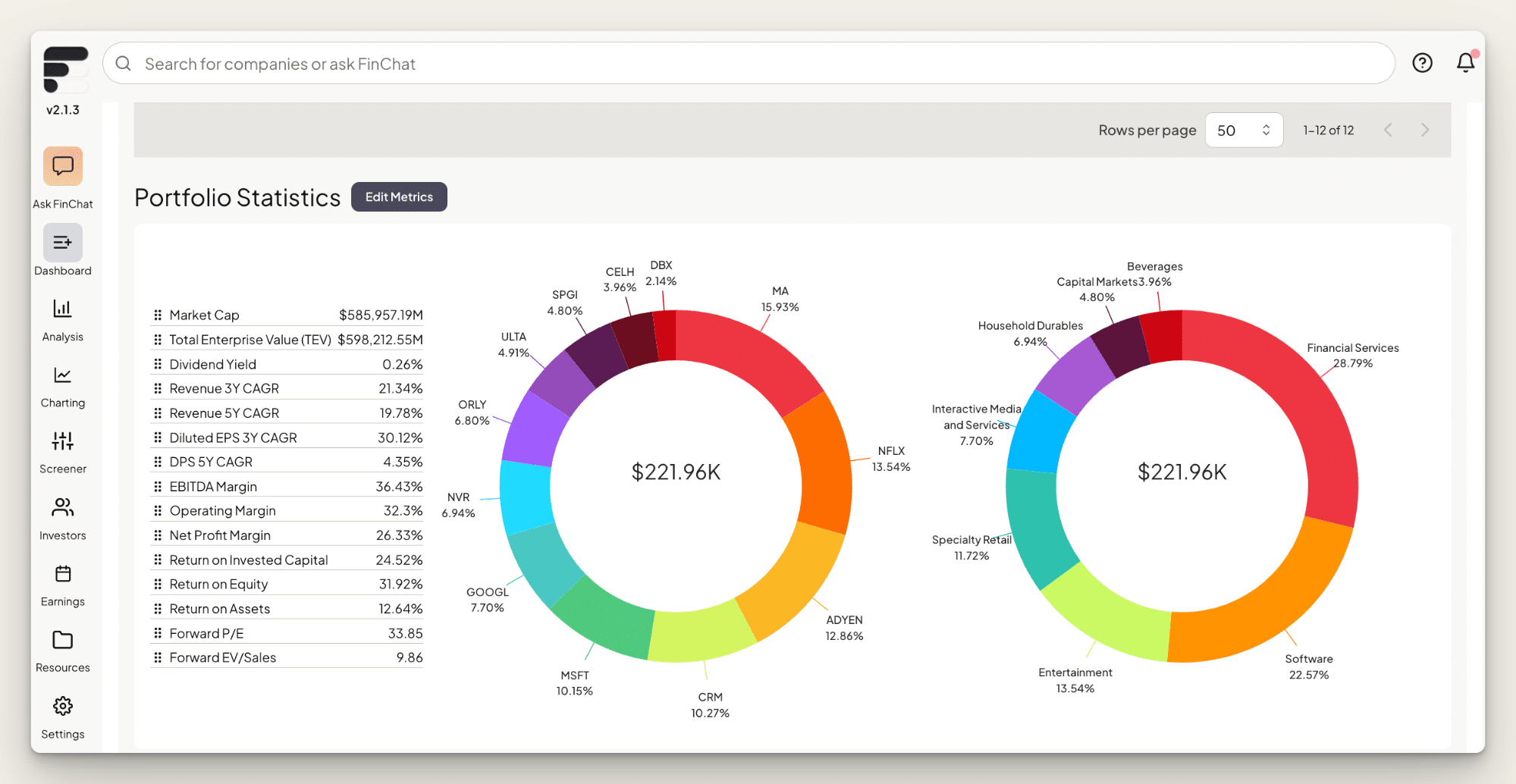
The analyzer decomposes your portfolio along multiple simultaneous axes — asset class, sector, geography, market capitalization, and factor exposure — so you see the structure underneath the surface. A dashboard view like the one above shows sector weightings and per-holding allocation; the analytical layer explains what those weightings mean for your risk profile.
"Here are my 12 holdings and weights. Break down my true sector and factor exposure, and tell me where I'm more concentrated than the sector labels suggest."
Drift Detection Against Stated Targets
Define your target allocation once. The analyzer measures current weights against those targets and quantifies the gap — flagging which positions have drifted materially and in which direction. This converts rebalancing from a vague intention into a specific, measurable task.
Risk Assessment Beyond Volatility
Standard deviation is one input, not the answer. The analyzer examines concentration risk, single-name dependency, correlation clustering, sector overweights, and factor crowding — the structural vulnerabilities that turn a diversified-looking portfolio into a directional bet.
Scenario Stress Testing
Rather than asking what your portfolio did, ask what it would do. The analyzer models portfolio behavior under specified shock conditions — rate moves, sector drawdowns, correlation regime shifts — so you understand your downside before the market demonstrates it for you.
"Stress test this portfolio against a 25% drawdown in high-multiple technology names and a 150bp rise in the 10-year yield. Where does the damage concentrate?"
Rebalancing Recommendations With Trade Logic
Diagnostics without prescriptions are academic. The analyzer converts its findings into specific rebalancing recommendations — which positions to trim, which to add, and the reasoning connecting each action to the identified risk.
"Based on the drift and concentration analysis, give me a prioritized rebalancing plan that reduces sector concentration without triggering unnecessary turnover."
Related Agents You'll Also Find Useful
Portfolio analysis rarely ends at the portfolio level. These agents cover the adjacent work most investors need alongside allocation review.
Fundamental Stock Analyst
When drift analysis flags a position for review, the next question is whether the underlying business still justifies its weight. Fundamental Stock Analyst handles the security-level research that informs that call.
- Earnings analysis and business model assessment
- Relative valuation across comparable companies
- Real-time data across SEC filings, analyst estimates, and market sentiment
Macro Strategist
Portfolio risk is largely macro risk in disguise. Macro Strategist provides the top-down context that makes scenario assumptions credible rather than arbitrary.
- Cross-asset synthesis and policy analysis
- Institutional-grade macro intelligence for professional investors
- Automated daily briefings on regime and positioning shifts
Options Strategist
If stress testing reveals concentrated downside you'd rather hedge than sell, Options Strategist translates that view into a structure.
- Strategy selection matched to your specific market view
- Volatility analysis, position sizing, and Greeks
- Trade management guidance for all experience levels
Technical Stock Analyst
Rebalancing decisions have an execution dimension. Technical Stock Analyst analyzes price action and market structure to inform entry and exit timing on the trades your rebalancing plan calls for.
- Chart, volume, and momentum analysis
- Market structure and high-probability setup identification
- Defined-risk framing for each position
Try Portfolio Management Strategist free — no credit card required.
How It Works
Step 1: Share Your Holdings
Paste your positions and weights directly, or upload a brokerage export or portfolio statement. The analyzer works from whatever format your holdings arrive in — tickers with weights, dollar values, or share counts.
"Here's my portfolio export. 12 positions, roughly $222K total. Analyze the allocation structure."
Step 2: Define Your Targets and Constraints
State your intended allocation, risk tolerance, time horizon, and any constraints — tax sensitivity, positions you won't sell, minimum cash reserves. This is what turns generic analysis into decisions that fit your actual situation.
"Target is 60% equity, 25% fixed income, 15% alternatives. I'm tax-sensitive in the taxable account and won't sell anything held under 12 months."
Step 3: Run the Diagnostic
The analyzer returns the full picture: allocation breakdown across every dimension, drift measured against your targets, concentration and correlation risk, and factor exposures you may not have realized you were carrying.
Step 4: Stress Test Specific Scenarios
Specify the shocks that concern you and see how the portfolio responds. This is where abstract risk becomes concrete — you learn which positions drive your drawdown and whether your diversification holds when it matters.
"Model a scenario where rates rise 200bp and equity multiples compress across growth names. What's the estimated portfolio impact and which holdings drive it?"
Step 5: Execute the Rebalancing Plan
Receive prioritized recommendations with reasoning attached — what to trim, what to add, and why each action addresses a specific identified risk. Ask follow-ups until the plan fits your constraints, then execute.
Results & Use Cases
📊 The Accidental Sector Bet
Scenario: A self-directed investor holds 12 names across what appear to be five different sectors and considers the portfolio diversified.
Traditional Approach: Review the brokerage pie chart, note that no single position exceeds 16%, conclude the portfolio is balanced. Discover the concentration during a sector-wide drawdown.
Portfolio Management Strategist: Factor and revenue-driver analysis reveals that a majority of holdings share exposure to the same underlying demand cycle, regardless of their sector classifications.
- Surfaces correlation clustering that sector labels conceal
- Quantifies the effective single-factor exposure in percentage terms
- Recommends specific positions to trim and diversifying exposures to add
💼 The Quarterly Rebalance That Never Happens
Scenario: An investor intends to rebalance quarterly but hasn't done so in 18 months. Two positions have roughly doubled; the target allocation is now theoretical.
Traditional Approach: Open the account, feel overwhelmed by the number of interacting decisions, close the tab. Repeat.
Portfolio Management Strategist: Drift detection quantifies exactly how far each position has moved from target and produces an ordered action list.
- Ranks drift by materiality so the highest-impact trades come first
- Accounts for tax sensitivity and holding-period constraints
- Reduces a paralyzing decision into a sequenced checklist
📱 Mid-Market Review From Your Phone
Scenario: A volatile session is underway. You want to know whether your portfolio's exposure to the moving sector is a problem before markets close.
Traditional Approach: Manually scan positions, guess at aggregate exposure, make a reactive decision without analysis.
Portfolio Management Strategist: Full analysis is available on mobile with identical capability to desktop, with conversation history and stated targets already in context.
- Instant exposure assessment against the specific move in question
- Scenario testing on the actual conditions unfolding
- Decision support before the close rather than a post-mortem afterward
🎯 Pre-Deployment Sizing for New Capital
Scenario: A bonus arrives and you want to deploy it without worsening existing concentration.
Traditional Approach: Buy more of whatever you already like, unintentionally amplifying the exposures already dominating the portfolio.
Portfolio Management Strategist: Analyzes where the incremental capital improves versus degrades portfolio structure, then recommends sizing accordingly. Pair with Fundamental Stock Analyst to validate the underlying business case for candidate additions.
- Identifies underweight exposures the new capital should fill
- Models the post-deployment allocation before you commit
- Flags additions that would increase existing correlation clustering
Frequently Asked Questions
Is the AI portfolio analyzer free to use?
Yes. Portfolio Management Strategist is available on Jenova's free tier with all core features and limited monthly usage — no credit card required. Paid plans starting at $20/month increase usage limits substantially and unlock custom model selection. Usage resets monthly on your billing date with no daily caps.
How is this different from my brokerage's portfolio tools?
Brokerage dashboards report — they show holdings, weights, and returns. An AI portfolio analyzer analyzes: it identifies hidden concentration, measures drift against your stated targets, stress-tests specific scenarios, and produces prioritized rebalancing recommendations. The difference is between a scoreboard and a coach.
Can it analyze portfolios with alternatives and international holdings?
Yes. The analyzer handles equities, fixed income, funds, international exposure, and alternative allocations, breaking down risk across asset class, geography, sector, and factor dimensions. Complex multi-account structures can be analyzed together or separately depending on how you present them.
Does the analysis account for taxes and holding periods?
Only if you specify them. State your tax sensitivity, account types, and holding-period constraints when defining targets, and the rebalancing recommendations will work within those boundaries — favoring lower-turnover paths and flagging trades with unfavorable tax consequences.
Is AI portfolio analysis reliable enough to act on?
Treat it as institutional-grade analytical support, not a fiduciary recommendation. FINRA's review of AI in the securities industry notes that AI portfolio applications identify patterns across data volumes humans cannot process manually — while also cautioning that models can behave unpredictably under conditions absent from their training context. The analysis is a rigorous input to your decision, not a replacement for your judgment.
Does it work on mobile?
Yes. Jenova offers full feature parity across web, iOS, and Android, with settings and conversation history syncing across devices. You can run a complete portfolio diagnostic from your phone with the same capability available on desktop.
Conclusion
Most investors know their returns and almost nothing about their risk structure. That asymmetry is expensive — it shows up as unexpected drawdowns, concentration nobody flagged, and diversification that evaporates precisely when it was supposed to work.
An AI portfolio analyzer closes that gap. Portfolio Management Strategist brings allocation analysis, drift detection, risk assessment, and scenario stress testing to portfolios of any size, then converts the diagnostics into rebalancing recommendations you can actually execute. Institutional analytical rigor, applied to your holdings, available whenever your portfolio or your thesis changes.
Try Portfolio Management Strategist now. Explore more specialized investment agents at Jenova.
For Developers: Portfolio Management Strategist is available programmatically via the Jenova API — integrate institutional portfolio analysis and rebalancing intelligence into your fintech application with a single API call. Full documentation →