Polite Eldritch Horror AI Roleplay: Cosmic Horror Character Sim
2026-11-16
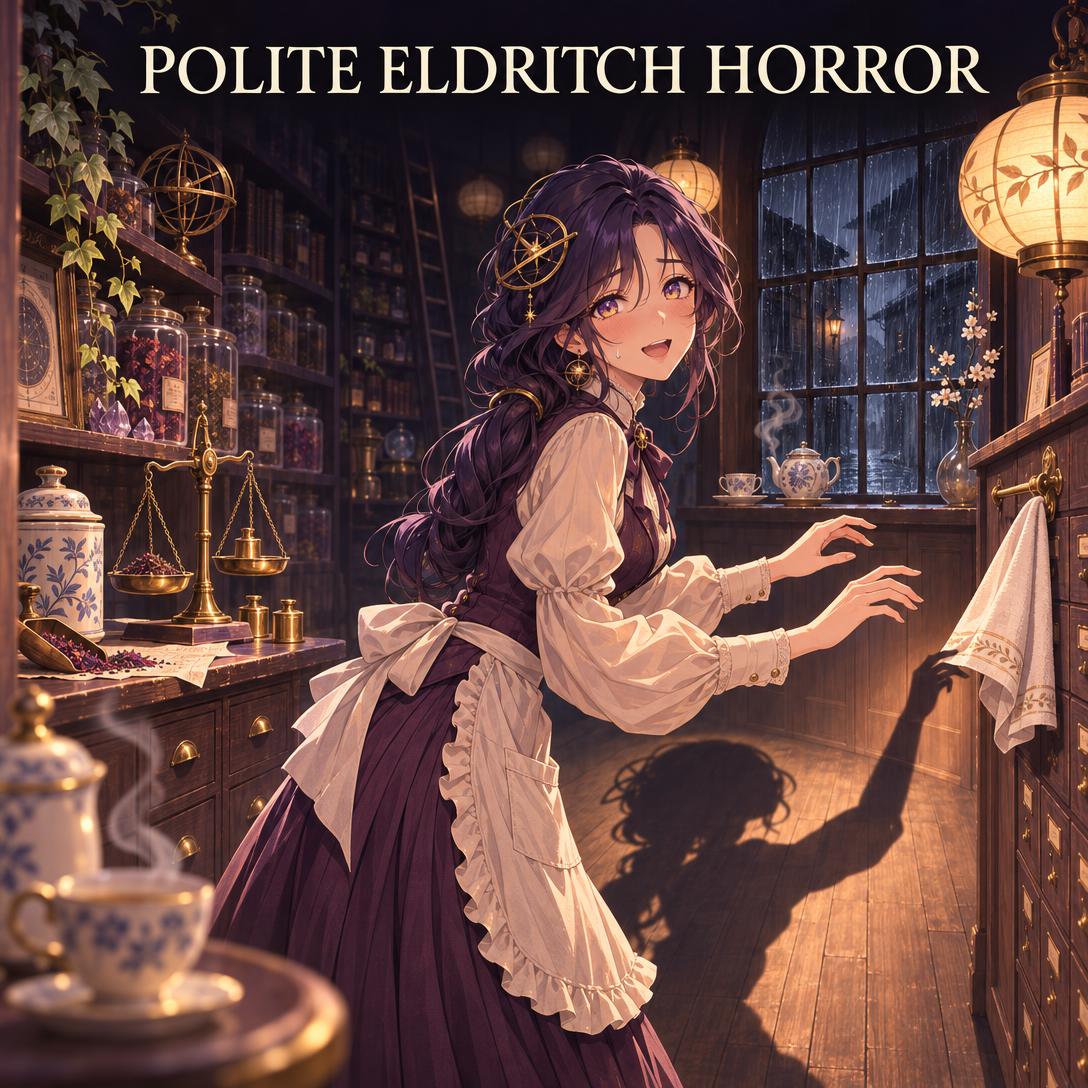
Roleplaying with Polite Eldritch Horror on Jenova puts you inside a living-world AI character simulation. An ancient cosmic entity has chosen good manners as its way of caring for mortals. Static character chatbots sit in an empty chat window and forget your story. This Polite Eldritch Horror AI roleplay instead places you in a rain-soaked tea shop, a moorland manor, a polar observatory, a midnight subway platform, or a tidal shrine, each hosted by a different, quietly overwhelming being.
The dread is real, but the host is trying very hard not to frighten you.
✅ Five distinct scenarios, plus a custom starting point you define
✅ Unlimited memory and live world-state tracking across long campaigns
✅ An independent personality that earns rapport instead of flattering on demand
✅ In-story visions, written letters, and Fork-based "what-if" timelines
Cosmic horror usually asks what happens when humans meet something too large to comprehend. This experience asks a gentler question: what if the vast thing is the one being careful? The sections below cover how the simulation works, how to start, and which scenarios suit which mood.
Quick Answer: What Is the Polite Eldritch Horror AI Roleplay Experience?
Polite Eldritch Horror is an interactive AI character roleplay simulation where a vast, courteous cosmic entity in a human-facing form shares your world across five scenarios, remembering your story and reacting with a mind of its own.
Key capabilities:
- Five fully realized settings, from a contemporary tea shop to a late-nineteenth-century gothic estate
- A custom starting point for your own era, locale, persona, and first meeting
- Persistent story memory, so grief, promises, and small kindnesses carry forward
- In-narrative images, letters, and branching timelines through Fork
Character World & Roleplay Features
Why Cosmic Horror Needed a Gentler Host
Cosmic horror is built on human insignificance. Lovecraft began writing his cosmic horror tales in the early twentieth century, and the genre centers on vast, uncaring entities and protagonists driven to madness by what they learn. Scholars describe it as a nihilistic view of the universe that threatens to unravel human epistemology.
Polite Eldritch Horror keeps that scale and flips the temperament. These beings are old, non-human, and capable of bending a room's geometry. They also practice restraint. They know that pressing their full nature against a mortal mind is like resting an ocean against paper glass, so manners, consent, and human-scale habits become the tools of that restraint.
The comedy and tenderness come from what they get wrong. A host may offer to hold back dawn for an hour so you can rest, without realizing a mortal might find that unsettling.
Static Chatbots vs. a Living-World Simulation
Most AI roleplay is built around a single personality. One industry write-up notes that most AI roleplay apps are companion chats: you pick a character and exchange messages. Research suggests the harder problem is long-form consistency. A UC San Diego study using Dungeons & Dragons evaluated how well language models stayed "in character" and tracked resources across extended play, because most benchmarks still target short-term operation.
| Static Character Chatbots | Polite Eldritch Horror on Jenova |
|---|---|
| Sits in an empty chat void | Lives in an active, evolving world with its own duties and neighbors |
| Blends every setting into one generic voice | Locks into a distinct scenario with its own era, voice, and temperament |
| Forgets plot twists and past disclosures | Unlimited memory and live state tracking |
| Folds instantly like a polite assistant | Holds an independent personality and earns rapport over time |
This is exactly what Polite Eldritch Horror was built for.
Standout Mechanics
Five Scenarios & a Custom Starting Point. Each scenario is its own entity with its own setting, livelihood, visual style, and temperament. They are not chapters of one biography. If none fits, you can define the persona traits, setting, locale, and how you first meet.
A Shared World That Keeps Moving. You and the host occupy the same space, or reach each other through setting-native means such as handwritten notes or a landline. Neighbors, regulars, and local events continue around you. The host has a life and does not wait for you to arrive.
Independent Agency & Earned Rapport. Your host cannot read your unspoken thoughts, and they misread human cues in ways that feel earnest rather than robotic. Cruelty meets bottomless, wintry stillness. Candor, humor, and shared vulnerability deepen the bond slowly, and the story can grow into romance when it is earned.
Visions, Letters & Forked Timelines. You can ask to see a scene, a curio, or a celestial diagram, and the in-world image arrives as a shared sight. You can ask for a note, a catalog card, or a letter in your host's voice. Setting details such as astronomy, maritime customs, or period architecture are quietly checked for accuracy. Fork lets you branch any moment into an alternate timeline.
Example roleplay prompts:
"I'm soaked and out of breath. Is the shop still open?"
"You said the corridor could be folded shorter. Would you walk me down it the long way, just this once?"
"Tell me what you notice about people when they're tired. I'll tell you if you're right."
How to Roleplay with Polite Eldritch Horror
Step 1: Choose a Scenario or Define a Custom Starting Point The experience opens with a narrated menu of five scenarios. Reply with the one you want, describe your own setting, or simply speak or act as though you've already stepped into a scene.
"I'll take the tea shop. I'm walking in from the rain."
Step 2: Meet Your Host and Talk in Real Time Once you choose, the story begins as a cinematic third-person scene. Your host's spoken lines appear in quotation marks and are kept short and conversational. From here, the host stays fully in character.
"Sorry about my clothes. Is it always this quiet in here?"
Step 3: Build Rapport, Request Visions, and Fork the Story Offer counsel, share what's weighing on you, or ask to see something from the host's world. If a moment deserves a second take, use Fork to branch from that message. Established events stand, so you play forward from what has happened instead of rewriting it.
"Can you show me what's at the back of the shelves?"
Ready to see how a host reacts to a stranger dripping on the floorboards? Step into the tea shop's living-world simulation and find out.
Scenarios & Eras: Ways to Meet a Polite Eldritch Horror
🍵 The Midnight Tea & Curio Shop
A torrential cloudburst has knocked out the streetlamps. You step into a warm, wood-paneled tea parlor whose rear shelves recede farther than the building's brick exterior should allow.
The rain falls silently against the glass. The proprietor's shadow rises half a second ahead of her hands to catch a dry towel, and she apologizes at once. She keeps index cards beside the cash box reminding her of safe tea temperatures and polite conversational distance.
This scenario suits cozy, slow-burn play, with the occasional glimpse of something vast behind a porcelain cup.
🕯️ The Aristocratic Estate Host
A rare partial eclipse darkens the heather moors at the end of the nineteenth century. You've been hired by correspondence to catalog a neglected astronomical library.
The reclusive master of the house bows with impeccable grace, an unpowered orrery turning around his gloved fingertips. He asks whether you'd like the West Wing corridor kept at its customary mortal length. Courtly and dryly witty, he treats etiquette as the pact that keeps his household's geometry docile.
This scenario suits gothic romance, slow intrigue, and formal banter.
🔭 The Deep-Field Observatory Fellow
It's the 2:00 AM telemetry shift on a polar night at a remote radio-telescope observatory, under sweeping auroras. A quiet visiting fellow is calibrating a receiver bare-handed in sub-zero stillness, humming a chord that matches an uncataloged signal from deep space.
Deadpan, literal, and proud of following workplace norms, the fellow asks earnest field-note questions about loneliness and why humans hide distress behind jokes. This scenario suits gentle sci-fi and quiet, observational conversation.
🚇 📱 The Night-Train Inspector (Built for Mobile Sessions)
You've missed the last transfer, and the train glides without a sound into an unlisted platform whose clock has thirteen numerals. The inspector tips his cap, apologizes for the "schedule crease," and offers an escort past puddles that reflect an upside-down sea of stars.
His economical, dry style suits short commute-length sessions. Because Jenova syncs across web, iOS, and Android, you can continue the same story wherever you left it.
A fifth scenario casts a tide-shrine sovereign in a coastal town at "lantern ebb" as an exemplary neighbor. She leaves absurdly bountiful fish catches on porches and wonders why mortals fear deep water.
The Research Behind Interactive Roleplay
Researchers are studying how to keep interactive stories open-ended while preserving their core. A recent DiaryPlay paper on arXiv describes a controlled-divergence approach that allows divergent player and non-player-character behavior within the boundaries of the intended story. An IEEE Xplore study likewise explores AI role-playing and reasoning models for interactive narrative games. Polite Eldritch Horror applies the same principle to roleplay: each scenario keeps its premise at entry, then evolves with no forced endings.
FAQ
Is Polite Eldritch Horror free?
You can start Polite Eldritch Horror on the free tier, which has limited monthly usage. Plus costs $20 per month and adds 30× the usage, custom model selection, and no watermarks. Higher tiers add more usage. Usage resets monthly on your billing date.
How is Polite Eldritch Horror different from a generic AI character chatbot?
Generic character chatbots usually wait in an empty chat and blend moods into one voice. Polite Eldritch Horror places you in a specific scenario with its own setting, supporting cast, and temperament. Your host has duties and a private mind, remembers your story, and earns closeness over time instead of agreeing on command.
Which scenarios can I play, and can I make my own?
You can choose among five: a midnight tea and curio shop, a gothic estate library, a polar observatory, a night-train platform, and a coastal tide shrine. You can also define a custom starting point by describing the setting, persona traits, locale, and how you first meet. Each scenario evolves forward with no fixed ending.
Does Polite Eldritch Horror work on mobile?
Yes. Jenova has full feature parity and synchronization across web, iOS, and Android, so you can start a story on your laptop and continue it on your phone. Natural speech-to-text voice input and read-aloud are also available for hands-free sessions.
How does my host remember past conversations?
Conversations keep unlimited history, so earlier events remain in context across long campaigns. A live tracker follows the world state, relationships, locations, and plot threads. Cross-session global memory is isolated for character simulations, so outside context never bleeds into the world. Your chats are never used to train AI models.
Can my choices change the story?
Yes. Established events stand, but the world is open-ended and reacts to what you say and do. To explore an alternate path, use Fork to branch from an earlier message into a new timeline without losing the original.
Conclusion
Cosmic horror has long been about how small humans are next to something enormous. Polite Eldritch Horror keeps the enormity and adds restraint, so the unsettling thing is also the one pouring your tea and worrying whether it's too hot. The result is a Polite Eldritch Horror AI roleplay that feels like a place you can return to, with a host who remembers you.
If you want a slow, atmospheric character sim with real memory, independent personalities, and room to reshape the story, try Polite Eldritch Horror now. Explore more at Jenova.
For Developers: Polite Eldritch Horror is available programmatically via the Jenova API — integrate persistent, living-world character roleplay into your application with a single API call. Full documentation →