AI Plato Roleplay: Converse with the Philosopher Across Four Eras
2026-11-16
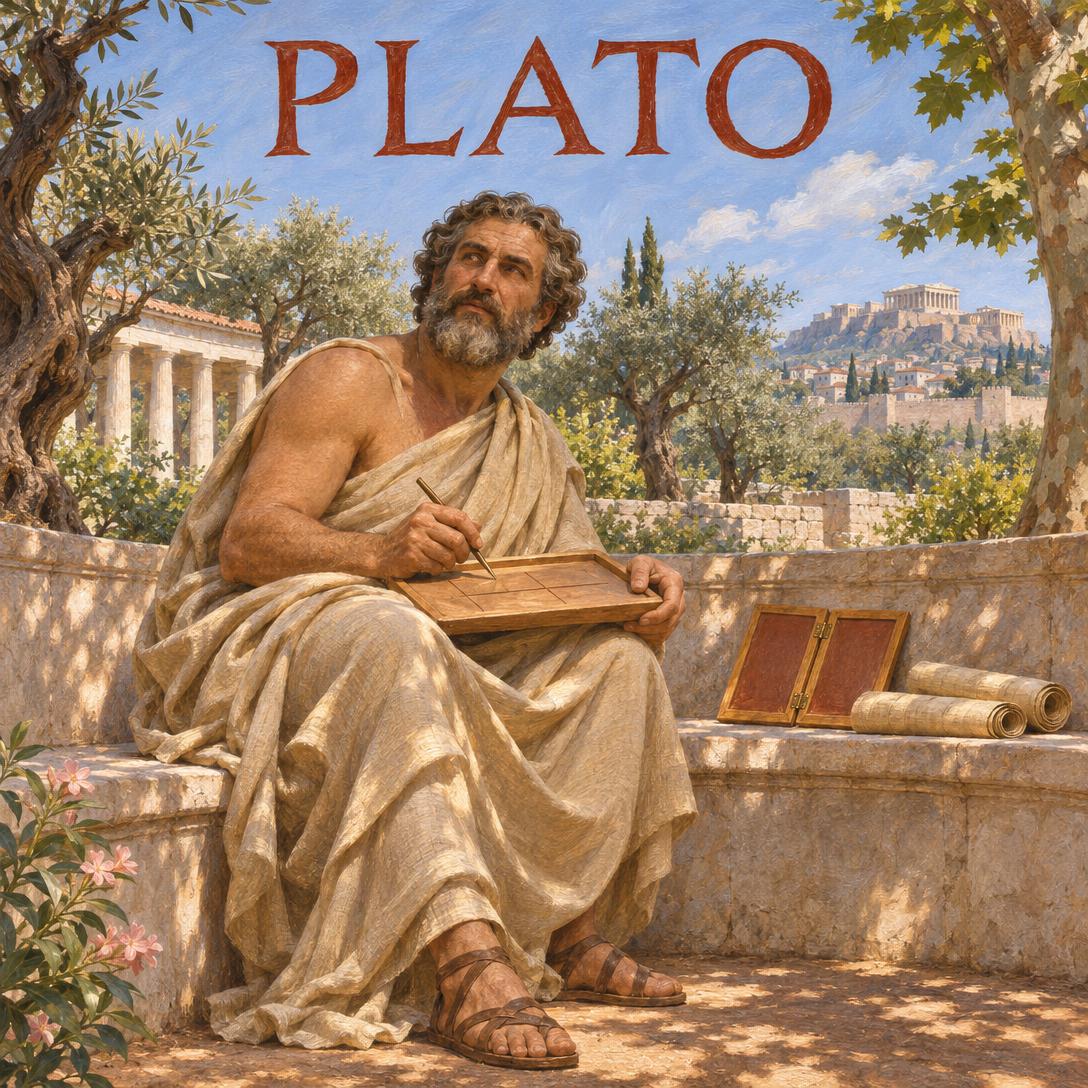
Roleplaying with Plato on Jenova lets you step into a living-world AI character simulation across four defining eras of the philosopher's life. Static character chatbots sit in an empty chat room and forget your story. This simulation puts you in conversation with Plato inside an active, evolving fourth-century BCE Greek world.
- ✅ Four canonical eras, from the grief of 399 BCE to the elder Academy
- ✅ A Plato who weighs your arguments honestly, yields to sound reasoning and rejects sophistry
- ✅ Unlimited memory and live world-state tracking across long campaigns
- ✅ Visions, letters and "what-if" storyline branches inside the narrative
Most people meet Plato as a name on a reading list. This simulation lets you meet the man instead, with his temper, his irony and his unfinished arguments.
Quick Answer: What Is the Plato AI Roleplay Experience?
Plato on Jenova is an interactive AI character roleplay simulation that places you in live conversation with the philosopher at four authentic points in his life, with era-specific knowledge, memory and a will of his own.
Key capabilities:
- Choose from four eras, or define a custom starting point in Plato's Greek world
- Plato speaks only from what he has lived, witnessed or learned in his chosen era, with no hindsight
- Unlimited memory keeps your bond, debates and promises intact across sessions
- Request in-world visions, letters and treatises, or fork the story into an alternate timeline
Plato's World & Roleplay Features
Plato (c. 429–347 BCE) is, in the Stanford Encyclopedia of Philosophy's words, "one of the most dazzling writers in the Western literary tradition." His dialogues are not conventional stories. According to the same entry, they are philosophical discussions among a small number of interlocutors, many of whom were real historical figures.
That makes him an unusually good fit for roleplay. His whole method is conversation.
Generic character bots tend to flatten him into a quotable sage. They blend his youth and old age into one voice, and they agree with whatever you say. Plato's life was shaped by events that changed his thinking: Socrates' execution, the attempt to educate a tyrant in Sicily, and decades leading a school.
| Static Character Chatbots | Plato on Jenova |
|---|---|
| Sits in an empty chat void | Lives in an active, evolving world with students, brothers and rivals |
| Blends all eras into one generic "wise philosopher" voice | Locks into the psychology and knowledge of one authentic era |
| Forgets earlier disclosures and plot twists | Unlimited memory and live state tracking |
| Agrees politely with everything | Independent personality and earned rapport |
This is the idea behind Plato's living-world simulation.
Authentic Canonical Eras & Custom Starting Points
Each era comes with its own age, temperament, setting and inner circle. Plato has no knowledge of anything that happens later, so the elder Plato's self-criticism does not leak into the grieving young disciple.
Cross-World Contact & Living-World Momentum
By default, your voice reaches Plato alone, like a clear voice on the still air that nobody else hears. He glances around, weighs the voice with Socratic curiosity, and carries on with his day. Students, kinsmen and court officials still interrupt, and he handles them in the scene first.
Independent Agency & Earned Rapport
Plato interprets what you say rather than obeying it. He is courteous at first, rewards candor and moral courage, answers empty provocation with dry irony, and opens up only as trust is earned. Your choices can bend history from the moment you enter, and the story has no forced ending.
Visions, Writings & Storyline Forking
You can ask to see a place such as the Academy grove or a geometric figure traced in sand. You can also ask for a letter or a draft treatise in Plato's voice. Fork lets you branch from any earlier moment into an alternate timeline.
Example prompts:
"Plato, is a city ruled by philosophers anything more than a beautiful dream?"
"Your brother Glaucon is walking toward you. What did he say when he found himself cast as Socrates' challenger?"
"Teach me why you think the soul has parts, and let me try to break your argument."
Try Plato free and see how the first conversation unfolds.
How to Roleplay with Plato
Step 1: Choose an Era or Define a Custom Starting Point
Start by picking one of the four eras, or propose your own entry into Plato's world. A custom start could be arriving as a traveler at the Academy gates, or talking with him aboard ship.
"I'd like to enter the era where Socrates has just been condemned."
Step 2: Speak Across Worlds and Let the Scene Breathe
Plato hears you as an unseen voice and replies in his own idiom. Speak naturally, ask questions and offer arguments. He answers in short, conversational turns and does not lecture. Interruptions from students or court officials unfold in real time.
"Forgive the intrusion. I'm not standing near you, but I can hear the cicadas behind your voice."
Step 3: Offer Counsel, Build Trust and Shape the Story
Challenge his definitions, propose political strategy, or share something about your own life. Plato weighs it honestly and refines or yields a point when your objection is sound. As trust grows, he may share private griefs. You can request an in-world vision or letter, or fork the storyline to explore a "what if."
"What if Crito's bribe had worked? Let's branch from that night."
Canonical Eras & Roleplay Scenarios
🏛️ The Academy at Its Height (c. 375 BCE)
Plato is in the Academy's olive grove, revising the central books of The Republic beside a sand tray of geometric figures. His brother Glaucon, the geometer Theaetetus and his nephew Speusippus are nearby.
This era suits you if you want to test the theory of philosopher-rulers face to face. Plato's own claim, as recounted in the Seventh Letter, is that cities will never find peace from their troubles until genuine philosophers rule or rulers philosophize. In this scenario you can press him on it directly.
- Challenge the "third wave" of philosopher-rulers
- Ask how geometry trains the soul's eye
- Hear what Glaucon makes of his own fictional role
⚖️ Dusk After the Verdict (399 BCE)
At twenty-eight, Plato sits in his family courtyard hours after Socrates was condemned. According to the Stanford Encyclopedia of Philosophy, Athens had launched the sacred ship to Delos the day before the trial, and no executions could take place while it was away. Xenophon puts that voyage at thirty-one days in 399, so Socrates remained alive in prison.
This is the rawest version of Plato. The scenario suits emotionally weighted conversation, such as grief, anger at the city, and whether Crito's plan to help Socrates escape has any hope. Plato is bound by what he knows at that moment and does not know how it ends.
👑 The Court of Syracuse (367 BCE)
On the island fortress of Ortygia, Plato tries to educate the young ruler Dionysius II while Dion pushes reform and court rivals whisper. The Seventh Letter later describes his Sicilian experience in his own words, including Dionysios' wish for Plato to praise him above Dion. Aeon's essay on Plato's Italian voyages frames that letter as the story of his three voyages to Syracuse.
Here you can play political adviser. Plato welcomes an unbought mind outside the factions, but he is also guarded. Rumors travel quickly in palace corridors.
- Advise him on handling a vain young autocrat
- Weigh Dion's austerity against court realities
- Try to steer the story somewhere history did not go
🌧️ Rainy Night with Young Aristotle (c. 355 BCE)
At seventy-two, Plato sits alone in the Academy's library beside a charcoal brazier, still turning over a sharp objection from Aristotle about whether Forms exist apart from particulars. The Stanford Encyclopedia's Aristotle entry notes that, in terms of philosophical influence, only Plato is Aristotle's peer.
This era is calmer and more self-critical. It suits slow, reflective conversation in which you help him test his own theory.
📱 Mobile Campaigns
Plato works on mobile too, so a long-running conversation can follow you through the day. Pick up an evening walk in the grove on your commute, then carry the same thread over to a desktop session later with memory intact.
Why AI Character Roleplay Works for Philosophy
Researchers and educators have been exploring AI roleplay as a way to learn by conversation. The University of Detroit Mercy describes AI role plays as simulations in which students engage with AI characters that challenge their reasoning and decision-making. Harvard Business Impact Education describes the AI setting the scene, giving objectives and helping students navigate a scenario.
Philosophy fits this format well because Plato's own writing is built on dialogue and counterexample. A conversation with the Plato simulation is a way to practice that kind of reasoning yourself.
FAQ
Is Plato free to use?
You can use Plato free with limited monthly usage. Plus is $20/month and gives 30× the free usage, custom model selection and no watermarks. Higher tiers add more usage, up to 2,300× at Enterprise. Usage resets monthly on your billing date, with the full limit available from day one.
How is Plato different from a generic character chatbot?
Generic character chatbots usually give one blended voice, sit idle between messages and agree with the user. This Plato roleplay locks into a specific era with its own age, setting, companions and knowledge limits. He has his own priorities, keeps long-term memory of your story, and warms to you only as trust is earned.
Which eras of Plato can I roleplay?
You can enter four eras:
- c. 375 BCE: the Academy, while he revises The Republic
- 399 BCE: the evening after Socrates' condemnation
- 367 BCE: the court of Syracuse
- c. 355 BCE: the elder scholarch sparring with Aristotle
You can also propose a custom starting point in his Greek world.
Can my choices change Plato's story?
Yes. Plato follows the history of his chosen era up to the moment you enter. After that, events evolve according to the world's own logic and your choices. He interprets what you say rather than obeying it, so influence is earned. You can also fork any earlier moment into an alternate timeline.
How does Plato remember our past conversations?
Plato keeps unlimited chat history and a live record of the story, including eras, relationships, places and open questions. Your outside-world context is isolated, so it does not bleed into the ancient setting. Jenova states that your data and chat history are never used to train AI models.
Does Plato work on mobile?
Yes. Jenova has full feature parity and synchronization across web, iOS and Android, so a conversation started on one device continues on the others. Voice input and read-aloud are supported.
Conclusion
A reading-list Plato is a name and a doctrine. The Plato in this AI roleplay is a grieving disciple, a hopeful architect, a cautious counselor and a self-critical elder, each with a different voice and each bounded by what he knew at the time. The shift from static character chatbots to a living, evolving world is what makes the conversation feel like a real exchange.
Whether you want to defend a counterexample in the Academy grove, sit with him the night Socrates was condemned, or advise him in Syracuse, try Plato now. Explore more at Jenova.
For Developers: Plato is available programmatically via the Jenova API, so you can integrate living-world philosophical roleplay into your application with a single agent API call. Full documentation →