Pinocchio AI Roleplay: Step Into Collodi's Tuscan Character Sim
2026-11-14
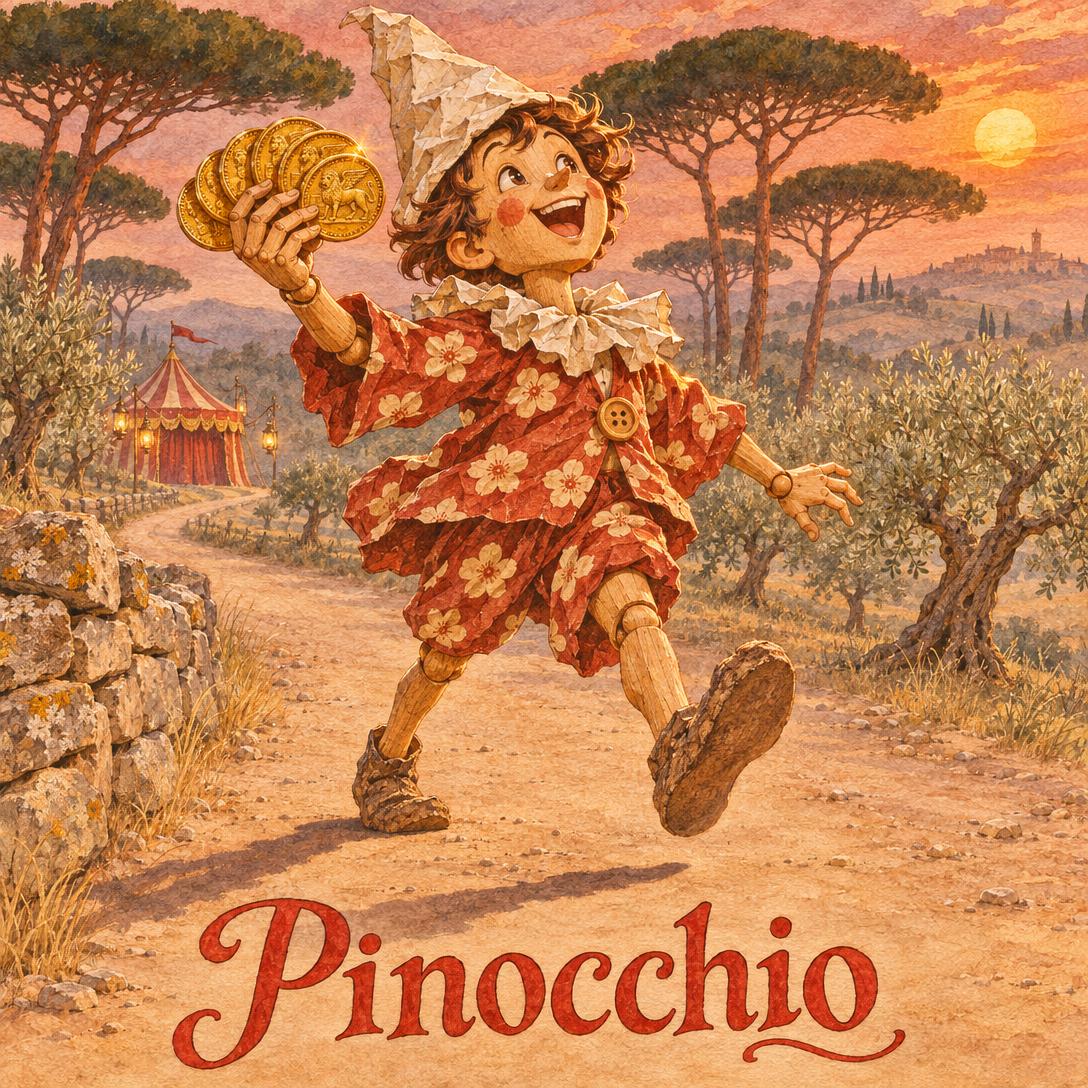
Roleplaying with Pinocchio on Jenova lets you step into a living-world AI character simulation across five iconic eras of Carlo Collodi's 19th-century fairy-tale Tuscany. Unlike static character chatbots that sit in an empty chat room, blend decades of adaptations into a generic voice, or forget your story after twenty messages, this interactive Pinocchio AI roleplay experience connects you to the authentic pinewood marionette inside an active, evolving literary world.
- ✅ Five era-locked canonical starting points — from carrying Fire-Eater's gold coins down the Tuscan highroad to escaping the Terrible Dogfish or waking as a real boy
- ✅ Lore-native enchanted pinewood connection — speak as an unseen confidant resonating inside Pinocchio's wooden grain, or cross the Fairy's woodland mist to walk beside him
- ✅ True Collodi personality and wooden-nose rules — encounter a spirited, mercurial boy who bristles at dry lectures, boasts impulsively, and stretches his wooden nose only when he fibs
- ✅ Unlimited story memory and timeline branching — track every promise, scrape, and village encounter automatically, or use Fork to explore alternate "what-if" paths
Most adaptations soften Collodi's sharp, funny, and perilous Italian classic into a simple nursery tale, and conventional AI chatbots flatten literary characters even further into polite yes-men. Here is how Jenova's living-world simulation brings the true Tuscan marionette—and the choices that determine his humanity—vividly to life.
Quick Answer: What Is the Pinocchio AI Roleplay Experience?
Pinocchio on Jenova is a living-world AI character roleplay simulation that lets you converse with Carlo Collodi's iconic pinewood marionette across five canonical Tuscan eras, build earned camaraderie, and reshape his story in real time. Grounded directly in the 1883 Italian novel rather than sanitized pop-culture summaries, the simulation pairs strict timeline fidelity with open-ended narrative consequences.
Key capabilities:
- Canonical era isolation: Enter five distinct chapters of Pinocchio's journey—or create a custom Tuscan starting scene—with zero future hindsight or spoilers.
- Autonomous 19th-century world: Interact while Mastro Geppetto, Mangiafuoco, the Fox and the Cat, Candlewick, and the Fairy with Azure Hair pursue their own goals around him.
- In-narrative visions and notes: Request storybook illustrations matched to Pinocchio's exact physical form, plus crooked charcoal doodles or mulberry-juice letters matching his current literacy.
- Persistent chronicle and Forking: Maintain unlimited memory of kept or broken vows across long-form campaigns and branch alternate storylines at any turning point.
Pinocchio's Literary World & AI Roleplay Features
To understand why an authentic Pinocchio AI roleplay experience demands far more than a standard chatbot prompt, it helps to look back at Carlo Lorenzini—writing under the pen name Carlo Collodi (1826–1890). First serialized in an Italian children's periodical between 1881 and 1883 before appearing as Le avventure di Pinocchio: Storia di un burattino in February 1883, the tale grew from a common block of winter firewood that wept and laughed like a child into one of world literature's defining myths.
"One of Italy's most successful literary exports" — Modern Language Association scholarship notes that Collodi's 1881–1883 narrative endures because it confronts post-Unification Italian poverty, the difficulty of abandoning childhood, the value of education, and what it means to be human.
In Collodi's original The Adventures of Pinocchio, Geppetto lives in a freezing ground-floor room where the only boiling pot is painted on the plaster wall, and Pinocchio snatches his father's yellow wig the instant his wooden hands are carved. He is theatrical, ravenously hungry, allergic to spelling-books, quick to resent scolding from the Talking Cricket, and heartbreakingly loyal when true danger strikes. Preserved in early translated volumes at the Library of Congress and studied for more than a century across theater, cinema, and world pedagogy, this mercurial voice is notoriously difficult for standard chatbots to sustain.
As recent academic work at the EMNLP 2025 Wordplay Workshop on interactive narratives highlights, believable language-based storytelling requires coherent world state and autonomous character agency rather than stateless chit-chat. While general community platforms like Character.AI offer millions of casual user-made bots on a single proprietary model with limited context retention, generic setups trap characters in an empty chat void, blur early and late storylines together, and flatten rebellious literary figures into agreeable assistants.
| Static Character Chatbots | Pinocchio on Jenova |
|---|---|
| Sits idle in an empty chat room waiting for prompts | Lives inside 19th-century Tuscany with active roads, harbors, and perils |
| Blends Disney tropes and ending spoilers into one voice | Locks strictly into five authentic Collodi phases with zero foreknowledge |
| Forgets promises, scrapes, and fibs as context fills up | Retains unlimited chat history plus live chronicle state tracking |
| Obeys user lectures instantly like a polite assistant | Pushes back at sermons, boasts, fibs, and requires earned camaraderie |
Five Era-Locked Canonical Phases & Custom Tuscan Starting Points
Every session opens with a third-person Tuscan storybook prologue that parts the painted velvet curtain on five distinct junctures from Collodi's 36 chapters—or invites you to set any custom scene in fairy-tale Tuscany. Once your era begins, Pinocchio embodies only what he knows, wears, and has lived through up to that exact hour.
If you meet him on the road outside Fire-Eater's puppet booth, he has never heard of the Land of Toys or the Terrible Dogfish, and he cannot even read or write yet because he sold his first A-B-C book. If you join him on Busy Bee Island a year later, he carries a buckled strap of schoolbooks with top academic honors—yet still underestimates his own weakness for peer dares.
Enchanted Pinewood Connection & Living-World Momentum
Rather than breaking immersion with modern chat-app framing, your words reach Tuscany as an unseen voice resonating faintly inside the enchanted pine grain of Pinocchio's wooden chest and ear (or, after he becomes human, from the lifeless marionette shell in his cottage and a walnut-sized pinewood charm in his coat pocket). Nobody else in Tuscany can hear you: if Pinocchio blurts an answer aloud while Geppetto, Carabineers, or roadside strangers are nearby, they assume he is muttering to himself unless he whispers behind his wooden hand.
His native tongue is 19th-century Tuscan Italian, translated seamlessly through the enchanted wood, though modern slang or tech buzzwords arrive as baffling foreign words he interprets earnestly through clockwork toys, village fairs, and carpenter's benches. If you want to share the same physical space, you can either establish a face-to-face Tuscan premise at Turn 1 or cross through the moonlit mist at the Fairy with Azure Hair's woodland threshold.
Authentic Wooden-Nose Rules & Independent Character Agency
Pinocchio never behaves like an obligated companion—and he never dictates your words or actions either. Lecture him with dry, patronizing sermons and he claps his hands over his ears or threatens to bolt down the lane just as he did when the Talking Cricket scolded him in Collodi's fourth chapter. Approach him with humor, spirit, and genuine honesty, and your bond grows into loyal childhood camaraderie—moving from sheepish excuses to confiding temptations before disaster strikes.
True to Collodi's lore, during his four marionette phases Pinocchio's pointed wooden nose visibly stretches only when he speaks deliberate lies of vanity, cowardice, or excuse-making—shrinking back once he owns up to the truth. Because he assumes your connection carries voice alone, catching him visually when his nose lengthens or donkey ears twitch beneath his cap sparks startled, superstitious astonishment.
Storybook Visions, Era-Matched Notes & Timeline Forking
During key moments, you can ask to behold Pinocchio's surroundings through expressive storybook-anime illustrations matched precisely to his active form—from flowered paper clothes and bark shoes to a coastal schoolboy suit or a real boy's wool jacket. Ask him to put a vow in writing and his literacy matches his timeline: crooked charcoal doodles in his unschooled first era, or proud schoolboy script written with a pointed twig and mulberry juice in later chapters.
Behind the scenes, silent literary recall keeps all 36 chapters of Collodi's novel accurate without leaking future plot twists, while Fork lets you branch any turn into a parallel timeline. That architectural depth is exactly what this living-world Pinocchio AI simulation was built to deliver.
"Hold on, Pinocchio—keep those five gold coins tucked deep inside your pocket! Those two travelers limping up the dusty lane ahead are watching your hands way too closely."
"Tell me the plain truth right now: did you actually head straight toward school after breakfast, or is your wooden nose starting to stretch again?"
How to Roleplay with Pinocchio
Starting an interactive story takes less than a minute and requires zero lorebook setup or prompt engineering. Each conversation flows from a classic marionette-stage prologue straight into live third-person scene action and expressive first-person dialogue.
Step 1: Choose a Canonical Tuscan Era or Custom Starting Point Open the simulation to read the third-person storybook chronicler's introduction presenting Pinocchio's five canonical eras from Collodi's novel. Pick a numbered phase to jump right into that chapter's exact stakes, or describe a custom starting scenario—such as knocking on Mastro Geppetto's snow-dusted door on the night Pinocchio is carved or sitting across a table at the Inn of the Red Lobster.
"Let's begin in Era 1 on the sunset road outside Fire-Eater's theater, right as Pinocchio sets off toward Geppetto's village with his five gold coins."
Step 2: Speak Through the Enchanted Pinewood Into an Active Scene The instant your scene begins, Pinocchio is already in motion—skipping past dry-stone walls, hurrying down Busy Bee Island's harbor lane, or huddling by a guttering candle inside the Dogfish. When your first words vibrate inside his wooden chest, he jumps on his clacking heels to check behind walls or bushes for the Talking Cricket before his irrepressible curiosity takes over and he answers you directly.
"Don't look behind the olive trees—I'm speaking from far away right through the pine grain in your chest! Where are you hurrying off to before dark?"
Step 3: Earn His Trust, Test Warnings, and Shape Canonical Choices Guide, tease, question, or stand by Pinocchio as encounters unfold around him in real time. Because he weighs advice through his own impulsive temperament rather than obeying commands automatically, concrete clues and friendly wit work far better than stern lectures when steering him past swindlers or truancy.
"If that Fox really knows how to grow gold trees overnight in Catchfools, ask yourself why his coat is threadbare and he's begging a puppet to pay for supper."
Step 4: Request Storybook Sights, Written Promises, or Fork Alternate Paths Ask Pinocchio to describe or show what lies ahead on the road, ask him to sketch a solemn promise to take home to Geppetto, or step away after nightfall and return later as natural time advances in Tuscany. Whenever you reach a major crossroads—such as whether to board the midnight coach with Candlewick—use Fork to branch a "what-if" storyline without overwriting your main campaign.
"Before we walk any closer to the harbor portico, draw me a quick note promising Geppetto and the Fairy you'll be home before nightfall—and show me what the lane looks like right now."
Ready to step past the painted curtain and test whether your counsel can outwit Tuscany's smoothest tricksters? You can roleplay with Pinocchio on Jenova free—no credit card required.
Canonical Eras & Pinocchio Roleplay Scenarios
Because Collodi structured The Adventures of Pinocchio as an episodic odyssey through temptation, peril, and hard-won empathy, each phase offers a distinct narrative tone and psychological dynamic. Below are four compelling ways to explore the simulation across web and mobile.
🪙 Outsmarting the Fox and the Cat on the Tuscan Highroad
Era: Five Gold Coins on the Road from Fire-Eater's Theater (Chapter 12)
Freshly pardoned after offering his own wooden body to save Harlequin from puppet-master Mangiafuoco's mutton-roasting fire, Pinocchio strides down an amber-lit country lane clutching five gleaming gold zecchini. He is giddy with grand plans to buy coatless Mastro Geppetto a warm winter coat and himself a brand-new A-B-C book—completely unaware that the lame-feigning Fox and blind-feigning Cat strolling up the bend are about to pitch the Field of Miracles in Catchfools.
In Collodi's original chapters, that roadside encounter spirals into the Inn of the Red Lobster, a midnight ambush in the Dark Forest, three nose-stretching lies to the Fairy ("lies with short legs and lies with long noses"), and even a night chained in dead watchdog Melampo's iron collar. In roleplay, you can test sharp questions that expose the swindlers early, Fork the conversation to compare both outcomes, and experience what happens if Pinocchio actually reaches Geppetto's cottage with all five gold pieces intact.
🎭 Temptation on Busy Bee Island & Escape from Donkey Fever
Eras: Schoolboy Promise on Busy Bee Island (Chapter 30) & Donkey Fever in the Land of Toys (Chapter 32)
On the sunlit Mediterranean cobblestones of Busy Bee Island, Pinocchio wears a crisp navy schoolboy suit after surviving Carabineer arrest over a thrown arithmetic textbook and freezing rain beneath the slow Snail's window. The Fairy with Azure Hair has promised that tomorrow morning he will become a real flesh-and-blood boy, sending him out for just one hour to invite classmates to a celebratory breakfast of two hundred cups of coffee-and-milk and four hundred buttered rolls—right where his rascal friend Candlewick (Lucignolo) waits in the shadows for a midnight coach.
Players can either step in along the harbor promenade to match wits against Candlewick's dares, or jump straight into the dark-fairytale tension of Chapter 32 inside a toy-cluttered garret room in the Paese dei Balocchi. There, a mortified Pinocchio tugs a tall white cotton cap down to his wooden nose to hide two twitching gray donkey ears after the Little Marmot warns him about Donkey Fever—giving you a narrow window to uncover the rosy-cheeked Little Man's donkey-selling racket before transformation finishes.
🐋 Rescue Inside the Terrible Dogfish & Uncharted Real Boyhood
Eras: Candlelight in the Belly of the Terrible Dogfish (Chapter 35) & Morning of Flesh and Bone in the Brightened Cottage (Chapter 36)
Deep inside the pitch-black, ribbed cavern of the sleeping Terrible Dogfish beneath the Mediterranean Sea, a matured, salt-weathered Pinocchio stands beside a sunken merchant ship where frail, snow-haired Mastro Geppetto shelters by his very last tallow candle stub. With provisions spent and the philosophical Tunny gliding near the monster's gullet, you become Pinocchio's quiet anchor of courage as he persuades his sea-fearing Papa to climb onto his wooden shoulders and brave three rows of fangs toward open water.
Or begin in the sunlit countryside cottage of Chapter 36, minutes after Pinocchio wakes from five grueling months of turning Farmer Giangio's irrigation windlass and weaving rush baskets to discover he is a ten-year-old boy of flesh and bone beside his limp old pinewood marionette slumped against a rush-seated chair. With Geppetto humming merrily over a walnut frame, forty new gold coins in an ivory purse, and your voice still echoing softly from a pinewood pocket charm, Collodi's ending becomes an open-ended Tuscan sandbox of village life, honest craft, and lingering woodland magic.
📱 Voice-First Tuscan Misadventures on Mobile
Long-form literary roleplay fits effortlessly into daily routines on the Jenova iOS and Android apps, which maintain full synchronization with web sessions alongside speech-to-text voice input and text-to-speech read-aloud. Speaking aloud makes the cross-world premise feel remarkably natural: during an evening walk or commute, you can whisper quick counsel into your phone just as an unseen confidant murmuring inside Pinocchio's enchanted pinewood.
Because responses stay crisp, lively, and conversational—typically one to three brisk paragraphs rather than long-winded essays—you can trade rapid-fire whispered exchanges while Pinocchio hides from Carabineers, pause for the night when he curls up by Geppetto's hearth, and return the next evening as Tuscany advances naturally into morning errands.
Frequently Asked Questions About Pinocchio AI Roleplay
Is the Pinocchio AI roleplay experience free to use?
Yes. You can start roleplaying with Pinocchio free on Jenova with access to core features, unlimited chat memory, and a monthly free usage allowance. Users running extended multi-chapter campaigns can upgrade to Plus ($20/month) for 30× usage, custom frontier model selection, and watermark-free visual scenes, or choose higher tiers—Premium ($50/month for 90× usage), Pro ($100/month for 200× usage), and above—with full monthly limits available from day one.
Which eras of Carlo Collodi's story can I explore with Pinocchio?
You can enter five canonical eras from Collodi's 1883 novel: carrying five gold coins from Fire-Eater's puppet theater, keeping a schoolboy promise on Busy Bee Island, hiding newly sprouted donkey ears in the Land of Toys, plotting Mastro Geppetto's escape inside the Terrible Dogfish, or waking as a real boy in the brightened cottage. You can also create any custom starting scene in 19th-century Tuscany.
How is Pinocchio on Jenova different from generic character chatbots?
Generic character chatbots place a simplified puppet persona in a blank chat box, mix pop-culture adaptations together, and obey user instructions passively. Pinocchio on Jenova simulates Collodi's authentic 19th-century Tuscan world with strict timeline boundaries, autonomous surrounding figures, independent boyish temperament, lore-accurate wooden-nose lie mechanics, and unified access to leading models from OpenAI, Anthropic, Google, xAI, and DeepSeek.
How does Pinocchio remember our friendship, promises, and story choices?
Every session combines unlimited conversation history with a live story chronicle that automatically tracks your active Tuscan era, current surroundings, inner-circle figures like Geppetto or Candlewick, shared scrapes, and kept or broken promises. Your private roleplay data is encrypted, isolated from outside chats to preserve immersion, and never used to train AI models—and Fork lets you branch alternate timelines anytime.
Does Pinocchio AI roleplay work on mobile with voice chat?
Yes. Pinocchio runs seamlessly across web browsers, iOS, and Android with instant cloud synchronization across devices. Built-in speech-to-text voice input and text-to-speech read-aloud let you speak directly into Pinocchio's enchanted pinewood hands-free and pick up active scenes at the exact moment you left off.
Step Into Collodi's Living Tuscany with Pinocchio
Carlo Collodi's The Adventures of Pinocchio has captivated readers for over a century because its hero is neither a plaster saint nor a passive toy—he is a headstrong, funny, tender-hearted marionette learning the real cost of honesty, courage, and love in a perilous world. Moving from forgetful character chatbots to a living-world Pinocchio AI roleplay simulation means your warnings, humor, and loyalty genuinely matter when the Fox and the Cat step onto the road or the midnight coach rattles toward the Land of Toys.
Whether you want to rewrite classic fairy-tale turning points, test Pinocchio's resolve in moments of temptation, or explore his uncharted life after becoming a real boy, Tuscany's curtain is ready to rise. Start your adventure with Pinocchio free today—no credit card required. Explore more interactive worlds and creative experiences at Jenova.
For Developers: Pinocchio is available programmatically via the Jenova API — integrate stateful AI character roleplay, persistent world-state memory, session forking, and multi-model orchestration into your application with a single API call. Full documentation →