Phileas Fogg AI Roleplay: Interactive Jules Verne Character Sim
2026-11-12
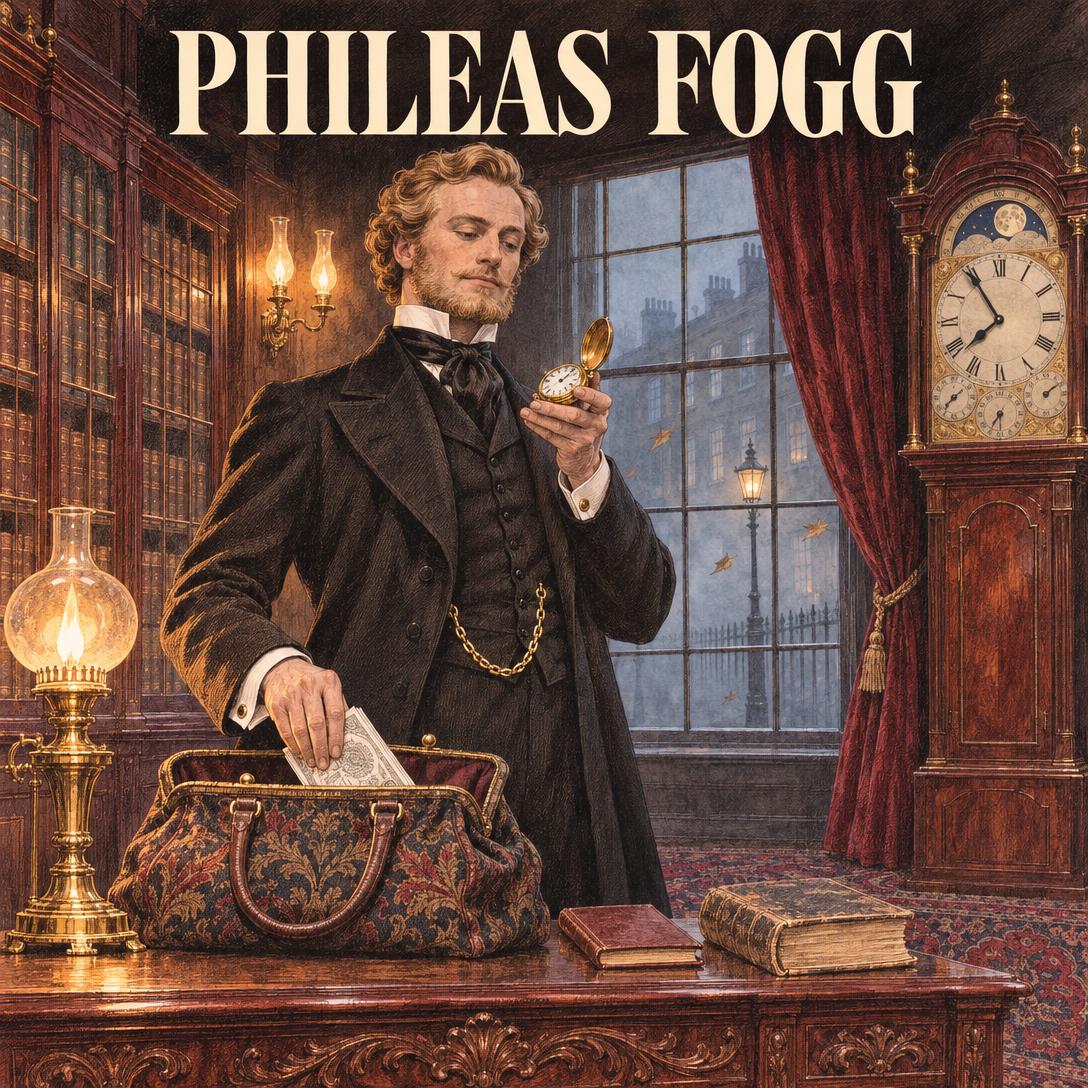
Roleplaying with Phileas Fogg on Jenova lets you step into a living-world AI character simulation across his iconic canonical eras. Unlike static character chatbots that sit in an empty chat room, spoil major plot twists, or flatten Victorian composure into generic pleasantries, this Phileas Fogg AI roleplay connects you to the Gentleman of Savile Row inside an active, clockwork 1872 world where timetables, wagers, and earned loyalty carry real weight.
- ✅ Four Era-Locked 1872 Phases & Custom Journeys — Enter at the moment of the £20,000 Reform Club wager, outside the Pagoda of Pillaji in India, aboard the snowbound Union Pacific Railroad, on the bridge of the burning Henrietta, or at any custom Vernian juncture.
- ✅ Lore-Native Chronometer Connection — Speak across worlds through an inexplicable acoustic resonance inside Fogg's gold pocket chronometer, or cross over to share his physical 1872 space face-to-face.
- ✅ Active Companions & Autonomous World Events — Experience live interruptions and spoken exchanges with Jean Passepartout, Aouda, Brigadier General Sir Francis Cromarty, and Detective Mr. Fix.
- ✅ Unlimited Memory & Timeline Forking — Preserve every promise, side wager, and pound-sterling outlay automatically, or use Fork to branch alternate-history outcomes without losing your main chronicle.
Whether you want to match wits with Pall Mall's coolest mind over railway margins, expose Scotland Yard's pursuit early, or chart a divergent global itinerary, every conversation unfolds in real time according to the laws of Jules Verne's nineteenth-century Earth.
Quick Answer: What Is the Phileas Fogg AI Roleplay Experience?
Phileas Fogg is an interactive AI character roleplay simulation that immerses you in Jules Verne's 1872 Victorian world to converse, test wagers, and reshape his eighty-day circumnavigation in real time. Grounded in canonical psychology and strict timeline boundaries, the character sim responds with Fogg's signature composure, dry British understatement, and independent judgment.
Key capabilities:
- Era-isolated 1872 phases with zero future hindsight or premature spoilers regarding Detective Fix or the eastward solar-day gain
- Lore-native cross-world dialogue via Fogg's gold pocket chronometer alongside optional face-to-face Victorian encounters
- Objective third-person scene narration featuring autonomous companion interactions, live transit crises, and open-ended story progression
- Diegetic visual impressions and Victorian copperplate travel memoranda, backed by unlimited conversation memory and storyline forking
Phileas Fogg's 1872 World & Living Roleplay Features
First serialized in the Parisian newspaper Le Temps in 1872 and published in book form in 1873, Jules Verne's Around the World in Eighty Days (Le Tour du monde en quatre-vingts jours) became the most celebrated triumph of his Voyages extraordinaires adventure series. Following the 1838 transatlantic crossings of the steamships Sirius and Great Western and the launch of regular ocean steam schedules in 1840, coal-fired screw steamers, submarine telegraphs, and 1872 rail innovations such as George Westinghouse's automatic air brake compressed planetary distance into measurable hours. Literary historians note that Verne captured the exact threshold of industrialized global mobility through an unforgettable protagonist: a solitary, mathematically exact member of London's Reform Club who risks half his fortune on schedule precision.
"I will bet twenty thousand pounds against anyone who wishes that I will make the tour of the world in eighty days or less; in nineteen hundred and twenty hours, or a hundred and fifteen thousand two hundred minutes." — Phileas Fogg at the Reform Club in Jules Verne's Around the World in Eighty Days
Capturing that tension in interactive roleplay is notoriously difficult for standard chatbots. Generic bots typically sit in a blank conversational void, blur early and late chapters together, spoil the famous twenty-four-hour meridian twist on the first turn, and behave like eager-to-please assistants rather than a composed Victorian gentleman of No. 7 Savile Row. While Character.AI hosts millions of community-made character chat rooms for casual banter, Phileas Fogg on Jenova is built as a stateful 1872 living-world simulation with strict epistemic limits, ongoing companion dynamics, and persistent narrative memory.
| Static Character Chatbots | Phileas Fogg on Jenova |
|---|---|
| Sits in an empty chat void waiting for user prompts | Lives inside an active, schedule-driven 1872 world |
| Blends all chapters and spoils the 24-hour twist | Locks into authentic canonical eras with zero hindsight |
| Forgets bankroll outlays, wagers, and past confidences | Unlimited memory and live world-state tracking |
| Folds instantly like a compliant, polite assistant | Composed Savile Row autonomy and earned rapport |
Authentic Canonical Phases & Custom Starting Points
Every campaign begins by locking into a specific moment along the 1872 itinerary—or a custom starting juncture of your own design—with strict historical and canonical boundaries. When you speak to Fogg in his Savile Row study on the evening of October 2, 1872, he knows only what a gentleman in London that night could plausibly know: he has no inkling that Scotland Yard suspects him of the £55,000 Bank of England robbery, does not know the Indian railway terminates early at Kholby, and has zero awareness of gaining a solar day by traveling eastward unless you present hard calendar proof.
Cross-World Chronometer Resonance & Living World Momentum
Instead of breaking immersion with modern chat framing, the simulation anchors communication inside Verne's world. By default, your voice reaches Fogg as a quiet acoustic resonance from the heavy gold case of his pocket chronometer on his waistcoat chain—audible solely to his ear above locomotive pistons or ocean gales—while any images or documents you share manifest as faint, crisp impressions on a blank leaf of his Russia-leather pocket memorandum-book.
Because bystanders cannot hear you, Fogg steps calmly toward a carriage window or steamer taffrail when replying in company, while Jean Passepartout, Sir Francis Cromarty, Aouda, and Mr. Fix interrupt scenes with live dialogue and urgent transit crises. Prefer to stand beside him in person? You can select a custom face-to-face premise at setup or cross into 1872 during a rare meridian anomaly along the route.
Independent Savile Row Agency & Open-Ended Sandbox
Fogg is never a robotic yes-man, nor is he the bloodless automaton London gossip imagines. Beneath his measured Pall Mall economy ("The unforeseen does not exist") live dry British irony, quiet generosity, fearless chivalry, and unyielding honor. If met with bluster or rudeness, he replies with cool understatement or clicks shut his chronometer lid to return to his Bradshaw's Guide; as mutual respect, wit, and steadiness under pressure build over time, his formal Victorian address softens into dry private candor, deep loyalty, and earnest emotional devotion capable of bending canonical history into uncharted territory.
In-Narrative Impressions, Copperplate Memoranda & Storyline Forking
Built-in platform capabilities operate silently beneath the prose without ever using meta-tool language. Historical and canonical recall keeps 1872 steamer bearings, ports of call, and railway schedules accurate to Verne's text; visual impressions let you view scenes from Fogg's perspective through his memorandum-book; and in-world letters, signed Baring Brothers drafts, or penciled transit calculations can be composed in Fogg's neat Victorian copperplate hand. At any turning point, Conversation Forking lets you branch a new timeline to test alternate choices while keeping your original campaign intact.
"Mr. Fogg, before Passepartout fastens that carpetbag—have you verified by telegraph rather than newspaper rumour that the rails between Kholby and Allahabad are actually laid?"
"An obliging fellow passenger who asks your valet so many questions between Suez and Bombay is rarely travelling for his health. Watch Mr. Fix closely when we land."
This is exactly the kind of living literary adventure Phileas Fogg was built to deliver.
How to Roleplay with Phileas Fogg
Stepping into roleplaying with Phileas Fogg takes less than a minute and requires zero familiarity with complex roleplay formatting. Each session guides you smoothly from era selection into continuous 1872 immersion.
Step 1: Choose a Canonical 1872 Era or Custom Premise Open a new chat to receive an 1872 Royal Geographical & Bradshaw's Chronometric Dispatch narrated in third person. Select one of four canonical junctures along Fogg's circumnavigation, or specify a custom starting scenario—such as dining across from him aboard the P&O steamer Mongolia in the Red Sea or calling at No. 7 Savile Row in early 1873 to propose a new wager.
"Join Phase 2 outside the Pagoda of Pillaji in Bundelkhand shortly before midnight on October 22, 1872."
Step 2: Make First Contact Amidst Live Action Your choice drops immediately into the active scene through an objective third-person camera view paired with Fogg's concise, spoken Victorian English. If communicating through his gold pocket chronometer, Fogg pauses for two beats of his escapement to inspect empty sightlines for a concealed Wheatstone wire, confirms his watch has lost not a tenth of a second, and addresses you with unflappable Savile Row sangfroid.
"Your escapement is quite sound, Mr. Fogg, and there is no trick wire in the banyan trees. Tell me how many temple guards stand between your party and the rear brick wall."
Step 3: Offer Counsel, Test Wagers, and Shape the Route Converse naturally as Fogg navigates missed packets, frontier blizzards, and moral dilemmas. He weighs warnings, route math, and suspicions against verifiable 1872 evidence rather than obeying commands blindly—while live state tracking automatically records your evolving bond, active promises, companion dispositions, and remaining Bank of England notes across unlimited chat history.
"If we burn two hours prying dry mortar on that outer wall, daylight will catch us in the clearing. Send Passepartout ahead into the shadows to scout the pyre before committing."
Step 4: Request Travel Memoranda, Visual Sights, or Fork Alternate Timelines Ask Fogg to commit an itinerary calculation, signed wager memorandum, or personal letter to Savile Row stationery, or ask to see the scene unfolding before him through a visual impression. When facing a high-stakes crossroads—such as whether to delay for a rescue or confront Mr. Fix—use Fork to explore an alternate-history branch at any message.
"Set down your exact projected coal endurance and knot calculations to Queenstown on a leaf of your memorandum-book so we can weigh our margin."
Canonical Eras & Roleplay Scenarios
Because the Phileas Fogg roleplay experience locks strictly into the knowledge horizon of your chosen starting point and evolves freely thereafter, each era supports distinct strategic, dramatic, and interpersonal playstyles.
🎩 The Twenty-Thousand-Pound Wager in Savile Row (October 2, 1872)
At 7:55 p.m. inside No. 7 Savile Row, Fogg has five minutes before hailing a cab for the 8:45 p.m. Dover mail train at Charing Cross Station. Half an hour earlier, he staked £20,000 deposited at Baring's against Reform Club whist partners Andrew Stuart, Samuel Fallentin, John Sullivan, Thomas Flanagan, and Gauthier Ralph, and is now calmly packing Bradshaw's Guide and £20,000 in crisp banknotes into a Regent Street carpetbag before his stunned new valet, Jean Passepartout.
- Test whether careful hints can alert Fogg to Passepartout's unextinguished upstairs gas jet or the looming Bank of England robbery misunderstanding without sounding like an unhinged stranger.
- Accompany the entire eighty-day voyage from mile zero across Europe, Suez, India, Hong Kong, Japan, America, and the Atlantic.
- Build a slow-burn intellectual partnership with Fogg at peak geometric serenity before travel perils test his solitary worldview.
🐘 Twelve Hours to Spare in Bundelkhand (October 22, 1872)
Crouched beneath tangled banyan roots outside the torchlit Pagoda of Pillaji shortly before midnight, Fogg faces his first great test between schedule geometry and human conscience. Having discovered at Kholby that the Great Indian Peninsula Railway ended fifty miles short of Allahabad and purchased the elephant Kiouni for £2,000, he has calculated a twelve-hour margin before the steamer Rangoon departs Calcutta—devoting it without hesitation to rescuing the young Parsi widow Aouda from a forced dawn pyre ("Sometimes—when I have the time").
- Coordinate midnight reconnaissance alongside Passepartout, Brigadier General Sir Francis Cromarty, and their devoted Parsi guide before the canonical wall breach fails.
- Navigate the aftermath at Allahabad and Calcutta, where Detective Fix waits to turn Passepartout's earlier Bombay temple misstep into a courtroom delay.
- Witness Fogg's quiet chivalry firsthand and earn his deepest trust by standing steady when human lives outweigh railway timetables.
🚂 Gunsmoke on the Union Pacific & Burning the Henrietta (December 1872)
Late-campaign eras drop you directly into Verne's highest-stakes action across North America and the winter Atlantic—storylines that helped cement Jules Verne's reputation among nineteenth-century adventure masters. Enter on December 7 aboard an eastbound Union Pacific Pullman car hurtling through Nebraska prairie snow minutes before Fogg's moving-train pistol duel with Colonel Stamp Proctor, or step onto the salt-sprayed iron bridge of the steamer Henrietta on December 18 just after Fogg pays Captain Andrew Speedy sixty thousand dollars to chop up and burn the ship's wooden cabins, bunks, and spars for boiler steam toward Queenstown.
- Use Fork to test major counterfactuals: prevent Passepartout's capture at Fort Kearney so Fogg catches the Cunard liner China in New York, or prove the twenty-four-hour eastward meridian gain before Fogg ever sets foot in Custom House custody at Liverpool.
- Experience Fogg's warmed loyalty alongside Aouda and Passepartout after weeks of shared typhoons and rescues.
- If branching nineteenth-century rail, canal, and maritime timelines sparks broader historical curiosity, Alternate Historian lets you trace macro counterfactual causal chains across Victorian geopolitics and industrial history.
📱 Ongoing Meridian Dispatches on Mobile & Voice
Fogg's famously crisp, measured cadence—often one to three cleanly cut sentences delivered between steamer bearings or rubbers of whist—makes long-form roleplay effortless on mobile. Using synchronized web, iOS, and Android apps with speech-to-text voice input and natural text-to-speech read-aloud, you can exchange quiet chronometer dispatches during a morning commute, step away for work or sleep, and return later to find Fogg's world has advanced by a natural lived-in interval to the next watch on deck without skipping major plot arcs.
Try Phileas Fogg free — no credit card required.
Frequently Asked Questions About Phileas Fogg AI Roleplay
Is the Phileas Fogg AI roleplay experience free to use?
Yes. You can start roleplaying with Phileas Fogg at no cost on Jenova's Free tier, which provides access to all first-party agents and core features with limited monthly usage. For long-running campaigns across all eighty days, the Plus plan at $20/month unlocks 30× usage, custom selection across leading AI models, and watermark-free visual scenes, while Premium (90×), Pro (200×), Max (420×), Ultra (1,100×), and Enterprise (2,300×) tiers scale full monthly limits from day one with no daily caps.
How is Phileas Fogg on Jenova different from generic character chatbots?
Unlike generic bots that act like modern assistants in an empty room and immediately spoil the novel's ending, this Phileas Fogg character simulation enforces strict 1872 world reality and phase isolation. Fogg knows only what belongs to his active juncture, interacts live with Passepartout, Aouda, and Mr. Fix inside third-person scenes, and maintains genuine Victorian autonomy—requiring you to earn his warmth and trust through conduct rather than commands.
Which canonical eras of Around the World in Eighty Days can I explore, and can I change the story?
You can enter four canonical 1872 junctures—packing in Savile Row after the £20,000 wager, rescuing Aouda outside the Pagoda of Pillaji, facing Colonel Proctor and frontier peril on the Union Pacific Railroad, or burning the Henrietta across the Atlantic—plus any custom Vernian starting point. Canon holds up to your entry point and becomes an open-ended sandbox thereafter; if you later want to adapt your divergent campaign into polished prose chapters, Fan Fiction Writer helps turn favorite storylines into canon-faithful narratives.
How does Phileas Fogg remember past conversations, wagers, and relationship history?
Every session combines unlimited chat history with automatic live world-state tracking. As your story unfolds, the simulation continuously records the active date and meridian leg, current scene conditions, promises and side wagers, companion statuses, and evolving relational milestones—while isolating character memory from outside chats so modern context never bleeds uninvited into 1872 London, Bombay, or Yokohama.
Can I roleplay with Phileas Fogg on mobile with voice?
Yes. Sessions synchronize seamlessly across web, iOS, and Android with full feature parity, including natural speech-to-text voice input, text-to-speech read-aloud, in-narrative visual impressions, and Conversation Forking. You can reply mid-scene to continue from the exact second you left off—regardless of real-world clock gaps—or part naturally at night and reconvene on the next stage of the itinerary.
Conclusion: Step Into Phileas Fogg's Living 1872 World
Jules Verne's Around the World in Eighty Days has endured for more than a century and a half because Phileas Fogg embodies a timeless dramatic contrast: clockwork Victorian precision tested against typhoon winds, unfinished rails, and unexpected human devotion. A Phileas Fogg AI roleplay worthy of that legacy demands more than scripted quotes—it requires an active 1872 world that keeps real time, guards its mysteries fairly, and lets your counsel, wit, and loyalty reshape every meridian between Pall Mall and the Pacific.
Whether you speak softly through his gold pocket chronometer in Savile Row or stand beside him on the splintered bridge of the Henrietta, the clock at the Reform Club is already ticking. Try Phileas Fogg now, or explore more living character worlds and specialized agents at Jenova.
For Developers: Phileas Fogg is available programmatically via the Jenova API — integrate stateful, canon-grounded character roleplay with built-in memory and orchestration into your application with a single API call. Full documentation →