AI Persona Memory Lorebook Generator: Build Worlds That Remember
2026-09-18
A lorebook that cannot remember is a wiki. A persona that cannot retrieve its own past is a prompt. In September 2026, novelists, game masters, and roleplay creators still lose canon because most generators write fluent entries and then forget who is wounded, what was stolen, and which faction is on high alert. Jenova functions as an AI persona memory lorebook generator: specialized agents build character bibles, location files, artifact records, and relationship maps—then keep that world state alive across sessions.
- ✅ Persistent, cross-session memory for personas, factions, and plot objects
- ✅ Private knowledge bases for lore bibles, model sheets, and world rules
- ✅ Domain agents for novels, games, comics, screenplays, and immersive roleplay
- ✅ Multi-model access so lore generation and continuity review can use different models
To understand why generation without memory fails, it helps to look at how lorebooks actually work—and where keyword injection still drops the living parts of a world.
Quick Answer: What Is an AI Persona Memory Lorebook Generator?
An AI persona memory lorebook generator is a tool that creates character, location, and faction entries, then stores them as retrievable world memory so stories and roleplay stay consistent over time. It is not a one-shot bio writer. It is a living canon.
Key capabilities:
- Generate personas, artifacts, locations, and factions from a brief or an existing bible
- Hold traits, vows, inventory, and current status in persistent memory instead of a vanishing chat window
- Keep the same world attached while you draft in Manga Creator, a screenplay, or a game design thread
- Map relationships so a stolen drive, a wounded mercenary, and an ally in the slums stay connected
Why Lorebooks Fail Without Persona Memory
Writers already treat generative tools as part of production. The AI book writing market was valued at $27.0 billion in 2025, while self-published titles reached 3.5 million in the same year. Volume is not the bottleneck. Holding a world together is.
But building a usable lorebook is frustratingly difficult:
- Keyword injection only fires when the exact name appears
- Token budgets punish rich worlds and force you to delete canon
- Static bios never update current status
- Personas, artifacts, and locations drift into separate documents
- Relationship graphs exist in the author’s head, not in the model
Keyword injection is not memory
Character.AI’s Lorebook is explicit about the mechanism: each entry has keywords, and when a keyword comes up in conversation, the character gets that entry. NovelAI’s Lorebook works the same way—activation keys in recent context insert supplemental text. That is retrieval, not remembering.
If a scene never names “Aethelgard Tower,” the fortress on high alert never enters the prompt. If a character alludes to “the wound” without the scar’s keyword, the model invents a different injury. A 2025–2026 survey of agent memory research treats this gap as structural: RAG-style lookup, conversational context, and true agent memory are different systems. Lorebooks that only search for keys are the first of those, not the last.
Personas, artifacts, and locations drift apart
A mercenary recovering from a shoulder wound, a stolen encrypted drive, a fortress on high alert, and a netrunner hiding in the slums are one plot. In most tools they become four files. Creators on platforms such as SillyTavern still debate whether character data belongs in the persona card or in world-info hacks—because the products split “who someone is” from “what the world knows.”
An AI persona memory lorebook generator has to treat those records as one graph. Otherwise the protagonist heals off-page, the MacGuffin respawns, and the ally forgets why she is in hiding.
Token budgets punish rich worlds
Lorebook guides warn that a smaller set of well-crafted entries outperforms a bloated dump, because every active entry consumes context. NovelAI even exposes token budgets, reserved tokens, and trim direction so entries can be cut when they do not fit.
That is the hidden tax of keyword lorebooks: the more world you write, the more you must leave out of the scene. Memory that lives outside the sliding window—then retrieves only what the scene needs—is the design that agent-memory research argues for: factual memory, experiential memory, and working memory as separate functions, not one stuffed prompt.
Current status is missing from static entries
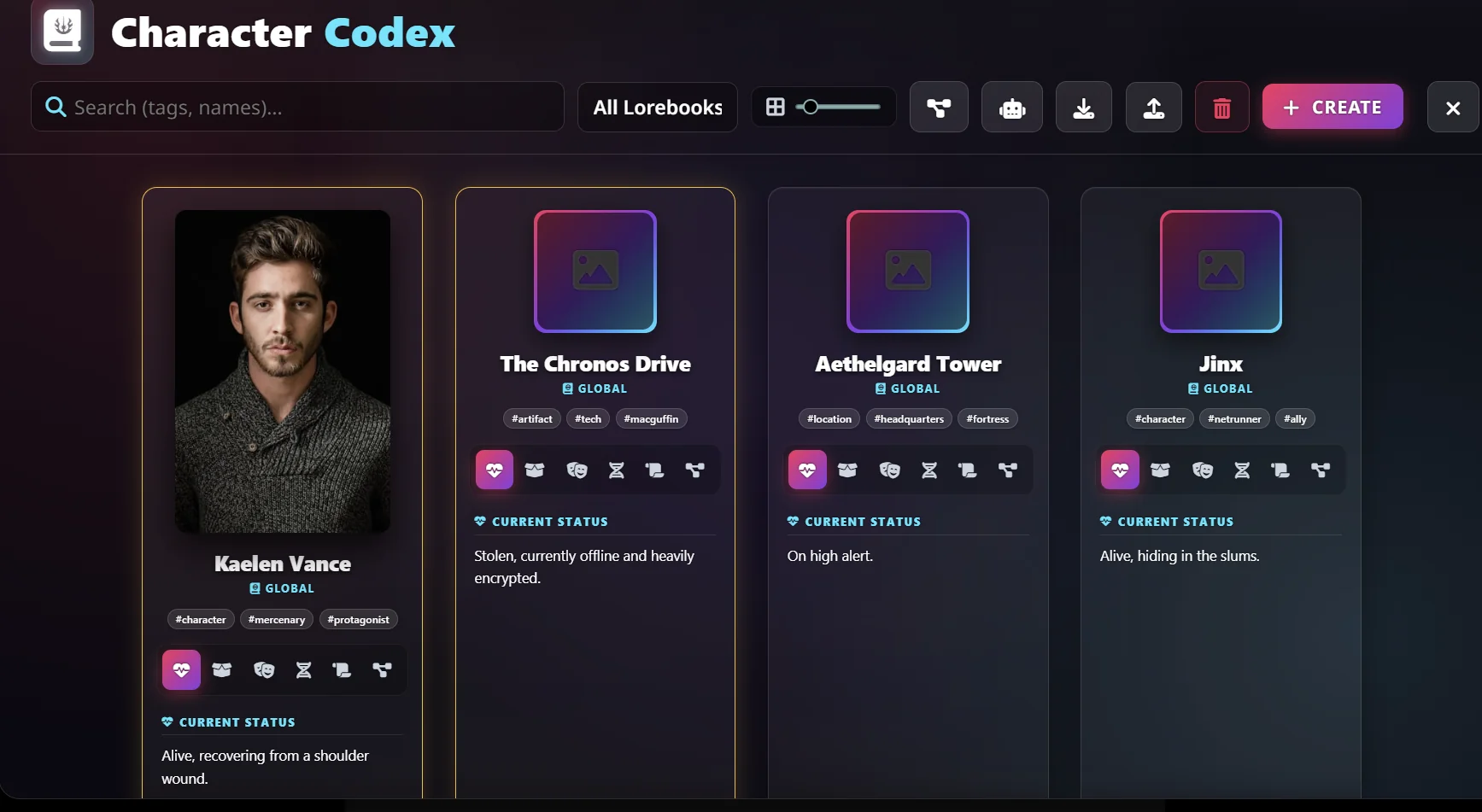
A biography says Kaelen Vance is a mercenary protagonist. A living lorebook says he is alive, recovering from a shoulder wound. Status is the difference between canon and a character sheet frozen at creation.
Roleplay communities feel this first. Character.AI’s own product framing admits that, until lorebooks, everything a character knew had to fit inside its definition. That definition rarely includes “stolen, currently offline and heavily encrypted.” Plot state changes every scene. If the generator cannot update it, players will.
Generation without a relationship graph
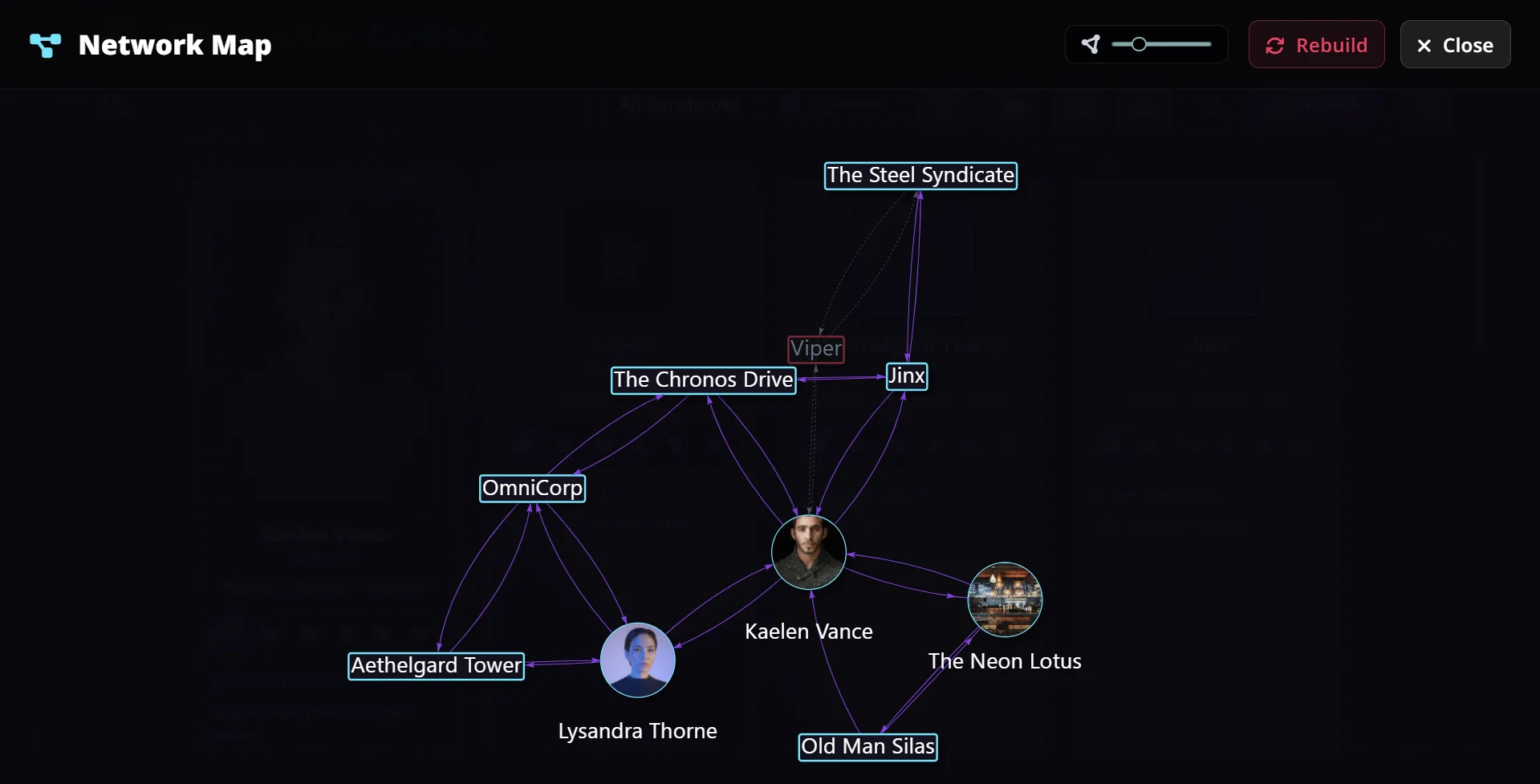
Worldbuilding roundups still rank keyword-driven lorebook fiction tools as a category of their own. Generation is solved enough to be a product feature. What remains unsolved is the map: who reports to OmniCorp, who sits in the Steel Syndicate, who drinks at the Neon Lotus, and which dotted line is a betrayal.
Cambridge work on Homo Promptus describes generative tools as external memory—authors already offload recall to machines. Offloading a list of names is easy. Offloading a living social graph is the actual job of an AI persona memory lorebook generator.
$22.21 billion — Generative AI market in 2025, with a projected climb toward the 2030s
90% — Content marketers expected to use AI in 2025, a reminder that fluent generation is now default—not a differentiator
This is exactly what Jenova was built for: agents that generate the bible and then remember it.
The Jenova Solution
Jenova does not treat a lorebook as a plugin on a generic chatbot. It gives you domain agents with persistent memory, document-grounded knowledge bases, and the ability to keep one world attached while you generate personas, draft scenes, and update status.
While NovelAI and Character.AI specialize in keyword-triggered world info, Jenova agents keep unlimited conversation history and cross-session memory, so a scar recorded in week one still constrains week twelve—even if nobody typed the keyword.
| Traditional lorebook workflow | Jenova |
|---|---|
| Write entries, then hope keys fire | Persistent memory plus an attached lore bible |
| Persona card separate from world info | Characters, artifacts, locations, and factions in one working thread |
| Static bios that never update | Current status, inventory, and relationship state that can change |
| Token budget fights your own canon | Retrieve what the scene needs without pasting the whole wiki |
| One general model for every medium | Game, manga, screen, and roleplay specialists on the same world |
Narrative identity: series bibles and episode knowledge
Film Screenwriter is built for concept, outline, draft, and revision—structure, dialogue, and character development in the same thread. Load the lorebook once. Ask it to generate missing supporting-cast entries, then flag any line that violates established knowledge.
For vertical series, Microdrama Screenwriter has to hold a person across 60–100 short episodes. A forgotten secret is not a continuity nit; it is a broken paywall arc. That format needs persona memory, not a fresh chat per episode.
Visual worlds: manga, comics, webtoons, and picture books
Manga Creator is designed for panel flow and a consistent art style from one-shots through long serialized runs. The lorebook here is visual as well as textual: costume language, scars, age, and silhouette.
Comic Creator does the same job in sequential Western layouts. Webtoon Creator adds full-color continuity for vertical scroll, where a wardrobe error is visible for an entire thumb-stop. Children's Book Creator treats recurring-cast art as a product requirement: the same child, same coat, spread after spread.
Games and living simulations
Game Designer Assistant supports brainstorming, systems notes, documentation, and concept art. Use it as the generator for faction dialects, item stats, and location files—then keep those documents in-thread so production does not invent a second version of the hero.
If you need the world itself to stay honest, Civilization runs a living political simulation where rivals remember slights. College Life does the social version: friendships and fallout that should not reset when you close the tab. The Mansion is the puzzle-box version of the same idea—rooms, secrets, and a protagonist who should not forget how they arrived.
Interiority: personas you can actually check
When the question is “would this person keep this secret?”, Personality Analyzer synthesizes Big Five, MBTI, Enneagram, and attachment patterns into a profile you can store beside the lore entry. Pair it with MBTI Personality Guide when you are verifying type rather than decorating a bio with four letters.
Language roleplay is a stress test for the same machinery. Learn Russian Through Roleplay is built around unlimited memory and character consistency so the scene partner does not become a new stranger every lesson. Learn English Through Roleplay uses the same immersive pattern: the persona has to stay the persona, or the practice stops feeling real.
Specialized AI Agents for Persona Memory and Lorebooks
An AI persona memory lorebook generator is most useful when the generator speaks the medium you ship in. These are the agents writers and designers typically open in the same month they start a world.
Game Designer Assistant — factions, items, and setting docs
Game Designer Assistant sits where writing, systems, and visual development meet. Ask it to generate a location bible, three faction dialects, and an artifact with clear rules—then keep those files attached so later systems notes cannot contradict them.
- Character and faction bibles as working documents
- Item and location entries that include current status, not only origin myths
- Concept-art direction tied to gameplay role so the silhouette matches the kit
If you also need sequential pages of the same cast, Comic Creator can take the locked persona into issue format without inventing a second costume language.
Film Screenwriter — knowledge walls and ensemble voice
Film Screenwriter walks a script from logline through revision. Use it as the prose half of your lorebook: generate supporting-cast entries, then audit “who knows what” before a leak wrecks act one.
- Scene-level motive and knowledge checks against the bible
- Voice samples stored in-thread instead of a new paste every act
- Outline-to-draft continuity for ensembles that share one world
Microdrama Screenwriter applies the same discipline when the story is sliced into dozens of short episodes and a single forgotten keyword can collapse a season.
Manga Creator — serialized faces that cannot wander
Manga Creator is a personal mangaka for complete stories, from one-shots to long epics. The lorebook is the style lock: panel grammar, costume language, and a face that still belongs to chapter one when you reach chapter fifty.
- Style lock across pages and volumes
- Character sheets translated into sequential pages
- Continuity notes you can interrogate mid-arc
Webtoon Creator and Children's Book Creator extend that demand into full color and picture-book spreads, where a drifting haircut is a product defect.
Personality Analyzer — the interior of the persona card
Personality Analyzer is the generator for interiority. A lorebook entry that lists “stoic mercenary” is not a person. A trait map you can check dialogue against is.
- Multi-framework trait maps (Big Five, MBTI, Enneagram, attachment)
- Dialogue audits against the profile
- Growth arcs that change a person on purpose, not by accident
Learn Russian Through Roleplay — memory as the product
Learn Russian Through Roleplay is built for unlimited scenarios, unlimited memory, and character consistency. It is a working demonstration of persona memory: if the scene partner forgets the park, the lesson fails.
- Long-running scene partners instead of disposable bots
- Relationship consequences that persist overnight
- The same immersive pattern as Learn English Through Roleplay when you want the world in another language
Try Jenova free — no credit card required.
How to Generate a Living Lorebook
You do not export a static JSON file and hope the next chat finds it. You attach canon, generate the missing entries, and keep working in one memory-bearing thread.
Step 1: Load whatever canon already exists Attach bios, maps, model sheets, and relationship notes as a private knowledge base. If you have nothing yet, start with a premise and a cast list. The agent should be able to quote the scar, the vow, and the forbidden word without a re-paste.
"Here is the premise, four names, and a list of facts nobody knows until chapter 6. Treat these as canon. Generate a lorebook with personas, locations, artifacts, and factions."
Step 2: Generate entries as a graph, not a pile Ask for characters, locations, items, and factions in one pass, then require explicit links: who owns the tower, who stole the drive, who is hiding and why. This is the difference between a wiki dump and an AI persona memory lorebook generator.
"Create lorebook cards for Kaelen Vance, Jinx, the Chronos Drive, and Aethelgard Tower. Include tags, current status, and how each card connects to the others."
Step 3: Lock personality so voice does not genericize Run the lead through Personality Analyzer or verify type with MBTI Personality Guide. Store that profile next to the bio so later scenes cannot turn a stoic captain into a helpful tutor.
"Build a trait map for Kaelen. He should not over-explain, joke about the wound, or trust OmniCorp. Flag any generated dialogue that violates this."
Step 4: Draft in the agent that matches the deliverable Open Game Designer Assistant for systems docs, Film Screenwriter for script, or Manga Creator for pages. Medium-specific agents catch medium-specific drift—speech on the page versus silhouette in a panel.
"Using only the attached lorebook, draft the alley scene. Jinx is hiding. Kaelen’s shoulder is not healed. Do not let anyone treat the Chronos Drive as recovered."
Step 5: Update status, then keep the same thread After the scene, write the new current status back into the bible: stolen, on high alert, trust damaged. Do not start a clean chat for the next chapter. Persistent history is how a relationship that turned in the slums stays turned on Wednesday.
"Update current status: Chronos Drive still stolen and encrypted. Aethelgard Tower remains on high alert. Kaelen is alive, recovering. Continue from there—no recap dump."
Results and Use Cases
📊 Cyberpunk novel with a living object bible
Scenario: A writer is 40,000 words into a heist story. The protagonist is wounded, the MacGuffin is offline, the fortress is on alert, and an ally is in hiding. Those four facts must survive every chapter.
Traditional approach: A spreadsheet of “current status,” keyword lorebook entries that only fire when names are typed, and a late reread that finds the drive in two places at once.
Jenova: Game Designer Assistant and Film Screenwriter share one attached bible. Status is part of the entry, not a sticky note.
- Artifacts and locations update when the plot moves
- Supporting cast does not forget why they are in the slums
- Relationship maps stay visible instead of living only in the author’s memory
💼 Ensemble screenplay under deadline
Scenario: A writer is turning a pitch bible into a feature with six speaking roles. Two characters share a secret; one of them cannot know it in act one.
Traditional approach: Color-coded scripts, a “who knows what” sheet, and a table read that exposes leaks.
Jenova: Film Screenwriter keeps the lorebook in-thread and audits knowledge, motive, and voice. Microdrama Screenwriter uses the same discipline when the story is sliced into dozens of short episodes.
- Knowledge walls that survive rewrite
- Distinct speech patterns per role
- Faster continuity passes than a full human reread of every draft
🎮 Indie game preproduction: hero, factions, NPCs
Scenario: A small team needs a protagonist kit, three faction dialects, and location files that will not contradict the combat fantasy.
Traditional approach: Wiki pages nobody updates, concept art that ages the hero between mood boards, NPCs who all sound like the designer.
Jenova: Game Designer Assistant holds systems and character docs together. Civilization can stress-test whether factions actually remember slights. College Life is the social sandbox when the design is about relationships rather than nations.
- Silhouette and kit locked before outsourcing
- Faction language that stays internally consistent
- A paper trail production can actually follow
📱 Mobile roleplay that remembers last night’s status
Scenario: On a commute, you continue a scene where the ally is still hiding and the protagonist’s shoulder is not healed. The next line has to honor location, injury, and trust—not reset to cheerful small talk.
Traditional approach: Screenshot the last reply, paste a recap, hope the model cares.
Jenova: A long-running thread on web or mobile keeps the incident. Learn English Through Roleplay or Learn Russian Through Roleplay can stay in character while you practice, because the scene partner is not allowed to become a new person.
- Relationship consequences that persist overnight
- Full feature parity across phone and desktop
- Speech-to-text when you cannot type a careful recap
FAQ
What is an AI persona memory lorebook generator?
An AI persona memory lorebook generator creates character, location, faction, and item entries, then keeps them as retrievable world memory so later scenes do not contradict canon. On Jenova, that work lives inside specialized agents with persistent memory and attached lore documents, rather than in a one-off prompt or a keyword-only wiki.
Is Jenova free to use for lorebook and persona work?
Yes. Jenova has a free tier with core features and limited monthly usage, and you can start without a credit card. Higher tiers increase usage if you run long series, large knowledge bases, or heavier visual passes. Continuity work is possible on free usage; volume is what you pay to scale.
How is this different from NovelAI or Character.AI lorebooks?
NovelAI and Character.AI inject keyword-triggered entries into context—excellent for lookup, limited for living status. Jenova agents keep cross-session memory, accept a private bible, and specialize by medium, so Manga Creator can hold a face while Film Screenwriter holds a knowledge wall. Generation and memory sit in the same thread.
Can it generate factions and locations, not just character bios?
Yes. A usable lorebook includes side characters, locations, items, events, factions, and rules—the same entry types Character.AI describes for Lorebook. Ask the agent for tagged cards, current status, and a relationship map so the fortress, the stolen drive, and the ally in hiding stay one plot.
Does an AI persona memory lorebook generator work on mobile?
Yes. Jenova is built for web, iOS, and Android with synced settings, so a lore thread you started at the desk is the same thread on the train. That matters for roleplay and for capturing a status change the moment the scene moves.
Will the lorebook stay perfectly consistent without a human editor?
No honest tool should promise that. Models still hallucinate, and research on agent memory exists because recall is an engineered system, not a given. Jenova reduces drift by persisting state and grounding in your bible. Final canon still belongs to the author.
Keep the World That Remembers
Lorebook generation without persona memory produces beautiful files that the next scene ignores. Keyword injection misses the wound nobody named. Token budgets delete the faction you spent a weekend writing. Status freezes at character creation.
An AI persona memory lorebook generator is the discipline of building the bible and then living in it: personas, artifacts, locations, and the graph that binds them. Jenova puts that discipline in the agents you already need to finish the work—Game Designer Assistant for worlds that hold, Film Screenwriter for voices that hold, Manga Creator for faces that hold, Personality Analyzer for interiors that hold. Load the sheets. Generate the missing cards. Update current status. Keep the thread.
Explore the full agent library at Jenova.
For Developers: Persona memory, lorebook generation, and world-state tracking in this article are available programmatically via the Jenova API — integrate living character bibles into your application with a single API call. Full documentation →