AI Pen Pal: Practice Spanish Through Daily Conversation
2026-09-12
Learn Spanish Through Roleplay helps you build usable Spanish by texting an AI pen pal that stays in character, remembers your life, and turns every exchange into practice. While flashcard streaks stall and classrooms go quiet when it is your turn to speak, this AI gives you unlimited, low-pressure conversation you can start on your phone. As of September 2026, more learners want daily dialogue than another isolated drill.
✅ Unlimited Spanish conversation without booking a tutor ✅ Persistent memory of your stories, level, and recurring mistakes ✅ Same thread on web, iOS, and Android ✅ Free to start—no credit card required
Apps sell vocabulary. Fluency comes from using it with someone who writes back. To understand why an AI pen pal matters, it helps to look at why speaking practice is the part of language learning people avoid.
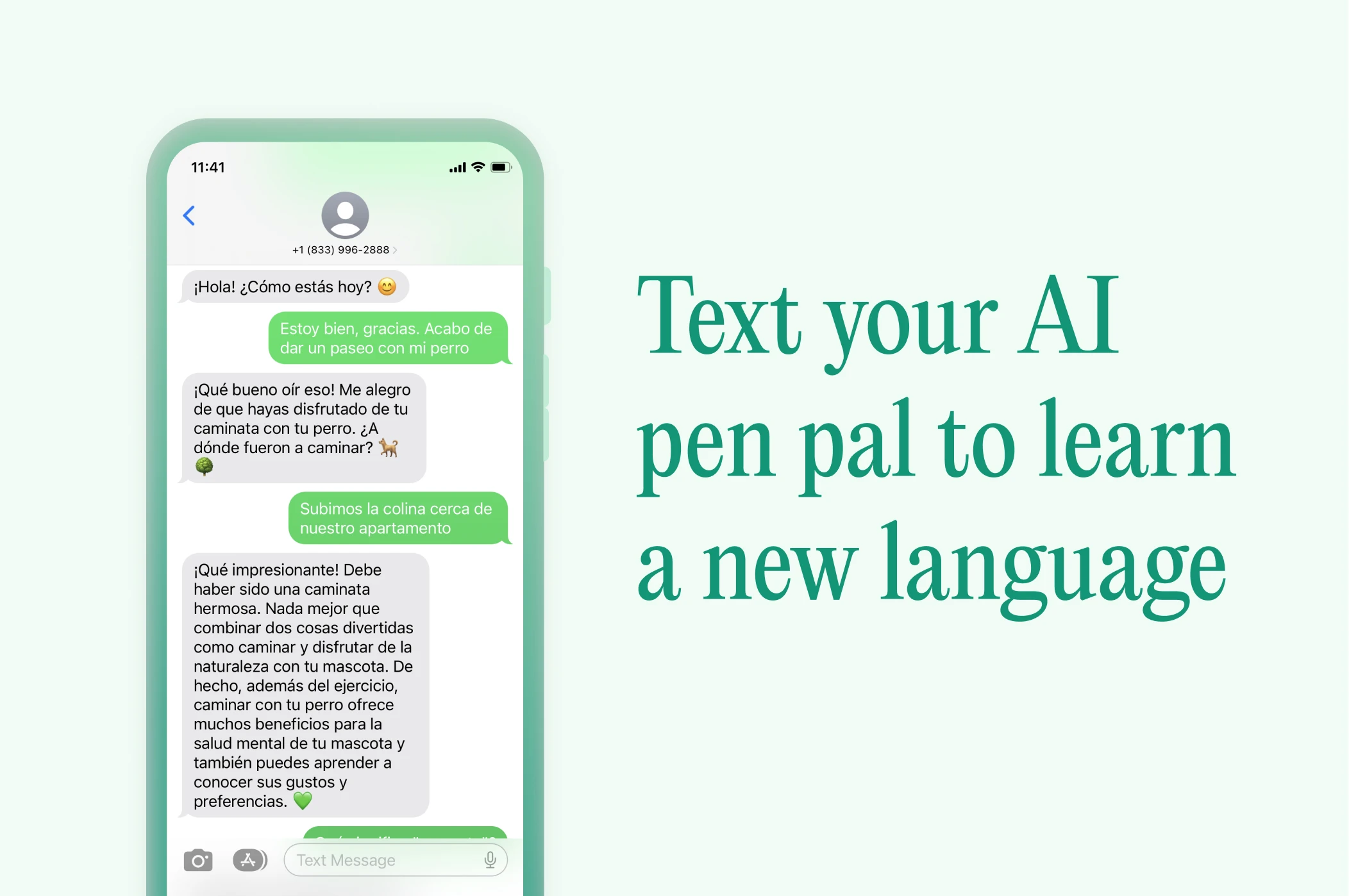
Quick Answer: What Is an AI Pen Pal?
An AI pen pal is a conversational language partner that texts with you in your target language so you build vocabulary, grammar, and confidence through daily dialogue. It is practice with a consistent correspondent, not a quiz and not a one-off chatbot session.
Key capabilities:
- Immersive Spanish roleplay that feels like messaging a friend
- Corrections woven into the conversation instead of a red-pen dump
- Memory of your level, interests, and the stories you already told
- The same pen-pal thread on a laptop or a phone between errands
Why Language Learners Never Get Enough Conversation
People do not fail Spanish because they never met a verb chart. They fail because they rarely use the language with someone who replies. Second-language research has long treated conversational interaction as central to acquisition, not a bonus activity after the “real” studying is done (Taylor & Francis). Conversation practice is where vocabulary stops being a list and becomes something you can retrieve under pressure (Learnlight).
Demand for that kind of practice is not small. The online language learning market is already a large, fast-moving category:
$24.39 billion — Online language learning market size in 2026
15.83% CAGR — Projected growth of online language learning from 2026 to 2031
Self-paced apps still take most of the revenue. Live conversation is where growth is concentrating—and where most learners still cannot get enough reps.
56.35% — Share of 2025 online language-learning revenue from self-learning apps
21.25% CAGR — Forecast growth for tutor-led live instruction through 2031
But getting reliable conversation is frustratingly difficult:
- Classroom speaking turns are short, public, and easy to dodge
- Human exchanges need matching time zones, similar levels, and social energy
- Vocabulary that looked easy on a quiz disappears the moment you have to reply
- Generic chatbots forget yesterday’s story and slip back into English
- Anxiety makes people skip the one activity that would help most
Speaking Anxiety Beats the Textbook
Foreign language speaking anxiety is not shyness as a personality trait. It is a specific freeze around retrieving words, being judged, and performing in real time. Open University research published in Language Teaching found that vocabulary retrieval is the primary anxiety trigger for language students—not a lack of interest in the language.
The same study shows the cost is participation, not talent. Students with declared mental health conditions scored similarly to peers when they submitted work, but they were far less likely to complete spoken tasks:
59% vs. 72.6% — Completion rate for interactive spoken assignments among students with mental health conditions versus peers
The researchers argue for AI-powered practice environments that let people speak without the stacked pressure of a tutor, a classmate, and a grade. An AI pen pal is that environment in the form people already use: a text thread.
Apps Drill; They Rarely Correspond
A streak is not a conversation. Market data also flags low course-completion and high churn as a drag on the category. That pattern matches what learners already know: tapping the right multiple choice answer does not prepare you to text a landlord in Spanish or tell a friend what you did after work.
Spanish is one of the fastest-growing language segments, which makes the conversation gap more expensive, not less.
20.20% CAGR — Forecast growth for Spanish courses in online language learning through 2031
You can finish a unit on the preterite and still be unable to narrate yesterday. The missing piece is a correspondent who keeps the language in motion.
Human Pen Pals and Tutors Are Hard to Sustain
Tutors help. They also cost money, require a calendar, and make every mistake feel like a performance. Human language exchanges can be excellent and still collapse under scheduling, uneven motivation, or the awkwardness of correcting a stranger.
Conversational AI is useful here because it can offer speaking practice with individualized feedback without a booking window (ScienceDirect). The design question is whether the partner remembers you, stays in the target language, and feels like a person you would actually text—not a search box with a sombrero.
This is exactly what Learn Spanish Through Roleplay was built for.
Why Learn Spanish Through Roleplay
Learn Spanish Through Roleplay is an AI pen pal for Spanish: immersive scenarios, a consistent correspondent, and practice that sticks because the conversation is about your actual day. You are not unlocking a lesson tree. You are messaging someone who expects a reply.
| Traditional Approach | Learn Spanish Through Roleplay |
|---|---|
| Flashcards and public speaking turns | Private daily texts in Spanish |
| Tutor slots you have to schedule | Conversation whenever you have five minutes |
| Chatbots that reset and switch to English | A correspondent that remembers your stories |
| Grammar drills with no one to write to | Corrections inside a living conversation |
| Anxiety around being judged out loud | Low-stakes practice you can repeat tonight |
A Correspondent, Not a Quiz Engine
The difference between a tutor worksheet and a pen pal is continuity. You can tell this AI you walked the dog up the hill behind your building, then get a reply that asks where you went, how the weather was, and whether the dog slowed down on the way back. Tomorrow it still knows the dog. That is how vocabulary attaches to a life instead of a unit title.
Set the relationship in plain language: a friend in Madrid, a coworker in Bogotá, a neighbor who only writes in Spanish. The roleplay holds. You are not fighting the tool to stay in character.
"Sé mi pen pal en español. Estoy en B1. Escríbeme como un amigo en Ciudad de México, pregunta por mi día, y corrige mis errores de forma natural en tu siguiente mensaje."
Corrections That Do Not Kill the Chat
Fear of mistakes is why people go silent. A useful AI pen pal does not pause the friendship to deliver a lecture. It recasts what you meant, keeps the thread moving, and—when you ask—explains the grammar in a short aside.
That matches how conversation actually teaches: you try a sentence, you hear a better version, you try again. You can request strict correction, gentle recasts, or “only stop me if a native speaker would misunderstand.” The control sits with you, which is the opposite of a classroom cold-call.
Scenarios You Would Actually Text About
Because the agent is built for living roleplay, you are not stuck in airport-dialogue purgatory. Ask for a messy roommate situation, a job interview, a date that went sideways, or a complaint to a landlord. The point is emotional specificity. Words stick when the moment matters.
If you want a quieter register, ask for slow, clear messages with a smaller vocabulary. If you want stretch, ask it to use idioms and then check that you understood them.
Practice That Lives on a Phone
Most online language learning already happens on mobile—mobile apps accounted for 62.05% of 2025 revenue in the category. An AI pen pal that you can only use at a desk is the wrong shape. This one continues on iOS and Android with the same history, which is what daily correspondence requires.
Related Agents You'll Also Find Useful
A Spanish pen pal is the right start if Spanish is the language you need this month. If you are collecting conversation partners—or you need English for work alongside Spanish for family—these agents extend the same habit.
If you also need English for work, travel, or exams, Learn English Through Roleplay gives you the same immersive, scenario-based practice in English. Idioms and natural speech show up inside the scene instead of on a separate list.
- Any scenario you can describe, from stand-ups to small talk
- Grammar that appears because the situation requires it
- A consistent English-speaking correspondent, not a reset every session
If French is next—or already competing with Spanish for your evenings—Learn French Through Roleplay is the matching pen pal for French vocabulary, grammar, and cultural tone.
- Emotionally specific scenes instead of tourist scripts
- Register and politeness practiced in context
- A thread you can keep alongside your Spanish one
If you already have some Spanish and want a nearby Romance language, Learn Portuguese Through Roleplay is a practical next correspondent. The overlap helps; the differences still need real messages, not a comparison chart.
- Brazilian or European flavor depending on the role you set
- Vocabulary anchored to scenes you will remember
- A way to keep a second language from stalling while Spanish stays daily
Try this Spanish pen pal free — no credit card required.
How an AI Pen Pal Works
Step 1: Set Who They Are and Where You Are Starting Say the relationship, the dialect, and your level in one message. “Friend in Seville, B1, talk about ordinary life” produces better Spanish than “help me learn Spanish.”
"Eres mi amigo en Buenos Aires. Habla solo en español. Estoy entre A2 y B1. Usa frases cortas al principio y sube el nivel si te sigo el ritmo."
Step 2: Start a Real Conversation, Not a Lesson Request Text what you would text a person: what you ate, a small annoyance, a plan for the weekend. Your Spanish pen pal will answer in kind, ask follow-ups, and keep the language in a social register.
"Hoy caminé con mi perro por la colina cerca de mi apartamento. Estaba cansado a mitad de camino. ¿Tú sacas a pasear a algún animal?"
Step 3: Choose How You Want to Be Corrected Ask for recasts in the next message, a short grammar note at the end, or a rewrite of your last paragraph. You can change the rule later. The point is to keep writing, not to wait until your Spanish is “ready.”
"Sigue la conversación, pero al final reescribe mis frases con errores y dime en una línea por qué."
Step 4: Keep the Same Thread Across Days Come back tomorrow and refer to yesterday. Memory is what makes this a pen pal instead of a demo. Mention the dog, the hill, the job interview. Continuity is the study plan.
Step 5: Move the Chat to Your Phone Open the same conversation on iOS or Android when you are on a bus, in a grocery line, or avoiding a speaking class warmup. Voice-to-text helps when typing accents is inconvenient; you can still ask it to correct what you meant.
Results & Use Cases
📊 The Student Who Goes Silent in Class
Scenario: A college learner knows the grammar on paper and cannot produce a sentence when the instructor looks at them. They skip oral practice, then fall further behind.
Traditional Approach: Wait for confidence to appear, rehearse one perfect paragraph, and still freeze. Spoken assignments are exactly where anxious students drop out.
Learn Spanish Through Roleplay: They text a low-stakes daily scene—ordering food, arguing about a group project, describing a walk—until retrieval is boring instead of terrifying. Class becomes the second conversation of the day, not the first.
- Private reps before public ones
- Vocabulary practiced in sentences, not rows
- A habit that does not depend on office hours
💼 The Professional Relocating to a Spanish-Speaking City
Scenario: A product manager has eight weeks before a Mexico City posting. They can read slides. They cannot handle a landlord WhatsApp thread or a lunch that is not about work.
Traditional Approach: A twice-weekly tutor, a phrasebook, and English as the escape hatch the moment things get specific.
The AI pen pal: They roleplay housing, onboarding, and small talk with coworkers, then ask for a more formal register for email. On weeks they also need English for global meetings, Learn English Through Roleplay covers that thread without replacing the Spanish one.
- Work and life Spanish in the same correspondence style
- Register control (tú / usted, casual vs. office)
- Practice volume tutors cannot match at the same cost
📱 Five Minutes on the Train
Scenario: A heritage speaker understands family Spanish and cannot write it without second-guessing every accent mark. They will not open a 30-minute lesson after work. They will answer a text.
Traditional Approach: Guilt, a downloaded app they ignore, and English at the dinner table.
Learn Spanish Through Roleplay: They send one voice-to-text message on the commute: what they cooked, a joke their cousin sent, a complaint about the weather. The reply arrives before the next stop. The phone is the classroom.
- Works on iOS and Android with synced history
- Short sessions that still accumulate
- A correspondent who does not expire at 9 p.m.
FAQ
What is an AI pen pal?
An AI pen pal is a language partner you message in the target language, consistently, about real or roleplayed life. The value is correspondence: follow-up questions, memory, and enough volume to make retrieval automatic. Learn Spanish Through Roleplay is built as that partner for Spanish, using immersive scenes rather than a syllabus of disconnected drills.
Is an AI pen pal free?
You can start for free, with core features and limited usage, and decide whether daily correspondence fits your routine before paying. Paid tiers increase usage if the thread becomes a daily habit. There is no requirement to subscribe just to see whether texting in Spanish feels useful.
How is an AI pen pal different from ChatGPT or a language app?
General chatbots can roleplay if you prompt them hard, then they forget the dog, drift into English, or turn into a lecturer. Drill apps are strong at recognition and weak at production. An AI pen pal is a specialist correspondent: it stays in Spanish, keeps your story, and treats correction as part of the message, not a separate product.
Can an AI pen pal help with speaking anxiety?
It can lower the barrier to using the language, which is the step anxious learners skip. Research on foreign language speaking anxiety points to vocabulary retrieval and fear of evaluation as the freeze—not a lack of study. Private, repeatable conversation is a rational first environment. It is practice, not therapy, and it does not replace a human class or a clinician when those are needed.
Does an AI pen pal work on mobile?
Yes. Web, iOS, and Android share history, which is required if the point is daily texts rather than a weekend study binge. Speech-to-text helps when you cannot type accents on a moving train. Settings sync, so the persona you set at a desk is still your pen pal on the phone.
Can an AI pen pal correct my Spanish grammar?
Yes, in the style you request: recasts, end-of-message rewrites, or brief explanations. Ask it to be strict if you are preparing for a formal email; ask it to stay conversational if you are rebuilding confidence. You remain responsible for high-stakes writing—contracts, exams, immigration forms—but daily grammar improves faster when every mistake has a next sentence attached.
Write Back Until Spanish Feels Ordinary
Most learners do not need another explanation of the subjunctive. They need someone to text who will answer in Spanish tomorrow. An AI pen pal attacks the real failure point: not enough conversation, too much anxiety around the little conversation they do get.
Learn Spanish Through Roleplay gives you that correspondent—scenes you care about, memory that compounds, and a thread you can open on a phone. Start with one ordinary message about your day. Keep the same chat going. Add French or Portuguese when you want a second inbox.
Explore more at Jenova.
For Developers: Learn Spanish Through Roleplay is available programmatically via the Jenova API — integrate immersive Spanish conversation practice into your application with a single API call. Full documentation →