AI Patent Research: Faster Prior Art Search and Patent Analysis
2026-08-17
The Patent, Trademark, Copyright & IP Researcher helps you run prior art searches, screen trademarks, and map technology landscapes by combining semantic understanding with real-time access to global patent databases. While traditional keyword searching forces you to guess the exact vocabulary an examiner or a competitor used, this AI reads for meaning — surfacing conceptually similar disclosures regardless of how they were worded.
✅ Semantic prior art search across patents and non-patent literature ✅ Landscape and competitive assignee analysis in a single conversation ✅ Freedom-to-operate and invalidity screening with jurisdiction awareness ✅ Plain-language explanations of claim scope and blocking risk
To understand why this matters, it helps to look at what patent professionals are actually up against. Prior art volumes are expanding faster than any human review team can absorb, examiners and applicants are working from different search vocabularies, and a missed reference discovered after grant can invalidate years of work. That is the problem AI patent research was built to solve.
Quick Answer: What Is AI Patent Research?
AI patent research is the use of machine learning and natural language processing to search, analyze, and interpret patent data — retrieving prior art by meaning rather than exact keywords and turning raw filings into decision-ready insight. It compresses work that once took weeks of manual database querying into minutes.
Key capabilities:
- Semantic prior art retrieval — finds conceptually equivalent disclosures even when terminology differs completely
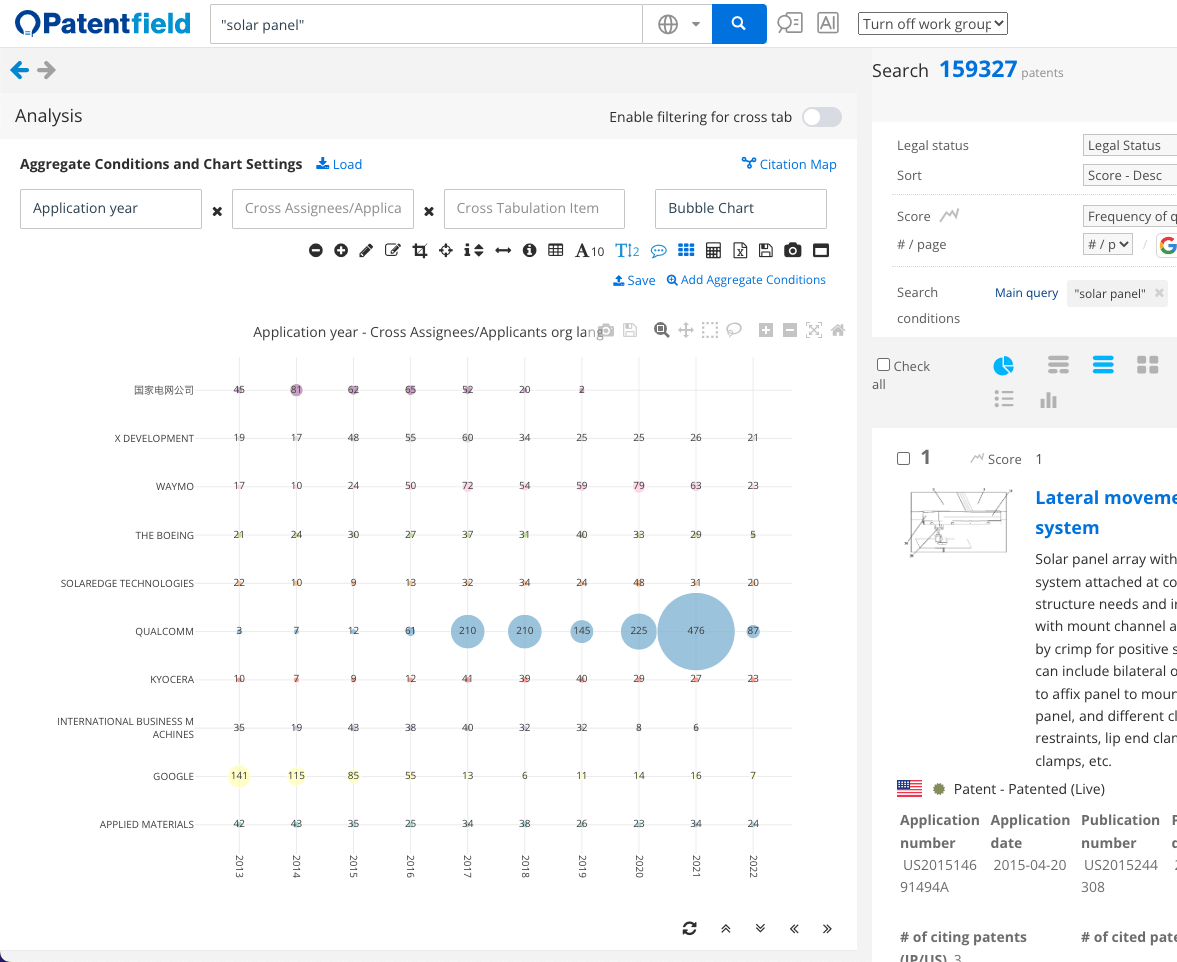
- Patent landscape analysis — maps filing velocity, assignee concentration, and white space across technology fields
- Claim and novelty assessment — compares your invention's features against the closest identified references
- Cross-jurisdiction and non-patent literature coverage — spans USPTO, EPO, WIPO records and scholarly publications through the IP Researcher
The Problem: Why Traditional Patent Search Breaks Down
Patent search is one of the few professional research tasks where a single missed document can void an asset worth millions. And the conditions for missing documents have never been worse.
30% to 50% of all patent applications are rejected due to prior art findings — according to USPTO data cited by Lumenci
26.5% of all patent clusters now contain at least one AI-relevant patent, spanning the full range of technology categories — CSET, Georgetown University
16,815 filings in computer technology made it the top technology field for European patent applications, up 3.3% year over year — European Patent Office Patent Index
But finding the right documents inside that volume is frustratingly difficult:
- Inconsistent document structure and formatting across jurisdictions and eras
- Deliberately broad or obfuscated claim language that defeats keyword matching
- Prior art scattered across patent databases, academic literature, product manuals, and conference proceedings
- Multilingual disclosures that never surface in English-only queries
- Search cost that scales linearly with thoroughness — more coverage always means more billable hours
Vocabulary Mismatch Defeats Keyword Search
A comprehensive review of patent retrieval techniques published in Applied System Innovation identifies inconsistent document structure and formats as a primary concern in prior art searching. Two inventors describing the same mechanism will routinely use entirely different terminology — one writes "lateral movement system," another writes "translational displacement assembly." Boolean search treats these as unrelated. A patent attorney running keyword queries must anticipate every synonym, every regional spelling, every era-specific term of art. Missing one costs the entire search.
Prior Art Extends Far Beyond Patents
Novelty-destroying disclosures live in journal articles, PhD theses, GitHub repositories, product datasheets, and trade show materials. The same review notes that patent retrieval research draws on non-patent datasets including PubMed and scholarly libraries alongside USPTO, EPO, and WIPO collections. Manually querying each source with a separate syntax and separate credentials is where most search budgets are consumed — and where coverage gaps quietly form.
Search Intensity Is an Economic Decision, Not a Best Practice
Research published in the International Journal of Industrial Organization examining whether innovators search for prior art identifies conditions under which innovators have no incentive to search at all, with search intensity rising alongside R&D cost. The uncomfortable implication: when searching is expensive, rational actors under-search. Cost is not a neutral factor — it directly degrades patent quality across the system.
Examination Bottlenecks Compound the Risk
The examination stage requires examiners to independently assess novelty, non-obviousness, and industrial applicability through targeted retrieval. When applicant-side and examiner-side searches diverge, applications proceed to costly office actions or issue with latent invalidity exposure. The USPTO has acknowledged this directly, launching an automated pre-examination search program specifically to give applicants earlier visibility into potential prior art issues.
This is exactly what the IP Researcher was built for.
The Solution: Why the AI IP Researcher Changes the Economics
The Patent, Trademark, Copyright & IP Researcher approaches patent search the way an experienced analyst does — by understanding what the invention does, then hunting for anything that accomplishes the same thing by any means or in any language. It reads claims, parses technical concepts, searches live sources, and returns findings with the reasoning exposed rather than a ranked list you have to reverse-engineer.
| Traditional Approach | Patent, Trademark, Copyright & IP Researcher |
|---|---|
| Boolean keyword strings requiring exhaustive synonym anticipation | Semantic search that matches on technical concept, not vocabulary |
| Separate queries across patent DBs, scholarly literature, and web sources | Unified research pass across patent and non-patent literature |
| Days to weeks per full prior art search | Substantive results within a single working session |
| Static result lists requiring manual relevance triage | Explained findings with relevance reasoning and claim-level context |
| Costs scale with thoroughness, incentivizing shallow searches | Iterative refinement at no marginal cost per query |
| English-first search, foreign disclosures easily missed | Cross-jurisdiction awareness across major patent offices |
Semantic Retrieval Over Literal Matching
The retrieval review documents a clear methodological shift toward semantic techniques — query expansion, claim tree structures that map hierarchical relationships between claim components, and patent ontologies that provide shared vocabulary across patent data. The IP Researcher applies this thinking conversationally. Describe your invention in plain engineering language and it constructs the search strategy itself.
"I've developed a solar panel mounting system that uses crimped bilateral clamps to affix panels to a channel rail without through-bolting. Find prior art that anticipates or renders this obvious."
Landscape Analysis Without a Separate Analytics Suite
Patent analytics, as WIPO defines it, leverages patent information to reveal innovation insights and trends in specific technology fields — supporting decisions in R&D, IP commercialization, licensing, and research collaboration. Historically that required dedicated software and a trained analyst. The IP Researcher delivers the same analytical output — assignee concentration, filing velocity, white space identification — as a direct response to a question.
"Map the competitive landscape for solid-state battery separator patents. Who are the top assignees, how has filing velocity changed, and where is the white space?"
Invalidity and Freedom-to-Operate Framing
Different search purposes demand different strategies. An invalidity search hunts for a single killing reference predating a priority date. A freedom-to-operate search hunts for live, enforceable claims in target markets. The IP Researcher adjusts scope, date filters, and jurisdictional focus based on which question you are actually asking.
"Run a freedom-to-operate assessment for launching a wearable ECG patch in the EU and Japan. Flag any live patents with claims that could block commercialization."
Trademark and Copyright Coverage in the Same Workflow
IP due diligence rarely stops at patents. Product launches need trademark clearance; content and software need copyright and licensing review. Handling all three within one research thread eliminates the context-switching that fragments most IP workstreams.
Related Agents You'll Also Find Useful
Patent research almost never exists in isolation. These agents cover the workflow steps immediately adjacent to IP analysis.
Deep Research
When prior art extends into commercial, regulatory, or market territory that patent databases do not index, Deep Research searches hundreds of sources and synthesizes findings with rigorous inline citations. Useful for establishing public disclosure timelines and commercial-use evidence.
- Multi-source synthesis with verifiable citation trails
- Comprehensive reports on technology adoption and market context
- Ideal for building the non-patent-literature half of a novelty argument
Academic Research Assistant
Non-patent literature is where a large share of novelty-destroying disclosures hide. This agent handles real-time literature discovery across major academic databases and repositories — exactly the material a Boolean patent query will never touch.
- Literature discovery across scholarly databases and preprint repositories
- Citation management and source verification
- Critical for chemistry, biotech, and materials science prior art
Professional Background Investigator
Before licensing, acquiring, or partnering around a patent portfolio, you need to know who is on the other side. This agent conducts deep professional background research across web and public sources to assess credentials and surface red flags.
- Counterparty credential and reputation assessment
- Public-source due diligence ahead of IP transactions
- Red flag identification before contracts are signed
Word Doc Generator
Search findings only create value once they are documented. This agent transforms research output into professionally formatted Word documents applying industry-standard conventions — turning a conversation into a filable search report or client memo.
- Automatic formatting for research reports and legal memoranda
- Clean export for client delivery and internal records
- Removes the manual reformatting step entirely
Try the IP Researcher free — no credit card required.
How AI Patent Research Works: Step by Step
Step 1: Describe the Invention or Question in Plain Language
Skip the Boolean syntax. State what the technology does, what problem it solves, and which features you believe are novel. The more mechanism you describe, the sharper the semantic search becomes.
"I need a novelty search on a method for detecting pulmonary nodules in CT scans using a segmentation model trained on synthetic augmented data."
Step 2: Specify Search Type and Jurisdictional Scope
Novelty, invalidity, freedom-to-operate, and landscape searches all require different parameters. Name the purpose, the target markets, and any relevant priority date so the search is scoped correctly from the start.
"Treat this as an invalidity search. Priority date is 2019. Focus on US, EP, and JP filings, and include academic publications."
Step 3: Review Findings With the Reasoning Attached
Results arrive as explained findings — what each reference discloses, which of your features it maps to, and why it matters. This is the step where a ranked list becomes an actual assessment.
Step 4: Iterate to Close the Gaps
Push back. Ask for foreign-language equivalents, narrow to a specific CPC class, or redirect toward a feature combination the first pass under-covered. Because each iteration costs nothing, you search until the coverage is genuinely complete rather than until the budget runs out.
"The first pass focused on segmentation architecture. Now search specifically for prior art on synthetic data augmentation in medical imaging training pipelines."
Step 5: Export the Search Report
Convert the finalized analysis into a formatted document for filing records, client delivery, or attorney review using the Word Doc Generator.
Results & Use Cases
📊 Pre-Filing Novelty Assessment for a Startup
Scenario: A hardware startup has three weeks before a provisional filing deadline and no in-house IP counsel.
Traditional Approach: A professional prior art search runs into four figures and takes one to three weeks — often exceeding the runway available before the deadline.
Patent, Trademark, Copyright & IP Researcher: A structured novelty search completed in a working session, identifying the closest references and highlighting which claimed features remain distinguishable before attorney engagement.
- Attorney time redirected to claim drafting rather than search
- Weak claim elements identified before they reach an examiner
- Filing decisions grounded in evidence instead of optimism
💼 Competitive Landscape Mapping for R&D Planning
Scenario: An R&D director must decide whether to invest in a technology area where a dominant competitor may already hold blocking positions.
Traditional Approach: Commission an external landscape report — significant cost, multi-week turnaround, and a static deliverable that ages immediately.
Patent, Trademark, Copyright & IP Researcher: Assignee concentration, filing velocity trends, and white space identified conversationally, with follow-up questions answered against live data.
- Filing trajectories reveal where competitors are accelerating or retreating
- White space surfaces where crowding is thinnest
- Roadmap decisions made with IP exposure visible upfront
🎯 Invalidity Search for Litigation Defense
Scenario: A manufacturer receives an infringement assertion and needs prior art predating the asserted patent's priority date.
Traditional Approach: Litigation-grade invalidity searches are among the most expensive IP research products, with cost scaling directly against thoroughness.
Patent, Trademark, Copyright & IP Researcher: Rapid identification of candidate references across patent and non-patent literature, with claim-element mapping to assess anticipation and obviousness arguments — paired with Academic Research Assistant for scholarly disclosures.
- Early read on defense strength before litigation spend escalates
- Non-patent literature coverage where the strongest references often hide
- Settlement posture informed by evidence, not guesswork
📱 Mobile IP Triage at a Trade Show
Scenario: A product manager sees a competitor's booth demo that looks uncomfortably close to a pending application and needs an answer before the flight home.
Traditional Approach: Photograph the booth, email counsel, wait several days for a response after the moment has passed.
Patent, Trademark, Copyright & IP Researcher: On-device patent research from the show floor — check the competitor's published filings, assess claim overlap, and decide whether to escalate before the event ends.
- Full functionality on iOS and Android
- Voice-to-text input for hands-free querying in noisy environments
- Same-day escalation decisions instead of week-later reactions
Frequently Asked Questions
Is AI patent research accurate enough for legal decisions?
AI patent research dramatically expands search coverage and surfaces references that keyword methods miss, but it supplements rather than replaces qualified counsel. Use the IP Researcher to build a comprehensive evidence base and understand your position, then have an attorney validate findings before filing, litigation, or transactional decisions. The value is in coverage breadth and speed, not legal opinion.
How is AI patent search different from Google Patents or Patent Public Search?
Traditional tools including USPTO Patent Public Search match your query terms against document text. AI patent research interprets technical concepts, so a search for one mechanism surfaces functionally equivalent disclosures described in entirely different vocabulary. It also spans non-patent literature in the same pass rather than requiring separate database queries.
Is the IP Researcher free to use?
Yes. All core features are available on the free tier with limited monthly usage. Paid tiers start at $20/month for 30× the free usage allowance plus custom model selection. Usage resets monthly on your billing date with no daily caps — your full allowance is available from day one.
Can it handle trademark and copyright research too?
Yes. The IP Researcher covers trademark screening and copyright lookup alongside patent work, which matters because product launches rarely involve only one form of IP. Clearing a brand name and confirming patent freedom-to-operate happen in the same research thread rather than across separate tools and vendors.
Are patent offices themselves using AI for prior art search?
Yes. The USPTO launched the Artificial Intelligence Search Automated Pilot Program to test automated pre-examination searches, delivering an Automated Search Results Notice to applicants before examination begins. The stated goal is improving examination quality and efficiency — a direct signal that AI-assisted retrieval is being adopted at the institutional level.
Does it work for non-English prior art?
Cross-jurisdiction coverage is core to how the agent scopes searches, spanning major patent office records including USPTO, EPO, and WIPO collections. Because semantic search operates on technical concepts rather than literal strings, functionally equivalent disclosures filed in other jurisdictions are far more likely to surface than under English-only keyword querying.
Conclusion
Patent search has always been constrained by the same tradeoff: thoroughness costs money, so most searches stop short of complete. That tradeoff produced a system where 30% to 50% of applications are rejected on prior art and where invalidity exposure sits latent inside granted portfolios.
AI patent research changes the underlying economics. Semantic retrieval finds what keyword matching structurally cannot. Unified access to patent and non-patent literature closes the coverage gaps that fragmented tooling creates. And zero marginal cost per query means you iterate until the search is actually complete rather than until the budget is spent. The institutional signal is already clear — patent offices are deploying the same class of technology into examination workflows.
For inventors, IP counsel, and R&D leaders, the practical question is no longer whether AI belongs in patent analysis. It is whether you are still paying the old price for the old coverage.
Try the Patent, Trademark, Copyright & IP Researcher now. Explore more at Jenova.
For Developers: The Patent, Trademark, Copyright & IP Researcher is available programmatically via the Jenova API — integrate semantic prior art search and IP landscape analysis into your legal tech or R&D application with a single API call. Full documentation →