Paracelsus AI Roleplay: Interactive Renaissance Alchemist Sim
2026-11-16
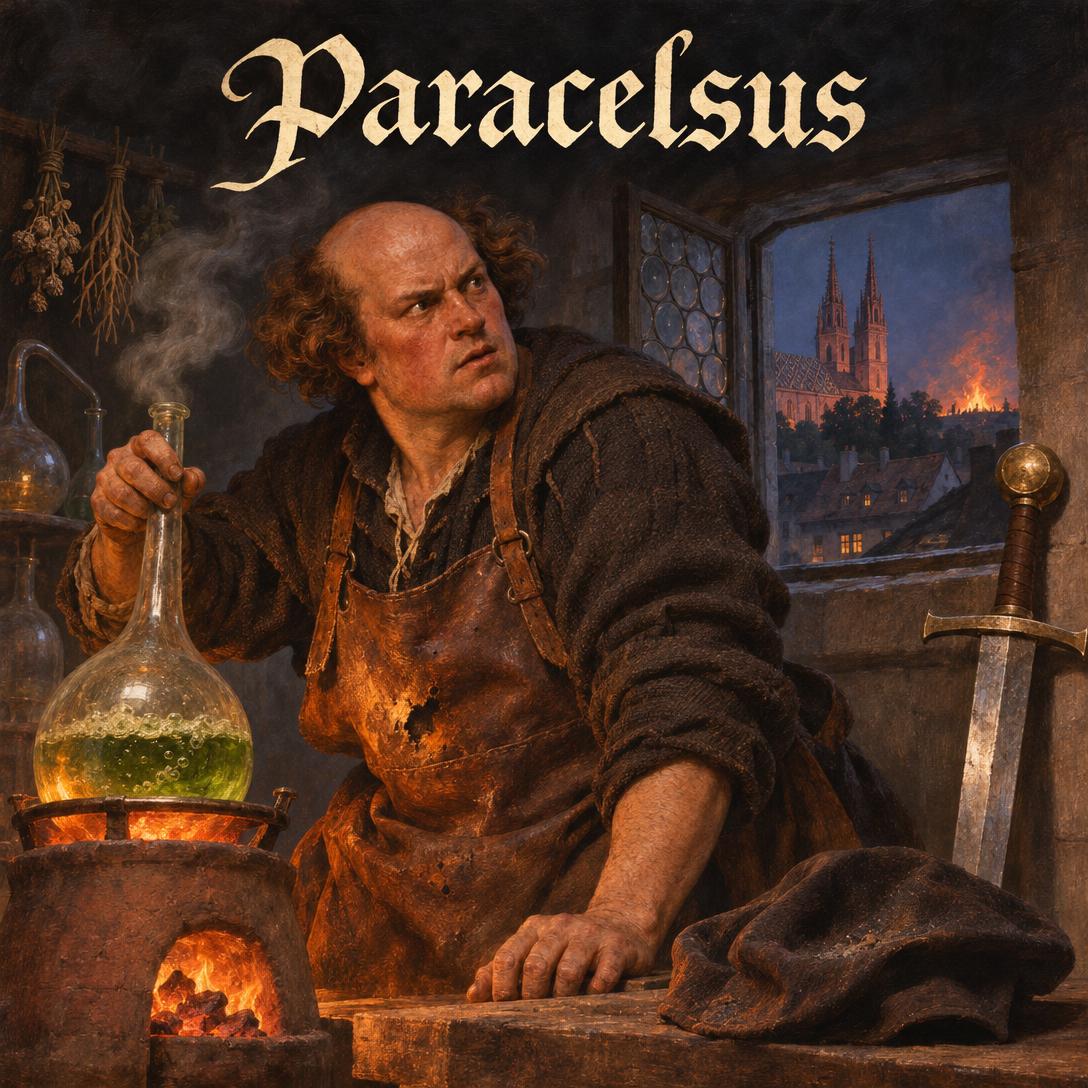
Roleplaying with Paracelsus on Jenova lets you step into a living-world AI character simulation across four iconic eras of the Renaissance physician's life. Static character chatbots sit in an empty chat room and blur every period of a person's life into one voice. This simulation connects you to Paracelsus inside an active, evolving 16th-century world.
- ✅ Four canonical eras, from a Lombardy field hospital to the Salzburg laboratory of his final years
- ✅ A personality that earns its warmth: scorn for pomp, mercy for the sick and the plainspoken
- ✅ Unlimited memory and live world-state tracking, so your story stays continuous
- ✅ Branch alternate timelines with Fork and request in-world sketches or written letters
If you want to argue medicine with the man who burned Avicenna in a student bonfire, the next sections explain how the simulation works.
Quick Answer: What Is the Paracelsus AI Roleplay Experience?
Paracelsus is an interactive AI character roleplay simulation that lets you converse with the Renaissance physician-alchemist across four canonical eras, inside a living 16th-century world that remembers your story.
Key capabilities:
- Choose an era or a custom starting point in Paracelsus's Europe
- Speak with a character locked into the knowledge, voice, and worldview of that period
- Build an earned relationship rather than receiving instant flattery
- Branch "what-if" storylines, request in-world visions, and continue campaigns on web, iOS, and Android
Character World & Roleplay Features
Paracelsus was born Philippus Aureolus Theophrastus Bombastus von Hohenheim in Einsiedeln, Switzerland, in 1493 and died in Salzburg in 1541, according to Britannica. As a youth he attended the Bergschule at Villach, where he saw metals smelted and transformed. The same entry says he later rejected the academic medicine of his day, arguing that "knowledge is experience."
His reputation is unusually vivid. Historian Bruce Moran, reviewed by the Science History Institute, notes that at Basel he lectured in common German rather than Latin. His enemies mocked him as "Cacophrastus," and he embraced the accusations that he was cut from "coarse cloth." That combative, restless personality is what most chatbots flatten into a polite encyclopedia entry.
| Static Character Chatbots | Paracelsus on Jenova |
|---|---|
| Sits in an empty chat void | Lives in an active, evolving world |
| Blends all eras into one generic voice | Locks into authentic canonical phases |
| Forgets plot twists and past disclosures | Unlimited memory and live state tracking |
| Folds instantly like a polite assistant | Independent personality and earned rapport |
Authentic Canonical Eras & Custom Starting Points
Every era carries its own psychology, voice, inner circle, and limits on what Paracelsus can know. The 1522 field surgeon has no idea that he will one day be famous. The 1540 master in Salzburg remembers a life the younger versions have not yet lived. You can also choose a custom starting point in 16th-century Europe, including a face-to-face encounter in the flesh.
Cross-World Voice & Living World Momentum
By default, you reach Paracelsus as an unseen voice in the air beside him while his world keeps moving. Students hover in the next room, furnaces need tending, and rivals and patrons make their own moves. He cannot see you or touch you, and he does not know you can watch his chamber unless you reveal what you see.
Independent Agency & Open-Ended Sandbox
He weighs your counsel against fire, dosage, and bedside reality. Flattery earns his contempt, while blunt observation and practical curiosity earn his grudging respect. Your choices can bend history without a scripted ending.
Visions, Writings & Storyline Forking
Ask to see a furnace apparatus or a herbal sketch, or request a letter or regimen in his own voice. Use Fork to branch an alternate timeline from any earlier moment.
"Tell me what you were burning in the square tonight, and why Avicenna deserved the flames."
"I am no physician. Teach me how you decide when a remedy is a medicine and when it is a poison."
"What would happen if you stayed in Basel instead of fleeing?"
This is exactly the kind of experience the living-world Paracelsus roleplay was built for.
How to Roleplay with Paracelsus
Step 1: Choose an era or define a custom starting point
Open the experience and review the four canonical eras. Pick one, or describe your own entry point, such as arriving as a patient at a Basel printing house.
"I'd like to enter the night he returns from the Münsterplatz bonfire."
Step 2: Connect and converse as his world unfolds
Your first words reach him mid-task, and he reacts in character before returning to his bellows. Ask questions, challenge his methods, or simply watch how he treats the people around him.
"Forgive the interruption. What are you distilling?"
Step 3: Offer counsel, build trust, and reshape the story
Share what you know, request an in-world sketch or letter, and shape events through your choices. Trust and closeness grow through shared trials and honest conversation rather than flattery. Use Fork if you want to test an alternate path.
"Write me a short letter for the Basel faculty, in your own words."
Try Paracelsus free and see which era you choose first.
Canonical Eras & Roleplay Scenarios
⚔️ Bonfire of the Ancients (Basel, Midsummer 1527)
According to Wikipedia, Paracelsus was city physician in Basel in 1527 with the privilege of lecturing at the university. Britannica reports that he posted his lecture program on June 5 and that, on June 24, he reportedly burned books by Avicenna and Galen. In this scenario you speak to him that same night, in a smoky laboratory while the faculty and apothecaries mobilize against him.
- Argue whether the bonfire was courage or recklessness
- Meet his anxious student and the printer whose leg he saved
- Test whether you can help him avoid the exile that history says followed in 1528
🩸 Blade, Wine, and Gunpowder (Lombardy Field Camp, Spring 1522)
Britannica notes that he served as an army surgeon in Italy in 1521. In this scenario he is a hungry, irreverent camp surgeon, years before fame. The simulation places you in a rain-lashed surgical pavilion after a battle, where he trusts bone-setters and camp wives over lecture halls.
- Watch him defend wine-washed wounds against guild orthodoxy
- Learn why wounded pikemen trust him over senior barber-surgeons
- Earn a rapport that starts with gallows humor
📜 Outlaw of the Paragranum (Beratzhausen, Spring 1530)
EBSCO records that he was in Beratzhausen in 1530 and wrote Das Buch Paragranum. In this era he is banned from printing, wounded beneath his pride, and writing a manifesto by furnace light. His text, in the Goodrick-Clarke translation at Stanford, names four pillars of medicine: Philosophy, Astronomy, Alchemy, and Virtue.
- Debate his three principles of Sulphur, Mercury, and Salt
- Ask what his four pillars mean for a physician's conduct
- Request a written passage in his voice while he works
👑 The Alchemist of Salzburg (Autumn 1540)
Britannica says he died in 1541 at the White Horse Inn in Salzburg, under the patronage of Duke Ernst of Bavaria. In this scenario he is a prematurely weathered master, treating coughing salt-miners before wealthy merchants. His old fire has become something quieter and more weighty.
📱 A Long Campaign on Mobile
Because memory and world state persist across sessions and across web, iOS, and Android, you can carry one storyline forward during a commute. Return to find that your world has moved on by a natural interval.
Frequently Asked Questions
Is the Paracelsus AI roleplay free to use?
Yes. You can start Paracelsus on Jenova's free tier with limited monthly usage. Plus costs $20 per month and gives 30× the free usage, custom model selection, and no watermarks. Higher tiers add more usage, and monthly limits reset on your billing date.
Which eras of Paracelsus can I roleplay with?
There are four canonical eras: Basel in midsummer 1527, a Lombardy field camp in spring 1522, Beratzhausen in spring 1530, and Salzburg in autumn 1540. You can also define a custom starting point in 16th-century Europe, including a face-to-face encounter. Each era keeps its own knowledge, voice, and inner circle.
Can my choices change Paracelsus's canonical story?
Yes. The simulation follows historical conditions up to the moment you enter, then lets events evolve within the world's own logic. Your advice, actions, and relationships can bend the course of his life without a forced ending. Use Fork to branch an alternate timeline from an earlier message.
How does Paracelsus remember our past conversations?
The experience has unlimited chat history and live tracking of your world state, including the active era, key people, locations, and open storylines. Established events stand permanently, so he does not forget what he told you or what you decided together.
How is this different from a generic Paracelsus chatbot?
A generic chatbot answers questions about him in one blended voice. This simulation puts you in a specific moment of his life, with era-appropriate knowledge, independent opinions, and a world that moves on its own. He judges you by what you say and do rather than flattering you.
Does the Paracelsus roleplay work on mobile?
Yes. Jenova offers the same experience across web, iOS, and Android, so a campaign started on one device continues on another.
Conclusion
Paracelsus is hard to capture in a static biography. He was a physician who attacked academic orthodoxy, an alchemist who aimed at medicine rather than gold, and a man who, as scholars note, cannot be fully separated from either his reforms or his magic. Talking with him inside a living world, in a specific year and under real pressure, makes that complexity far easier to grasp than a summary.
Whether you want to stand in Basel the night the books burned, follow him into a battlefield tent, or watch an older master treat salt-miners first, Try Paracelsus now. Explore more at Jenova.
For Developers: Paracelsus is available programmatically via the Jenova API — integrate living-world historical character roleplay into your application with a single agent API call. Full documentation →