AI Pantheon Generator: Design Gods for TTRPG Worldbuilding
2026-09-04
Game Designer Assistant helps you generate a complete fictional pantheon by turning a setting, tone, and a few constraints into named gods, domains, cults, and conflicts. While a typical pantheon generator stops at a name and a portentous title, this AI builds a divine system you can drop into a campaign bible or a novel outline. In September 2026, tabletop groups and fantasy authors still lose whole evenings trying to make random deities feel inevitable.
✅ Coherent domains, tenets, taboos, and holy days—not a disconnected name list ✅ Built-in rivalries, heresies, and churches with political weight ✅ Campaign-ready documentation you can revise mid-draft or mid-session ✅ Useful for TTRPGs, novels, comics, and game lore bibles
A roll table can spark a mood. A living mythology needs structure: who the gods are, what they cost their worshipers, and how they collide. To understand why that gap matters, look at how most pantheons actually get built today.
Quick Answer: What Is an AI Pantheon Generator?
An AI pantheon generator is a design tool that creates complete fictional gods—names, domains, cults, and rivalries—so writers and game masters can build a coherent mythology in minutes. Game Designer Assistant does that work as part of broader game and world design, not as a one-click name dump.
Key capabilities:
- Generate original deities with domains, symbols, tenets, and forbidden rites
- Map alliances, schisms, and cult politics across a full pantheon
- Produce campaign-bible documentation and iterate when the table surprises you
- Adapt tone for high fantasy, sword and sorcery, mythic horror, or science-fantasy
Why Most Pantheon Generators Stall After the Name
Fantasy still dominates tabletop play, and players expect a world that feels older than the adventure hook. Industry analysis puts the global tabletop RPG market at USD 2.41 billion in 2026, with growth projected through the next decade.
That demand is not abstract. Reporting on the same market notes that more than 3.4 million U.S. adults participated in tabletop RPGs in 2023. Fantasy worldbuilding remains the default entry point.
But assembling a pantheon that can survive contact with players is frustratingly difficult:
- Random tables give flavor without theology
- Borrowed real-world gods create originality and ethics problems
- Isolated deities collapse the first time a player asks “why would anyone worship this?”
- Continuity breaks across sessions, books, and supplements
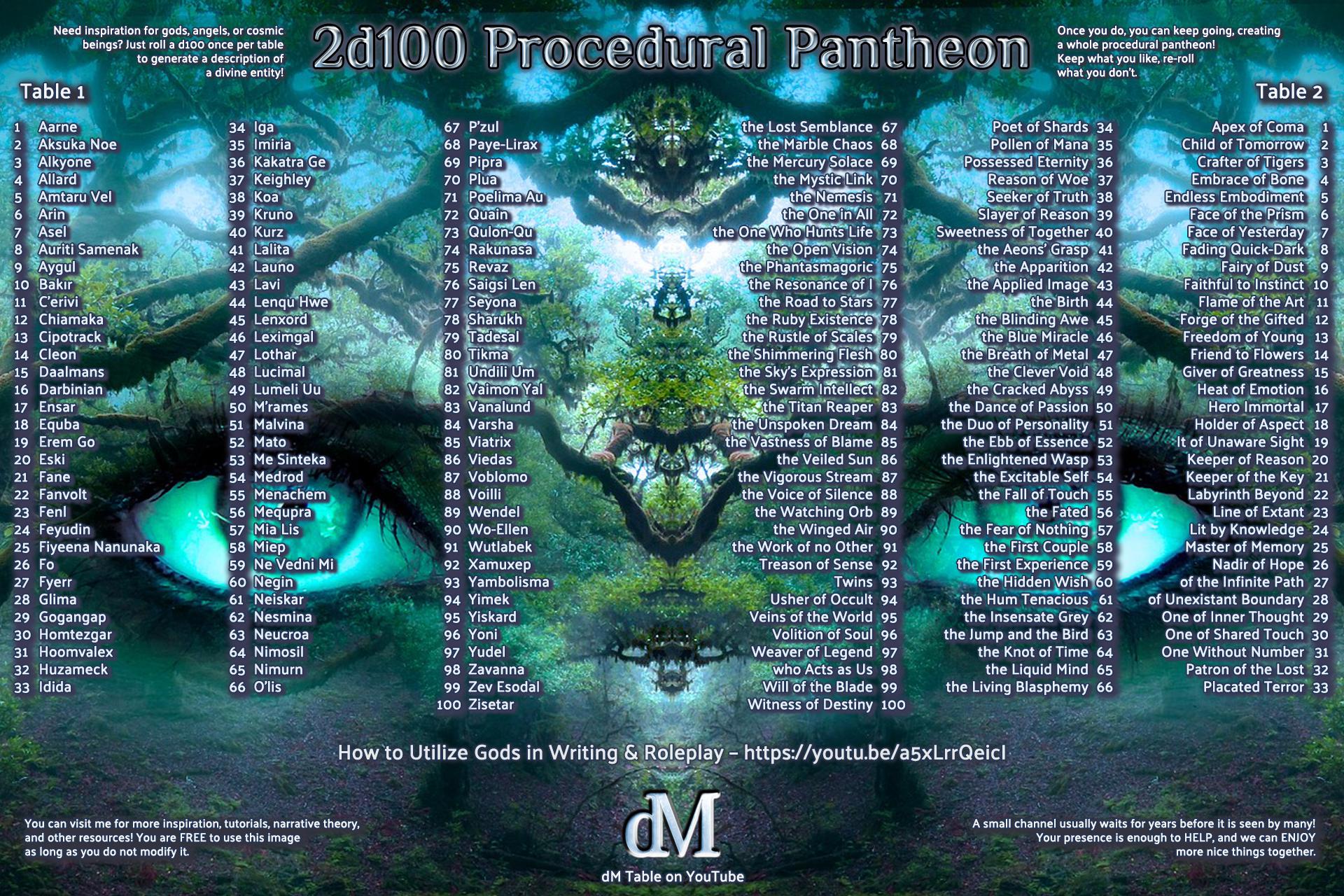
Procedural tables are a legitimate craft tool. Procedural generation is the algorithmic creation of content rather than hand-authoring every asset, and a 2d100 god list is the tabletop version of that idea. The limit is structural. A name such as “Witness of Destiny” is a prompt, not a religion.
Fantasy still needs internal law. Worldbuilding guidance for the genre is blunt: even invented realms require consistent rules, social structures, and geographies, and writers are urged to study real myth systems for resonance without photocopying them. A pantheon that cannot answer how a harvest fails, how a king is crowned, or how a heresy starts will not hold a campaign.
Time pressure makes the problem worse. About 42% of new players are deterred by complex rules and expensive starter kits. GMs already carry rules load; they should not also have to invent a cosmogony from scratch the night before session one. Digital play does not remove that burden—it concentrates it. Digital TTRPG platform adoption has been reported around 48%, which means more groups playing more often, with less downtime to worldbuild by hand.
Creative writers running into the same wall increasingly use AI for ideation rather than finished prose. Research on working writers finds that AI shortens feedback loops in ideation and editing and that many authors treat models as a muse or planning partner while keeping final voice under human control. A pantheon is exactly that kind of planning object: high-structure, easy to revise, fatal when it is only a list of cool names.
This is exactly what an AI pantheon generator was built for.
Why Game Designer Assistant
Game Designer Assistant treats a pantheon as a game system, not a poem. You specify the culture, climate, and conflict of the setting. It returns deities who have jobs, costs, and enemies—then documents them so a table or a manuscript can actually use them.
Worldbuilding is not scenery. As one widely cited craft guide puts it, worldbuilding is a foundation readers can lose themselves in, not a painted backdrop. Gods are load-bearing in that foundation: they explain weather, law, war, and grief. This AI pantheon generator is built to produce that load-bearing layer.
| Traditional Approach | Game Designer Assistant |
|---|---|
| Roll a name and a vague title | Named god plus domain, tenet, taboo, and cult practice |
| Isolated deities with no politics | Rivalries, alliances, heresies, and church factions |
| Hours of wiki-sprawl after the spark | Campaign-bible entries you can revise in conversation |
| Easy to accidentally clone a living religion | Original systems constrained by your setting’s rules |
| Flavor text that dies on first player question | Motives, miracles, and social consequences |
Domains that behave like systems
A usable god is a bundle of mechanics wearing a myth. Ask for a coastal bronze-age pantheon and you should get a tide-keeper whose priests tax harbor fees, a storm-twin who is propitiated before raids, and a grain-mother whose famine rites double as poor relief. That is systems analysis applied to theology: incentives, resources, and failure states.
"Generate a five-god pantheon for a coastal bronze-age city-state. Each deity needs a domain, a sacred color, one forbidden rite, and a political conflict with another god."
Cults, not just cosmologies
Players almost never meet a god. They meet a priesthood, a roadside shrine, a tax, a funeral. The stronger output of this tool is cultus: initiation, tithes, holy days, and what happens to apostates. That is the difference between lore and play.
"Turn this war god into a mystery cult with three initiation degrees, a public festival, and a secret that would start a civil war if revealed."
Documentation you can run
Game design work dies when it stays in chat. The agent’s documentation habit—briefs, relationship maps, faction one-pagers—is what makes a pantheon generator useful at the table. You leave with something a player can read, not a transcript you have to reverse-engineer.
"My players killed a demigod last session. Draft the schism this creates among the remaining eight deities, including two rival churches in the capital."
Related Agents You'll Also Find Useful
If you are generating gods, you are usually about to put them on stage. These agents sit one step downstream of the pantheon bible.
Roleplay Game Master
Once the deities exist, you still need a table that remembers them. Roleplay Game Master runs immersive sessions with persistent memory and stable characters, so a priest’s dogma does not drift between nights.
- Holds cult NPCs, omens, and temple politics across long campaigns
- Lets you test whether a god’s tenets survive actual player choices
- Useful the same week you finish the pantheon, not “someday”
Film Screenwriter
Myths are scenes. If your pantheon needs an origin cycle, a fall from heaven, or a mortal who steals fire, Film Screenwriter turns theology into dramatic structure, dialogue, and visual set pieces.
- Origin myths with act structure instead of wiki infodumps
- God-versus-god conflict with human-scale stakes
- Useful for novels, actual-play intros, and cinematic campaign openers
Comic Creator
Iconography is half of religion. Comic Creator can storyboard a creation myth, a saint’s martyrdom, or a temple mural so your table sees the gods the way worshipers would.
- Sequential myth pages and temple-frieze layouts
- Consistent divine visual language across issues or handouts
- Strong fit when your campaign bible needs art direction, not only text
Try it free — no credit card required.
How an AI Pantheon Generator Works
You do not need a design degree. You need a setting sentence and a willingness to interrogate the first draft.
Step 1: State the world, not the god
Open your game design partner and describe climate, technology, and the human problem the culture cannot solve alone. Gods grow from unmet needs. “Desert river empire, bronze weapons, annual flood fails every seventh year” yields better deities than “make a cool snake god.”
"Bronze-age river empire. The flood fails every seventh year. I need a pantheon of six that explains drought, kingship, and funerary law. No copies of Egyptian gods—original names and rites."
Step 2: Constrain tone and count
Cap the number of gods. Name the tone (grim, luminous, bureaucratic, folk). Ask for relationships up front so you do not generate six disconnected mascots. A tight pantheon of five to nine will outperform a directory of forty.
"Five gods plus two dead ones still worshiped as ancestors. Tone: folk-horror agrarian. Show marriages, betrayals, and which cult runs the courts."
Step 3: Force the cult to the surface
For each deity, demand a public face and a private cost. Who collects the tithe? What is illegal? What miracle would a village actually pray for on a Tuesday? This is where a pantheon generator becomes playable.
"For each god, give: street-level shrine, priestly hierarchy, one legal privilege, one taboo that creates crime, and a rumor peasants believe that theologians deny."
Step 4: Stress-test with a player-shaped disaster
Feed the pantheon a crisis: a saint is exposed as a fraud, a relic is stolen, a king converts. Ask what each church does in the next thirty days. Keep what produces drama; cut what only produces lore.
"A coastal city converts to a foreign moon cult after a tsunami. Using this pantheon, outline 30 days of riots, edicts, and miracles. Flag anything inconsistent."
Step 5: Lock the bible, then keep talking
Export the relationship map and one-pagers into your campaign notes. When the table invents a new heresy, bring it back and ask for a canonical response. The value is revision speed, not a sacred first draft.
Results & Use Cases
📊 Homebrew Campaign Bible in One Evening
Scenario: A GM has six days until a new coastal campaign. The group wants original gods, not a published setting’s roster.
Traditional Approach: Two weekends of wiki pages, a half-finished family tree, and three deities who all secretly do “war and also wisdom.”
Game Designer Assistant: A six-god pantheon with flood rites, harbor tithes, and a schism the party can join or exploit in session two.
- Playable cults instead of flavor names
- Conflicts that generate adventures without extra plotting
- Notes the GM can hand a player who wants to be a cleric
💼 Novel Myth Cycle Without Infodump
Scenario: A fantasy novelist needs an origin war that explains a caste system, but every draft turns into a lecture.
Traditional Approach: A lore appendix nobody asked for, then a rewrite to bury it in dialogue.
Film Screenwriter: The same theology recast as a three-act myth with human witnesses, so the gods stay offstage until they matter.
- Origin story that can be told at a funeral, not in chapter one
- Character-scale stakes hanging off divine law
- A pantheon that serves plot instead of stalling it
📱 Last-Minute Cult on the Train
Scenario: The party ignored the dungeon and walked into a village the GM did not prep. The session starts in forty minutes.
Traditional Approach: Panic, a nameless “harvest god,” and a forgotten NPC priest.
Game Designer Assistant on mobile: A local saint, a forbidden well, and a festival that starts tonight—generated on a phone, consistent with the campaign’s existing sky-gods.
- Full web, iOS, and Android parity, so prep is not chained to a desk
- Fast local cults that still obey the big pantheon’s rules
- Enough texture to improvise a temple map and two omens
After the session, drop those NPCs into Roleplay Game Master so the village priest still remembers who desecrated the well.
🎯 Graphic-Novel Creation Myth
Scenario: An indie team wants a twelve-page myth comic as a stretch-goal PDF for a TTRPG Kickstarter.
Traditional Approach: A writer’s outline that an artist has to reverse-engineer into panels.
Comic Creator: Sequential pages for the death of the first sun, with a visual grammar that matches the pantheon bible’s symbols and colors.
- Shared iconography between the rulebook and the comic
- A myth players can read in five minutes
- Art direction that does not fight the theology
FAQ
What is a pantheon generator?
A pantheon generator is any tool—dice table, algorithm, or AI—that produces fictional gods for stories and games. The useful version does more than emit names. It specifies domains, cult practice, and relationships so the result can survive a curious player or a later chapter. An AI pantheon generator adds revision: you can demand a schism, a famine rite, or a dead god and keep the rest of the system intact.
Is an AI pantheon generator free?
Jenova offers a free tier with core features and limited monthly usage, which is enough to build a first pantheon and stress-test it. Paid plans increase usage if you are documenting a full setting, a published module, or a novel series. There is no credit-card wall to try the workflow. Check current plan details in the Subscribe menu if you need higher volume.
How is an AI pantheon generator different from a random god table?
A 2d100 table is excellent at surprise. It is weak at consequence. Random titles rarely explain who collects tithes, which god the courts invoke, or what happens when a relic is stolen. This AI treats deities as interlocking systems. You keep the spark of procedural naming if you want it, then force theology, politics, and play around the result.
Can a pantheon generator work for D&D, Pathfinder, or original systems?
Yes. Specify the rules culture, not only the aesthetic. Ask for domains that map to cleric lists, or ask for a system-agnostic bible with tenets instead of spell schools. For a published world, constrain the output: “compatible with a polytheistic city-state, no overlapping the existing eight gods.” Original systems benefit even more, because you can define miracles as setting laws rather than spell slots.
Does a pantheon generator work on mobile?
Yes. The same agent runs on web, iOS, and Android with settings in sync. That matters for GMs who generate a village cult on a commute, then refine the campaign bible at a desktop later. Speech-to-text is available if you would rather talk through a cosmogony than type it on a phone.
Will an AI pantheon generator copy real-world religions?
It can drift toward familiar patterns if you give it no constraints—that is a prompt problem, not a reason to skip the tool. State “original names, no one-to-one mapping to living faiths,” and ask it to use comparative structure (sky father, hearth keeper, psychopomp) without copying liturgy. Study real myth for craft; do not republish it as your setting’s church. Film Screenwriter is the right next step when you want those original gods in scenes rather than in a wiki.
Conclusion
A pantheon generator used to mean a list of names you still had to turn into a religion. That is why so many campaigns stall at “the sun god, plus a war god, plus something about death.” Game Designer Assistant closes that gap: domains that behave like systems, cults that collect taxes, rivalries that create adventures, and documentation you can run tomorrow.
If you are building a TTRPG setting, a fantasy novel, or a myth comic, start with the human problem the culture cannot solve—and let the gods be the answer that costs something. Try the AI pantheon generator when you need a divine system, not another page of titles.
Explore more at Jenova.
For Developers: Game Designer Assistant is available programmatically via the Jenova API — integrate pantheon generation and game-design workflows into your application with a single API call. Full documentation →