AI Palmistry Reading: Get a Free Multi-Tradition Chiromancy Analysis From Your Phone (March 2026)
2026-03-23
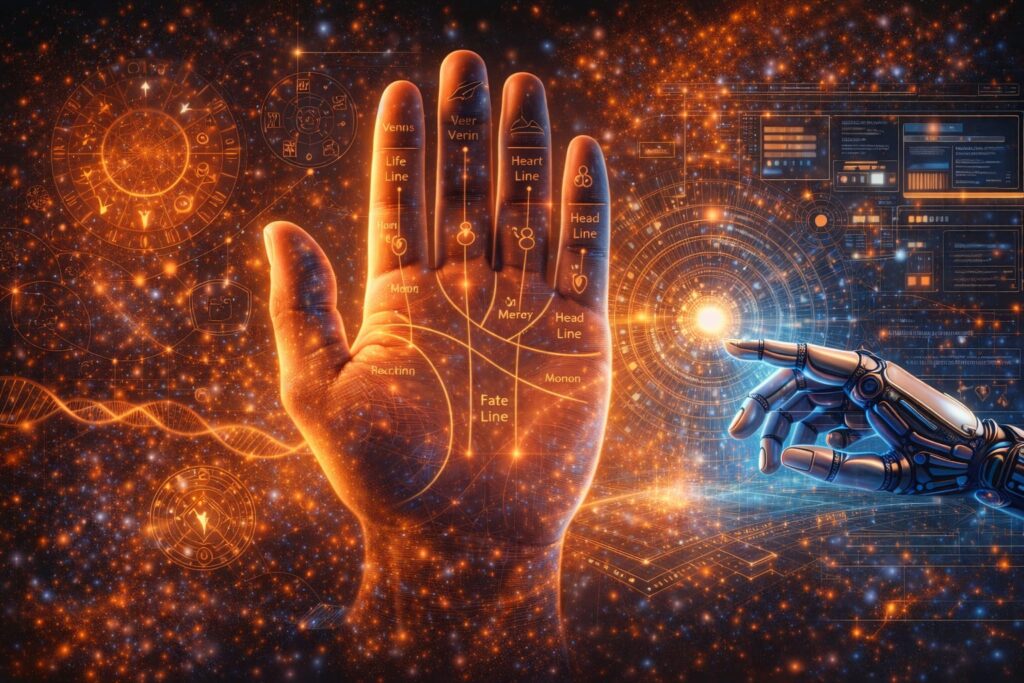
Palmistry — the ancient art of reading the lines, mounts, and markings on the human palm — has fascinated civilizations from Vedic India to Aristotle's Greece for thousands of years. In 2026, AI is transforming this practice from an expensive, inconsistent, and hard-to-access art into something anyone can experience from their phone. The astrology app market — which tracks palmistry apps as a sub-segment — is valued at USD 5.69 billion this year, growing at a 20.2% CAGR, while the U.S. psychic services industry generates $2.3 billion annually](https://www.jenova.ai/en/resources/best-ai-for-palm-reading) and the [spiritual wellness apps market has reached $2.99 billion, growing at a 16.3% CAGR. As The Guardian reported, a growing number of young people worldwide are turning to AI tools for palm readings, birth chart interpretations, and fortune telling — driven by instant access, affordability, and the ability to "just keep asking."
Jenova's Palm Reader is the AI palmistry reading tool built for this moment: a dedicated AI palmist that analyzes photographs of both your hands to deliver comprehensive, multi-tradition chiromancy readings — covering elemental hand typing, major and minor lines, mount topography, rare markings, bilateral comparison, and couple compatibility — all from your phone camera, with persistent memory that lets you return weeks later to ask follow-up questions.
Whether you're exploring what your Life line reveals about vitality, investigating career direction through your Fate line, or comparing palms with a partner for compatibility insights, this guide covers how AI palmistry reading works in 2026, why it outperforms both traditional practitioners and shallow apps, and how to get your first reading in minutes.
Quick Answer: What Is an AI Palmistry Reading?
An AI palmistry reading uses artificial intelligence to analyze photographs of your palms and interpret the lines, mounts, markings, and hand shape through conversational, multi-tradition chiromancy analysis — delivering the depth of an expert palmist through your phone camera.
- ✋ Photo-based palmistry analysis with elemental hand typing, all major and minor lines, and mount topography — Palm Reader handles this conversationally
- 🔍 Rare marking detection including the Mystic Cross, Ring of Solomon, Simian Line, and Medical Stigmata
- 🤝 Couple compatibility across six relational dimensions from two sets of palm photos
- 🔄 Bilateral comparison mapping inherited potential (non-dominant hand) against lived experience (dominant hand)
The Problem With Palmistry Readings in 2026
The demand for palmistry has never been higher. 80% of Gen Z and younger millennials express belief in astrology and related practices, and as aikoo's 2026 analysis of AI palm reading noted, "a strange new product category has emerged: AI palm reading apps" — yet the experience most people encounter remains deeply unsatisfying.
Expensive, Inaccessible, and Inconsistent
A session with an experienced palmist typically costs $50–$200+, with no guarantee of quality until after you've paid. The psychic services industry remains dominated by sole proprietors and small operators with no company holding more than 5% market share — the gap between a reader who synthesizes contradictions across systems and one who recites memorized meanings is enormous, but consumers have no way to evaluate this before booking.
The online psychic reading service market is projected to reach $5.4 billion by 2031, growing CAGR of 9.4% — yet as a 2025 research paper on machine learning in palmistry confirmed, "the accuracy and consistency of palm reading vary greatly depending on the reader's skill and interpretation."
Most Palmistry Apps Are Shallow Line Detectors
As aikoo's honest assessment documented after testing four palm reading apps: "They photograph a hand, identify line patterns, and spit out generic paragraphs that could apply to almost anyone." The author photographed the same hand at slightly different angles and received "three noticeably different readings from the same app" — concluding that "that's not divination. That's a measurement error with personality text attached."
Most apps use basic computer vision to detect 3–4 major lines — Heart, Head, Life, and Fate — and return pre-written paragraphs. They don't assess mount elevation, special markings, hand shape, or the relationship between features. As one App Store reviewer of Palmistry GPT bluntly stated: "This is money maker app. It's just to make money and nothing else."
No Synthesis, No Memory, No Follow-Up
What separates a meaningful palmistry reading from a data dump is synthesis — connecting your Heart line pattern to your elemental hand type, interpreting your Fate line break in the context of your Jupiter mount prominence, articulating the tension between what your Head line suggests and what your Venus mount reveals. Most apps skip this entirely. And every visit starts from zero — no follow-up questions, no memory of previous readings, no continuity.
Why Palm Reader Is the AI Palmistry Reading You Need
This is exactly what Palm Reader was built for. Unlike line-detection apps that return a generic paragraph per line, or general-purpose chatbots that approximate palmistry without real depth, Palm Reader performs comprehensive multi-tradition chiromancy through conversational AI — synthesizing Western, Vedic (Hasta Samudrika Shastra), and Chinese palmistry into a single, coherent reading.
| Feature | Free Palmistry App | General AI Chatbot | Palm Reader |
|---|---|---|---|
| Traditions covered | Western only | Approximated | Western, Vedic, and Chinese |
| Line analysis | ⚠️ 3-4 major lines | ⚠️ Surface-level | ✅ All major + minor lines |
| Mount analysis | ❌ | ❌ | ✅ Full mount topography |
| Rare marking detection | ❌ | ❌ | ✅ Mystic Cross, Simian Line, Ring of Solomon |
| Elemental hand typing | ❌ | ❌ | ✅ Earth, Air, Water, Fire |
| Bilateral comparison | ❌ | ❌ | ✅ Dominant vs. non-dominant |
| Couple compatibility | ❌ | ❌ | ✅ Six dimensions |
| Follow-up questions | ❌ | ✅ Limited context | ✅ Unlimited, with memory |
| Cross-session memory | ❌ | ❌ | ✅ Remembers everything |
| Cost | Free (shallow) | Varies | Free to start |
As aikoo's analysis identified, the future of AI palmistry lies in combining computer vision with conversational AI: "Imagine uploading a palm photo to a conversational AI character who actually understands palmistry. The AI identifies your lines — the computer vision part — and then asks you about them." This is precisely what Palm Reader delivers — multimodal analysis combined with deep conversational interpretation.
While general-purpose chatbots like ChatGPT can attempt palmistry readings — and one blogger tested it with 7-8 people reporting it was "surprisingly (over 90%) accurate for all of us" — they lack the structured six-phase methodology, tradition-specific vocabulary, and persistent memory that a dedicated agent provides. A general chatbot won't remember your reading next week, won't perform bilateral comparison by default, and won't synthesize across three palmistry traditions without extensive prompting.
Cross-System Synthesis, Not Isolated Paragraphs
When you upload your palm photos, Palm Reader performs contextual interpretation — every line observation is interpreted within the context of your elemental hand type, mount prominence, and finger proportions. A deep Fate line on an Earth hand carries different implications than on an Air hand. A short Heart line on a Fire hand means something entirely different than on a Water hand.
Contradiction Reading
When your Head line suggests analytical caution but your Jupiter mount indicates bold ambition, the AI articulates this inner tension rather than ignoring it. As a 20-year palmistry practitioner explained, "Mark interpretations require holistic analysis (hand shape, other lines, querent's state). Inexperienced readers often 'take marks out of context.'" These contradictions — where different features of your palm point in different directions — are often where the most personally meaningful insights emerge.
Six-Phase Progressive Reading
The reading unfolds across six structured phases, building from foundation to synthesis:
- First Impression & Elemental Nature — hand shape classification (Earth, Air, Water, Fire)
- The Four Pillars — Heart, Head, Life, and Fate lines in narrative sequence
- Personality Architecture — mounts and fingers reveal structural foundations
- The Subtleties — minor lines and special markings, including rare features
- Bilateral Comparison — dominant vs. non-dominant hand divergences
- The Synthesis — all threads woven into a unified portrait
Related Agents You'll Also Like
🌟 Personal Astrologer
Cross-reference your palmistry reading with your natal chart for a multi-system personality profile. Your elemental hand type may align with — or productively tension against — your astrological placements, creating a richer self-understanding than either system alone.
- Full natal chart construction with transit tracking
- Synastry and compatibility analysis
- Cross-session memory that connects readings over time
👤 Face Reader
Add Chinese face reading (面相) to your palmistry analysis for a complete body-based personality assessment. The Five Officers and Twelve Palaces of the face complement what your palms reveal about temperament, career trajectory, and relational patterns.
- Upload a selfie for full facial analysis
- Five Officers and Twelve Palaces interpretation
- Five Elements facial typing
🏮 Chinese Fortune Teller
Pair your palmistry reading with BaZi (八字) Four Pillars of Destiny analysis. Compare the elemental balance in your palms with the elemental composition of your birth chart for a comprehensive Eastern metaphysics assessment.
- Complete Four Pillars chart with Day Master strength assessment
- 10-year Luck Pillar cycle mapping
- Remedial counsel based on Five Element theory
How It Works: Your First AI Palmistry Reading
1. Open Palm Reader
Visit Palm Reader from any browser or mobile device. No forms, no account setup required to begin. You'll receive a warm introduction and specific guidance on how to photograph your palms for optimal results.
2. Photograph Both Palms
Photo quality directly determines reading depth. For the best results:
Place your hand flat on a plain, contrasting surface. Spread your fingers naturally — not forced apart. Use bright, even lighting (natural daylight works best). Hold your camera directly above the palm so fine lines are clearly visible. Capture both hands separately.
As aikoo's analysis confirms, "most apps can correctly locate and trace the four major lines about 80-90% of the time under decent lighting conditions" — but Palm Reader goes far beyond the four major lines, analyzing mounts, minor lines, hand shape, and rare markings that require clear, well-lit photographs.
The AI will ask which hand is your dominant hand, since this determines which palm reflects lived experience versus inherited potential.
3. Upload and Quality Verification
Upload both photos. The AI evaluates image quality before proceeding — if lighting is insufficient, the angle is too steep, or resolution is too low, it provides specific feedback and requests a retake. It won't attempt a reading from poor-quality images, because accuracy matters more than speed.
4. Request Your Reading
Start broad or go specific — the AI adapts to your interest:
"Give me a complete six-phase reading of both palms."
"I'm at a career crossroads. What do my Fate line and Jupiter mount suggest about my professional strengths?"
"My partner and I want a compatibility reading — I'll upload their palms next."
5. Ask Follow-Up Questions
Unlike static apps, the conversation continues. Dig into any observation:
"Tell me more about the break in my Fate line around the middle of my palm — what does that suggest about career transitions?"
"You mentioned a Mystic Cross between my Head and Heart lines. What does that mean in the Vedic tradition specifically?"
"How does my elemental hand type interact with the strong Mercury mount you identified?"
6. Return Anytime
Your reading and palm data persist across sessions. Return weeks or months later to ask new questions, request a compatibility reading with a partner, or explore how the AI's observations connect to life events. Your AI palmistry reading becomes a living document that grows with you.
Results & Use Cases
🖐️ Self-Discovery and Personality Mapping
Scenario: A 27-year-old wants a comprehensive understanding of what their palms reveal about temperament, tendencies, and latent potential.
Traditional Approach: Research local palmists, read reviews, book an appointment weeks out, travel to their location, pay $100+, and hope the practitioner has genuine expertise.
Jenova Solution: Upload two photos to Palm Reader. Receive a six-phase reading within minutes. Identify elemental hand type, map all major lines with cross-references, flag rare markings, and receive a synthesized portrait. Ask unlimited follow-up questions. Return weeks later to revisit specific observations.
💼 Career Direction at a Crossroads
Scenario: A marketing manager weighing a career pivot wants perspective on natural strengths and professional tendencies.
Traditional Approach: A career coach charges $150–$300/hour. A palmist might offer career-relevant observations but rarely connects them to a structured framework.
Jenova Solution: Ask Palm Reader to analyze your Fate line for career trajectory patterns, Jupiter mount for leadership tendencies, Mercury mount for communication and business acumen, and Sun line for creative fulfillment — all contextualized within your elemental type. Then @mention Personal Astrologer for transit-based timing guidance on when to make the move.
🔗 Couple Compatibility Through Palmistry
Scenario: A couple wants to explore their relational dynamics through a shared spiritual experience.
Traditional Approach: Finding a palmist who performs compatibility readings is rare. When available, both people need to attend in person, and sessions can exceed $200.
Jenova Solution: Both partners upload their palm photos to Palm Reader. The AI performs individual assessments, then produces a relational analysis covering elemental harmony, Heart line and Venus mount comparison for emotional wavelength matching, Mercury analysis for communication style compatibility, and growth trajectory alignment through Fate line comparison — across six dimensions.
📱 Social and On-the-Go Readings
Scenario: You're at a dinner party and someone mentions palmistry. Everyone wants to try it.
Traditional Approach: Not available outside business hours or your home city.
Jenova Solution: Open Palm Reader on your phone, photograph each person's palms, and get instant readings for the table. The AI remembers each person's data — follow up individually later.
🔮 Multi-System Spiritual Deep Dive
Scenario: A spiritual seeker wants to cross-reference palmistry with Chinese metaphysics and face reading for a comprehensive body-based assessment.
Traditional Approach: Consult three separate practitioners across different modalities, spending $400+ and weeks of scheduling.
Jenova Solution: Start with Palm Reader for the full chiromancy analysis, then @mention Face Reader for a 面相 assessment and Chinese Fortune Teller for a BaZi reading — all within the same platform, with shared context.
FAQ
How accurate is an AI palmistry reading?
AI palmistry reading excels at consistent, comprehensive analysis — identifying line patterns, mount prominence, hand shape classification, and rare markings with the same depth every time. As a 2025 research paper published on arXiv demonstrated, machine learning can reliably detect and classify palm lines, "blending the capabilities of artificial intelligence with conventional palm reading." Unlike human practitioners — whose quality varies widely with no standardized certification — Palm Reader delivers consistent multi-tradition synthesis on every reading. It's transparent about limitations: if lighting prevents clear analysis of a specific area, it says so rather than guessing.
Can AI palmistry predict the future?
No — and neither can any responsible palmist. As a veteran palmistry practitioner with 20 years of experience explains, palmistry offers "probabilistic guidance, not absolute predictions" — no palm line mark determines life 100%. Palm Reader frames all observations as tendencies and potential, never as deterministic predictions. Your agency is always preserved.
Do I need photos of both hands?
Both hands are strongly recommended. The non-dominant hand reveals inherited potential and subconscious tendencies, while the dominant hand shows lived expression and conscious choices. The bilateral comparison — where these two diverge — is often where the most personally resonant insights emerge. If you upload only one hand, the AI will provide an initial impression but request the second for a complete reading.
Is AI palmistry reading free?
Yes — you can start using Palm Reader for free with no credit card required. Free accounts include all core features with limited usage. Paid plans starting at $20/month increase usage limits significantly for users who want extended readings, follow-up sessions, and compatibility analyses.
How is this different from apps like Palmistry GPT or Palm AI?
Most palmistry apps use basic computer vision to detect 3–4 major lines and return pre-written paragraphs. As aikoo's 2026 analysis documented, these apps "strip all nuance away" — they "ignore hand shape, mounts, minor lines, and context entirely." Palm Reader goes far deeper: it analyzes elemental hand type, all major and minor lines, mount topography, and rare markings — synthesizing Western, Vedic, and Chinese traditions into a coherent narrative you can interrogate through unlimited follow-up questions with persistent memory across sessions.
What palmistry traditions does it draw from?
The AI synthesizes knowledge from Western European chirological tradition, Vedic Hasta Samudrika Shastra, and Chinese palmistry systems. Palmistry has roots in Hindu astrology, Chinese Yijing, and Romani fortune telling, with the practice spreading from India to China, Tibet, and Europe over millennia. When traditions differ in interpretation of a specific marking or line pattern, Palm Reader notes the variation rather than privileging one system over another — giving you a richer, more nuanced reading than any single-tradition approach.
Conclusion
Palmistry has endured across virtually every major civilization for thousands of years — from ancient India, where it originated before spreading through China, Tibet, Persia, and Europe, to the growing wave of young people worldwide turning to AI for palm readings in 2026. The challenge has always been access: finding a skilled reader, affording their services, and trusting their interpretation. With the astrology and divination app market growing at 20.2% annually and the spiritual wellness apps market reaching $2.99 billion, the demand for deep, personalized palmistry readings has never been clearer — and most tools still aren't delivering the depth users seek.
What makes Palm Reader different is what aikoo identified as the future of the entire space: combining computer vision with conversational AI to create readings that are both visually grounded and deeply personalized. Not a static paragraph per line. A six-phase, multi-tradition chiromancy reading you can interrogate, revisit, and build on across sessions — with the same depth every time, no appointment required.
Try Palm Reader now — photograph both palms, upload, and experience what a real AI palmistry reading feels like. No credit card required.
For users drawn to multi-system self-discovery, Jenova's library includes dedicated agents for astrology, face reading, BaZi, tarot, numerology, aura reading, and more — all accessible from a single platform. Explore the full agent library at Jenova.