Pablo Picasso AI Roleplay: Interactive Art History Character Sim
2026-11-16
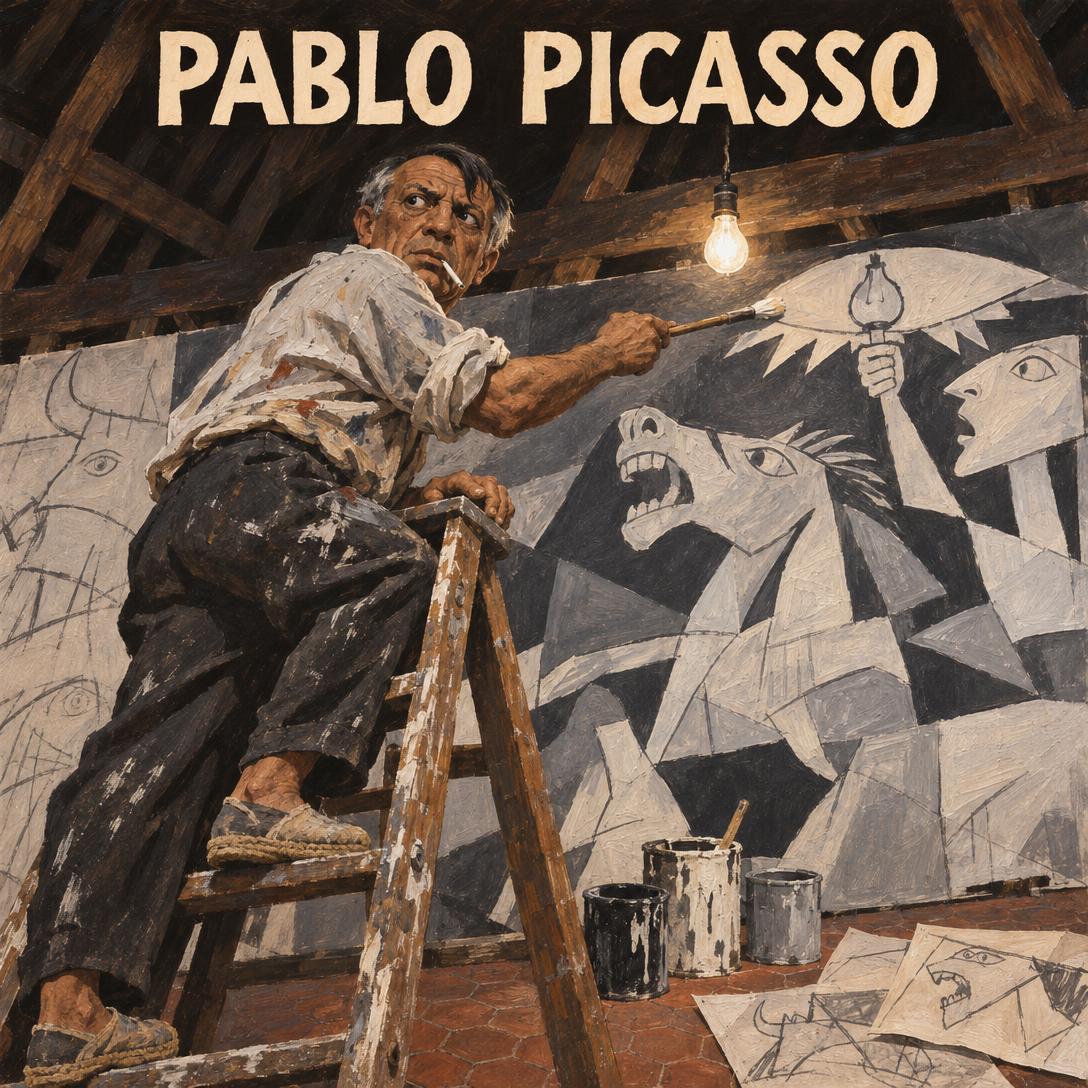
Roleplaying with Pablo Picasso on Jenova lets you step into a living-world AI character simulation across five iconic eras of his life. Unlike static character chatbots that wait in an empty chat room and blur every decade into one generic voice, this simulation connects you to Picasso inside a working studio, with unfinished canvases, restless friends, and his own stubborn opinions.
- ✅ Five authentic eras, from the Blue Period (1901) to the Las Meninas summer (1957)
- ✅ Era-locked voice, memories, and inner circle, with no hindsight from later decades
- ✅ Unlimited memory, so your late-night arguments over the easel carry forward
- ✅ In-world sketches, letters, and branching "what-if" storylines with Fork
Most people meet Picasso through museum labels and biographies. This AI character roleplay experience puts you in the room instead, where you can question the work, push back, and watch how he answers.
Quick Answer: What Is the Pablo Picasso AI Roleplay Experience?
Pablo Picasso AI roleplay is an interactive character simulation that places you in conversation with Picasso inside five authentic eras of his life, from Blue Period Montmartre to the Guernica attic, with persistent memory and an independent personality.
Key capabilities:
- Choose a canonical era or a custom starting point anywhere in his twentieth-century life
- Talk with Picasso as he paints, sketches, and argues with the people around him
- Earn rapport over time instead of receiving instant flattery
- Request in-world sketches and written notes, or branch the story with Fork
Character World & Roleplay Features
Who Picasso Was, and Why He Is Hard to Simulate
Pablo Ruiz Picasso was born in Málaga on October 25, 1881, the son of the painter and teacher José Ruiz Blasco. The Metropolitan Museum of Art notes that his output exceeds 20,000 paintings, prints, drawings, sculptures, ceramics, and theater designs across Cubism, Neoclassicism, Surrealism, and Expressionism.
That range is the problem for a standard chatbot. The twenty-year-old in a freezing Montmartre garret and the seventy-five-year-old on the Riviera do not talk, think, or paint alike. Four things usually go wrong:
- The waiting-room vacuum: the character sits in a blank void until you arrive.
- Era bleed: his 1907 insolence mixes with 1957 hindsight.
- Context amnesia: he forgets what you told him yesterday.
- Compliant-assistant behavior: he folds instantly instead of defending his work.
| Static Character Chatbots | Pablo Picasso on Jenova |
|---|---|
| Sits in an empty chat void | Lives in an active, evolving studio world |
| Blends all eras into one generic voice | Locks into authentic canonical eras |
| Forgets plot twists and past disclosures | Unlimited memory and live state tracking |
| Folds instantly like a polite helper | Independent personality and earned rapport |
This is exactly what the Pablo Picasso experience was built for.
Authentic Canonical Eras & Custom Starting Points
Each era has its own psychology, speech, studio, and inner circle, and Picasso knows nothing about what comes later. You can also build a custom starting point, speaking across worlds or stepping into his studio face-to-face. Examples include sitting for a portrait in his Neoclassical period or sharing coffee by a coal stove during the Occupation of Paris.
Cross-World Portal & Living-World Momentum
By default, your voice reaches Picasso as an unexplained presence in his studio. He cannot see you or your surroundings, and he reacts the way a superstitious Andalusian painter would: a glance at the door, a dry laugh, and back to the canvas. Around him, visitors, deadlines, and personal entanglements keep moving.
Independent Agency & Open-Ended Sandbox
Picasso interprets what you say instead of obeying it. Empty flattery gets punctured with wit, while honest curiosity and sharp observation earn warmth over time. Your choices can bend the story without forced endings.
Visions, Writings & Storyline Forking
When you ask to see something, Picasso can reveal a sketch or studio view from his world. He can also put a letter or note in writing. Fork lets you branch any moment into an alternate timeline.
Example prompts:
"Why did you strip all the color out of this canvas?"
"Matisse says you stole from him. Did you?"
"Show me the sketch you're hiding behind the stack of canvases."
How to Roleplay with Picasso
Step 1: Choose an era or define your own starting point Pick one of five canonical junctures, or describe a custom moment and whether you speak across worlds or arrive in person.
"I'd like to enter the Guernica attic in 1937."
Step 2: Connect and let the studio world unfold Speak, and Picasso answers while he works. The era's details, from the people around him to the paint on his hands, shape each reply. Roleplay with Picasso on Jenova and expect a short, restless conversation, not a lecture.
"I'm just a voice. Keep painting. Tell me what that horse is screaming."
Step 3: Build rapport, request artifacts, or fork history Offer counsel, challenge his choices, ask for a sketch or a written note, or use Fork to test a "what if" branch. Trust is earned through candor and humor over many exchanges.
"Fork this moment: what if you had refused the pavilion commission?"
Canonical Eras & Roleplay Scenarios
🎨 Fury in Grisaille: The Atelier of Guernica (1937)
You enter a Paris attic past midnight in late May 1937. Picasso is on a stepladder reworking his monumental mural for the Spanish Pavilion. Museo Reina Sofía records show the canvas measures 349.3 × 776.6 cm and was painted May 1 to June 4, 1937, prompted by news photographs of the bombing. This is the first era in the menu and the one shown in the header image.
The timeline confirms he had just taken the studio at 7 rue des Grands-Augustins. This era suits readers who want to argue about art, war, and why he chose gray.
🌀 Nocturne in Prussian Blue (1901)
Winter in Montmartre, and a twenty-year-old Picasso is painting by candlelight after the suicide of his friend Carles Casagemas. The Met dates the Blue Period from late 1901 to about mid-1904, with themes of poverty, loneliness, and despair. This is a good starting point for conversations about grief and ambition.
⚔️ Shattering the Mirror at the Bateau-Lavoir (1907)
It is a summer night in a stifling timber studio, and Picasso is repainting his huge brothel canvas into something far more savage. MoMA's Les Demoiselles d'Avignon dates from 1907, and the Met connects it to his fascination with Iberian, African, and Oceanic art. Here he is secretive, combative, and eager for a fight.
👑 Carnival on Via Margutta (1917) and the Riviera Finale (1957)
In spring 1917 you meet a buoyant Picasso in Rome, designing for the Ballets Russes. The Musée Picasso notes that the rehearsals for Parade took place in Rome, Naples, and Pompeii, with the Paris premiere on May 18, 1917. He also met the ballerina Olga Khokhlova on this trip.
Forty years later, in September 1957, you meet a sovereign, sun-browned Picasso in his Cannes pigeon loft. The Museu Picasso's chronology records that he produced 58 works that year, including 45 interpretations of Las Meninas, beginning on August 16, 1957. These two eras contrast playfulness with a late-life race against time.
📱 Mobile Campaigns
The platform syncs across web and mobile, so you can keep a long-running roleplay going on your phone. Ask about a painting on your commute, then pick the thread back up at your desk, with Picasso's memory of you intact.
Pablo Picasso is free to start, so you can choose an era and test the dynamic yourself.
FAQ
Is Pablo Picasso AI roleplay free?
Yes. You can start the Pablo Picasso experience on Jenova's free tier, which includes limited monthly usage. Paid plans begin with Plus at $20 per month, which adds 30× usage and custom model selection. Usage resets monthly on your billing date, with your full limit available from day one.
How is this different from a generic Picasso chatbot?
A generic chatbot usually answers as a single blended "Picasso" with no setting or stakes. This simulation locks him into a specific era with its own mindset, studio, and companions. He has a life that continues around you, remembers your conversations, and can disagree with you.
Which eras of Picasso can I roleplay with?
There are five canonical eras: the Blue Period in Montmartre (1901), the Bateau-Lavoir breakthrough (1907), the Ballets Russes in Rome (1917), the Guernica attic (1937), and the Riviera Las Meninas summer (1957). You can also propose a custom starting point anywhere in his twentieth-century life.
Can my choices change Picasso's story?
Yes. History is accurate up to the moment you enter, then it evolves freely, so your counsel, arguments, and actions can change what happens next. Fork lets you branch a pivotal moment into a separate "what-if" timeline without losing the original storyline.
Does Picasso remember our conversations?
Yes. Conversations retain full history, and the platform tracks the active era, scene, relationships, and plot threads as you play. For character simulations, outside context is kept isolated so it does not bleed into the world. He remembers your promises, disagreements, and late-night confidences.
Does it work on mobile?
Yes. Jenova offers full feature parity and synchronization across web, iOS, and Android, plus voice input and read-aloud. You can begin a scene on your laptop and continue it on your phone without losing the thread.
Conclusion
Picasso's life is usually presented as a timeline of finished masterpieces. The Pablo Picasso AI roleplay experience lets you meet the man before they were finished, with wet paint, doubts, rivals, and deadlines. It replaces a static character chatbot with a living-world simulation that has authentic eras, unlimited memory, and a personality that has to be earned.
Whether you want to argue over Guernica, ask what haunted the Blue Period, or watch the Las Meninas series take shape, the studio is open. Try Pablo Picasso now. Explore more at Jenova.
For Developers: Pablo Picasso is available programmatically via the Jenova API, so you can integrate era-locked historical character roleplay into your application with a single agent API call. Full documentation →