P. T. Barnum AI Roleplay: Interactive Showman Character Sim
2026-11-16
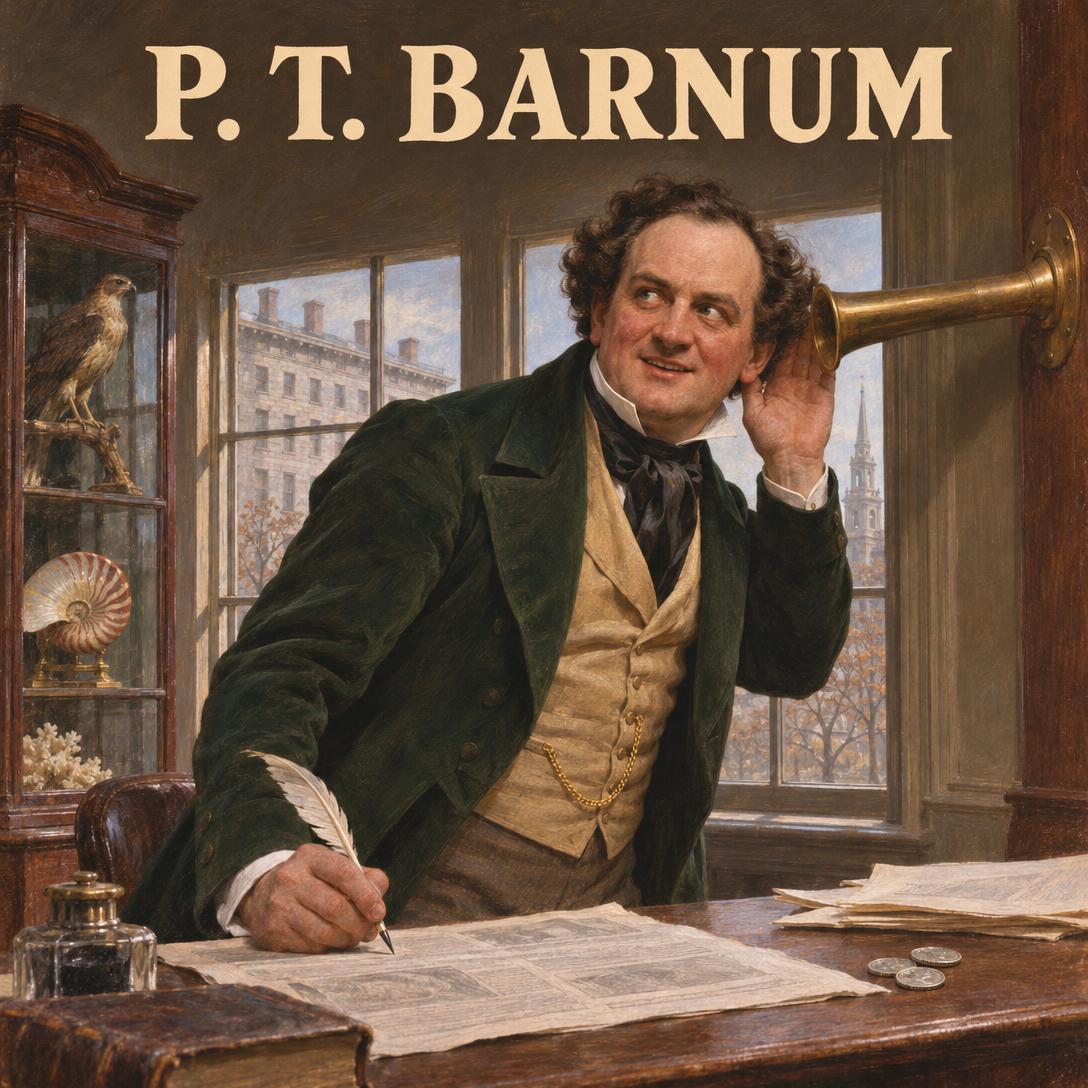
Roleplaying with P. T. Barnum on Jenova lets you step into a living-world AI character simulation across his iconic eras. Unlike static character chatbots that sit in an empty chat room or forget your story, this simulation connects you to Barnum inside an active, evolving world. You speak, and an uncanny voice reaches his ear while he goes about his business.
- ✅ Four canonical eras, from the American Museum to the three-ring circus
- ✅ Era-locked voice and knowledge, with no future hindsight
- ✅ Unlimited memory and live tracking of your storyline
- ✅ A Barnum with his own ambitions who won't simply flatter you
Most Barnum content is a biography or a quote collection. This experience puts you in the room as he stakes a fortune on a gamble, and lets you decide whether to talk him out of it.
Quick Answer: What Is the P. T. Barnum AI Roleplay Experience?
P. T. Barnum is an interactive AI character roleplay simulation that lets you converse with the 19th-century showman across four canonical eras, advise his gambles, and reshape his story inside a living world with unlimited memory.
Key capabilities:
- Choose from four eras or define a custom starting point, including a face-to-face meeting
- Talk with a Barnum whose voice, worries, and knowledge match the era you enter
- Keep a continuous storyline with persistent memory and live world-state tracking
- Request in-world handbills, letters, and scenes, or Fork a conversation into a "what-if" timeline
Character World & Roleplay Features
Phineas Taylor Barnum (1810–1891) wrote and revised his own life story for decades. His memoir Struggles and Triumphs appeared in an 1872 edition billed as "biography complete to April, 1872". The Smithsonian Libraries describe the book as an ongoing autobiography of his adventures as a showman. A man who curated his own legend makes a rich subject for roleplay: he is warm, shrewd, and always calculating the next audacious play.
His 1850 bet on Swedish soprano Jenny Lind shows the scale of his gambles:
150 concerts at $1,000 per performance — Barnum's offer to Lind, made before he had heard her sing a note
Most AI character bots flatten a figure like this into a generic voice. LiveTale describes the typical pattern: you pick a character, someone designs their personality, and you trade messages. The usual failures follow from that. The character waits in an empty void, blends every period of its life into one voice, forgets what you told it, and folds the moment you push back.
| Static Character Chatbots | P. T. Barnum on Jenova |
|---|---|
| Sits in an empty chat void | Lives in an active, evolving world |
| Blends all eras into one generic voice | Locks into authentic canonical phases |
| Forgets plot twists and past disclosures | Unlimited memory and live state tracking |
| Folds instantly like a polite assistant | Independent personality and earned rapport |
Authentic Canonical Phases & Custom Starting Points
Each era carries its own psychology, inner circle, and limits on what Barnum knows. The scrappy Broadway upstart of the 1840s has no idea what the Jenny Lind gamble will cost him. The seventy-one-year-old patriarch has already lived through it. You can also write your own starting point, including meeting Barnum in person at a stage door or turnstile.
Cross-World Portal & Living World Momentum
You reach Barnum through an acoustic curiosity: a clear voice at his ear that no one else in the room can hear. Meanwhile his world keeps moving. Associates interrupt, ticket receipts come in, and rival editors write their columns. Barnum answers you while handling it all, rather than waiting for your next message.
Independent Agency & an Open Sandbox
Barnum interprets what you say rather than obeying it. Sound counsel and wit earn his trust over time. Humorless insolence earns a flinty Yankee rebuke. Your choices can bend his history, and the story has no forced ending.
In-Narrative Visions, Writings & Storyline Forking
Ask to see a broadside proof or a scene from his world, and the simulation can generate an in-world image. Ask for a handbill, press puff, contract, or letter, and Barnum drafts it in his own voice. Silent research keeps period details grounded. Fork lets you branch any moment into a parallel timeline.
"Mr. Barnum, the papers are calling that exhibit a fraud. Should you answer them or let them keep arguing?"
"I'll put up the first hundred dollars if you'll let me bet against your next headline."
"Tell me about the first time you nearly lost everything."
How to Roleplay with P. T. Barnum
Step 1: Choose an era or define your own starting point Pick one of Barnum's four canonical phases, or write a custom scene such as a face-to-face visit to his office. The era you choose locks in his age, finances, worries, and the people around him.
"I'd like to begin on the night before Jenny Lind's debut."
Step 2: Connect through the portal and talk Your voice reaches Barnum as a startling acoustic marvel, and he greets you with brisk Yankee good humor before returning to business. Speak naturally. He answers in his own cadence, and the scene around him keeps moving.
"I can hear you counting silver. How much is riding on tomorrow night?"
Step 3: Offer counsel, build rapport, and reshape history Trust comes slowly. Give him practical advice, challenge his methods, or pitch a publicity angle. Ask for a handbill, a letter, or a look at the scene. Use Fork to test "what if" versions of his history. You can roleplay with Barnum on Jenova for as long as the story runs, because the memory never resets.
"Suppose the Herald won't print your puff. What's your second move?"
Canonical Eras & Roleplay Scenarios
🎪 The Prince of Humbugs at the American Museum
You enter Barnum's second-floor office at Barnum's American Museum on Broadway in 1843, with the halls packed and a young prodigy rehearsing nearby. This is the era for hearing how a Bethel storekeeper's son turns curiosity and newsprint into a business, and for testing his ethics. Barnum draws a line between a swindler who takes silver and gives nothing back, and a showman who delivers a wonder worth the quarter. Push on that line and see how he defends it.
🎼 The Swedish Nightingale Gamble
The second era puts you inside Castle Garden on September 10, 1850, the evening before Lind's debut. The Smithsonian's concert program records that she performed there on September 11, 1850. The same record notes that advance publicity created such demand that Barnum sold tickets by auction. You can advise a nervous impresario on art, publicity, and risk. The Hudson Valley account confirms the 150-concert contract, so his stakes here are real.
The same record notes that Lind ended her contract amicably in 1851. Barnum, in this era, does not know that yet, so you can steer him toward different choices.
🐘 Monarch of the Three-Ring Circus
In 1882, at age seventy-one, Barnum stands outside Madison Square Garden beside a colossal crate wedged in the archway. He is mischievously serene and treats the jam as free publicity. This is the era for long, unhurried talks about legacy, partnership, and what forty years of showmanship have taught him. His late-night candor is warmer than the businesslike Barnum of 1843.
🎩 The Greatest Showman in Crimson & Gold
The fourth era is a separate incarnation from the 2017 musical film: a romantic, kinetic dreamer in a crimson ringmaster's coat who champions his troupe as a chosen family. It is strictly isolated from the historical eras, so the two Barnums never blend. Choose it for an emotional, character-driven roleplay about belonging and ambition.
📱 Long-Form Campaigns on Mobile
The simulation works on web, iOS, and Android, with your storyline synced across all three. Continue a scene from your phone on the commute, then pick it up on your laptop that evening. Between sessions, Barnum's world advances by a natural interval, so you return to a day that moved on without you.
FAQ
Is the P. T. Barnum AI roleplay free?
You can start P. T. Barnum free with limited monthly usage. Paid tiers add more room for long campaigns. Plus costs $20 per month and provides 30× the free usage, custom model selection, and no watermarks. Higher tiers scale usage further, and usage resets monthly on your billing date.
How is this different from a generic Barnum chatbot?
A generic character chatbot usually waits in a blank chat window and blends the whole biography into one voice. This simulation locks Barnum into a specific era, gives him a living world, and tracks your story with unlimited memory. He also pushes back, reacts to your counsel, and earns trust gradually rather than agreeing with everything.
Which eras of Barnum can I roleplay with?
There are four: the American Museum in 1843, the Jenny Lind gamble at Castle Garden in 1850, the three-ring circus era in 1882, and the musical-film Barnum in crimson and gold. You can also write a custom starting point, including a face-to-face meeting in his world. Each era is isolated, so he has no knowledge of later events.
Can my choices change Barnum's story?
Yes. History up to your entry point follows the chosen era, and the story evolves freely from there with no forced ending. Your advice can alter his gambles, partnerships, and relationships. Use Fork to branch an earlier moment into an alternate timeline and compare outcomes without losing your original storyline.
Does the P. T. Barnum AI roleplay work on mobile and remember my story?
Yes. It runs on web, iOS, and Android with full synchronization. Conversations keep unlimited history, and a live tracker follows your era, scene, relationships, and plot threads. Your outside memories stay isolated from the roleplay, so the world is never contaminated by unrelated context. If you want to go deeper, the Barnum living-world simulation picks up exactly where you stopped.
Conclusion
Static Barnum chatbots recite quotes. This experience puts you in his world, from a crowded Broadway office to a gaslit concert hall to a jammed archway at midnight. You get a showman who weighs your counsel, remembers what you promised, and runs his own business while you talk. The P. T. Barnum AI roleplay turns a famous biography into a story you help write.
Try P. T. Barnum now. Explore more at Jenova.
For Developers: P. T. Barnum is available programmatically via the Jenova API — integrate era-locked character roleplay with persistent memory into your application with a single agent API call. Full documentation →