AI Overthinking Coach: Break Rumination Loops With Guided Practice
2026-08-15
The Meditation Guide works as your AI overthinking coach — identifying the specific pattern behind your mental loops, matching the technique most likely to interrupt it, and walking you through practice in real time. While generic advice tells you to "just stop thinking about it," this AI diagnoses whether you're dealing with rumination, worry, or post-event replay, then prescribes accordingly.
✅ Trained across every major contemplative tradition — Vipassana, MBSR, Zen, Tibetan, Yoga Nidra, and secular protocols ✅ Technique matching by loop type — 3 a.m. replay, pre-event worry, decision paralysis, or social post-mortems ✅ Custom guided scripts generated on demand for the exact loop you're stuck in ✅ Expert troubleshooting for when practice makes the loop louder instead of quieter
Overthinking isn't a personality quirk — the research literature treats repetitive negative thinking as a measurable, transdiagnostic process with real downstream consequences. To understand why an always-available coach beats another meditation app subscription, let's look at what rumination actually does and why conventional tools keep failing the people caught in it.

Quick Answer: What Is an AI Overthinking Coach?
An AI overthinking coach is a conversational AI trained in evidence-based practice that identifies your specific rumination pattern, matches an interruption technique to it, and guides you through the practice on demand — at the exact moment the loop starts.
Unlike static meditation apps that serve everyone the same library, a coaching agent adapts to your loop type, remembers what you've already tried, and troubleshoots when a technique backfires.
Key capabilities:
- Loop diagnosis — distinguishes rumination (past-focused replay) from worry (future-focused anticipation), since they respond to different interventions
- Technique matching — pairs your pattern with a specific practice instead of defaulting to generic breathing
- On-demand guided sessions — 2-minute interrupts for acute spirals, longer protocols for evening wind-down
- Custom script generation — written for your exact situation, length, and preference
- Adverse effect guidance — expert support when introspective practice amplifies the loop, a documented risk most consumer apps ignore entirely
- Complementary lifestyle support — coordinates with movement and nutrition guidance that affects the physiology underneath the thinking
The Problem: Overthinking Is a Mechanism, Not a Mood
Repetitive negative thinking is not a passive experience you wait out. Research characterizes rumination as a mechanism that actively develops and sustains psychological difficulty — and the population carrying it is enormous.
12 billion working days lost every year to depression and anxiety globally, at a cost of US$1 trillion per year in lost productivity — World Health Organization, Mental Health at Work
15% of working-age adults were estimated to have a mental disorder in 2019 — World Health Organization
Over a third of participants defined rumination specifically as repetitive, perseverative, and difficult to stop — Understanding the experience of rumination and worry
Nearly 50% of individuals who could benefit from therapeutic services are unable to reach them — Stanford HAI
The interventions that interrupt rumination are well documented in the clinical literature. Access to someone who can select and guide the right one is the bottleneck. But getting real, personalized help with overthinking is frustratingly difficult:
- Therapy is expensive, slow, and rationed — waitlists and per-session costs put structured support out of reach for most people caught in daily loops
- Meditation apps are catalogs, not coaches — they hand you a library and leave the hardest decision, technique selection, entirely to you
- Generic advice treats all overthinking as one thing — worry and rumination are distinct processes that respond differently to intervention
- Loops don't respect business hours — the 3 a.m. replay and the pre-meeting spiral happen far outside any appointment window
- Nobody troubleshoots when practice backfires — turning attention inward can intensify a loop, and most tools say nothing about it
Rumination Is Transdiagnostic — and Standard Treatment Underperforms Against It
The clinical literature treats repetitive negative thinking as a process that cuts across diagnostic categories rather than belonging to any one condition. A systematic review and meta-analysis on worry and rumination as a transdiagnostic target frames repetitive negative thinking as encompassing both worry and rumination and treats it as a transdiagnostic process worth targeting directly.
Notably, research reviewed by Frontiers in Psychology indicates that standard cognitive behavioral therapy "seems less effective in reducing depressive rumination" — which the same work describes as a key risk factor in the onset and persistence of depression. In other words: the general-purpose approach is not automatically the right approach for loops specifically. Technique selection matters enormously, and a static app library cannot make that call for you.
Worry and Rumination Are Not the Same Problem
This distinction is the single most useful thing most overthinkers have never been told. Rumination is typically past-oriented — replaying what happened, what it meant, why you said that. Worry is future-oriented — rehearsing what could go wrong. Post-event rumination research examines the relationship between replaying social events afterward and social anxiety symptoms as a distinct phenomenon worth studying on its own terms.
Give someone a future-focused grounding technique when their actual problem is a post-event social post-mortem and it will feel useless — because it is. Matching the intervention to the loop's direction is basic competence, and it's exactly what a search bar can't do.
Mindfulness and CBT Approaches Help — But Delivery Quality Varies
Evidence supports the underlying methods. A systematic review assessing treatments used to reduce rumination and worry concluded that mindfulness-based and cognitive behavioural interventions "may be effective in the reduction of both rumination and worry." And a review of interventions summarized by the American Psychiatric Association found that among interventions reviewed, roughly one third specifically targeted rumination — and those were significantly more effective at reducing it.
Read that again: interventions designed to target rumination outperformed those that weren't. Specificity is the active ingredient.
Guided Support Beats Unguided Content — The Data Is Clear
Here's the finding that should reshape how you think about wellness apps. A study of digital mental health coaching in clinically diverse populations compared users who received coaching against users who only used the companion app. Coaching users showed significantly greater symptom reduction — with the effect "primarily driven by changes in anxiety and stress."
The critical detail: engagement with app content did not significantly differ between the groups. Both groups used the app similarly. The coaching group improved more anyway. As the authors put it, coaching's effectiveness "was not contingent on differential app usage."
Content is not the differentiator. Guidance is.
AI Support Works Best as a Skills Coach, Not a Therapist Substitute
A systematic review in Frontiers in Digital Health examining human, AI, and hybrid health coaching found that AI coaching "generally reported positive improvements in psychological wellbeing, including reductions in depressive symptoms and anxiety."
At the same time, Stanford HAI research documented real risks when chatbots are positioned as therapist replacements — including failures to recognize suicidal intent and stigmatizing responses across models. The study's authors note AI tools may be genuinely helpful in "less safety-critical scenarios" like "supporting journaling, reflection, or coaching," while cautioning that "LLMs for therapy" requires critical thinking about the appropriate role.
The distinction is the entire product design question. A coaching agent that teaches skills and guides practice is a fundamentally different thing from a chatbot pretending to be a clinician.
This is exactly what the Meditation Guide was built for.
Why the Meditation Guide Works as Your Overthinking Coach
The Meditation Guide is a dedicated coaching agent, not a content library with a search field. It carries deep training across every major contemplative tradition and — critically — knows how to select between them based on the loop you're actually stuck in.
Describe a 2 a.m. replay of a conversation from three years ago, and it doesn't hand you a generic 20-minute body scan. It identifies past-oriented rumination in a low-arousal nocturnal state and prescribes accordingly. That diagnostic step is the skill a good human teacher provides — and it's the skill missing from virtually every consumer wellness app.
| Traditional Approach | Meditation Guide |
|---|---|
| Therapy waitlists measured in weeks or months | Available instantly, any hour, any time zone |
| $100–$200+ per coaching session | Free tier available, no credit card required |
| Generic app library — you guess which technique | Practice matched to your specific loop type |
| Same audio file for every user | Custom scripts generated for your exact situation |
| Silence when practice makes the loop worse | Expert guidance for adverse effects and difficult sessions |
| No memory between sessions | Persistent recall of your patterns, history, and what's failed |
Diagnosis Before Prescription
The agent's first move is identifying what kind of loop you're in. Past-oriented replay, future-oriented worry, decision paralysis, and social post-mortems each respond to different technique families. Getting this wrong is why most people conclude "meditation doesn't work for me."
"I keep replaying a conversation from a meeting last Tuesday. It's been five days. What is this and what actually stops it?"
Interrupt Protocols Sized for Real Moments
Loops don't wait for a free half hour. The Meditation Guide builds short-form interrupts — two to three minutes — that you can deploy the moment you catch yourself spiraling, alongside longer protocols for evening wind-down when the day's unfinished thinking surfaces.
"Give me something I can do in three minutes at my desk when I notice I've been stuck on the same thought for twenty minutes."
Custom Guided Scripts on Demand
Rather than scrolling a catalog for something close enough, you describe the loop and receive a script written for it — right length, right technique, right tone.
"Write me a 6-minute script for winding down when my brain won't stop rehearsing tomorrow's difficult conversation. Secular language, no visualization."
Troubleshooting When Practice Amplifies the Loop
This is where the Meditation Guide separates itself decisively. Turning attention inward can, for some people, make rumination louder — a well-documented phenomenon that consumer apps almost universally ignore. When that happens, the agent adjusts technique family, shifts to external-anchor or movement-based practice, dials intensity down, or flags clearly when professional support is the right call instead.
"Every time I sit and observe my thoughts I end up more tangled in them than when I started. What's going wrong?"
Related Agents You'll Also Find Useful
Overthinking rarely stays in one domain. These agents address the situational and physiological drivers that practice alone can't resolve — each a natural next step in the same workflow.
Fitness & Workout Coach
WHO guidance on mental health at work explicitly lists "opportunities for leisure-based physical activity" among recommended individual interventions. If your loops run hardest when you've been sedentary and mentally overloaded, structured movement is often the faster lever than another sitting practice.
- Custom programs matched to your schedule, equipment, and current fitness level
- Real-time session coaching with form guidance and video demonstrations
- Progress tracking that connects training consistency to how your head feels
Public Speaking Coach
If your overthinking concentrates around presentations, meetings, and social post-mortems — the exact territory post-event rumination research examines — targeted anxiety management plus rehearsal beats general practice every time.
- Dedicated anxiety management techniques for performance situations
- Audience simulation and Q&A pressure-testing
- Delivery coaching that reduces the raw material your brain replays afterward
Negotiation Coach
A large share of decision paralysis is genuine strategic uncertainty wearing a rumination costume. When you're looping on a salary conversation or a contract term, a preparation playbook resolves the loop faster than any breathing technique.
- Strategy sessions that convert circular worry into a concrete plan
- Role-play simulations that pressure-test the outcomes you're catastrophizing
- Preparation frameworks from salary talks through complex deals
Personal Financial Advisor
Money is one of the most common loop subjects, and it's a domain where the underlying uncertainty is often genuinely resolvable. Turning a vague 3 a.m. financial dread into an actual number and an actual plan removes the fuel.
- Expert guidance across budgeting, debt management, and retirement planning
- Concrete modeling for the major decisions you keep circling
- Ongoing partnership rather than a one-time consultation
Try the Meditation Guide free — no credit card required.
How It Works: From Loop to Interrupt
Step 1: Describe the Loop, Not the Diagnosis
Skip the self-labeling. Describe what the thought actually is, when it starts, how long it runs, and what you were doing beforehand. The agent uses this to classify the loop type and rule out techniques likely to intensify it.
"Every night around 11 I start replaying every awkward thing I said that day. It runs for an hour or more before I fall asleep."
Step 2: Get Your Technique Match and the Reasoning
You receive a specific recommendation plus the rationale — which practice, why it fits this loop's direction and arousal level, and how it differs from whatever you tried before. Understanding why a technique fits measurably improves whether you stick with it.
Step 3: Run the Practice in Real Time
Request a session and the agent guides it live, with pacing, cues, and adjustments. Sessions run as short as two minutes for an acute spiral or extended for structured evening practice.
"Guide me through it right now — I've been stuck on the same thought for half an hour and I need to work."
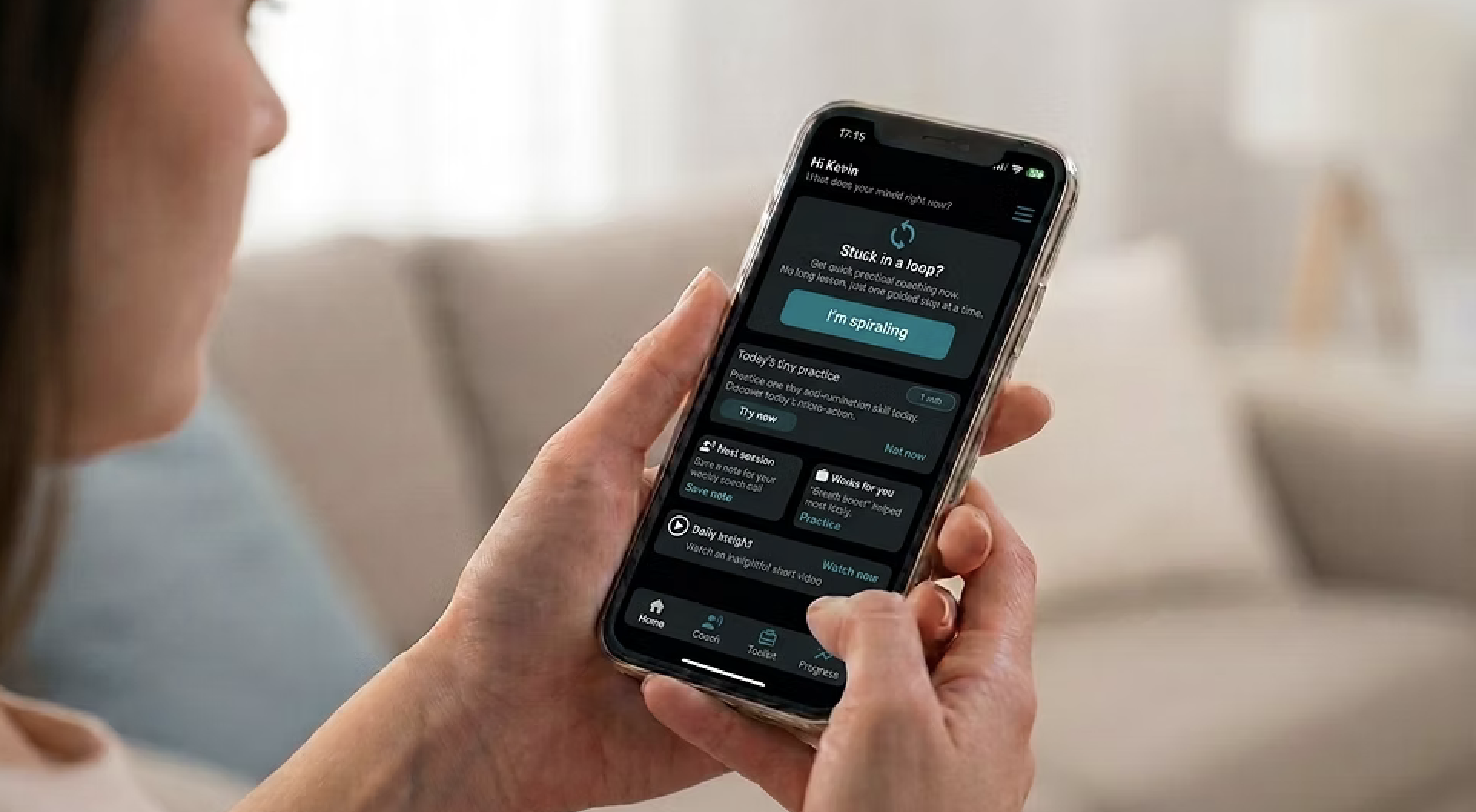
The value of an on-demand coach is precisely this moment — the "I'm spiraling" moment, when the loop is live and a catalog of pre-recorded audio is the last thing that will help.
Step 4: Report Back and Refine
Tell the agent what worked and what didn't. It adjusts technique, duration, and timing based on your actual results rather than assuming the first prescription was correct. Persistent memory means you never re-explain your history.
"The counting practice worked at my desk but does nothing at night. What should I switch to for the 11 p.m. version?"
Step 5: Layer in the Supporting Levers
Once your interrupt practice is stable, extend into what feeds the loops — bringing in the Fitness & Workout Coach for movement, or the Negotiation Coach when a specific unresolved decision is generating the material.
Results & Use Cases
🌙 The 3 A.M. Replayer
Scenario: Falls asleep fine, wakes at 3 a.m. with a specific conversation looping on repeat, loses 90 minutes to the ceiling before the alarm.
Traditional Approach: Sleep hygiene listicles that all say the same five things, or scrolling until exhaustion wins.
Meditation Guide: Techniques suited to nocturnal rumination in a low-arousal state — accessible on a phone in the dark without navigating a menu system while half-awake. Yoga Nidra and related protocols designed specifically for the sleep-adjacent state.
- Available at the exact moment the loop is running
- Practices that don't require full wakefulness to execute
- Distinguishes nocturnal replay from daytime worry and treats them differently
💼 The Post-Meeting Post-Mortem
Scenario: A product manager who performs fine in meetings and then spends the next four hours dissecting one sentence they said, unable to focus on actual work.
Traditional Approach: A three-week wait for a first therapy appointment at $150+ per session, or an app that suggests a 15-minute body scan they don't have time for.
Meditation Guide: A short interrupt protocol matched to post-event rumination — the pattern research on social anxiety and post-event processing examines directly — deployed the moment the replay starts rather than hours later.
- Interrupts sized for real calendar gaps, not idealized blocks
- Technique switches when a practice stops working, instead of silent abandonment
- Persistent memory of what's already been ruled out
🎯 The Person Meditation Made Worse
Scenario: Tried a popular app, found that observing thoughts made them louder and more sticky, concluded overthinking is just who they are.
Traditional Approach: Quit entirely. No app offers troubleshooting for this despite it being a real and recognized phenomenon.
Meditation Guide: Identifies why introspective practice is amplifying the loop, switches to external-anchor or movement-based technique families, and rebuilds tolerance gradually — with explicit boundaries on when professional care is the right answer instead.
- Direct expertise in adverse effects rather than a support vacuum
- Entire technique families most users never discover exist
- Honest about the limits of what AI coaching should handle
📱 The Decision Paralysis Spiral
Scenario: A founder stuck on a hiring decision for eleven days, running the same three scenarios on loop without converging, losing sleep and momentum.
Traditional Approach: More research, more spreadsheets, more circular conversations with the same two friends.
Meditation Guide: Separates the genuine decision problem from the rumination wrapped around it — clearing enough mental bandwidth to think, then handing the strategic component to the Negotiation Coach or Personal Financial Advisor where the loop is actually about unresolved uncertainty.
- Distinguishes "I need to think more" from "I'm looping and calling it thinking"
- Interrupt practice that restores decision-making capacity
- Complementary agents that resolve the underlying question
Frequently Asked Questions
Is an AI overthinking coach free to use?
Yes. The Meditation Guide is available on Jenova's free tier with all core features and no credit card required. Paid plans start at $20/month for substantially higher usage limits and custom model selection, scaling through several tiers. Usage resets monthly on your billing date with no daily caps.
How is this different from a meditation app like Calm or Headspace?
Those platforms are content libraries — you browse and pick. A coaching agent diagnoses your loop type, recommends a specific technique with reasoning, generates custom scripts, and troubleshoots when practice isn't working. Research on digital coaching found that guided users improved more than app-only users even with equivalent content engagement — guidance is the variable, not the library.
Can an AI overthinking coach replace therapy?
No, and it shouldn't try. Stanford HAI research documents real risks when AI chatbots are positioned as therapist replacements, while noting AI may be genuinely useful for coaching and reflection. The Meditation Guide is a skills and practice coach for everyday overthinking. For clinical anxiety, depression, OCD, trauma, or crisis situations, licensed professional care is the right path — and the agent will say so.
Does practice actually reduce rumination?
The underlying methods have research support. A systematic review of treatments for rumination and worry found mindfulness-based and cognitive behavioural interventions may be effective in reducing both. Notably, interventions specifically targeting rumination outperformed general approaches — which is precisely why technique matching matters more than technique volume.
What's the difference between overthinking, worry, and rumination?
Rumination is generally past-oriented — replaying events, mistakes, and their meanings. Worry is future-oriented — rehearsing what might go wrong. Clinical literature groups both under repetitive negative thinking and treats it as a transdiagnostic process. They respond to different interventions, which is why a coach that identifies which one you're in outperforms generic advice.
Does it work on mobile?
Yes. Jenova offers full feature parity across web, iOS, and Android, with settings synced across devices. That matters here more than in most categories — the loop usually starts when you're nowhere near a laptop.
What if practice makes my overthinking worse?
Tell the agent immediately. Introspective practice intensifying a loop is a real phenomenon, and the Meditation Guide is specifically equipped to troubleshoot it — switching technique families, reducing intensity, shifting to external-anchor or movement-based practice, or recommending professional support when that's the honest answer.
Conclusion
Overthinking is not a character flaw and it is not something you can decide your way out of. Research treats repetitive negative thinking as a mechanism — one that over a third of people describe as fundamentally difficult to stop, and one that standard general-purpose approaches address less effectively than interventions built specifically for it.
The gap has never been information. It's been access to someone who can tell you which loop you're in, which technique interrupts it, and what to do when that technique doesn't work. Nearly half of people who could benefit from therapeutic support can't reach it, and the apps filling the gap hand you a catalog and wish you luck.
An AI overthinking coach closes that gap. Loop diagnosis before prescription. Interrupt protocols sized for the moments loops actually happen. Custom scripts for your exact situation. Persistent memory so you never re-explain. And — uniquely — expert troubleshooting when practice makes things louder instead of quieter.
Start with the loop you're actually stuck in, not a search bar. Try the Meditation Guide now. Explore more at Jenova.
For Developers: The Meditation Guide is available programmatically via the Jenova API — integrate expert rumination-interruption and guided practice coaching into your wellness or mental health application with a single API call. Full documentation →