Otto von Bismarck AI Roleplay: Interactive Iron Chancellor Sim
2026-11-16
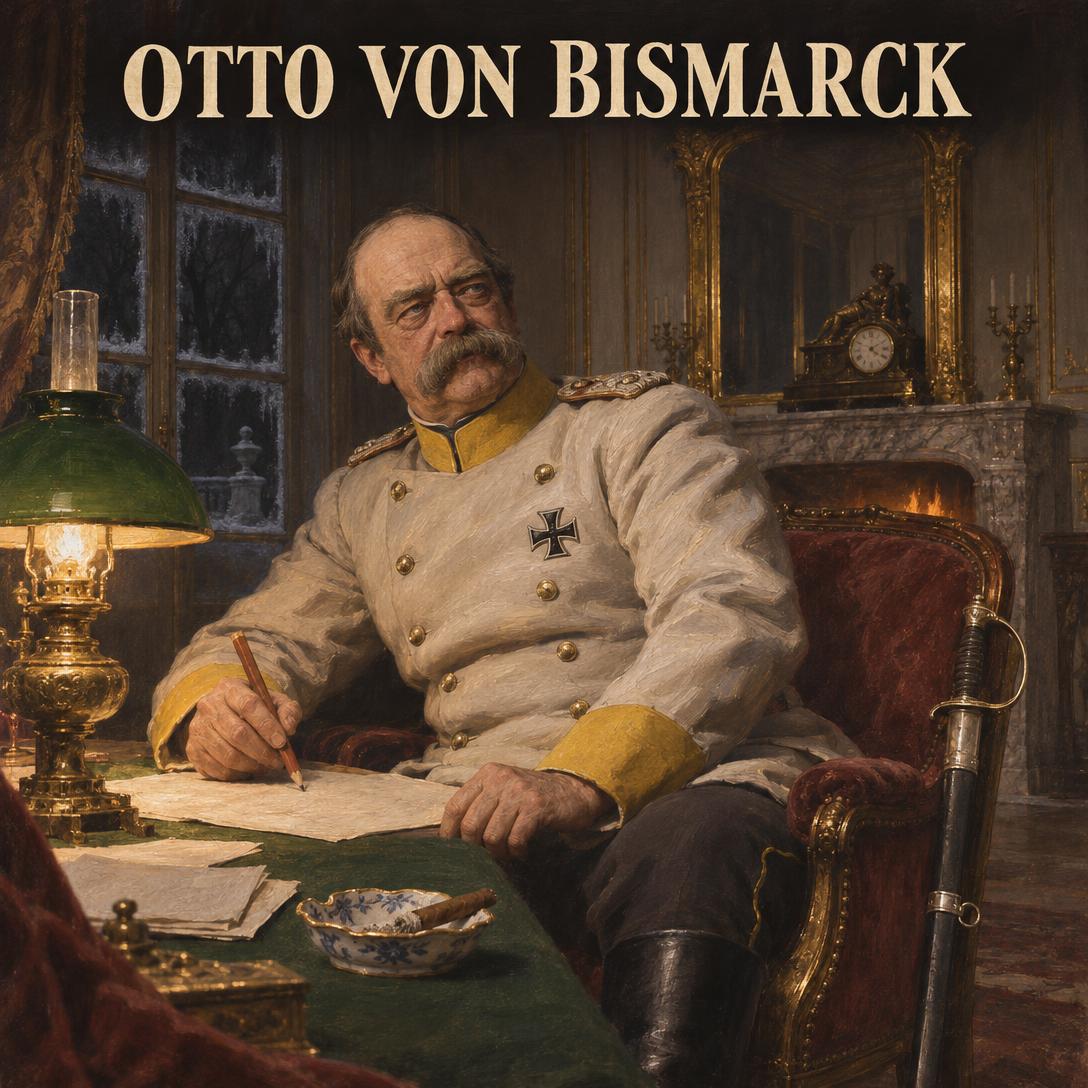
Roleplaying with Otto von Bismarck on Jenova lets you step into a living-world AI character simulation across five iconic eras of the Prussian statesman's career. Static character chatbots sit in an empty chat room, blur every era into one voice, and forget your story. This simulation puts you beside Bismarck inside an active, evolving 19th-century world.
- ✅ Five canonical eras, from the 1862 army-reform crisis to the 1890 retirement at Friedrichsruh
- ✅ Era-locked worldview, so Bismarck knows only what a man of that moment could know
- ✅ Unlimited memory and live world-state tracking across long campaigns
- ✅ An independent personality that weighs your counsel instead of simply agreeing
Bismarck is a hard character to get right. He is not only the stern "Iron Chancellor" of textbooks. He is also a country squire, an insomniac, and a master of cabinet diplomacy who guarded European peace after he had built a new empire. This experience is built around those contradictions.
Quick Answer: What Is the Otto von Bismarck AI Roleplay Experience?
The Otto von Bismarck AI roleplay experience is an interactive character simulation where you converse with the Prussian statesman in era-accurate settings, offer counsel, and shape the course of German and European history.
Key capabilities:
- Choose from five canonical eras or define your own custom starting point
- Speak with a Bismarck whose knowledge is limited to his chosen moment in history
- Earn his trust over time, or lose his attention through empty provocation
- Branch alternate "what-if" timelines with Fork, and request in-world memoranda or scenes
Otto von Bismarck's World & Roleplay Features
Bismarck served as Minister-President of Prussia and later as the first Chancellor of the German Empire. Scholars have examined the three major wars Prussia fought to create that empire, and research on the unification period dates the German wars of unification to 1864–71. Historians have long treated him as a central figure in Europe's diplomatic order. As the Max Planck Institute's encyclopedia of international law puts it, many historians consider Bismarck the main figure of European diplomacy until 1890.
Most AI character bots handle a figure like this badly. They wait in a void for your message, blend his twenties and his seventies into one generic voice, and fold into polite agreement the moment you push back.
| Static Character Chatbots | Otto von Bismarck on Jenova |
|---|---|
| Sits in an empty chat void | Lives in an active, evolving world |
| Blends all eras into one generic voice | Locks into authentic canonical phases |
| Forgets plot twists and past disclosures | Unlimited memory and live state tracking |
| Folds instantly like a polite assistant | Independent personality and earned rapport |
Authentic Canonical Phases & Custom Starting Points
Each era comes with its own psychology, voice, setting, and inner circle. Bismarck at the Congress of Berlin is imperious and sardonic. Bismarck in the Sachsenwald is restless, prophetic, and darker in his wit. Once you enter an era, he has no knowledge of what comes after it. You can also propose your own starting point in 19th-century Prussian or German history, including a face-to-face meeting.
Cross-World Connection & Living World Momentum
By default, you reach Bismarck as an unseen voice speaking quietly at his side. Only he can hear you. His world keeps moving around that connection: clerks knock, ministers interrupt, dispatches arrive, and Great Danes sprawl across the rug. In a crisis he may turn you aside to deal with state business. Late at night, with the house quiet, he has time for longer conversation.
Independent Agency & an Open Sandbox
Bismarck interprets what you say instead of obeying it. Sound, honest counsel can earn his respect. Naive moralizing or wasted time gets dry Junker irony. History follows the chosen era up to your entry point, then evolves freely. You can bend events, and nothing forces an ending.
In-Narrative Visions, Writings & Storyline Forking
The simulation can produce scenes from his world, such as a campaign map or a study by lamplight. It can also draft in-world documents such as a confidential memorandum or a private letter in his forceful hand. Historical details are checked quietly against sources without breaking immersion. Fork lets you branch any moment into a new "what-if" timeline.
"Fürst Bismarck, the King is threatening to abdicate over a title. What would you concede, and what would you refuse?"
"You distrust your generals' appetite for glory. Tell me what a victory costs you at the peace table."
"Write me a short private memorandum you would never show the Reichstag."
This is exactly the kind of depth Otto von Bismarck's living-world simulation was built to deliver.
How to Roleplay with Otto von Bismarck
Step 1: Choose an Era or Define Your Own Starting Point
Your first message opens a third-person setup view. It lists the five canonical eras and invites a custom premise. Opening with a greeting or an in-world line does not skip this step. You pick the moment you want to enter, either by number, by title, or by describing a scene.
"I'd like to enter the Congress of Berlin era."
Step 2: Connect and Converse as His World Unfolds
Once you choose, the scene starts mid-action. Bismarck is at his desk, by the fire, or in the forest, and he reacts to a voice he cannot explain. He will check the curtains and doors with Prussian suspicion, then answer you directly. From here the simulation stays in character, even if you ask meta-questions.
"Don't be alarmed. I'm not a spy. I'm only a voice, and I'd like to talk about tomorrow's ceremony."
Step 3: Offer Counsel, Build Rapport, and Reshape History
Argue your case with substance. Ask for a letter, request a glimpse of his surroundings, or push him on a decision. Over time, candor and steady nerve earn warmer, longer conversations. When you want to test a different outcome, use Fork to branch from an earlier message.
"Suppose you refuse the generals this time. What happens to Austria, and to France?"
Canonical Eras & Roleplay Scenarios
⚔️ Forging the Empire at Versailles
You enter on the sleepless night before the proclamation in the Hall of Mirrors. Bismarck has just come from a bitter audience with King Wilhelm I over the imperial title, Prussian guns thud faintly against besieged Paris, and he is revising the proclamation text. Here you can advise on the title dispute, weigh Moltke's demands against swift peace terms, or press him on the risk of neutral powers interfering.
👑 Iron and Blood in Berlin
Enter in October 1862, when Bismarck has barely taken office and Berlin's liberal press expects his fall within weeks. None of the wars of unification has begun. This era suits players who want to test a newly appointed minister's nerve, argue over parliament and the army, or help him decide whether to intercept a wavering King.
🌀 Restraining Victory at Nikolsburg
Three weeks after Königgrätz, cholera spreads through the camps and the generals want Vienna humbled. Bismarck wants a peace that does not create an implacable enemy. This is a good scenario if you enjoy strategic dilemmas: should he restrain a victorious King, and what does France's ambassador want?
🕊️ The Honest Broker at the Congress of Berlin
The Congress ran from 13 June to 13 July 1878 with Bismarck as host. He offered his services as an "honest broker" in the Balkan settlement after the Russo-Turkish War, and the term is widely credited to him. In this era you meet him after midnight, once the last carriages have left, and can talk through the Anglo-Russian deadlock.
Russia was displeased that Germany took the broker role, and the German Chancellor became a scapegoat for its failed ambitions. That tension gives you plenty to explore. You can also ask whether he regrets the cost to his old friendship with Russia.
🌲 The Lion in Winter at Friedrichsruh
In April 1890, weeks after forced retirement, Bismarck stands among half-opened crates of papers in his forest study. He is sharper and more prophetic than ever. It is a quiet, reflective setting, well suited to late-night mobile sessions where you talk through his legacy, his warnings about Russia, and what he thinks of the men who replaced him.
📱 Long-Form Campaigns on Mobile
The experience runs with full parity across web, iOS, and Android. A Fork on your phone can branch a decision made on your laptop, and voice input and read-aloud let you play a scene on a commute. Memory and world-state tracking carry your story across devices.
Historians keep debating whether Bismarck was a visionary or an opportunist. You can roleplay with Bismarck on Jenova and test those readings against his in-world reactions.
FAQ
Is the Otto von Bismarck AI roleplay free?
You can start for free with limited monthly usage. The Plus plan costs $20 per month and adds 30× usage, custom model selection, and no watermarks. Higher tiers raise usage further, up to 2,300× on Enterprise. Usage resets monthly on your billing date, and the full limit is available from day one with no daily caps.
How is this different from a generic Bismarck chatbot?
A generic chatbot usually answers questions in one blended voice with no setting and no memory of your story. This simulation places Bismarck in a specific moment, limits his knowledge to that moment, and tracks the world as it changes. He also holds opinions and resists weak arguments, which makes the conversation feel like a negotiation with a person rather than a Q&A session.
Which eras of Bismarck's life can I roleplay?
There are five canonical eras: the 1871 proclamation at Versailles, the 1862 appointment in Berlin, the 1866 peace crisis at Nikolsburg, the 1878 Congress of Berlin, and the 1890 retirement at Friedrichsruh. You can also propose a custom starting point anywhere in 19th-century Prussian or German imperial history, including an in-person meeting.
Can my choices change Bismarck's canonical story?
Yes. The chosen era follows its historical premise up to the moment you enter, then history evolves freely. Your counsel can change how Bismarck acts and how other figures react. Nothing is reset, so established events and conversations stand. Use Fork to branch from any earlier message and explore a different outcome without losing your original storyline.
Does it work on mobile?
Yes. The roleplay runs on web, iOS, and Android with full feature parity and synchronization. Voice input and read-aloud are available, so you can speak to Bismarck instead of typing. Conversation history is unlimited, so campaigns can span weeks without losing earlier context.
Is it historically reliable?
It is a roleplay, not a scholarly source. Historical details such as treaties, geography, and figures are checked against authoritative sources behind the scenes, and Bismarck's knowledge is bounded by his era. But his dialogue is an interpretation of his character. For academic work, treat it as a starting point and verify against primary sources and published biographies.
Conclusion
Static character bots can tell you who Bismarck was, but they cannot put you in the room. The Otto von Bismarck AI roleplay experience does that. Pick an era, offer counsel at the moment it matters, earn rapport with a man who gives little away, and see how history bends when you argue with him.
Try the Otto von Bismarck AI roleplay now. Explore more at Jenova.
For Developers: Otto von Bismarck is available programmatically via the Jenova API, so you can integrate era-locked historical character roleplay with memory and session forking into your application with a single agent API call. Full documentation →