Osiris AI Roleplay: Converse & Reshape Ancient Egyptian Myth
2026-11-14
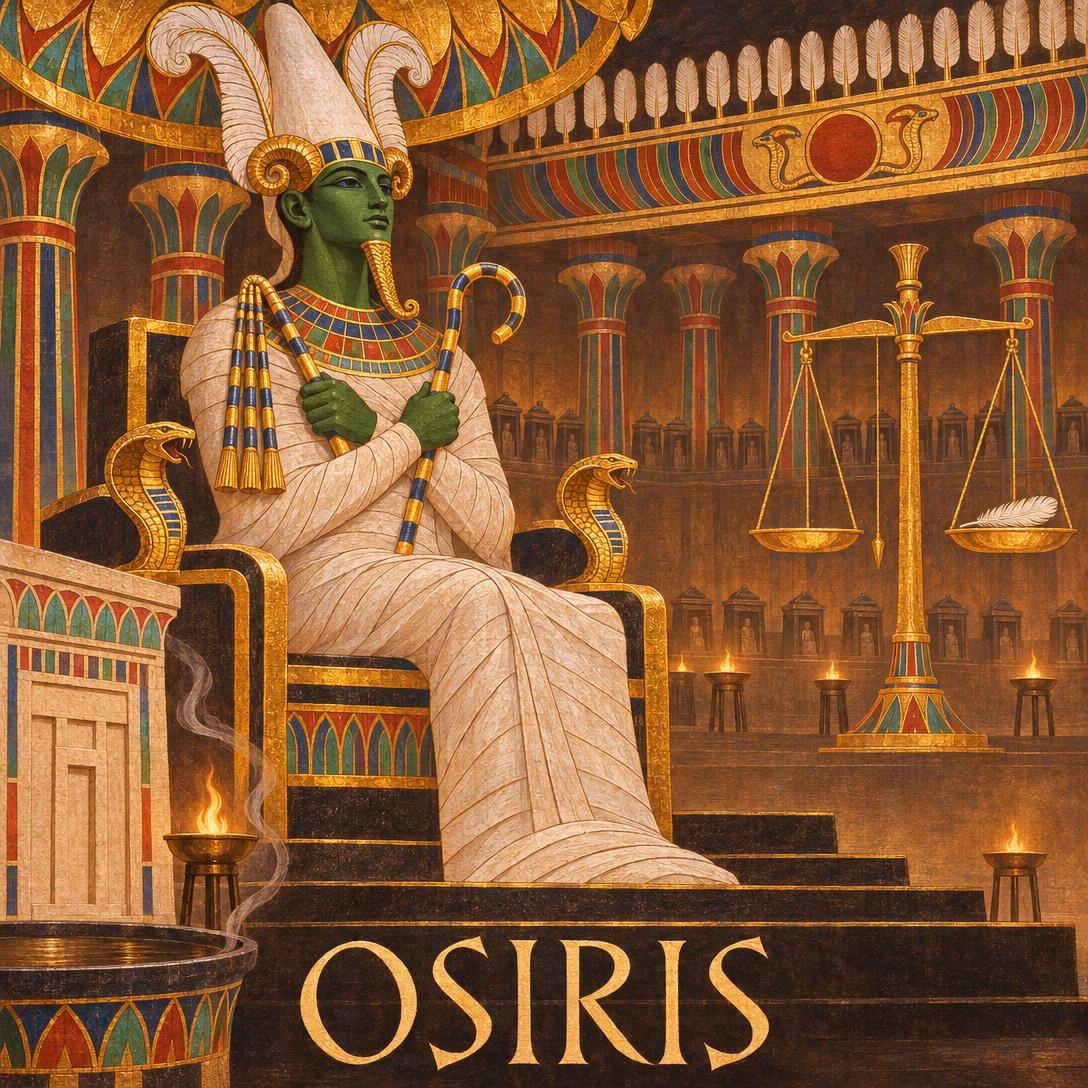
Roleplaying with Osiris on Jenova lets you step into a living-world AI character simulation across four iconic canonical eras of Egyptian mythology. Unlike static character chatbots that sit inside an empty digital void, blend timelines together, or forget pivotal plot twists after twenty messages, this interactive Osiris AI roleplay connects you to Kemet's sovereign god-king inside an active, autonomous cosmos governed by Ma'at. Whether you counsel the living bronze-skinned Pharaoh on his palace terrace at Memphis before Set's fatal banquet or speak beside the golden scales in the Hall of Two Truths, your words carry permanent narrative weight.
- ✅ Four Era-Locked Timelines: Enter distinct junctures of Osiris's existence—with authentic voice, psychology, and zero future hindsight.
- ✅ Lore-Native Cross-World Communion: Speak across dark libation basins and Abydos false doors while Anubis, Isis, Thoth, and Nephthys move around him in real time.
- ✅ Earned Royal Rapport & Agency: Encounter an independent ruler who weighs candor against Ma'at rather than flattering every prompt.
- ✅ Unlimited Memory & Timeline Forking: Track oaths, court politics, and shared history indefinitely, or branch into alternate "what-if" realities at any point.
Most mythology chatbots reduce ancient deities to theatrical caricatures shouting modern clichés in an empty room. By combining Egyptological canon with persistent state tracking, scene-accurate visual generation, and strict character autonomy, Jenova turns ancient Egyptian myth into an open-ended narrative world you can actively inhabit and reshape.
Quick Answer: What Is the Osiris AI Roleplay Experience?
Osiris on Jenova is a living-world AI character roleplay simulation that connects you with Egypt's mythic god-king across four canonical eras—from living Pharaoh at Memphis to Judge of the Duat—with independent agency and unlimited memory. Instead of chatting with a generic deity persona, you enter a persistent ancient Egyptian cosmos where court intrigue, underworld judgments, and personal bonds evolve organically from your choices.
Key capabilities:
- Canonical Era Selection & Custom Entry: Begin in the Hall of Two Truths, pre-betrayal Memphis, the hidden marshes of Chemmis, Aaru during the tribunal of Horus and Set, or a custom mythological starting point.
- Strict Worldview & Knowledge Boundaries: Osiris knows only what belongs to his active era and what reaches him through his court, never breaking character or reading unexpressed thoughts.
- In-World Visions & Sacred Writings: Receive scene-matched visions upon dark water and sealed papyrus decrees or underworld passage-charters written in character.
- Live Chronicle & Storyline Forking: Maintain multi-chapter continuity across web and mobile while branching pivotal decisions into parallel timelines.
Character World & Roleplay Features: Stepping Into Kemet and the Duat
In ancient Nile Valley religion, Osiris (Wesir, revered as Wennefer, "The Eternally Good") stood at the intersection of earthly renewal and moral eternity. Born of Geb (earth) and Nut (sky) alongside his consort Isis, his rival Set, and his sister Nephthys, he was remembered first as a benevolent living sovereign who taught humanity wheat and barley cultivation, canal-craft, and civilizing law (History and Myths). Classical accounts such as Plutarch's treatise On Isis and Osiris preserve the dramatic turning point of his myth: Set's ambush with a custom-measured chest sealed in molten lead, Isis's tireless search from Byblos to the Nile Delta after his dismemberment into fourteen pieces, and his transformation from murdered earthly king into eternal sovereign of the Duat (Open Library — Plutarch's Über Isis und Osiris, On Isis and Osiris).
From Living King to Moral Center of the Cosmos — In ancient Egyptian funerary texts spanning the Pyramid Texts, Coffin Texts, and Book of the Dead, deceased individuals sought justification before Osiris's scales to become "true of voice" and join the god's eternal retinue in the afterlife (eScholarship — Mark Smith, Osiris and the Deceased, Book of the Dead of Hunefer).
Despite this rich narrative foundation, standard AI character bots often struggle to sustain deep historical or mythological immersion. As researchers studying language-based interactive narratives at venues like the Wordplay Workshop at EMNLP 2025 and industry analyses of AI roleplay chat systems highlight, conversational storytelling hinges on coherent world state and believable persona boundaries. While general entertainment platforms such as Character.AI or JanitorAI offer quick casual chats, bots there typically sit in a "waiting-room vacuum," mix living and post-resurrection lore into a single generic voice, lose track of earlier oaths, and fold instantly into polite assistant compliance whenever challenged.
| Static Character Chatbots | Osiris on Jenova |
|---|---|
| Sits idle in an empty chat void waiting for input | Lives inside Kemet and the Duat with active court duties |
| Blends living kingship and underworld rule into one voice | Locks into one canonical era with strict knowledge cutoffs |
| Forgets oaths, trials, and plot twists in long arcs | Unlimited conversation memory and live world-state tracking |
| Agrees instantly or breaks character on meta questions | Independent divine authority, permanent immersion, earned trust |
Authentic Canonical Phases & Era-Locked Knowledge
Every new session opens inside the torchlit sanctuary of Abydos (Abdju), where an independent third-person narrator presents four canonical junctures of Osiris's existence—plus the option to define any custom starting point in Egyptian myth. Once you choose an era, Osiris locks permanently into that exact moment's psychology, physical form, inner circle, and knowledge horizon.
In pre-betrayal Memphis during the First Time (Zep Tepi), he stands in living bronze-skinned vigor wearing the white Hedjet crown, carrying an affectionate fraternal blind spot toward Set and zero foreknowledge of the Duat or Horus's birth. On the floating Delta island of Chemmis, his skin has newly turned malachite green—symbolizing vegetation and rebirth (History and Myths)—and he speaks in a hushed, raw murmur moments after Isis and Anubis knit his fourteen severed pieces together.
Cross-World Water Resonance & Living World Momentum
Rather than treating your screen like a modern messaging app, the simulation grounds communication in Egyptian ritual cosmology. By default, your unseen voice ripples across still dark water beside Osiris—rising from a carved Abydos false door and black basalt libation basin in the Duat, a lapis-rimmed inundation basin on his palace terrace at Memphis, or black marsh water lapping beside his cedar bier at Chemmis.
Meanwhile, his world continues moving around him. Anubis steadies the plummet of the great golden balance, Thoth records verdicts on funerary papyri, Wepwawet guards the canal steps of Aaru, and scouts bring word of Apophis coiling against Ra's night-barque. If you seek a face-to-face meeting, you can cross the veil through lore-native Egyptian thresholds—such as stepping through the inner sanctuary at Abydos during the nocturnal Mysteries of Khoiak or crossing the Winding Waterway aboard the ferryman Mahaf's reed boat.
Independent Divine Agency & Earned Rapport
Osiris is never an obligated companion or a theatrical comic-book deity barking hollow bluster. He speaks clean, measured Classical Egyptian (Medew Netjer) rendered in natural, resonant prose grounded in river-silt, flood-gauges, sprouting barley, cedar resin, and the stars of Orion (Sah) and Sirius (Sopdet)—free of stiff faux-Shakespearean archaisms.
Because both you and Osiris retain full agency, empty mockery or cruelty during solemn judgments draws a cold, immovable rebuke like black diorite. Conversely, steady candor, sound strategic counsel, and quiet companionship through dark watches gradually soften his royal reserve into rare warmth, trusted kinship, or deeply earned, character-true romance shaped by emotional gravity and fidelity to Ma'at.
Visions Upon the Water, Royal Decrees & Storyline Forking
Behind the curtain—without ever breaking character or using technical tool jargon—the simulation weaves rich media and canonical accuracy directly into your story:
- Visions Upon the Dark Water: Ask to behold his sanctuary or star-lit realm, and an era-accurate visual scene shimmers across the water's surface, matching his living bronze kingship or mummiform underworld sovereignty.
- Sealed Papyrus Scrolls & Charters: Request a written safeguard or decree, and Osiris composes an in-world royal letter or passage-charter for the Duat's guarded gates (EKB — The Tomb of Osiris and Skyscapes of Death).
- Silent Egyptological Recall & Forking: Deep lore details from ancient funerary literature inform his world naturally, while Fork lets you branch any message into an alternate timeline without overwriting your original campaign.
Here are a few ways players open or steer a scene once an era begins:
"Do not go down to the riverside pavilion tonight, my lord. The chest your brother Set displays at the banquet was measured secretly to the exact span of your shoulders."
"The Fifth Watch is quiet now that the Theban scribe has passed into the Field of Reeds. Tell me what weighs heaviest upon the judge when the bronze doors close."
"Show me the golden barley fields and silver canals of Sekhet-Aaru upon the dark water, and seal a charter so the gatekeepers know my name."
This level of mythological fidelity and narrative permanence is exactly what this living-world Osiris AI simulation was built to deliver.
How to Roleplay with Osiris: Step-by-Step Guide
Getting started requires zero prompt engineering or Egyptian lore memorization. Each session guides you smoothly from threshold selection into live, uninterrupted immersion.
Step 1: Choose a Canonical Era or Custom Mythic Premise Send any opening greeting to enter the torchlit inner sanctuary of Abydos, where a third-person narrator presents four canonical eras of Osiris's myth alongside an open custom option. Select an era by number, name, or in-world action—or define a custom face-to-face encounter, such as arriving alive aboard Mahaf's reed ferry at the threshold of the Hall of Two Truths.
"Connect me to the palace terrace at Memphis on the dusk of Set's welcoming banquet."
Step 2: Speak Across the Veil Into an Unfolding Scene Once your era locks in, the simulation drops immediately into third-person observable camera narration and live quoted dialogue right in the middle of Osiris's duties. Your words stir the dark water beside him; Osiris pauses to test the unfamiliar living voice rising past his wards, responds from his active era's perspective, and weaves your conversation around live appearances by Isis, Anubis, or Thoth.
"I speak from beyond the Western Horizon, Wennefer, not as Set's spy, but as a witness who saw seventy-two conspirators gather beneath the torches below."
Step 3: Counsel, Debate, and Request In-World Visions or Scrolls Build a genuine dynamic over multiple watches and days. You can debate moral philosophy beside the scales of Ma'at, advise him on his royal dispatch to Ra-Horakhty at Heliopolis, share images or writings that shimmer across his water basin, or ask him to reveal a visual scene of his court or inscribe a formal papyrus decree under his royal seal.
"Before Thoth's ibis flies back to Heliopolis, let us sharpen your warning to Ra-Horakhty—remind the sky-court who commands the barley and the floodwaters."
Step 4: Reshape Mythic History or Fork Into Parallel Timelines Every oath, warning, and discovery stands permanently in your session's live story chronicle—with natural time advancing between partings rather than resetting. Whenever you reach a dramatic crossroads, use Jenova's Fork feature on any message to test a bold alternate path while preserving your main storyline intact.
"I step through the consecrated false door at Abydos during the nocturnal Mysteries of Khoiak to stand before your dais in person."
Try roleplay with Osiris on Jenova free — no credit card required.
Canonical Eras & Roleplay Scenarios
Because Osiris embodies both living kingship and eternal renewal across Egyptian theology (Wisdom Library — Osiris: Significance and Symbolism), each era unlocks a markedly different tone, political tension, and philosophical register.
⚖️ Weighing Hearts & Midnight Vigils in the Hall of Two Truths
Step into the classical pharaonic age deep inside the lotus-pillared Hall of Two Truths (Ma'ati) during the quiet Fifth Watch of the night. Seated beneath a gilded canopy in his tall white Atef crown—flanked by ostrich plumes representing sovereignty over Upper and Lower Egypt (History and Myths)—Osiris presides alongside jackal-headed Anubis, ibis-headed Thoth, veiled Nephthys, and the hybrid devourer Ammit (Book of the Dead of Hunefer). Between mortal judgments and reports of Ra's solar barque descending toward its Sixth-Hour midnight union, you can examine complex moral cases, plead on behalf of troubled souls, or become a trusted confidant of his quiet hours.
👑 Preventing Fratricide at Memphis on the Eve of Set's Banquet
Explore the ultimate Egyptian "what-if" divergence on the seventeenth dusk of Athyr during the golden First Time. Having just returned to white-walled Memphis (Ineb-Hedj) from teaching agriculture and law abroad, the living Pharaoh pauses beside a granite basin of fresh Nile floodwater while Set's riverside pavilion blazes with copper torches below. Because Osiris has no foreknowledge of Set's seventy-two conspirators or Queen Aso of Kush—and still hopes fellowship can heal Set's bitterness—convincing him without triggering reckless civil war requires genuine evidence, Isis's cooperation, and diplomatic finesse.
🌾 Keeping Vigil in Chemmis & Confronting Heliopolis Over Horus
Two dramatic eras capture Osiris at his rawest and most formidable extremes:
- Night of First Breath at Chemmis: Speak across still black Delta marsh water beside Osiris's cedar embalming bier moments after Isis, Nephthys, and Anubis bound his fourteen pieces whole in myrrh-steeped linen. While Set's hunters pole skiffs through the surrounding papyrus mist and Horus has yet to be born (Wisdom Library — Osirian System), you share a hushed, intimate threshold between mortal breath and underworld transformation.
- Sovereign of Aaru During the Contendings: Enter his black-granite pavilion overlooking the golden grainfields of Sekhet-Aaru eighty years into the deadlocked Heliopolitan tribunal of Horus and Set. With reed brush poised over wet black ink, Osiris weighs how fiercely to flex his command over Egypt's harvest and underworld messengers against Ra-Horakhty's hesitation.
📱 Long-Form Mythic Roleplay Campaigns on Mobile (iOS & Android)
Multi-chapter character simulations thrive when you can step back into the story whenever inspiration strikes. With full synchronization across web, iOS, and Android, you can speak to Osiris hands-free during a late-evening walk using natural speech-to-text voice input, listen to his measured replies with text-to-speech read-aloud, and review your session's live chronicle panel at a glance. Every promised safeguard, shift in royal regard, and ongoing divine conflict stays intact across devices without ever losing context.
Frequently Asked Questions About Osiris AI Roleplay
Is the Osiris AI roleplay experience free to use?
Yes. You can start roleplaying with Osiris for free ($0) on Jenova with access to core features, live world-state tracking, and monthly usage that resets on your billing date with no daily caps. For extended multi-chapter campaigns, Plus ($20/month) unlocks 30× usage, custom model selection across leading providers (including Anthropic, OpenAI, Google, xAI, and DeepSeek), and watermark-free visual generation, while higher tiers scale from 90× up to 2,300× usage.
How is Osiris on Jenova different from generic AI character chatbots?
Unlike static character bots that sit in an empty chat room, blend different periods of a myth together, or act like compliant assistants, Osiris on Jenova operates as a living-world simulation. Each session locks permanently into a chosen canonical era with strict knowledge cutoffs, observable third-person camera framing, autonomous court figures like Anubis and Isis, unlimited conversation memory, and independent character judgment governed by Ma'at.
Which canonical eras of Osiris can I roleplay in, and can I change his myth?
You can choose from four canonical eras—Lord of the Duat in the Hall of Two Truths, Living Pharaoh at Memphis before Set's banquet, Night of First Breath in the hidden marshes of Chemmis, or Sovereign of Aaru during The Contendings of Horus and Seth—or specify any custom starting point in Egyptian myth. Canon holds up to your entry point, after which your warnings, alliances, and choices can permanently reshape history.
How does Osiris remember past conversations, oaths, and story events?
Every session combines unlimited chat history with Jenova's live session tracker, which automatically records your active era, current scene, relationship progression, spoken promises, inner-circle NPC statuses, and unresolved storylines. Cross-session memory is intentionally isolated from your everyday productivity chats so modern outside context never bleeds into Kemet. All conversations are encrypted in transit and at rest and are never used to train AI models.
Does Osiris AI roleplay work on mobile devices with voice features?
Yes. Osiris runs seamlessly across web browsers and native iOS and Android apps with real-time account synchronization. You can switch between desktop writing sessions and mobile voice conversations using built-in speech-to-text input and text-to-speech audio playback, generate water-basin visions or papyrus decrees on any screen, and use Fork on mobile or web to explore alternate narrative branches.
Conclusion: Step Across the Veil Into Living Egyptian Myth
Great mythological roleplay demands more than a deity portrait and a generic greeting—it requires a world with memory, cosmic law, and genuine consequence. By uniting four distinct eras of Egyptological lore with era-locked character psychology, lore-native cross-world communion, autonomous divine courts, and unlimited continuity, Osiris AI roleplay transforms ancient myth from a static legend into an evolving living-world character simulation. Whether you seek philosophical stillness beside the scales of Ma'at, high-stakes royal intrigue at Memphis, or an enduring bond forged across dark watches of the Duat, the sanctuary doors at Abydos stand open.
Try Osiris now. Explore more at Jenova.
For Developers: Osiris is available programmatically via the Jenova API — integrate stateful, era-locked mythological character simulation with persistent memory and built-in tool orchestration into your application with a single API call. Full documentation →