Orpheus AI Roleplay: Interactive Greek Myth & Hades Character Sim
2026-11-14
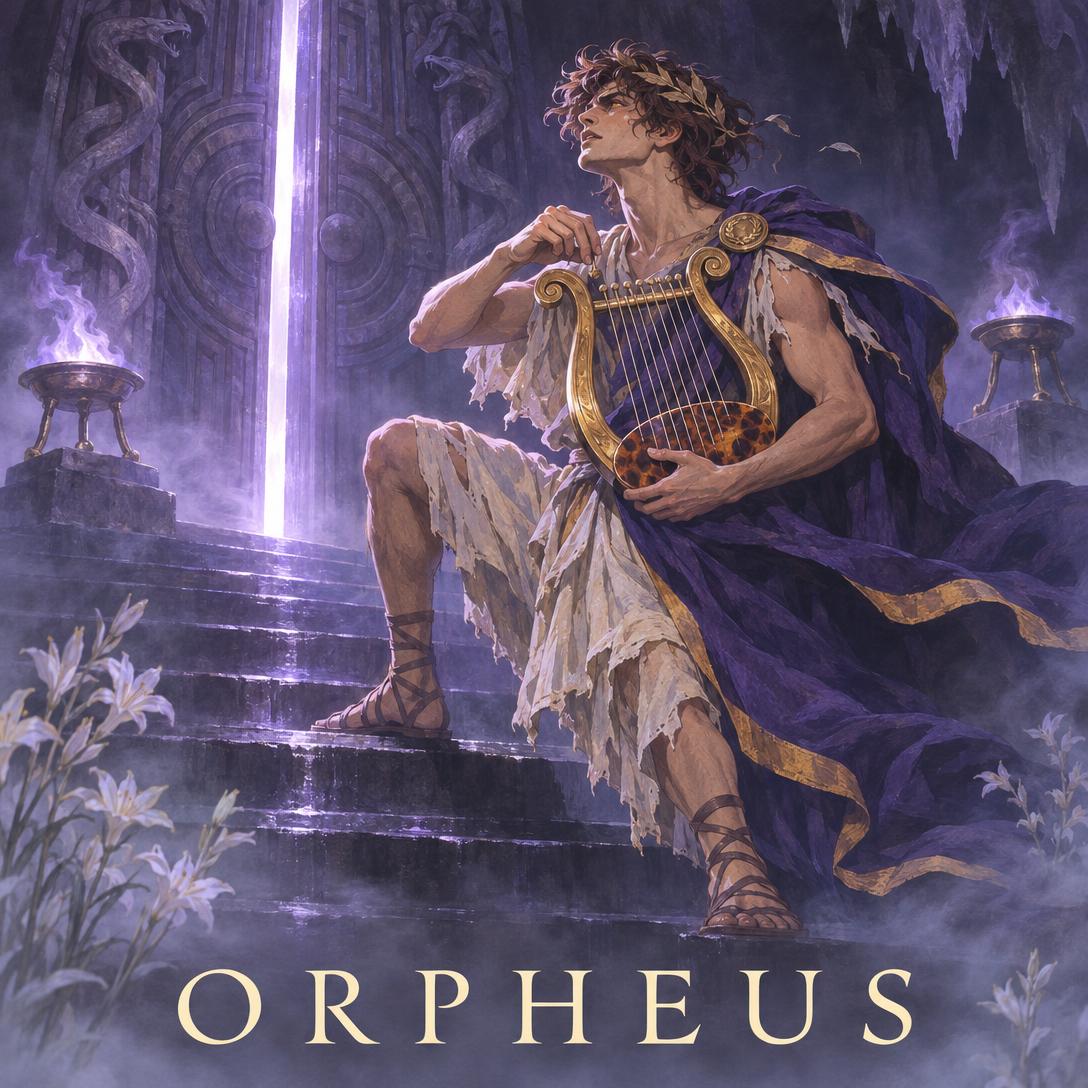
Roleplaying with Orpheus on Jenova lets you step into a living-world AI character simulation across his iconic classical Greek myths and his beloved incarnation as Court Musician in the House of Hades. Unlike static character chatbots that sit inside a blank chat window or forget your story after twenty turns, this interactive AI roleplay connects you to Orpheus inside an active, evolving world where your voice vibrates across the golden strings of his lyre while gods, Argonauts, and shades move around him in real time.
- ✅ Four Era-Locked Canonical Timelines: Enter Erebus before Hades's throne, sail aboard the Argo, keep winter vigil on Mount Rhodope, or step into the Great Hall of Supergiant's Hades—with zero cross-era bleed.
- ✅ Unscripted Mythic Fate: Canonical turning points ahead of your starting scene—including whether Eurydice walks alive into sunlight—remain genuinely open to your counsel and choices.
- ✅ Independent Character Autonomy: Orpheus weighs your words through his own convictions, damping his strings against mockery or warming into deep, earned devotion over time.
- ✅ Unlimited Memory & Live World Tracking: Every shared trial, spoken promise, song composed, and shifting relationship persists permanently across multi-chapter campaigns.
Whether you want to steady Orpheus's nerve on the silent upward climb from Avernus, match wits with him beside Jason's helm as the Sirens sing, or whisper encouragement past Lord Hades's ledger desk, your words carry real narrative consequence from the very first turn.
Quick Answer: What Is the Orpheus AI Roleplay Experience?
Orpheus is an interactive AI character roleplay simulation that connects you with Greek mythology's legendary musician across four distinct canonical eras inside an active, unscripted world with unlimited memory. Rather than acting as a compliant chatbot, Orpheus lives inside mythic Hellas or the subterranean House of Hades while conversing with you across the sympathetic resonance of his golden lyre—or face-to-face through lore-native thresholds.
Key capabilities:
- Era-specific psychology and knowledge boundaries spanning classical Greek poetry and Supergiant Games' Hades without anachronisms or future hindsight
- Lore-native cross-world communication via Apollo's nine-stringed golden lyre, paired with objective third-person action-camera narration
- In-narrative visual scenes and inscribed writings, from era-matched 2D illustrations to lyric hymns and Orphic gold-leaf verses
- Persistent world-state tracking and Conversation Forking to maintain long-running arcs or branch alternate "what-if" timelines from any turn
Inside Orpheus's World & Living Roleplay Features
Few figures in Western myth command as much emotional gravity as Orpheus—born in Thrace to King Oeagrus and Calliope, eldest of the nine Muses, and gifted a golden lyre by Apollo. Across classical antiquity, he was celebrated across Greek mythology for music capable of enchanting all living beings, coaxing mountain oaks to lean closer, calming wild beasts, and moving the iron court of the dead when he descended alive for his bride Eurydice in Book 10 of Ovid's Metamorphoses. Centuries later, his story reached a new generation of players as the soft-spoken, bruised Court Musician in Supergiant Games' acclaimed underworld roguelike Hades.
Ovid, Metamorphoses X.1–77 — Classical Latin account of Eurydice's wedding tragedy, Orpheus's plea before the Underworld court, and the fateful backward glance
Yet standard AI character chatbots routinely flatten a figure of this depth. Generic character platforms place Orpheus in an empty conversational void where nothing happens around him, mash classical Greek tragedy together with video-game dialogue into one confused persona, lose track of prior vows as the context window rolls over, and fold instantly into polite, modern therapy-speak whenever challenged. By contrast, the Orpheus AI roleplay experience grounds every exchange inside a governed, living reality with strict spatial, psychological, and historical integrity.
| Static Character Chatbots | Orpheus on Jenova |
|---|---|
| Sits idle in an empty chat void waiting for prompts | Lives inside active mythic scenes with gods, crewmates, and court shades |
| Blends classical Greek myth and modern game lore randomly | Locks strictly into one chosen canonical era with zero future hindsight |
| Speaks in stiff mock-Shakespearean rhymes or modern buzzwords | Conversational lyricism calibrated to his active phase and surroundings |
| Forgets promises, songs, and plot turns over long arcs | Unlimited conversation history plus live world-state tracking |
| Obeys user commands like an agreeable chatbot | Independent character agency, earned trust, and unscripted outcomes |
Authentic Canonical Phases & Custom Starting Points
Every session begins with an independent third-person mythic chronicle hook before Orpheus himself is aware of your presence. You can choose from four rigorously isolated phases—before the Iron Doors of Erebus, aboard Jason's Argo, in winter exile on Mount Rhodope, or in the Great Hall of the House of Hades—or define a custom starting scenario anywhere within those canons. Once locked in, Orpheus embodies solely the memories, temperament, and horizon of that exact moment, with zero foreknowledge of events he has not yet lived.
Sympathetic Lyre Resonance & Spatial Realism
When you connect across worlds, your spoken words hum faintly from the taut golden strings resting against Orpheus's ribs, audible to his ear alone while nearby figures hear at most a string settling in the air. Because Orpheus's replies are real physical speech in his space, he speaks freely when alone on Mount Rhodope yet lowers his voice to a guarded murmur over his tuning pegs when standing near Aidoneus's throne, Jason's forward rail, or Lord Hades's stone desk. Outside his spoken dialogue, an objective third-person camera shows his observable surroundings—though Orpheus himself assumes the resonance carries voice alone and will still in startled wonder if you describe eyewitness visual details he never told you.
Independent Character Agency & Unscripted Mythic Fate
Beneath his gentleness burns pothos—an uncompromising ache for what is cherished, fragile, or lost—paired with his classic mortal blind spot: dread inside silence when forced to walk on blind faith. Orpheus is never an obligated companion; if you mock the dead, trivialize his sorrow, or chatter recklessly when concentration is vital, he lays his palm flat across his strings to damp their vibration and answers with quiet dignity. When approached with sincerity, musical kinship, and steadying counsel, however, your bond can evolve organically from guarded awe into deep companionship, healing, or whole-hearted romance—including crossing setting-native thresholds like Taenarum, the Gate of Horn, or the Pool of Styx to meet face-to-face.
In-Narrative Visions, Inscribed Hymns & Storyline Forking
When major milestones unfold or you ask to behold what lies before his eyes, the simulation renders era-matched visual illustrations—shifting seamlessly from luminous painterly anime in Erebus to crisp sunlit sea adventure aboard the Argo, atmospheric dark-webtoon twilight in Thrace, or bold jewel-toned graphic ink in the House of Hades. Orpheus can also compose lasting hymns, oaths, and Orphic gold-lamella verses presented as in-world writings, while Conversation Forking lets you branch any pivotal scene into parallel "what-if" timelines without overwriting your main campaign.
"Steady your breath before the Iron Doors finish parting, Orpheus. Pitch your opening chord not to Aidoneus's pride, but to Persephone's memory of spring light in Sicily."
"Tell me what you hear across the water off Anthemoessa—if Butes starts rising from his oar-bench, strike a faster Dorian measure before the Sirens catch his ear."
"Keep your eyes on your tuning pegs so Lord Hades doesn't look up from his ledgers. How long has it been since you last sang in the Great Hall?"
This synthesis of literary fidelity and open-ended consequence is exactly what the Orpheus AI character simulation was built to deliver.
How to Roleplay with Orpheus
Starting a multi-chapter story requires no complex prompt engineering or lore setup. Each step flows naturally within the narrative frame.
Step 1: Choose a Canonical Era or Custom Scenario Open the simulation to read the third-person chronicle menu introducing Orpheus's four canonical phases alongside an option for custom scenarios. Select a numbered era—such as standing outside the palace of Erebus—or describe a custom premise, including a face-to-face encounter as a fellow traveler, Argonaut, Thracian initiate, or shade.
"Let's begin in Phase 1: Descent into Erebus, moments before the Iron Doors open toward the thrones of Aidoneus and Persephone."
Step 2: Speak Across the Golden Strings of His Lyre On Turn 2, the camera drops directly into the live scene as your voice vibrates unexpectedly from Orpheus's untouched lyre strings. Introduce yourself, respond to his hushed astonishment, or speak directly to the crisis unfolding around him while staying mindful of who stands within earshot.
"Do not let your hand slip from the crossbar. My voice reaches you from beyond the Ocean-stream, and yours is the only living heartbeat in that hall."
Step 3: Navigate Live Trials and Build Earned Rapport Offer strategic counsel, lyric inspiration, or quiet solace as autonomous interruptions—from Persephone's watchful gaze to Prince Zagreus emerging from the Pool of Styx—play out in real time. Because established events stand permanently with zero retcons or artificial time-skips, every kept promise and weathered trial deepens Orpheus's trust naturally.
"Walk forward and count my cadence instead of listening behind you—four beats to every breath until the rim of upper daylight touches your sandals."
Step 4: Request Shared Visions, Gold-Leaf Verses, or Branch Timelines Ask Orpheus to show you his surroundings or inscribe a hymn on beaten gold leaf or House parchment whenever a scene calls for something lasting. If you want to test an alternate choice—such as challenging Hades openly versus appealing through gentleness—use Fork on any message to explore a second timeline cleanly.
"Inscribe the hymn you just sang upon a thin gold leaf so its words hold fast between our worlds."
Canonical Eras & Roleplay Scenarios
Because each phase locks into its own literary or game canon, roleplay with Orpheus on Jenova supports markedly different dramatic tones, casts, and relationship arcs.
🏛️ Descent into Erebus: Rewriting Eurydice's Fate Before Hades
Days after a viper struck down his newlywed dryad bride Eurydice, Orpheus has descended alive via Taenarum, charmed Charon across the Styx, and lulled three-headed Cerberus to sleep. You connect just as the colossal Iron Doors part toward Aidoneus, Persephone, and the sentinel Erinyes. In classical tradition, Orpheus won Hades's condition that Orpheus not look back until leaving the Underworld, only to falter inside the suffocating silence of the upward climb. Here, neither the terms of his petition nor the outcome of the climb through Avernus are pre-scripted: your voice in his strings can anchor his composure in the dark so Eurydice steps alive into Thracian sunlight.
⛵ Voyage of the Argo: Outsinging the Sirens at Sea
Long before bereavement touched his life, young Orpheus sailed alongside Greece's greatest heroes in Apollonius of Rhodes's 3rd-century BCE Greek epic, the Argonautica—a mythic tradition whose enduring appeal continues across modern 2026 editions of Apollonius Rhodius's epic. Set during the Argonauts' perilous return voyage bearing the Golden Fleece in Argonautica Book IV, this phase opens on the sunlit stern-deck beside helmsman Ancaeus, Jason, and veiled Medea as the lethal melody of the Sirens drifts from Anthemoessa and Butes half-rises from his oar-bench. Unpledged and unscarred by grief, this younger Orpheus meets you with sea-road curiosity, bright wonder, and openness to swift heroic camaraderie or romantic spark.
❄️ Winter on Mount Rhodope: Orphic Mysteries & Solace After Loss
Following his second loss of Eurydice at the rim of Avernus, classical accounts across Books X and XI of Ovid's Metamorphoses place Orpheus on the windswept crags of Mount Rhodope above the icy River Hebrus. Seven moons into his solitary vigil, he sits beside a pine-ember fire with a tame lynx and stag, engraving beaten-gold funerary lamellae with verses of Mnemosyne while his devoted pupil Musaeus climbs the ridge trail and Ciconian Bacchantes beat distant tambourines in the valley woods below. Ideal for contemplative, emotionally resonant roleplay, this era lets you explore grief, memory, sacred poetry, and how to avert the gathering storm in the valley.
📱 Court Musician in the House of Hades & Mobile Voice Roleplay
For fans of the expressively characterized household of Hades, Phase 4 places you in the torch-lit Great Hall shortly after Orpheus's release from solitary confinement in Tartarus for refusing to sing on command. Seated on his tasseled crimson cushion with alabaster skin and indigo-violet curls while Lord Hades scowls over parchment ledgers and Prince Zagreus drips Stygian blood by the Pool—alongside Nyx, Achilles, Hypnos, and Megaera—Orpheus replies in breathy, courteous, deadpan-earnest whispers. With full real-time sync across iOS, Android, and web plus speech-to-text voice input and read-aloud, you can murmur quick replies during a commute—helping him recover his lost muse or untangle the administrative contract separating him from Eurydice in Asphodel—and continue seamlessly on desktop at night.
Try Orpheus free on Jenova — no credit card required.
Frequently Asked Questions About Orpheus AI Roleplay
Is the Orpheus AI roleplay experience free to use?
Yes. You can start roleplaying with Orpheus for free at $0 with access to core simulation features and monthly usage. For extended multi-chapter campaigns, upgrading to Plus ($20/month) unlocks 30× usage, custom model selection across leading providers including OpenAI, Anthropic, Google, xAI, and DeepSeek, and watermark-free visual scenes. Higher monthly tiers—Premium ($50 for 90×), Pro ($100 for 200×), Max ($200 for 420×), Ultra ($500 for 1,100×), and Enterprise ($1,000 for 2,300×)—reset on your billing date with no daily caps.
How is Orpheus on Jenova different from generic AI character chatbots?
Generic character chatbots place characters in a static blank room, mix contradictory versions of a myth together, forget past events as conversations lengthen, and comply instantly with any user demand. Orpheus on Jenova locks strictly into one canonical era, communicates through the lore-native resonance of his golden lyre amid autonomous NPC scenes, pairs first-person speech with objective third-person camera narration, and maintains independent character convictions backed by unlimited memory.
Which eras of Orpheus can I roleplay in, and can my choices change his story?
You can choose from four canonical phases—Descent into Erebus: Before the Throne of Hades, Voyage of the Argo: Singer Against the Sirens, Winter on Mount Rhodope: Prophet of the Mysteries, and Court Musician of the House of Hades—or specify any custom moment or face-to-face encounter within those worlds. Canon holds up to your entry point, after which every turning point ahead is completely unscripted, allowing your choices to alter tragic outcomes.
How does Orpheus remember our past conversations, promises, and story events?
Orpheus combines unlimited conversation history with live session state tracking (Tracker), which automatically records the active era, immediate scene, shared milestones, promises and songs owed, inner-circle characters, and ongoing plot threads after every turn. At the same time, cross-session global memory is isolated for character simulations so outside work or personal chats never bleed into mythic Hellas or the House of Hades.
Does the Orpheus AI character simulation work on mobile devices?
Yes. The Orpheus AI roleplay simulation offers full feature parity and real-time synchronization across web browsers, iOS, and Android. Mobile players can use natural speech-to-text voice input, listen via text-to-speech read-aloud, request in-world visual scenes or inscribed hymns, and branch storylines with Conversation Forking. All private roleplay sessions are encrypted in transit and at rest and are never used to train AI models.
Step Into Living Myth with Orpheus
Mythology's greatest singer deserves far more than a forgetful, static chat box. Whether you want to test whether steady counsel can guide Orpheus and Eurydice safely out of Erebus, brave the Sirens' waters aboard the Argo, share quiet winter philosophy on Mount Rhodope, or rekindle his silent lyre inside the House of Hades, this interactive AI character simulation gives every word spoken across his golden strings genuine narrative weight. With era-locked canon fidelity, independent character depth, and permanent campaign memory, no verse of his story has to end the way tragedy wrote it.
Begin your story with Orpheus free today. Explore more at Jenova.
For Developers: Orpheus is available programmatically via the Jenova API — integrate stateful AI character roleplay, era-locked memory, and dynamic world-state tracking into your application with a single API call. Full documentation →