AI Original Character Generator: Build Consistent OCs in Minutes
2026-09-07
Creative Fiction Writer helps you generate an original character by turning a short brief — era, wound, voice, and look — into an OC with backstory, speech patterns, and design notes you can actually use. While image tools output a pretty still and name lists spit syllables, this AI writes the interior life that makes a character original. In September 2026, more indie games, webcomics, and custom casts are shipping than large studios can staff; the bottleneck is no longer a blank page. It is a character that still sounds like themselves in scene two.
✅ Builds a full OC from a sentence, a tropes list, or a messy reference board ✅ Locks voice, flaws, and secrets so the character does not drift mid-draft ✅ Produces design notes an artist, GM, or panelist can work from ✅ Fits novels, comics, screenplays, and tabletop casts
To understand why a dedicated original character generator matters, look at how most OCs are made today: a saved face, a wiki stub, and a hope that personality will arrive in chapter three. That workflow produces a costume. It rarely produces a person.
Quick Answer: What Is an Original Character Generator?
Creative Fiction Writer is an original character generator that turns a short brief into a full OC — voice, backstory, flaws, and design notes — you can write, draw, or play. You describe who they are; the AI returns a character that holds.
Key capabilities:
- Generates a cast-ready OC from demographics, a visual still, or a one-line concept
- Locks diction, wounds, and in-character boundaries so the voice does not flatten
- Writes appearance and costume notes that match the personality, not a random aesthetic
- Adapts to novel, comic, screenplay, or TTRPG format on request
- Keeps the same OC consistent across later chapters, issues, and sessions
Why Most Original Characters Collapse After the First Scene
Creators do not lack tools that draw a face. Adobe Firefly’s AI character generator will produce a cyberpunk bounty hunter or a storybook creature from a text prompt, and video pipelines now treat reusable character references as a workflow, not a one-off render. Indie teams have more reason than ever to invent casts of their own: California College of the Arts faculty describe a “golden age” for individual creator game artists, with crowdfunding and direct distribution letting small teams ship without a studio gate.
The money around generated assets is no longer theoretical.
$660 million — Steam games that disclosed generative AI use, as collated for 2025
But getting an original character that writes — not a pretty still wearing a name — is still frustratingly difficult:
- Image generators give a look; they do not give a voice, a secret, or a refusal
- Name-and-aesthetic randomizers produce tropes, not people
- Design sheets stall at costume and hardware while dialogue still sounds like the author
- Form-based “identity forges” dump a bio that never reaches the scene
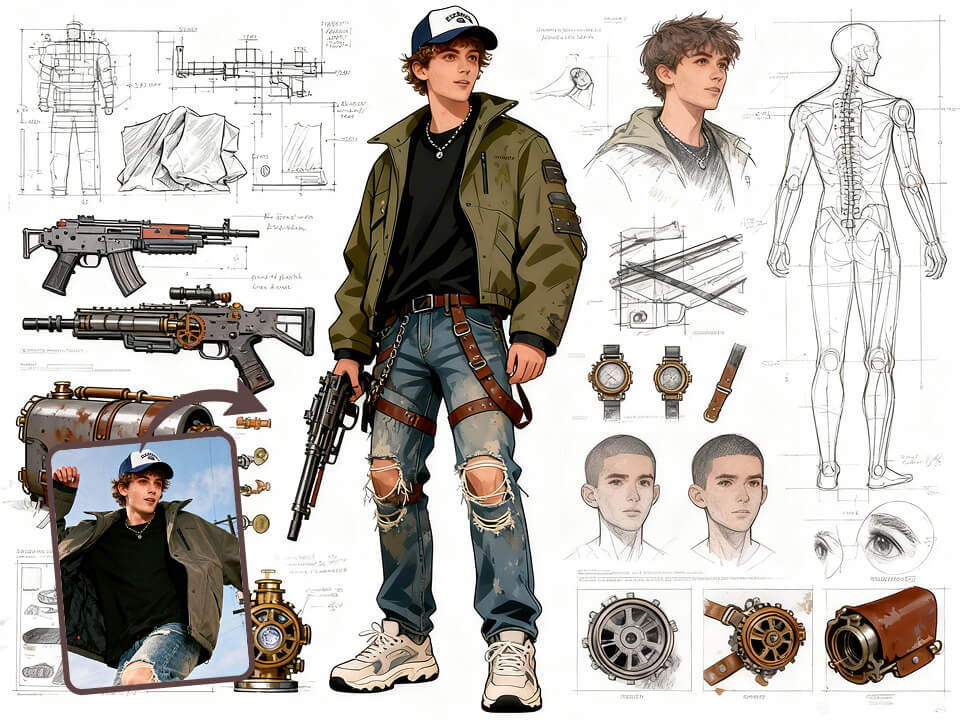
Those friction points show up in the two artifacts OC creators already know. A full design sheet can specify a bomber jacket, a rifle, and three expressions and still leave you with no idea how the character insults someone. A cyberpunk card with streetname, implants, and a Generate Identity button can return “reclusive, pragmatic, tech-savvy” and a paragraph of backstory — and that paragraph still reads like flavor text the moment you ask the OC a hard question.
A face is not a character
As one character-tool maker put it, the hard part is not making a character — it is keeping that character usable. Usable means the same diction in chapter four, the same knowledge gaps in issue two, the same costume logic when they run. A still cannot do that. A wiki page that never gets opened during drafting cannot either.
Randomizers average everyone into a type
“Brooding rogue, found family, hidden royal blood” is a Pinterest tag. An original character generator has to encode how that person talks when they are tired, what they will not confess, and which metaphors they hide behind. Without those constraints, language models default to a blended average: witty, over-explaining, and oddly modern in every setting.
Identity cards that never enter the draft
Form UIs are good at fields. They are bad at drama. Streetname, implants, motivations, four personality bullets, a save button — that is a character-select screen, not a scene partner. If the generator cannot answer in voice, you still have to invent the OC a second time when you sit down to write.
This is exactly what Creative Fiction Writer was built for.
Why Creative Fiction Writer
This original character generator treats OC creation as the start of the story, not a separate export. You describe the person in ordinary language. The AI writes voice, history, wants, design notes, and lines they would never say — then stays that person when you interview them, drop them in a scene, or ask for a comic-ready sheet.
| Traditional Approach | Creative Fiction Writer |
|---|---|
| Prompt an image, then invent a personality later | Voice, wound, and look generated together |
| Hours on a wiki that never reaches the dialogue | Sample lines, secrets, and speech tics in one pass |
| Name generators and tropes lists | Constraints that change how the OC actually talks |
| Identity-card UIs that dump a bio | A character you can interview and put in conflict |
| Every OC sounds like the author | Distinct diction, refusals, and knowledge gaps |
A bible you can write from
Ask for a structured sheet and you get fields a novelist, GM, or artist can use: appearance, core wound, speech tics, relationships, secrets, costume logic, and what would make this person walk out of a room. Ask for prose and you get a first-person interior that already sounds like someone. Either way, the generator is not a bio machine. It is a character who will answer in voice.
"Generate an original character: 19, dock mechanic in a dying port city, green bomber jacket she refuses to replace. Speaks in short sentences. Collects broken watches. Secret: she still writes letters to a sister who left. Give me a visual design sheet in words, 8 sample lines, and 3 hard boundaries."
Voice lock, not aesthetic lock
A design sheet can specify ripped jeans, a rifle, and a baseball cap. That is styling. An OC needs the behavior those clothes imply: how they stand in a doorway, what they do with their hands when they lie, which compliments they ignore. The AI holds those constraints so a taciturn mechanic does not suddenly deliver a TED Talk on found family.
Research that shows up in the person
Original does not mean unmoored. Period slang, regional work culture, weapon handling, and subcultural dress only matter if they change the line. This AI does the homework inside the character — so a steampunk runner does not describe a rifle like a museum placard, and a cyberpunk operative does not explain the net like a tutorial.
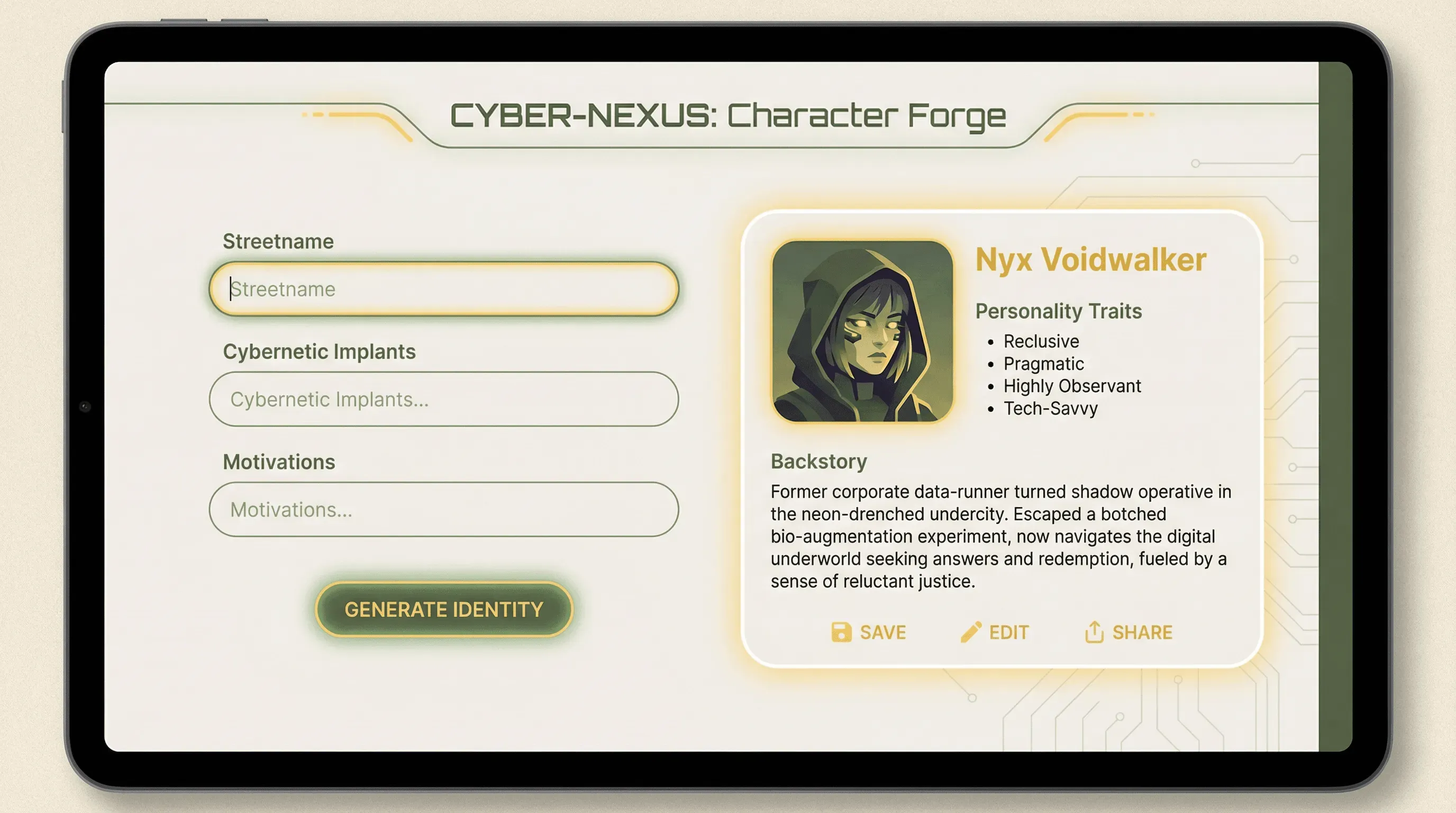
Card-style forges are useful for a snapshot. The difference is what happens next. If you cannot ask Nyx Voidwalker a question she would dodge, you do not have an OC. You have a trading card.
From still to scene
Visual generators advertise consistency across poses and settings. That solves the art problem. Design writing in 2026 is also pushing characters from static images toward interactive, personalized entities. A fiction-first original character generator solves the other half: the OC has to remain themselves when the plot turns. While Firefly specializes in the picture, this AI specializes in the person you then draw, cast, or play.
Related Agents You'll Also Find Useful
If you are already generating an original character, these agents cover the adjacent work: play, dramatic structure, and sequential art. Use them around the same OC, not instead of the bible.
Roleplay Game Master
If the OC is meant to be inhabited — TTRPG, rehearsal, or long-running scenes — Roleplay Game Master takes the sheet and plays it with memory that does not reset.
- Holds diction and secrets across sessions
- Stress-tests whether the voice survives player chaos
- Useful the night before a game when the OC has to talk, not just exist on paper
Film Screenwriter
When the OC belongs in a script, Film Screenwriter puts them in scenes: want versus need, dialogue with subtext, an arc that does not announce itself.
- Scene-level tests of whether the voice survives conflict
- Dialogue passes that strip exposition
- Structure from concept through revision
Comic Creator
If the original character is for sequential art, Comic Creator turns the bible into panels: acting, costume continuity, and layouts that match how this person moves.
- Visual acting that follows the personality, not a stock pose
- Issue-level consistency for a recurring OC
- A path from character sheet to page
Try the generator free — no credit card required. Bring the related agents in when you need to play, script, or draw the same OC.
How to Generate an Original Character
Step 1: State the job of the character
Do not start with hair color. Start with what this OC has to do in the work: foil the hero, hold a secret, refuse the deal, make the heist worse. One sentence of function beats a paragraph of aesthetics.
"I need an original character who is the rival cartographer on a river expedition — charming with patrons, vicious about credit, and who will never admit she misread the tributary."
Step 2: Add three constraints that change the voice
Give age or era, a speech tic, and a hard boundary. Constraints are what stop the model from averaging the OC into “witty and kind.”
"Age 41. Speaks in complete, slightly formal sentences. Never swears. Will not discuss her brother. Uses map metaphors when she's lying."
Step 3: Ask for sheet and sample lines together
Request a structured bible (appearance, wound, costume logic, secrets, relationships) plus eight lines in voice. If you have a reference still, describe it. If you need comic or TTRPG formatting, say so in the same brief.
"First a structured OC sheet with design notes I can hand to an artist. Then 8 lines, first person, and 3 things she would never say."
Step 4: Interview them, then stress-test
Ask the OC a question they would dodge. Offer a bribe. Skip ahead two weeks. If the diction, refusals, and knowledge gaps hold, you have a character. If they wobble, name the wobble and lock it.
"She would not explain the river lore to me like a tour guide. Stay in her contempt. She assumes I already know, and she's annoyed I don't."
Step 5: Keep the same thread as the source of truth
Once the OC is right, keep using the same conversation so details accumulate. Add a short bible recap only if you start a fresh thread. The point of a generator that also writes the person is that you should not re-paste a character card every session.
Results & Use Cases
📚 A novel OC whose dialogue stops sounding like you
Scenario: Your protagonist is a 19-year-old mechanic in a dying port. Every line still sounds like a novelist.
Traditional Approach: A 2,000-word backstory document you never open during drafting, plus a folder of jacket references.
The AI original character generator: Build the OC, then interview them. Steal the phrases that keep coming back. That is your voice bible.
- First-person answers expose diction you would not have invented
- Hard boundaries prevent “wise beyond their years” drift
- Design notes stay attached to the personality, so costume changes mean something
🎨 A comic protagonist with a usable design bible
Scenario: You need a lead for a 12-issue independent book. You can draw. You cannot afford three weeks of character development before page one.
Traditional Approach: A turnaround sheet with no interior life, then dialogue that fights the face you already inked.
Generated OC plus a sequential pass: Get appearance, acting tics, and sample lines first. Then hand the same bible to Comic Creator for panels that follow how this person actually stands, lies, and runs.
- Costume logic that survives issue five
- Expressions tied to the wound, not a generic anger chart
- A character who can carry a cliffhanger because they want something
📱 Last-minute OC on your phone before the sprint
Scenario: You have a 40-minute train ride and a writing group that expects a new original character tonight. You have a job (rival professor) and a vibe (petty, botanical). You do not have a laptop.
Traditional Approach: Panic-scroll a tropes wiki and improvise a personality that collapses by scene two.
On mobile: Voice-to-text the job and one wound. Get a sheet, three relationships, and an opening line before you reach your stop. Web, iOS, and Android keep the same thread so you can continue at the desk.
- No desktop-only card editor
- Speech-to-text for briefs you can dictate
- The OC is waiting in the same chat when you sit down
🎲 A tabletop original who survives contact with players
Scenario: Saturday session in two hours. You need a dockside fence who does not sound like last month’s temple clerk.
Traditional Approach: A name generator, a random trinket, and your default voice.
Generated OC, then play: Write the person first — diction, secret, what they will not sell. When the table starts, continue the same character in play rather than reading a wiki aloud.
- Unique speech patterns per NPC
- Secrets that can leak later because they were written as load-bearing
- Fast enough to generate a replacement when the party murders the plot hook
Independent tables already mix analog play with digital character tools; virtual tabletops such as Roll20 exist specifically to add maps, sound, and character designs to that hybrid. The missing piece is usually the person behind the token.
FAQ
What is an original character generator?
An original character generator is an AI that turns a brief — role, flaws, look, speech patterns — into a full OC you can write, draw, or play. The useful test is consistency: does the character keep the same diction, knowledge, and refusals after the first scene? A tool that only renders a face is a character art generator. A tool that only fills name fields is a randomizer. You want both the bible and the voice.
Is Creative Fiction Writer free?
Yes. You can use it on the free tier with no credit card. Paid plans raise monthly usage if you run large casts, long revision passes, or heavy research. Start on free, generate one OC, and stress-test them in a scene before you decide you need more volume.
How is an AI original character generator different from a character art generator?
Art generators, including Adobe Firefly’s character tools, are built to produce a look from a prompt. An original character generator is built to produce a person: voice, wound, secrets, costume logic, and lines they would never say. Use an art tool when you need a still. Use this AI when the OC has to survive dialogue. Many creators do both — generate the interior first, then commission or prompt the face.
Can I generate OCs for novels, comics, games, and fanfiction?
Yes. The same engine will write a dock mechanic for a novel, a rival for a webcomic, a custom PC for a Saturday game, or an OC who has to stand next to canon characters without sounding like a self-insert. For scripts, bring in Film Screenwriter. For pages, use Comic Creator. The OC sheet stays the source of truth.
Does an original character generator work on mobile?
Yes. Create the OC on a phone, continue on a laptop, and pick the same thread back up at the table or the desk. Voice-to-text is useful when you would rather dictate “cynical half-orc cleric, hates temples” than type a sheet. Feature parity across web, iOS, and Android means you are not locked to a desktop identity-card editor.
How do I keep an OC from turning into a generic trope?
Give constraints that hurt: a word they will not say, a secret they will not confess, a metaphor they hide behind, a person they will not discuss. Then interview them. If the model explains lore like a tour guide, tell it the character would never do that. Original is not a random aesthetic. Original is a specific set of refusals.
Generate an OC You Can Actually Use
Most original characters fail for a boring reason: they were never built as people. They were faces pasted onto a helpful narrator, or bios that never reached the scene. A real original character generator has to do two jobs in order — write a character with goals, frustrations, and a voice, then stay that character when the plot gets inconvenient.
Creative Fiction Writer is the AI that does both. Describe the person. Lock the constraints. Interview them until the diction holds. When you need to play, script, or draw the same cast, the related agents above plug into the same workflow.
Try it with one stubborn OC tonight. If the voice still holds after you insult them, you have a character. Explore more at Jenova.
For Developers: Creative Fiction Writer is available programmatically via the Jenova API — integrate original character generation into your application with a single API call. Full documentation →