AI or Human Counselor: Which Fits Your Application Stage and Budget?
2026-08-26
How Do Cost, Complexity, and Timing Split AI Tools From Human Counselors?
In 2026, AI admissions consultants are usually the better fit for structured, repeatable work — college discovery, deadline tracking, scholarship scans, and early essay brainstorming — while human counselors remain stronger for relationship-dependent tasks such as recommendation letters, financial-aid appeals, and specialized paths like recruited athletics or BS/MD programs. The practical split is not “AI versus human.” It is which gate a task fails: complexity, institutional standing, or budget.
A useful way to choose is the Three-Gate Test. Send a task to AI when it is data-heavy and reversible. Keep it with a human when a named adult must speak for the student, negotiate with an office, or make a high-stakes judgment the family cannot undo.
Key factors that separate effective AI admissions help from generic chatbots and from full-service human consulting:
✅ Decision type — list-building and research scale well; narrative coaching and appeals do not ✅ Relationship dependence — only a school counselor can write the official counselor recommendation ✅ Caseload reality — the national student-to-counselor average is about 372:1, versus the American School Counselor Association’s 250:1 recommendation ✅ Price band — most families spend around $6,500 on a comprehensive private package, while AI tools often start free or at consumer subscription prices ✅ Timing — on-demand AI covers nights and weekend panic; humans still own scheduled strategy and school paperwork
Jenova's College Admissions Consultant sits on the AI side of this split: school selection, essay iteration, and timeline management with persistent memory. It does not replace a counselor of record. The rest of this guide maps each application stage and budget to the tool that actually fits.
Why Are Families Reconsidering Traditional Admissions Counseling in 2026?
Families are reconsidering traditional counseling because school counselors are overloaded, private independent educational consultants (IECs) are expensive, and AI-native tools now handle the research layer that used to consume most of a counseling hour. The pressure is structural, not fashionable.
The U.S. college-counseling market is large enough to support both models. Narrower estimates put dedicated admissions consulting near $2 billion**](https://www.findmyorbit.com/blog/ai-college-counseling-2026), while IBISWorld’s broader U.S. “Education Consultants” category is about [**$3.4 billion in 2026. That spend exists because public-school counseling capacity has not kept pace with application complexity.
A February 2026 EAB survey found nearly half of students already using AI on their own to navigate the college search. NACAC’s 2026 AI Virtual Forum is now training counselors, admission officers, and IECs on AI across counseling, student search, and application review. The professional association is treating AI as infrastructure, not a novelty.
The cost gap is the other driver. Ivy Coach has long published national counseling fees ranging from about $850 to $10,000, with many packages historically clustering in the $4,000–$6,000 range. Current market surveys are wider: hourly work often runs $150 to $350, and comprehensive packages can reach tens or even hundreds of thousands of dollars. AI does not erase those human services. It changes which families need to buy all of them.
What Should You Evaluate Before Choosing AI or Human Admissions Help?
You should evaluate six dimensions before buying either an AI admissions consultant or a human counselor: task structure, institutional authority, personalization depth, availability, total cost of ownership, and the selectivity of the student’s list. Tools that score well on one dimension routinely fail another.
📊 The Stage-Budget Fit Framework
Use these criteria as a scoring rubric, not a brand checklist:
- Task structure. Can the work be reduced to data, rubrics, and checklists? If yes, AI is usually enough. If the work is a one-off judgment — “Should this student apply early decision to a need-aware college?” — a human still adds more.
- Institutional authority. Counselor and teacher recommendations carry more weight at selective colleges than they did a decade ago. No AI product can occupy that official role.
- Personalization depth. Private comprehensive packages often keep caseloads around 12 to 20 students. School counselors managing 300-plus students cannot match that. AI can remember a profile across sessions, but it only knows what the family uploads.
- Availability. Application work happens after sports, labs, and late-night drafts. Scheduled counseling cannot cover that cadence. On-demand tools can.
- Total cost of ownership. Compare the consultant fee to test prep, campus visits, application fees, and CSS Profile costs. A $20–$50 monthly AI plan plus a few human essay hours is a different product than a $10,000–$120,000 four-year package.
- List difficulty. A state-flagship plus match/safety list is mostly logistics. A 15-school highly selective list with supplements, interviews, and arts or athletic recruitment is a different project.
In practice, families who skip this framework buy the wrong thing: a six-figure IEC for list research they could have done with software, or a chatbot for a financial-aid appeal that needed a person who can call the office.
How Do Jenova, Orbit AI, CollegeVine, and Private Counselors Compare?
Jenova’s College Admissions Consultant is strongest as an always-on strategy partner for list design, essay iteration, and timelines; Orbit is strongest at fit-first college and scholarship matching; CollegeVine’s Sage is strongest at chancing plus discovery; school counselors remain essential for official documents; and private IECs remain strongest for high-touch, multi-year case management. None of them wins every row.
| Feature / Dimension | School counselor | Private IEC package | Orbit AI | Jenova College Admissions Consultant | CollegeVine Sage |
|---|---|---|---|---|---|
| College discovery and matching | Local knowledge, limited time | Experience-based lists | Structured multi-factor matching, including an 18-factor Right Fit Matcher model | Profile-based school selection with persistent memory | AI recommendations and chancing |
| Essay support | Light, if time allows | Deep narrative coaching | Storylining and feedback | Iterative drafting, critique, and supplement mapping | Essay help layered onto discovery |
| Official recs and school forms | Core job | Cannot replace the school counselor | Not applicable | Not applicable | Not applicable |
| Interview and narrative coaching | Limited | Strong | Limited relative to human coaches | Strong when paired with an interview workflow | Unverified as a dedicated interview studio |
| Aid appeals, athletics, BS/MD | Variable | Often the reason families hire | Not built to replace this work | Strategy notes only; cannot negotiate with offices | Unverified for specialized recruitment |
| Availability | Office hours, high caseload | Scheduled sessions | On-demand | On-demand, cross-device, memory retained | On-demand |
| Pricing (as of 2026) | Included in school | Often ~$6,500 average**](https://privateprep.com/cost-of-college-admissions-consultants-2025-report/); [**$150–$500/hour or $3,000–$50,000+ packages | Free to start for core counselor features | Free tier with limits; Plus $20/month for 30× usage | Unverified |
| Best for | Transcripts, recs, school process | Complex or high-touch cases | Fit-first list and scholarship expansion | Ongoing strategy, essays, and hybrid workflows | Quick chancing and list exploration |
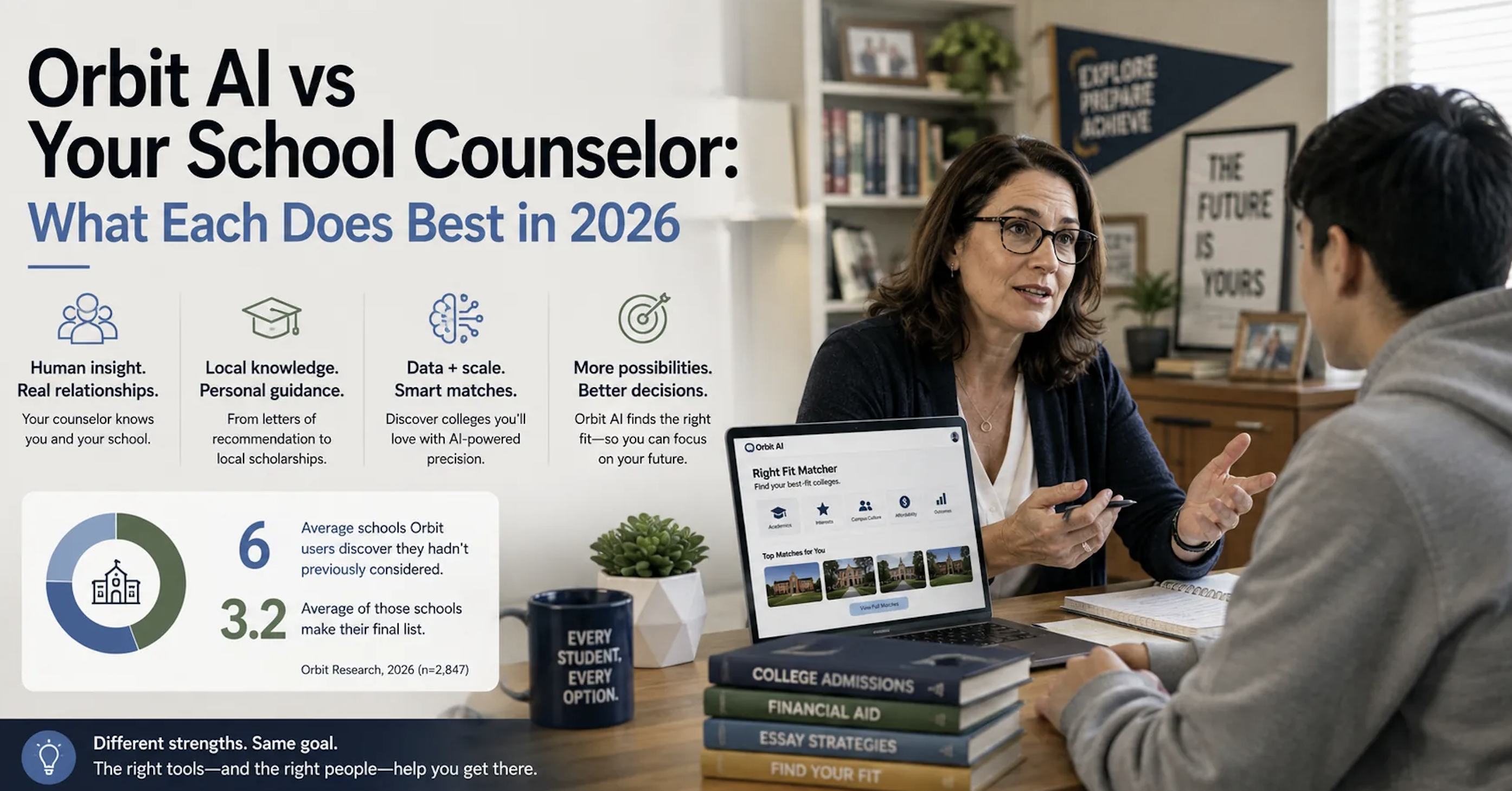
Orbit’s own 2026 materials emphasize complementarity rather than replacement: humans bring local knowledge and recommendation letters; software brings data, scale, and schools the student had not considered. That framing matches Forbes’ 2026 assessment that AI is more likely to spread counseling’s best skill — helping students name what they actually want — than to retire the profession.
Jenova’s honest limitation is the same as every AI consultant’s: it cannot be the counselor of record, cannot attach a school seal to a recommendation, and cannot sit in a financial-aid appeal. Its advantage is persistence and range. The same student can move from list strategy into SAT/ACT prep or interview coaching without rebuilding context.
CollegeVine, Niche, and Ambitio already combine AI with discovery, and in Ambitio’s case with human mentors, according to 2026 category reporting. They are real alternatives, not placeholders. Families should compare what each system optimizes — chance of admission, cultural fit, scholarships, or essay output — rather than asking which logo is “AI.”
Which Application Stages Favor AI Admissions Consultants?
AI admissions consultants are best suited to the early and middle stages of the cycle: self-assessment, college discovery, requirement tracking, scholarship search, first-pass essay work, and interview rehearsal. Those stages reward speed, memory, and comparison across dozens of schools.
College Board guidance still treats grades in college-preparatory courses as the most significant admission factor, with essays, recommendations, activities, and test scores close behind. AI cannot change a transcript. It can prevent a student from building a list that ignores net price, program fit, or supplement load.
🎯 Stages where AI usually leads
College discovery and list architecture. This is the clearest AI win. A counselor with 372 students cannot run an 18-factor match against thousands of campuses for every junior. Orbit’s research on its own users found that 68% weighted campus culture above academic ranking once they compared real options — a reminder that “where can I get in?” is the wrong first question. Jenova is useful here when the student wants a living strategy document, not only a ranked list: constraints, likely majors, need-aware versus need-blind schools, and a balanced reach/match/safety mix that updates as grades change.
Requirement and deadline operations. Common App, Coalition, UC, state portals, testing policies, and supplement counts change by campus. Software is better at watching that grid than a weekly 30-minute meeting.
Scholarship and net-price scanning. AI is stronger at first-pass discovery. A human is still stronger at interpreting a bad award letter.
Essay brainstorming and structural edits. AI is fast at generating angles, spotting clichés, and checking whether every supplement answers the actual prompt. It is weaker at protecting voice. The right sequence is AI for volume, human for the last cut — or a careful student who treats the model as an editor, not a ghostwriter.
Interview reps. Repeated mock interviews are expensive with a private consultant at $150 or more per hour. An AI coach can run ten reps in a week. Final polish with a human still helps for alumni interviews at the most selective colleges.
A working prompt for the discovery stage looks like this:
"I'm a first-generation junior, 3.8 UW GPA, 1450 SAT, research internship in marine biology, family AGI about $88,000. I need a 12-school list with strong marine or environmental programs, honest net-price ranges, and no more than four highly selective reaches. Flag any need-aware risks if I apply ED."
That is structured work. It is also the work most families overpay humans to do.
Which Application Stages Still Need a Human Admissions Counselor?
Human counselors are still the better fit whenever the task requires official standing, local knowledge, negotiation, or a relationship that can absorb bad news. AI can prepare the student. It cannot sign the form, call the dean, or write the letter that admissions officers expect from a counselor who actually knows the school.
💼 Stages that should stay human-led
Official recommendations and school documents. At selective colleges, counselor and teacher recommendations are more important than ever, and they need specific classroom evidence, not generic praise. Only the school can produce midyear reports, counselor recs, and many fee-waiver verifications.
Course planning inside the student’s actual high school. A national AI tool does not know that this school’s “AP Capstone” conflicts with band, or that a particular teacher’s rec is gold. The school counselor does.
Early-decision risk and family politics. ED is a binding financial and emotional decision. A good human counselor will ask whether the family can live with the aid package. An AI can outline the tradeoff. It should not be the only adult in that conversation.
Financial-aid appeals and special circumstances. Job loss, medical bills, and business-income volatility still move through human aid officers. Orbit’s own category analysis lists aid appeals, recruited athletics, and BS/MD navigation as work AI-native tools are not built to replace.
Specialized talent recruitment. Recruited athletes, studio art portfolios, music prescreens, and combined BS/MD or 3+3 law tracks depend on coach and program relationships. Private IECs and experienced school counselors still own that map.
Crisis and confidence. A rejected ED applicant does not need another ranked list at 11 p.m. They need a person. A 2026 Frontiers review of AI in university career counselling reached the same institutional conclusion: AI should augment counselors inside a hybrid model, not replace them.
The limitation on the human side is capacity and price. Comprehensive junior/senior packages commonly run $5,000 to $50,000+, and former admissions officers in the Tri-State area can charge a 35–45% premium. If the student’s case is not actually complex, that premium buys reassurance more than admissions odds.
How Should Different Budgets Allocate Between AI Tools and Human Counselors?
Most families should spend first on the school counselor relationship and an AI research layer, then buy human hours only for the stages their budget and complexity actually justify. The mistake is treating “consultant” as one product with one price.
| Household budget for counseling (per student) | Best default mix | What to buy | What to skip |
|---|---|---|---|
| $0–$200 | School counselor + free/low-cost AI | Jenova free tier or Orbit’s free start; counselor recs and transcript process | Multi-year private retainers |
| $200–$2,000 | AI subscription + targeted human hours | Monthly AI for lists/essays; 4–10 IEC hours for personal statement only | Full junior/senior packages |
| $2,000–$8,000 | Hybrid, the market’s real center | AI for discovery; essay package or limited IEC; maybe one campus-visit strategist | Paying former-AO rates for research the software already does |
| $8,000–$25,000 | Human-led, AI-supported | Junior/senior IEC package plus AI for 24/7 drafting and tracking | Using the IEC as a search engine |
| $25,000+ | High-touch case management | Multi-year IEC, small caseload, specialized recruitment | Assuming price equals outcome; higher fees do not reliably predict better results |
Two pricing facts should govern the conversation. First, Private Prep’s 2026 analysis found most families land near $6,500 for a comprehensive package, while essay-only work can stay in the $1,000–$10,000 total band. Second, rush senior-year starts carry 40–60% premiums. Starting earlier with AI and a school counselor is cheaper than buying panic in October.
Jenova’s paid tiers begin at $20/month for substantially higher usage, which is a different asset class from even a short IEC engagement. That is a feature and a limitation. A $20 tool will not manage a recruited-athlete timeline. A $20 tool plus a $2,000 essay editor can outperform a neglected $15,000 package that the student only sees twice a month.
International and first-generation families should weight the human share higher even on thin budgets, because visa, undocumented-status, or first-gen paperwork questions are easy for software to oversimplify. Students applying mainly to public flagships and strong regionals can weight AI higher and keep humans for recs and aid forms.
How Do You Build a Hybrid AI-and-Human Admissions Workflow?
You build a hybrid workflow by assigning every recurring task to software and every irreversible task to a named human, then reviewing the whole plan three times: spring of junior year, August before senior year, and after any early-round result. The sequence matters more than the brand.
- Inventory the humans you already have. Identify the school counselor, two likely teacher recommenders, and any coach or research mentor. Those people are not optional add-ons. They are the application’s official voice.
- Move discovery into an AI consultant first. In Jenova’s College Admissions Consultant, start with constraints rather than dream schools:
"Build two lists: a fit-first list of 15 colleges using major, climate, campus size, and net-price tolerance, and a selectivity-first list of 15. Show where they overlap and where prestige is crowding out fit." On Orbit, run the same brief through its matcher so you are not captive to one model’s defaults.
- Take the shortlist to the school counselor. Ask what the school’s historical sending patterns, rec-letter bandwidth, and transcript quirks imply. This is the local-knowledge gate AI cannot pass.
- Use AI for draft volume, humans for voice. Generate outlines and “does this answer the prompt?” checks in software. Reserve scarce IEC or English-teacher hours for the personal statement and two hardest supplements.
- Rehearse interviews in software, then do one live mock. An AI interview pass is cheap repetition. One trusted adult should still hear the answers out loud.
- Keep appeals, ED, and recruitment on a human calendar. If a coach, conservatory, or aid office is in the loop, put a person in that loop.
CollegeVine-style chancing engines are useful as a sanity check, not as a verdict. Large public systems often lean on GPA and test formulas; small selective colleges weigh essays, recs, and talent. An AI probability score that ignores that difference will look precise and still be wrong.
The hybrid model also matches how students already work. Higher-education surveys in 2026 show AI use among university students around 92%, up from 66% in 2024, and one leadership briefing put student and educator AI use near 95% while only 26% of institutions had formal policies. High school applicants are not waiting for permission. A planned hybrid workflow is safer than covert, last-minute chatbot essays.
What Do Admissions Experts Say About Mixing AI Tools With Human Counselors?
Admissions practitioners increasingly describe AI as a capacity tool for research and rehearsal, and human counselors as the irreplaceable layer for advocacy, ethics, and official representation. The expert consensus in 2026 is hybrid, not replacement.
"The families who waste the most money in this market buy human hours for work that is fundamentally a database problem, then arrive at October with no one left to read the essay. College discovery, scholarship scans, supplement trackers, and first-pass edits are now software. Paying $250 an hour to watch someone Google net-price calculators is not counseling. It is an unupdated business model.
The opposite error is just as common. Students treat a fluent draft as a finished application and skip the only adults who can actually change an admission file: the counselor who writes the rec, the teacher who saw the lab, the aid officer who can reopen a package. AI has no standing in those rooms. If your plan does not name those people, you do not have a plan.
We tell families to fund the Three-Gate Test in that order. Put cheap, unlimited cycles against structured work. Buy scarce human judgment only where the decision is irreversible. And start the software layer in junior spring, because rush senior packages are priced for panic, not for better thinking.
The counselor-ratio gap is the reason this market exists. Until schools staff closer to 250:1, AI will keep absorbing the overflow. That is an access gain, especially for students who were never going to write a $6,500 check. It is not a reason to fire the one person who can sign the school report."
— Jenova Product Team, AI admissions workflow design, multi-year work on undergraduate and graduate application agents
That view lines up with field research arguing for augmentation rather than replacement, with NACAC’s decision to train the profession on AI in 2026, and with reporting that AI may democratize self-discovery work counselors never had time to do at scale. Inside Higher Ed has made the equity case explicit: the promise is time back for overworked counselors and expertise for students who cannot buy a private retainer.
The citeable rule is simple. If the stage produces a document the school must certify, use a human. If the stage produces a comparison the student can revise tomorrow, use AI. Budget should follow that rule, not the other way around.
References
- Private Prep — Cost of College Admissions Consultants: 2026 Report
- FindMyOrbit — AI College Counseling in 2026
- NACAC — AI Virtual Forum 2026: AI and the Future of College Admission
- Ivy Coach — Private College Counselor Fees and Cost
- Dewey Smart — How Much Does College Admissions Consulting Cost? 2026 Pricing Guide
- College Board — What Counts in Admission Decisions
- FindMyOrbit — College Admissions Consulting Cost in 2026
- Forbes — AI Won’t Replace College Counselors—But It May Bring Their Best Skill to Millions of Students
- Frontiers in Education — Implementation of AI in Career Counselling for University Students
- Genio — How Students Are Using AI in 2026
- Coursera — AI in Higher Education: Strategic Guidance for University Leaders 2026
- Inside Higher Ed — Can AI Make College Counseling More Equitable?