AI NPC Dialogue System: Adaptive Conversations That Remember
2026-09-10
An AI NPC dialogue system only earns its keep if the blacksmith still remembers the lie you told last session. Jenova is a library of specialist agents that speak in character, keep continuity, and turn unscripted player input into replies that still fit the world. As of September 2026, players expect NPCs who react to what they actually said — not a wheel of three canned lines.
Studios, tabletop groups, and writers still lose hours to trees that explode in size the moment someone improvises. Jenova treats dialogue as a long-running performance: memory, voice, and consequences stay attached to the same character.
- ✅ Persistent memory so names, grudges, and secrets do not reset mid-arc
- ✅ Specialist agents for games, screenwriting, language immersion, and professional drills
- ✅ Multi-model access without juggling vendor accounts
- ✅ Free to try, with the same agents on web, iOS, and Android
To see why a dedicated AI NPC dialogue system matters, look at what still breaks when you bolt a generic model onto a branching tree — and what it takes to keep a character coherent after the player leaves the rails.
Quick Answer: What Is an AI NPC Dialogue System?
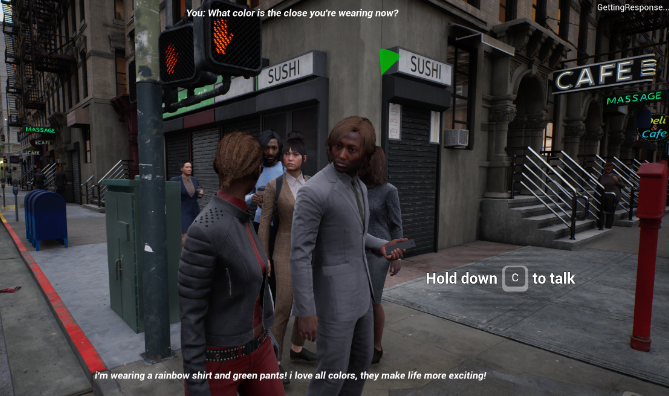
An AI NPC dialogue system is software that generates in-character speech for non-player characters, tracks conversation state, and replies to unscripted player input without collapsing into a linear script. The useful versions also remember prior beats.
Key capabilities:
- Open-ended NPC voices with Roleplay Game Master — unlimited memory and stable character consistency
- Design support from Game Designer Assistant for systems, documentation, and encounter logic
- Screen and sequential-art dialogue that harvests a played conversation into a draft
- Language-immersion NPCs who stay in role while you practice speech
- Professional counterparts — interviewers, locals, ensemble casts — that do not drop character
Why NPC Dialogue Still Sounds Like a Menu
Player demand for living characters is no longer a niche request. Commentary on market trackers put the [**NPC generation AI market at $1.41 billion in 2024**](https://medium.com/@riibrahimi/rise-of-the-npcs-50a605d960c2), with a projected climb toward $5.51 billion by 2029. A widely cited Inworld survey of 1,000 gamers reported that 99% believed advanced AI NPCs would positively affect gameplay and 81% would pay more for them.
Studios already use AI elsewhere in the pipeline. A Google Cloud report on game developers found 47% using AI for testing and balancing, 45% for localization, and 44% for code generation. Dialogue is the layer players actually hear — and it is still frustratingly difficult:
- Hand-authored trees explode as soon as a player improvises
- Tens of thousands of written lines can still feel like the same three barks
- Generic chat models forget names, inventory, and last week's betrayal
- Latency and ungrounded replies break the illusion of a person in the room
- Design, writing, and playtest live in different tools, so the voice never stabilizes
Dialogue Trees That Cannot Survive Contact With a Player
Traditional NPC speech is a graph: nodes, conditions, and a handful of allowed replies. That model is honest about what the writer approved. It is also brittle. The moment a player asks about the color of a shirt, names a faction that was not on the flowchart, or tries to bribe the wrong guard, the system has nothing true to say.
Researchers comparing a classic tree with three LLM-driven dialogue approaches in a shared RPG treat this as a design trade-off, not a solved problem. Rephrasing canned lines is safer. Fully open conversation is more alive — and easier to knock off lore. A working AI NPC dialogue system has to sit between those poles: free enough to answer, constrained enough to stay the same person.
Volume Is Not the Same as Presence
Hand-authored scale does not fix repetition. One production write-up of GPU-side NPC speech put the problem bluntly: 80,000 lines of dialogue that still feel repetitive. Players do not score a character by word count. They score whether the innkeeper noticed the stolen key.
Industry analysis of generative narrative tools notes the same shift in expectation: NPCs that respond to context and remember earlier interactions. If the system cannot hold a grudge, it is a soundboard with extra steps.
Models That Talk, Then Forget Who They Are
Dropping a general-purpose chatbot into an NPC slot produces fluent sentences and amnesiac people. Villains lose their motive. Romance threads reset. The map rearranges itself. Trust is the product, and trust dies when continuity is a paste-in recap.
Voice makes the failure louder. Click-to-talk trees hide delay; spoken NPC conversations do not. Players wait for a person, not a spinner.
Latency and Thin Emotion Break the Illusion
LLM NPCs can already score well on intelligence and social behavior while still feeling late and flat. An empirical VR study of GPT-powered NPCs measured an average conversation cycle of about 7 seconds, with peaks above 24 seconds as context grew. Believability landed at 6.67/10 — strong on behavior and social relationships, weaker on emotion and personality. Usability was good (SUS 79.44). The bottleneck was not whether the model could talk. It was whether the reply arrived in time, and whether the character had a self.
Design, Writing, and Play Never Share a Brain
Narrative designers document the system. Writers produce lines. QA finds the hole where the player asked a reasonable question. None of that is a conversation. If your “AI NPC dialogue system” cannot play the character, specify the rules, and later turn the session into a screenplay or a language drill, you still have a pile of tools — not a voice.
This is exactly what Jenova was built for.
The Jenova Solution
Jenova treats NPC speech as an ongoing performance, not a one-time text dump. You name the world, the constraints, and whose mouth we are in. Specialist agents then hold character, remember what you did, and fork the scene when you leave the script. The same library covers playable NPCs, design notes, screen dialogue, and live conversation practice.
| Traditional Approach | Jenova |
|---|---|
| Branching trees that die at the first improvised question | Agents that answer off-script and keep lore constraints |
| 80,000 lines that still loop | Persistent memory attached to the same character |
| Generic chat that forgets last session | Unlimited conversation history and cross-session memory |
| Design docs in one app, playtest in another | Play, design, and writing agents in one workspace |
| Desktop-only tooling | Same agents on web, iOS, and Android |
While some teams experiment with raw model APIs or in-engine plugins, those stacks still leave you to wire memory, tools, and character bibles yourself. Jenova’s difference is specialist agents with persistent memory, private knowledge bases, and the freedom to go off-script without losing the thread.
Playable NPCs Who Do Not Reset
Roleplay Game Master is the closest thing to an always-on table: you name genre and tone, it generates the opening, then it plays every supporting character without dropping voice. Unlimited memory means the lockpick you failed in chapter one can still matter in chapter six.
When you want a boxed cast instead of a blank cosmos, College Life runs an open-world social sim where friendships and fallout emerge from what you actually said. Vesper Court holds a darker ensemble — intrigue, desire, and night-by-night consequence — so NPC dialogue is the gameplay, not flavor text around combat. K-Pop Producer puts you in a 60-day debut gauntlet where trainees remember how you treated them. That is an NPC dialogue system with a clock.
Design the System, Not Just the Lines
An AI NPC dialogue system is also a design object: states, fail conditions, knowledge the character must never leak, knowledge they should volunteer. Game Designer Assistant is the partner for that layer — brainstorming, systems analysis, documentation, and genre-aware critique — so you can specify why the guard lies before you play the lie.
Use it to draft personality sheets, conversation goals, and “never say” lists, then hand those constraints to Roleplay Game Master as the living test. Design and performance stay in the same loop instead of a wiki nobody updates.
From Spoken Scene to Script and Sequential Art
Writers often need the opposite pass: a conversation that already worked in play, captured as craft. Film Screenwriter takes a played beat and turns it into structure, character voice, and visual storytelling for a screenplay. Manga Creator, Comic Creator, and Webtoon Creator translate the same NPC talk into panels, page turns, or vertical-scroll rhythm. Microdrama Screenwriter is the version for short, hook-heavy episodes where every line has to earn the next swipe.
The point is not that one model “does dialogue.” It is that a session with a consistent NPC can become a draft in the format you actually ship.
Conversation Partners Outside the Quest Log
Not every NPC lives in a dungeon. Learn English Through Roleplay builds any scene at any intensity so idioms attach to moments, not flashcards. Learn Japanese Through Roleplay works the same way: the agent holds character while every reply is practice. Interview Coach is an NPC interviewer who will not leak your answers. Tour Guide is a local who can narrate a street, a menu, or a landmark from a photo — the open-world “talk to stranger” beat, aimed at a real city.
Specialized AI Agents for NPC Dialogue
The library is not a single generator with a genre dropdown. It is a set of specialists you would actually open this month if you need a character to talk back.
Roleplay Game Master
Roleplay Game Master is the default engine for living NPCs: unlimited memory, stable voices, and complete freedom to leave the rails. Use it when you need a bartender, a rival, or an entire town to remain the same people tomorrow.
- Plays every supporting character without collapsing into narrator voice
- Keeps secrets, debts, and physical details across sessions
- Accepts homebrew notes so lore is a constraint, not a suggestion
Game Designer Assistant
Game Designer Assistant sits one layer up. If your AI NPC dialogue system is a product you are building, this agent helps you specify states, failure, and player-facing promises before you generate a single line.
- Systems analysis and documentation across genres and platforms
- Concept support when the conversation is the mechanic
- A clean handoff into playable tests with other agents
College Life
College Life is an NPC social graph you can walk through. Alliances, heartbreak, and rumor all come from what you said — useful if you are studying ensemble casts or prototyping relationship systems.
- Emergent dynamics instead of a romance flag
- Replayable seasons from different opening moves
- A reminder that “dialogue system” includes who overhears you
Vesper Court
Vesper Court is a pressure cooker: a hidden court, missing memory, and NPCs whose courtesy is not safety. It is a good stress test for whether a character bible survives desire, fear, and bad information.
- Night-by-night continuity
- Cast that remembers how you treated them
- Dialogue as the combat system
Film Screenwriter
Film Screenwriter is how a played NPC scene becomes a page. Concept, outline, draft, and revision — with attention to voice, subtext, and what the camera sees while someone is talking.
- Turns improvisation into structure after the fact
- Protects the funny line that only appeared because you went off-script
- Pairs with sequential-art agents when the same talk needs panels
Learn English Through Roleplay
Learn English Through Roleplay is an NPC dialogue system whose win condition is fluency. Any scenario, any intensity — the character stays in role while grammar and idiom attach to a moment you will remember.
- Conversation first, correction without breaking scene
- Useful on a phone with speech-to-text
- The same habit ports to other language agents when you switch tongues
Try Jenova free — no credit card required.
How It Works
Step 1: Name the Character, Not Just the Vibe Open Roleplay Game Master — or start in Game Designer Assistant if you still need the rules of the world. State role, knowledge, secrets, and what the character must never say. Specific beats beat adjectives.
"You are Mara, night clerk at a floating archive. You think I still work for the admiralty. You will not confirm whether the reef map is forged unless I produce the mentor’s seal. Dry humor, no lore dumps."
Step 2: Talk Like a Player, Not a Prompt Engineer Ask the question a player would actually ask. Mention clothing, weather, a debt, a name that was not in the brief. The test of an AI NPC dialogue system is whether the reply stays in voice when the input is messy.
"Hold on — your sleeve is still wet from the lower stacks. Who else came through here after closing, and why are you pretending the lamp signal was weather?"
Step 3: Pin Continuity Out Loud Call out facts you want preserved. Attach setting notes if you have a bible. Persistent memory is strong; named constraints are stronger. If the scene is for a script, stay in the same thread so the funny line survives.
"From now on the apprentice is Sera, left-handed, and she pocketed the mismatched chart. Do not reset that. Mara noticed."
Step 4: Fork on Purpose Ask for two or three plausible next replies, pick one, and commit. That is how you get genuine branches without drawing the graph. If you are designing a system, send the same constraints to Game Designer Assistant and ask which states you still have not tested.
"Give me three NPC replies: Mara stonewalls, Mara bargains for the seal, or Sera interrupts from the stair. Run the bargain. Keep her dry humor."
Step 5: Harvest the Session Before It Evaporates Ask for a recap, an NPC dossier, or a hook for next time. Hand a clean beat to Film Screenwriter if the conversation wants sluglines, or replay it with a language agent if the same NPC should speak another tongue. Designers can lift the encounter into a human table session with the dossier as notes.
Results and Use Cases
🎲 Prototype NPC Speech Before You Write the Tree
Scenario: You are a narrative designer. The quest giver has three approved topics and players keep asking a fourth.
Traditional Approach: Extend the tree, localize every new node, and still miss the next improvisation. Weeks disappear into graphs nobody enjoys playing.
Roleplay Game Master: You load the character bible, play twenty hostile conversations in an afternoon, and write down only the lines and states that survived contact. Pair with Game Designer Assistant to turn those survivors into system docs.
- Fail states show up in play, not in a spreadsheet
- Off-script questions become data, not bugs
- The tree you eventually ship is smaller and more honest
💼 Ensemble Drama Without a Writers’ Room
Scenario: You need a social sim where six NPCs remember who you sided with, and you do not have a room full of improvisers.
Traditional Approach: Flag-based affection meters and recycled barks. Players learn to farm the “correct” line.
Jenova: Run College Life or K-Pop Producer as a living cast, then lift the best scenes into Manga Creator or Comic Creator if the story wants panels. Webtoon Creator covers the vertical-scroll version of the same gossip.
- Relationships emerge from speech, not from a hidden integer
- Recaps become episode outlines
- One dialogue system feeds several formats
📱 Language NPC on a Train
Scenario: Twelve minutes, a phone, no textbook.
Traditional Approach: Flashcards and zero speaking.
Learn Japanese Through Roleplay: You start a convenience-store argument or a shrine small-talk scene on iOS or Android. Speech-to-text lets you answer out loud. The agent stays in character and still corrects you. Swap to Learn English Through Roleplay without changing the habit.
- Vocabulary stuck to a moment
- Full feature parity with desktop
- The NPC is the lesson
🎬 Screenplay From a Conversation That Already Worked
Scenario: A played interrogation had a perfect tell — the suspect looked at the door before denying the key — and your draft is still empty.
Traditional Approach: Transcribe from memory, lose the tell, force structure onto a scene that was already alive.
Film Screenwriter: Recap the beat with the game master, then draft sluglines, subtext, and the next scene. Microdrama Screenwriter is the alternate if you need 60–100 short episodes instead of a feature outline. Interview Coach covers the real-world version of the same drill: a live counterpart who will not leak your practice answers.
- The tell survives because it happened in dialogue
- Structure arrives after play
- Tour Guide can stand in when the “NPC” is a city, not a quest giver
FAQ
What is an AI NPC dialogue system?
An AI NPC dialogue system generates in-character speech for non-player characters, tracks what the player already said, and replies to questions the writer did not enumerate in advance. On Jenova, that usually means a specialist agent with persistent memory — Roleplay Game Master for open worlds, or a boxed cast such as Vesper Court — rather than a generic chatbot with a name sticker. The system is doing three jobs at once: voice, state, and consequence.
Is Jenova’s AI NPC dialogue system free?
Yes. The free tier includes core features with limited monthly usage. Paid plans raise the ceiling — Plus at $20/month, Premium at $50, and higher tiers for heavier play — without daily caps. Usage resets on your billing date. You can run a full NPC scene before you decide whether you need more room.
How is this different from a dialogue tree or a generic chatbot?
A tree only contains what a writer approved; a generic chatbot fluently forgets. Jenova agents are built for long-running play: unlimited chat history, specialist instructions, and optional private notes so lore is a constraint. You can also move the same conversation into design docs, a screenplay, or a language drill without exporting a transcript into five other apps. Trees remain useful for shipping. They are a poor place to discover what players will actually say.
Can the characters stay consistent across sessions?
That is the design goal. Agents keep unlimited history and persistent memory, so a mentor’s grudge or a forged chart can still matter later. Reinforce continuity by naming the facts you care about. Start a new thread for a hard reset; stay in the same one for a saga. If a character feels thin, the usual fix is a tighter bible — secrets, diction, and “never say” lists — not a longer first prompt.
Does an AI NPC dialogue system work on mobile?
Yes. Web, iOS, and Android share the same agents and synced settings. Solo NPC scenes, language practice, and mock interviews are all viable on a phone, including with speech-to-text. Long campaigns are easier with a keyboard, but nothing about the dialogue system is desktop-only.
Can I use this to design a game’s NPC system, not just chat?
Yes. Game Designer Assistant is built for systems analysis and documentation. Play the character in Roleplay Game Master, then send failures and surprising player questions back as design notes. Film Screenwriter and the sequential-art agents cover the case where the conversation is content you will publish, not only a prototype.
Make the Character Answer, Then Remember
An AI NPC dialogue system is only worth using if it survives contact with a player. The old stack — exploding trees, repetitive barks, and chatbots that forget the lie — still produces more menus than people. Jenova’s answer is a set of specialists that speak in character, keep the facts that matter, and let you harvest the scene into design notes, a script, or another language.
Whether you need Roleplay Game Master for a town that should not amnesia itself, Game Designer Assistant to specify the rules of speech, or Film Screenwriter to turn a lived conversation into pages, the loop is the same: name the person, talk off the rails, pin continuity. Explore the full agent library at Jenova and run the next NPC line while the question is still in your head.
For Developers: Every agent in this article is available programmatically via the Jenova API — build AI-powered NPC dialogue, tutoring, or coaching features into your application with a single integration. Full documentation →