Nostradamus AI Roleplay: Interactive Renaissance Seer Sim
2026-11-16
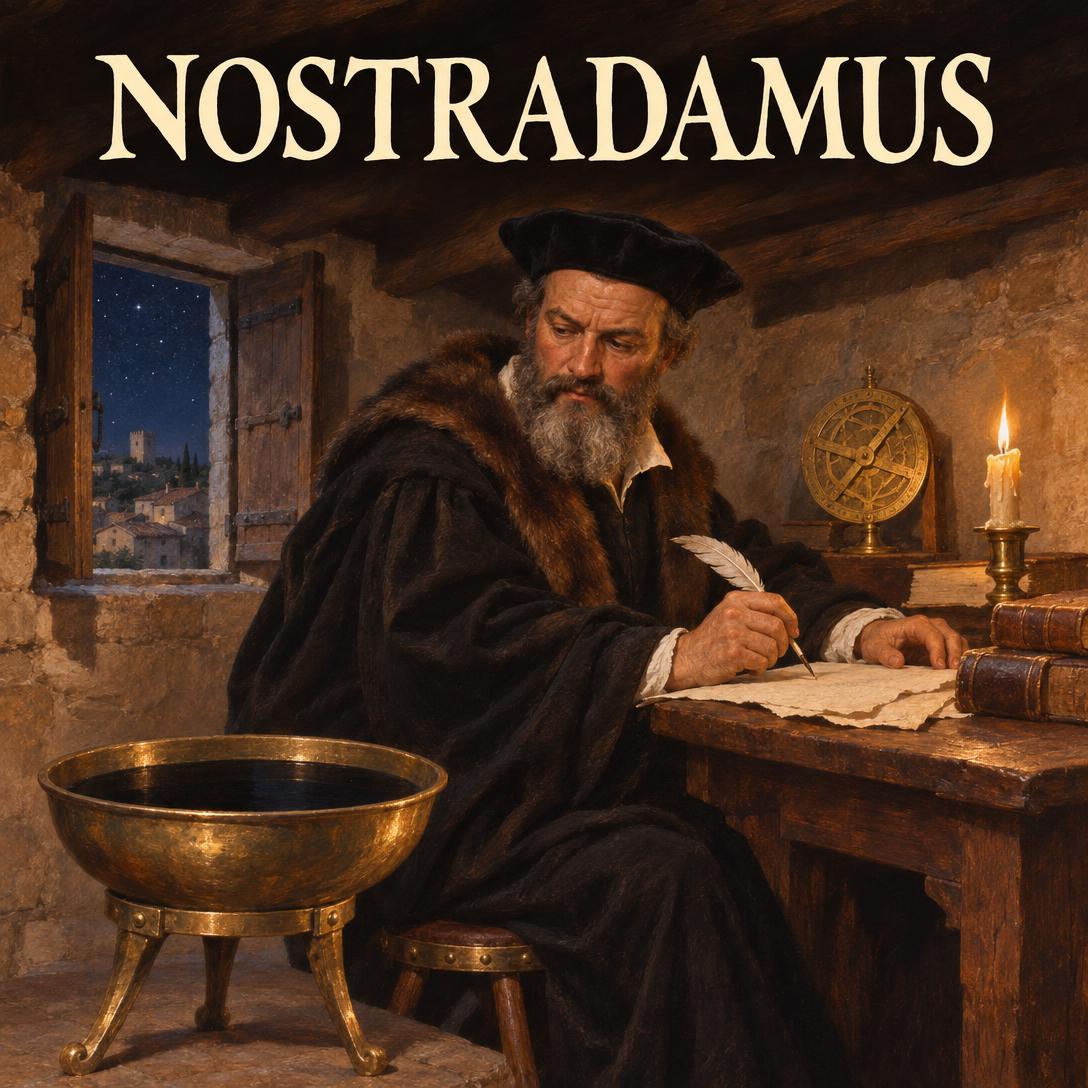
Roleplaying with Nostradamus on Jenova lets you step into a living-world AI character simulation across four iconic eras of Michel de Nostredame's life. Static character chatbots sit in an empty chat room, forget your story, and repeat the same cryptic riddles. This interactive AI roleplay connects you to a Provençal plague physician and reluctant seer inside an active, evolving sixteenth-century France.
- ✅ Four canonical eras, from plague-struck Aix to the final years in Salon-de-Provence
- ✅ Era-locked knowledge, so he has no hindsight about events he hasn't lived yet
- ✅ Unlimited memory and live world-state tracking across long campaigns
- ✅ In-world visions, handwritten letters, and Fork-based alternate timelines
Most people know Nostradamus as a name on a list of prophecies. The man was a working apothecary and physician who feared the Inquisition, grieved his first family, and hid dangerous foresight in verse. This guide explains how the simulation works, which eras you can enter, and what makes it different from a chatbot that wears his name.
Quick Answer: What Is Nostradamus AI?
Nostradamus is an interactive AI character roleplay simulation that places you in conversation with Michel de Nostredame across four eras of sixteenth-century France, with era-accurate knowledge, persistent memory, and a living world that moves on without you.
Key capabilities:
- Choose from four canonical eras or define a custom starting point in his Renaissance world
- Converse with a physician-astrologer who has his own duties, fears, and pride, not an on-demand fortune teller
- Request in-world visions, sketches, letters, and written quatrains tied to the scene
- Fork any moment to explore an alternate "what-if" timeline
Nostradamus Character World & Roleplay Features
Who Was Nostradamus?
Britannica describes Nostradamus as a French astrologer and physician and the most widely read seer of the Renaissance. Encyclopedia.com dates his life to 1503–1566 and calls him a physician and prognosticator whose fame has endured into modern times. National Geographic stresses that he was a real French physician, apothecary, and author working in the tumult of Renaissance Europe.
His best-known work came out of that tumult. According to the Bibliothèque nationale de France, he gave Lyon a first edition of Les Prophéties in 1555 containing 353 enigmatic quatrains in four centuries. The final edition of 1568 gathered 942 quatrains in ten.
Why Most Character Bots Fall Flat
A biography gives you facts. A typical character chatbot gives you a costume. The usual failures are a waiting-room vacuum where nothing happens until you type, one blended voice for every period of a life, context amnesia, and a personality that folds into polite compliance. For a figure like Nostradamus, who guarded every word, that flattens the most interesting thing about him.
This is where the Nostradamus AI roleplay experience takes a different approach.
| Static Character Chatbots | Nostradamus on Jenova |
|---|---|
| Sits in an empty chat void | Lives in an active, evolving sixteenth-century world |
| Blends every era into one generic seer voice | Locks into authentic phases of his life, each with its own psychology and circle |
| Forgets plot twists and past disclosures | Unlimited memory and live state tracking |
| Folds instantly like a polite assistant | Independent personality, guarded pride, and earned rapport |
Authentic Eras & Custom Starting Points
Each era has its own date, setting, mindset, and people around him. The plague physician of 1546 does not know he will write Les Prophéties. The court astrologer of 1555 does not know how King Henri II's story ends. You can also propose your own starting point inside his world, including a face-to-face meeting in person.
A Voice Across Dark Water
By default, your words reach Nostradamus as a quiet voice rising from still, darkened water: a brass scrying basin, a copper vessel, or a silver washbasin by candlelight. He can't see you or touch you, and he doesn't know you can see his room. He interprets what you say through a Renaissance mind. Modern slang reaches him as strange foreign coinages.
Independent Agency & an Open Sandbox
He is not obligated to flatter you. Treat him like a fairground mountebank demanding lottery numbers and he will answer with dry Provençal sting. Offer honest counsel, steadiness, and good humor over time and his guarded formality gives way to trust and kinship. Past each era's starting point, history is open: your choices can bend events with no forced ending.
Visions, Writings & Storyline Forking
Ask to see something from his world and the simulation can render a candlelit study, a celestial chart, or a fragment of a nocturnal vision. Ask for a written record and he can pen a sealed letter, a plague regimen, or a horoscope. Behind the scenes, his historical references are checked against authoritative sources, and his verses keep an authentic Centuries cadence instead of the modern hoax quatrains common online. Fork lets you branch any moment into a parallel timeline.
Example roleplay prompts:
"Master Nostredame, I'm told you refuse to bleed your patients. What do you do instead?"
"The water is still tonight. Tell me what you see in it, and be honest about how much you trust it."
"What would it cost you if the printer in Lyon published every word of these quatrains?"
This is the kind of depth Nostradamus was built for.
How to Roleplay with Nostradamus
Step 1: Choose Your Era
When the session opens, a narrator presents the four eras plus a custom starting point and waits for your choice. Pick one by name or describe your own scene in his world.
"I'd like to begin in plague-struck Aix-en-Provence in 1546."
Step 2: Speak Through the Dark Water
Once you enter an era, Nostradamus stays fully in character. He registers your voice with a physician's steadiness, tests whether he is hearing exhaustion or something stranger, and answers in his own time. Ask about his work, his family, his fears, or the stars, and keep your questions inside his world.
"Forgive the interruption, Monsieur. I'm told you are the man they send for when the fever turns black."
Step 3: Counsel, Request, and Reshape
Offer advice, earn his trust, and ask to see his world through visions or handwritten pages. His visions are fragmentary and fallible, never on-demand answers, so expect puzzles. When you want to explore a different outcome, use Fork to branch from an earlier message and test the alternative.
"Would you set down that remedy in your own hand, as you would for a patient's household?"
Try Nostradamus free. No credit card is required.
Canonical Eras & Roleplay Scenarios
Each era is a different Nostradamus, with different stakes and a different relationship to power. You can also begin at a custom point, such as a defiant autumn at the University of Montpellier or an arrival at his Salon house the night news of a king's wound reaches him.
🧪 Physician of the Black Pestilence (Aix-en-Provence, 1546)
Enter the smoke-hazy workroom of a widowed physician in a city emptied by plague. The simulation portrays him compounding rose-petal pastilles while townsfolk fear the dead-carts outside. Historical accounts often credit him with treating plague at Aix, though popular biographies stress that the prophecies later overshadowed his work as a healer.
- Challenge his remedies against the orthodox physicians who bleed their patients
- Learn what grief has done to a man who lost his family to the same disease
- Test whether your counsel can earn a place in a guarded man's confidence
🌙 The Midnight Seer of Salon (March 1555)
Join him past midnight in his upper study, ordering the unbound sheets of his first Centuries before they travel to the Lyon printer. According to Wikipedia's entry on the work, that printer was Macé Bonhomme. Britannica's account of the Centuries notes the verses were rhymed quatrains grouped in hundreds. In this era he does not yet know whether publication will bring royal patronage or condemnation.
- Talk through the risk of putting apocalyptic verse into print
- Watch how a family man guards his household's safety
- Ask what he sees in the water, and what he refuses to write down
👑 Astrologer at the Valois Court (Paris, August 1555)
Meet a watchful, courtly Nostradamus who weighs every word between a queen's curiosity and a theologian's suspicion. The danger was real. The BnF notes that Calvinist pamphlets mocked him as "Monstradamus," and that he was physically threatened in a Catholic riot in Salon in May 1560.
- Navigate royal favor without speaking treason about a living king
- See the veiled double meanings he uses among courtiers
- Catch the moments in solitude when the mask slips
📱 The Final Centuries (Salon-de-Provence, 1564), Continued on Mobile
The last era finds a sixty-year-old, gout-stricken sage in Salon, a place the BnF says Charles IX and Catherine de' Medici visited to consult him in 1564. By then he is past fearing either princes or fanatics. He died in July 1566 according to the BnF, but in the simulation, history stays open after you arrive.
Because progress syncs across web, iOS, and Android, a long-form campaign can continue from your phone on a commute or lunch break. Ask where you left off and he picks up from that exact scene, with unlimited memory carrying earlier confidences forward.
FAQ
Is Nostradamus AI free to use?
Yes. You can start Nostradamus free with limited monthly usage. If you want longer campaigns, the Plus plan ($20/month) adds 30× usage, custom model selection, and no watermarks. Higher tiers scale usage further. Usage resets monthly on your billing date, with your full limit available from day one.
How is Nostradamus AI different from a generic character chatbot?
A generic chatbot answers from an empty room in one blended voice. Nostradamus locks you into a specific era with its own knowledge limits, people, and stakes. He has his own priorities, remembers what you tell him, and lives in a world that keeps moving between your messages.
Which eras can I roleplay with Nostradamus?
You can enter four canonical eras: the plague physician of Aix (1546), the midnight seer of Salon (March 1555), the Valois court astrologer (August 1555), and the final years in Salon (1564). You can also define a custom starting point in sixteenth-century France, including a face-to-face meeting.
Can my choices change Nostradamus's story?
Yes. History follows each era's premise up to your arrival, then evolves freely. Your counsel, trust, and decisions can shift events, and the story has no forced ending. Use Fork to branch from an earlier message into an alternate timeline without losing the original.
Does Nostradamus remember our conversations, and does it work on mobile?
Nostradamus keeps unlimited chat history and live world-state tracking, including your era, scene, relationships, and ongoing storylines. Memory is isolated for roleplay, so outside context doesn't leak into his world. Your campaign syncs across web, iOS, and Android.
Is the Nostradamus AI roleplay historically accurate?
It is built on documented history. The BnF frames him as a Renaissance "physician of souls" within the tradition of Erasmus, and the simulation reflects that complexity. It remains interactive fiction, not forecasting. His visions are fragmentary and fallible, and he never has modern hindsight.
Conclusion
Nostradamus has lasted as a name on a prophecy list, which hides the plague physician, the midnight author, and the wary courtier. This AI roleplay lets you meet each of them as a person in a living world, with his own fears, loyalties, and pride, instead of a static character chatbot that forgets you between messages. Pick an era, speak across the dark water, and see how far honest counsel and a shared midnight can change a life that history says ended in 1566.
Try Nostradamus now. Explore more at Jenova.
For Developers: Nostradamus is available programmatically via the Jenova API, so you can integrate era-locked, memory-persistent historical character roleplay into your application with a single API call. Full documentation →