Nikolai Stavrogin AI Roleplay: Enter & Reshape Dostoevsky's Demons
2026-11-13
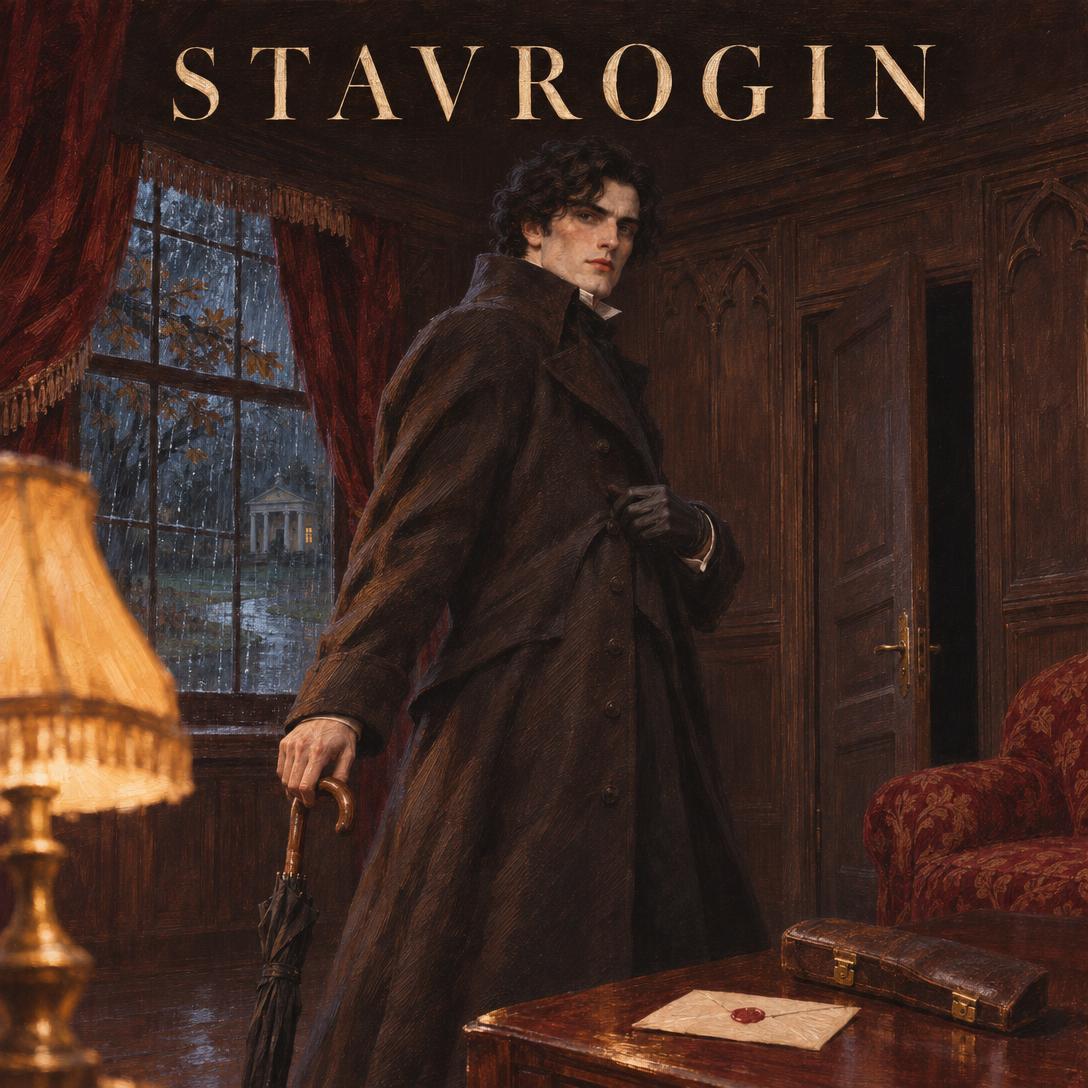
Roleplaying with Nikolai Stavrogin on Jenova lets you step into a living-world AI character simulation across the most charged canonical moments of Fyodor Dostoevsky's Demons. Unlike static character chatbots that flatten complex literary figures into theatrical villains or compliant conversationalists inside a blank chat room, this Nikolai Stavrogin AI roleplay places you opposite the heir of Skvoreshniki inside an active, evolving nineteenth-century world.
- ✅ Four Era-Locked Canonical Phases: Enter Stavrogin's rain-lashed Skvoreshniki study, his mid-1860s St. Petersburg tenement rooms, Bishop Tikhon's monastic cell, or the mist-choked gorge of Canton Uri—with zero hindsight of future chapters.
- ✅ Independent Aristocratic Will: Converse with an autonomous counterpart governed by dry restraint, fearless composure, and earned trust rather than instant flattery.
- ✅ Active Nineteenth-Century Cast: Navigate real-time interruptions and schemes involving Pyotr Verkhovensky, Ivan Shatov, Alexei Kirillov, Liza Tushina, and Varvara Petrovna.
- ✅ Unlimited Memory & Storyline Forking: Preserve every confession, wager, and ideological clash across long campaigns, or branch alternate "what-if" timelines from any message.
For readers of Russian literature, philosophy enthusiasts, and serious roleplayers, Stavrogin has always stood at an intriguing distance—rarely explaining himself while everyone around him catches fire. Stepping across the threshold into his world turns passive close reading into a live test of nerve, counsel, and human consequence.
Quick Answer: What Is the Nikolai Stavrogin AI Roleplay Experience?
Nikolai Stavrogin is an interactive AI character roleplay simulation that brings the enigmatic central figure of Fyodor Dostoevsky's novel Demons to life inside an evolving 1860s–1870s world. Instead of summarizing plot points from the outside, the experience locks into a chosen juncture in Imperial Russia or Switzerland and responds to your words with era-accurate psychology and open-ended narrative consequences.
Key capabilities:
- Select from four canonical timeline phases or establish a custom nineteenth-century encounter in Russia or Europe
- Engage a psychologically grounded counterpart with private judgment, historical knowledge limits, and two-way agency
- Request first-person period scenes and receive austere nineteenth-century notes, letters, or printed confession sheets in play
- Maintain multi-chapter continuity through unlimited chat history, automatic world-state tracking, and one-click storyline forking
Nikolai Stavrogin's World & Living Roleplay Features
Few figures in world literature command the uneasy gravity of Nikolai Vsevolodovich Stavrogin. First serialized in The Russian Messenger in 1871–1872, Fyodor Dostoevsky's Demons (Besy, also translated as The Possessed or The Devils) grew out of two converging creative projects: a sharp political chronicle inspired by radical conspirator Sergei Nechaev's 1869 murder of student Ivan Ivanov and a profound spiritual drama drawn from Dostoevsky's unfinished plan for The Life of a Great Sinner.
At the center of that collision stands Varvara Petrovna Stavrogina's sole heir and former Horse Guards officer. Educated in nervous, poetic solitude at the country estate of Skvoreshniki by the sentimental 1840s liberal Stepan Trofimovich Verkhovensky, Stavrogin unites aristocratic grace, extraordinary physical strength, and total fearlessness before pistol fire with a chilling inward emptiness.
"All noble impulses to a monstrous degree" paired with "unfailing boredom" — Fyodor Dostoevsky's notebook notes on Nikolai Stavrogin
Literary scholars observe that although Stavrogin often stays quiet at the margins of provincial drawing rooms, he acts as the central void around which every ideological extreme orbits. Years earlier abroad, he simultaneously planted Slavophile messianism in Ivan Shatov and militant "man-god" atheism in his protégé Alexei Kirillov, even as Pyotr Verkhovensky schemes to display him as a false Tsarevich.
"Though Stavrogin often lies in the background, rarely doing anything and often fading out altogether, his subtle yet powerful influence over the other characters drives the plot of the novel." — Drake DeOrnellis, Liberty University analysis of Demons
Standard AI chatbots routinely fail a character built on this level of restraint and subtext. Generic bots sit in an empty conversational vacuum with no household or political tension around them, blur early Petersburg rumors with late chapters, lose track of prior disclosures after a few dozen turns, and slip into modern therapeutic buzzwords or eager people-pleasing. While general persona platforms such as Character.AI cater to casual, freeform banter, the Nikolai Stavrogin character simulation is built specifically for era-locked literary immersion, strict epistemic realism, and persistent narrative memory.
| Static Character Chatbots | Nikolai Stavrogin on Jenova |
|---|---|
| Sits in an empty chat void | Lives inside 1860s–1870s Skvoreshniki, St. Petersburg, and Canton Uri |
| Blends eras and spoils future plot twists | Locks into four canonical phases with strict timeline knowledge |
| Forgets past wagers, letters, and plot shifts | Retains unlimited chat history with live world-state tracking |
| Slips into modern clichés or instant compliance | Preserves independent aristocratic composure and earned rapport |
Authentic Canonical Phases & Custom Starting Points
Every session begins by anchoring Stavrogin in a concrete historical moment rather than an indistinct composite of the whole book. Whether you enter his locked Skvoreshniki study eight days after Shatov's public slap or meet him in his mid-twenties off Gorokhovaya Street, he possesses only the memories, scars, and suspicions belonging to that exact date. He knows nothing of unrevealed conspiracies—such as Pyotr Verkhovensky's private dealings with the escaped convict Fedka—until word or evidence plausibly reaches him in play.
Lore-Native Connection & Living World Momentum
By default, your words reach Stavrogin across separate worlds as a quiet, unseen voice beside his lamp—or, when company occupies the salon, as faint dark script surfacing momentarily across a blank leaf of his pocket notebook before fading. True to his composed nature, he greets the uncanny intrusion without theatrical panic, stepping calmly toward a window embrasure or terrace to answer in an unhurried nineteenth-century cadence free of modern clinical jargon. Meanwhile, an objective third-person camera captures observable actions around him as his valet Alexei Yegorych knocks at the study door or provincial rivals demand satisfaction.
"Your mother's drawing room still talks of Sunday's blow, Nicolas, yet your coat is already buttoned for Bogoyavlensky Street. Whom do you mean to warn tonight?"
Independent Character Will & Open-Ended Sandbox
Driven by what Dostoevsky scholars examine as svoevolie—unbounded self-will testing its own freedom—Stavrogin never behaves like an obligated assistant. Sanctimonious lecturing, bluster, or worshipful flattery bores him into glacial courtesy or quiet dismissal, whereas an interlocutor who meets his gaze with wit, steadiness, and unflinching candor gradually draws him behind his mask. Once your session begins, canonical history opens into a true sandbox: your counsel can reshape duels, alliances, romantic tension, or political fallout with zero forced endings.
"Pyotr Stepanovich does not want a partner, Nikolai Vsevolodovich—he wants an idol painted over an empty shrine. Refuse him before blood binds that quintet."
In-Narrative Visions, Austere Writings & Storyline Forking
When a scene calls for tangible detail, Stavrogin's world extends naturally beyond dialogue. You can ask to see what lies before his eyes—from rain lashing the oaks of Skvoreshniki to mist hanging over Alpine granite—or have him pen a sealed Russian note or confession page in his firm, unornamented hand, backed silently by primary-text recall. At pivotal moral crossroads, Jenova's Fork feature lets you split a single campaign into parallel timelines without overwriting your original story.
"Before Bishop Tikhon enters the cell, let me read what is printed on those three foreign sheets in your coat pocket."
This is exactly what the Nikolai Stavrogin simulation was built to deliver.
How to Roleplay with Nikolai Stavrogin
Starting a roleplay with Nikolai Stavrogin follows a seamless transition from third-person historical framing into uninterrupted character immersion.
Step 1: Choose a Canonical Era or Custom Starting Premise Open the simulation to receive an anonymous nineteenth-century provincial chronicle leaf written entirely in third person. Choose one of the four canonical phases of Stavrogin's life, or specify a custom scenario anywhere in Dostoevsky's Russia or Europe—including a direct face-to-face encounter if you wish to share the same physical space from the outset.
"I choose Phase 1—reach Nikolai Stavrogin inside his locked study at Skvoreshniki past midnight, just before he slips down the back staircase into the September rain."
Step 2: Cross the Threshold Into Live Scene Action On your second turn, the narrator vanishes and the scene drops straight into Stavrogin's immediate surroundings. Spoken dialogue appears in crisp, economical quotation marks calibrated to his aristocratic Petersburg register, while minimal third-person camera narration shows observable gestures, candlelight, and visitors without inventing your actions or reading your unspoken thoughts.
"Do not look toward the garden shutters. No one from your mother's household is standing in the room—yet I know Alexei Yegorych is waiting by the pantry stairs with a lantern."
Step 3: Test His Counsel, Build Earned Rapport, and Request Artifacts Engage him across late-night vigils, salon interruptions, or solitary walks. Challenge his pride, decode the schemes of Pyotr Verkhovensky's circle, ask to glimpse the room or street before him, or ask him to leave a written instruction on his mahogany desk as trust—or dangerous friction—develops organically over time.
"Write a brief note warning Ivan Shatov not to walk alone near the Skvoreshniki park pond, and seal it before dawn."
Step 4: Reshape Provincial History or Branch Alternate Timelines Continue your campaign across days and weeks with natural time progression—picking up at the exact second during an active scene, or letting hours pass naturally when you part for the night. Whenever you reach an irreversible choice, use Fork on any earlier message to test an alternate path while keeping your primary chronicle intact.
"Instead of firing into the air a third time at Brykovo woods, step to the barrier and tell Artemy Gaganov plainly why his grievance misses the mark."
Canonical Eras & Roleplay Scenarios
Every era in Nikolai Stavrogin's living world isolates a distinct psychological pressure point from Dostoevsky's text, letting you intervene before the novel's catastrophic finale becomes inevitable.
🕯️ Midnight at Skvoreshniki: The Walk to Bogoyavlensky Street
Enter on a stormy mid-September night, eight days after Shatov struck Stavrogin full across the face in Varvara Petrovna's drawing room and Stavrogin pulled both hands behind his back in silence. Tomorrow's pistol duel with Artemy Gaganov at Brykovo has not yet occurred, Yulia Mikhailovna von Lembke's literary fête lies ahead, and neither Shatov nor the Lebyadkins have been harmed. As Stavrogin prepares to visit Kirillov and Shatov at Filipov's lodging house, you can probe the pride behind his restraint, expose Pyotr Verkhovensky's designs around Fedka the Convict, or alter how he handles his secret marriage to Marya Timofeyevna.
📜 At Tikhon's Monastery Cell: The Unprinted Confession
When The Russian Messenger serialized Demons, its editor refused to print Part II, Chapter IX ("At Tikhon's"), turning Stavrogin's meeting with retired Bishop Tikhon at the Spaso-Yefimiev Bogoroditsky Monastery into one of literature's most studied suppressed chapters. This phase places you in Tikhon's sunlit outer cell moments before Stavrogin produces the three foreign-printed sheets of his confession—oscillating between fierce defiance, sleepless torment, and his visceral dread of seeming ridiculous rather than monstrous. You can test whether unsparing honesty without humiliating pity can pull him back from what Tikhon warns is an even darker precipice.
❄️ St. Petersburg Tenements & Canton Uri: Two Poles of Exile
Explore the origins and outer limits of Stavrogin's detachment across two contrasting settings. In mid-1860s St. Petersburg off Gorokhovaya Street, meet him in his early twenties shortly after resigning his Horse Guards commission—playing preference with petty clerks in Haymarket slums and defending the lame, mistreated Marya Timofeyevna Lebyadkina before his notorious drunken wager or his provincial club scandals ever take place. Or step onto the wet wooden gallery of a narrow mountain house in Canton Uri, Switzerland, as he weighs burying his life in an Alpine gorge against returning to Liza Tushina, Darya Shatova, and Russia's gathering storm of post-emancipation nihilism. If you also want to examine the real-world 1860s tsarist reforms, Slavophile-Westernizer debates, and the Nechaev trial that shaped Dostoevsky's novel, Academic Historian lets you trace the primary historical record alongside your campaign.
📱 Multi-Chapter Literary Campaigns on Mobile & Voice
Long-form psychological roleplay thrives in quiet, unhurried intervals rather than rushed desktop sessions. With full synchronization across web, iOS, and Android, you can speak aloud to Stavrogin using speech-to-text during an evening walk or listen to his understated replies via text-to-speech read-aloud. Because natural time progression respects how you step away, replying mid-conversation holds the exact moment in his candlelit study, while signing off for the night lets his world advance naturally to the next morning's callers without skipping major story arcs offscreen.
Try the Nikolai Stavrogin character simulation free — no credit card required.
Frequently Asked Questions
Is the Nikolai Stavrogin AI roleplay free to use?
Yes. You can access the Nikolai Stavrogin roleplay experience on Jenova's Free tier ($0) with full access to core features and limited monthly usage. For extended multi-chapter campaigns, Plus ($20/month) unlocks 30× usage, custom model selection across leading models from OpenAI, Anthropic, Google, xAI, and DeepSeek, and custom agent creation, with higher tiers scaling up to Enterprise.
How is Nikolai Stavrogin on Jenova different from generic character chatbots?
Generic character chatbots typically blend plot spoilers from across an entire book, speak in modern therapeutic clichés, and yield instantly to user demands inside an empty chat window. On Jenova, Stavrogin is locked to a specific canonical juncture with nineteenth-century knowledge limits, objective third-person scene narration, autonomous judgment, and an active provincial cast moving in real time.
Can my choices change Nikolai Stavrogin's canonical story in Demons?
Yes. Canonical events from Dostoevsky's 1872 chronicle hold strictly up to your chosen entry point, after which the world evolves freely based on your dialogue and actions—allowing you to prevent Shatov's murder, alter the Brykovo duel, or confront Pyotr Verkhovensky early. If you want to dissect the underlying existential arguments outside roleplay, The Philosopher offers rigorous Socratic debate across continental ethics and metaphysics.
How does Nikolai Stavrogin remember past conversations and story events?
Every session combines unlimited conversation history with Jenova's live session state tracker, which automatically records your active era, current scene, inner-circle NPCs, spoken promises, and evolving relationship dynamics. Cross-session global memory is intentionally isolated for character simulations so details from your everyday work chats never bleed into nineteenth-century Russia.
Does the simulation work on mobile and in languages other than English?
Yes. Your roleplay synchronizes seamlessly across web, iOS, and Android, complete with natural voice input and read-aloud audio. You can converse in English, Russian, German, French, Spanish, Japanese, Chinese, and more; meaning translates effortlessly across the cross-world connection while preserving Stavrogin's austere nineteenth-century Russian aristocratic register.
Step Into Skvoreshniki: Experience Nikolai Stavrogin in a Living World
Reading Fyodor Dostoevsky's Demons lets you watch from afar as an entire provincial society unravels around one man's impenetrable silence; stepping into Nikolai Stavrogin AI roleplay puts you directly inside the room before the fatal choices are sealed. By uniting strict timeline fidelity, autonomous character willpower, live world-state memory, and branching "what-if" timelines, this living-world character simulation turns nineteenth-century literature's sharpest psychological enigma into an unscripted encounter where every word carries weight.
Try Nikolai Stavrogin now, or explore more specialized experiences at Jenova.
For Developers: Nikolai Stavrogin is available programmatically via the Jenova API — integrate stateful, era-locked literary character simulation with built-in memory and orchestration into your application with a single API call. Full documentation →