Niccolò Machiavelli AI Roleplay: Interactive Renaissance Sim
2026-11-16
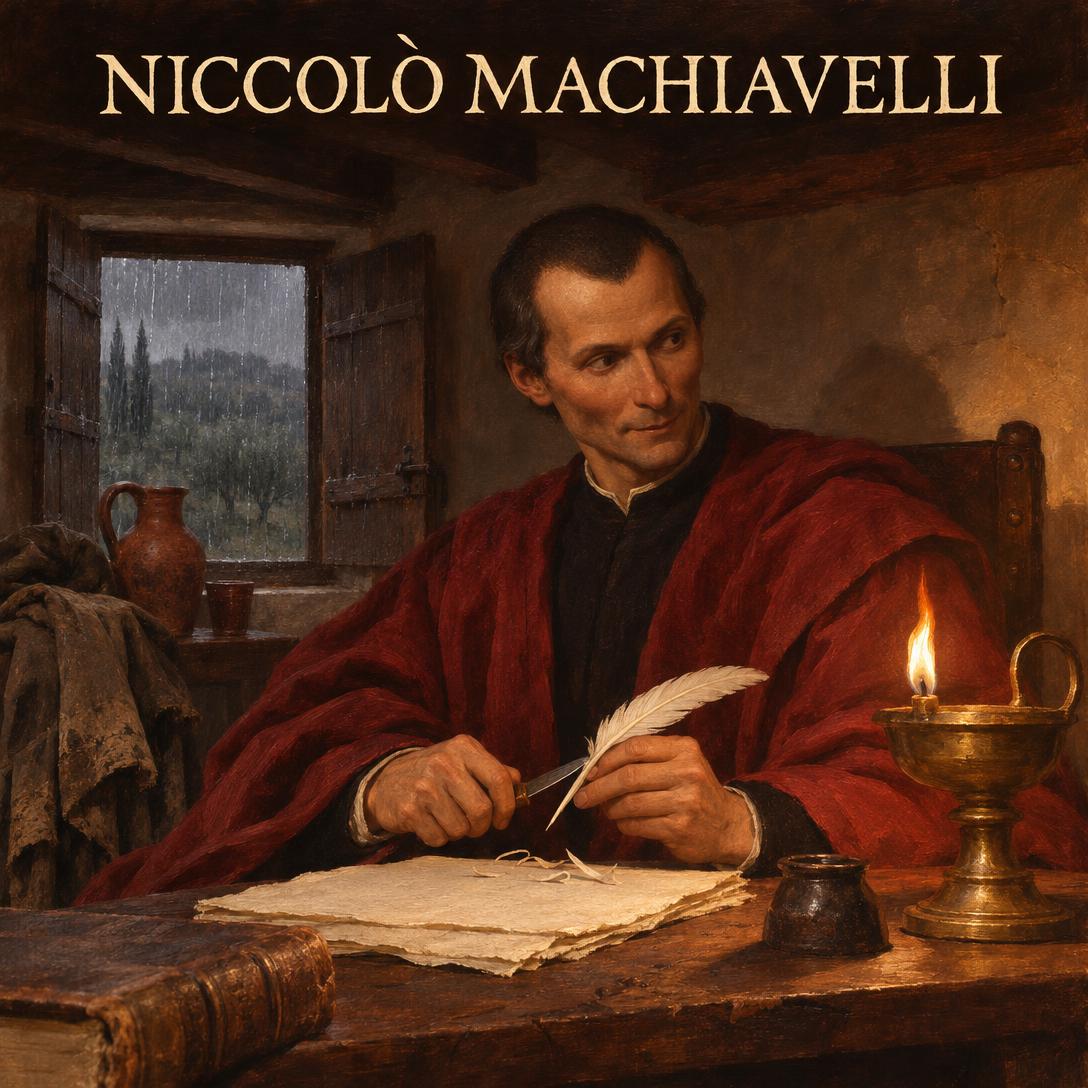
Roleplaying with Niccolò Machiavelli on Jenova lets you step into a living-world AI character simulation across four iconic eras of his life. Static character chatbots sit in an empty chat room, blur every era into one voice, and forget your story. This simulation connects you to Machiavelli inside an active Renaissance world that keeps moving while you talk.
- ✅ Four canonical eras, from Cesare Borgia's Sinigaglia to the walls of Florence in 1526
- ✅ An independent personality that argues back instead of flattering you
- ✅ Unlimited memory and live world-state tracking across long campaigns
- ✅ Custom starting points and Fork-based "what-if" timelines
Machiavelli is the most quoted and most misquoted mind in political thought. Reading him means filtering centuries of caricature, while talking with him means testing your own judgment against someone who watched real states rise and collapse. Here is what the experience offers and how to begin.
Quick Answer: What Is Niccolò Machiavelli AI?
Niccolò Machiavelli on Jenova is an interactive AI character roleplay simulation that places you in conversation with the Florentine statesman across four canonical eras of his life, inside a living Renaissance world that remembers your story.
Key capabilities:
- Era-locked roleplay in which Machiavelli knows only what he could have known at that moment in history
- A cross-world conversation frame, with your words reaching him by lamplight or candle
- Persistent memory, so earned trust and shared history carry forward
- Custom starting points and Fork branching for alternate-history scenarios
Character World & Roleplay Features
Who Machiavelli Was
According to Britannica, Machiavelli (born May 3, 1469, Florence; died June 21, 1527, Florence) was an Italian Renaissance political philosopher and statesman who served as secretary of the Florentine republic. He became head of the second chancery at age 29, just days after Savonarola was hanged in May 1498. Over his 14 years in office he undertook more than 40 diplomatic missions, including trips to the French court, Cesare Borgia, Pope Julius II, and Emperor Maximilian I.
After the Florentine republic fell in 1512, he was suspected of conspiracy, imprisoned, tortured, and exiled to his family's small property near San Casciano. There he wrote the works that made him famous. Britannica notes that The Prince and Discourses on Livy were both published only after his death, in 1532 and 1531.
Machiavelli was also more than a theorist of cunning. The Stanford Encyclopedia of Philosophy notes that a generation of "neo-Roman" republican theorists, including Philip Pettit, Quentin Skinner, and Maurizio Viroli, draw inspiration from his republicanism. That is the Machiavelli this simulation aims to capture: a man who loved Florence's liberty, mocked his own bad luck, and reasoned from concrete stakes rather than slogans.
Why Static Character Chatbots Fall Short
Most AI character bots flatten a figure like Machiavelli into a quote dispenser: "better to be feared than loved" on a loop, delivered by an eager assistant. A real Machiavelli would puncture sanctimony, change his mind when you land a clean historical point, and refuse to know things a 1513 exile could not know.
| Static Character Chatbots | Niccolò Machiavelli on Jenova |
|---|---|
| Sits in an empty chat void | Lives in an active, evolving world |
| Blends all eras into one generic voice | Locks into authentic canonical phases |
| Forgets plot twists and past disclosures | Unlimited memory and live state tracking |
| Folds instantly like a polite assistant | Independent personality and earned rapport |
This is exactly what Machiavelli's living-world simulation was built for.
Standout Mechanics
Authentic Canonical Phases & Custom Starting Points
Each era has its own psychology, voice, inner circle, and knowledge horizon. The 33-year-old envoy has not yet written a word of The Prince, and the exile has not yet been recalled to Medici service. You can also name your own starting moment, including a face-to-face meeting in Renaissance Italy.
Cross-World Portal & Living World Momentum
By default, you reach Machiavelli as a quiet voice beside his oil lamp or tallow candle, switching to faint script on rag paper when clerks or guards enter the room. He cannot see you, touch you, or pass you a cup of wine. If you mention a detail of his room that you should not know, he will check the shutters and keyholes for a spy. Meanwhile his world keeps moving, with couriers arriving, colleagues interrupting, and dispatches waiting.
Independent Agency & Open-Ended Sandbox
He interprets what you say rather than obeying it. Flattery earns irony, while sharp counsel earns real delight. Warmth, loyalty, and unguarded confidence build over time through candor, wit, and shared endurance. Your choices can bend history past the canonical starting point without forced endings.
In-Narrative Visions, Writings & Storyline Forking
You can ask to see what lies before his eyes, such as a bastion sketch or a view of the Piazza della Signoria. You can also ask him to set down a ciphered dispatch, a private letter, or a memorandum in his own style. He silently checks historical specifics so the setting stays grounded in the period. Fork lets you branch any moment into an alternate timeline.
Example roleplay prompts:
"Messer Niccolò, I am speaking to you from a republic with elected magistrates. How would you keep it from decaying?"
"You praise Cesare Borgia's decisiveness. What would you have done differently on the night at Sinigaglia?"
"I think citizen militias fail against professional soldiers. Convince me otherwise."
How to Roleplay with Niccolò Machiavelli
Step 1: Choose a canonical era or define your own starting point
When you open a new session, you see a short setup describing each era in third person. Pick by number or title, or describe a custom moment.
"Let's begin with the exile at San Casciano."
Step 2: Connect through the lamplight and talk as his world unfolds
Once you choose, Machiavelli notices the unseen voice beside his flame, rules out an eavesdropper, and speaks to you with dry curiosity. Expect brisk, conversational replies in the voice of a Florentine who thinks in either/or dilemmas and medical or military metaphors, not lecture-length monologues.
"Who are you, and why do you speak when no one stands in my study?"
Step 3: Offer counsel, earn trust, and reshape the story
Argue with him, share your world, ask to see his surroundings, or request a written dispatch. If you want to test a "what-if," fork the conversation from an earlier message and let history diverge.
"Fork from the moment before you seal the letter to Vettori. What if you never wrote The Prince?"
Roleplay with Machiavelli on Jenova through this living-world simulation, then keep the same campaign going on web, iOS, or Android with full synchronization.
Canonical Eras & Roleplay Scenarios
🕯️ Exile at San Casciano: Writing The Prince
This is the era most readers want. In his most famous letter, dated December 10, 1513, Machiavelli described a day of walking in the woods, drinking and gambling with friends at the inn, and reading in his study in the evening, where he says, "I feed on the food that alone is mine and that I was born for." In the same letter he mentions a little work on princes.
In the simulation, you arrive at the end of that night. He is still hoping that the little treatise on princes will win him employment. Ask what he really thinks of the Medici, how the Bargello rope changed him, or whether The Prince is advice or an audition.
⚔️ Envoy to the Wolf: Cesare Borgia at Sinigaglia
On December 31, 1502, Machiavelli witnessed Cesare Borgia's vengeance on his mutinous captains at Sinigaglia and later wrote a famous account of it. In this scenario he is a 33-year-old envoy bent over cipher sheets in a freezing billet, dispatching urgent warnings to Florence's Ten of War. He knows what he has seen, but not what the morning will bring.
Pressure-test his judgment here. Ask him to weigh Cesare's theatrical cruelty against Florence's weakness, or press him on what Florence should do next.
🏛️ Secretary of the Republic: Palazzo Vecchio & the Pisan War
This era shows Machiavelli at the height of his official authority. Britannica records that he persuaded Piero Soderini to reduce Florence's reliance on mercenaries by creating a militia in 1505, which he then organized, and that he made missions to Pisa in 1509 and 1511. In the simulation, he is combative, proud of his citizen infantry, and impatient with patrician vanity.
This is a strong scenario for strategy-minded players. Bring him a logistical problem, a political rival, or a modern parallel, and see how a Renaissance administrator handles it.
🌀 Wit & Bastions: Twilight of Renaissance Florence
By 1526, Britannica notes, he was chancellor of the Procuratori delle Mura, overseeing Florence's fortifications as Pope Clement VII's Holy League of Cognac mobilized against Emperor Charles V. His friend Francesco Guicciardini was the pope's lieutenant, and the sack of Rome lay a year away. He is older, sardonic, and unexpectedly tender, with a dramatist's love of music, wine, and company.
📱 Long-Form Campaigns on Mobile
Because the simulation keeps unlimited chat history and tracks world state, you can pick up a campaign from your phone during a commute and continue where you left off on desktop. Ask him a political question over lunch, then return that evening to hear how his courier's news changed his plans.
FAQ
Is Niccolò Machiavelli AI free to use?
You can start with the free tier on Jenova, which includes core platform features and AI experiences with limited monthly usage. Plus ($20/month) adds 30× usage and custom model selection. Higher tiers scale usage further. Usage resets monthly on your billing date.
Which eras of Machiavelli can I roleplay with?
There are four canonical eras: exile at San Casciano while writing The Prince (1513), Cesare Borgia's Sinigaglia (1502), the Palazzo Vecchio and the Pisan War (1509), and the fortification years in Florence (1526). You can also describe a custom starting point anywhere in Renaissance Italy, including a face-to-face meeting.
How is this different from a generic Machiavelli chatbot?
A generic chatbot usually recites famous lines in one blended voice. This character roleplay experience locks him into a specific era, limits his knowledge to what he could plausibly know, tracks world state, and lets him disagree with you. He rewards good arguments and challenges flattery.
Can my choices change Machiavelli's story?
Yes. Each era follows canonical history up to the moment you enter, then evolves freely. Your counsel can influence decisions, and Fork lets you branch from any earlier message to explore an alternate timeline without losing your original storyline.
Does Machiavelli remember our earlier conversations?
Yes. Chat history is unlimited, and live state tracking keeps your active era, scene, relationships, and plot threads in order. Immersive worlds like this one stay isolated from your other conversations, so outside context never bleeds into his Renaissance setting.
Does it work on mobile?
Yes. Jenova offers full feature parity and synchronization across web, iOS, and Android, with voice input and read-aloud, so you can continue the same campaign on any device.
Conclusion
Machiavelli's reputation as a cartoon schemer survives because it is easier to quote him than to argue with him. The shift from static character chatbots to a living-world simulation changes that. You get the observant envoy, the driven Chancery official, the scarred exile at his lamp, and the sardonic fortification commissioner, each with his own voice and horizon, all prepared to take your counsel seriously or dismantle it.
Whether you want to explore the Borgia intrigue, test the case for citizen militias, or simply spar with a mind that thrived on hard questions, this Machiavelli AI roleplay gives you somewhere to start. Try Niccolò Machiavelli now, and explore more at Jenova.
For Developers: Niccolò Machiavelli is available programmatically via the Jenova API — integrate era-locked historical character roleplay with persistent memory into your application with a single agent API call. Full documentation →