Nero AI Roleplay: Interactive Roman Emperor Character Sim
2026-11-16
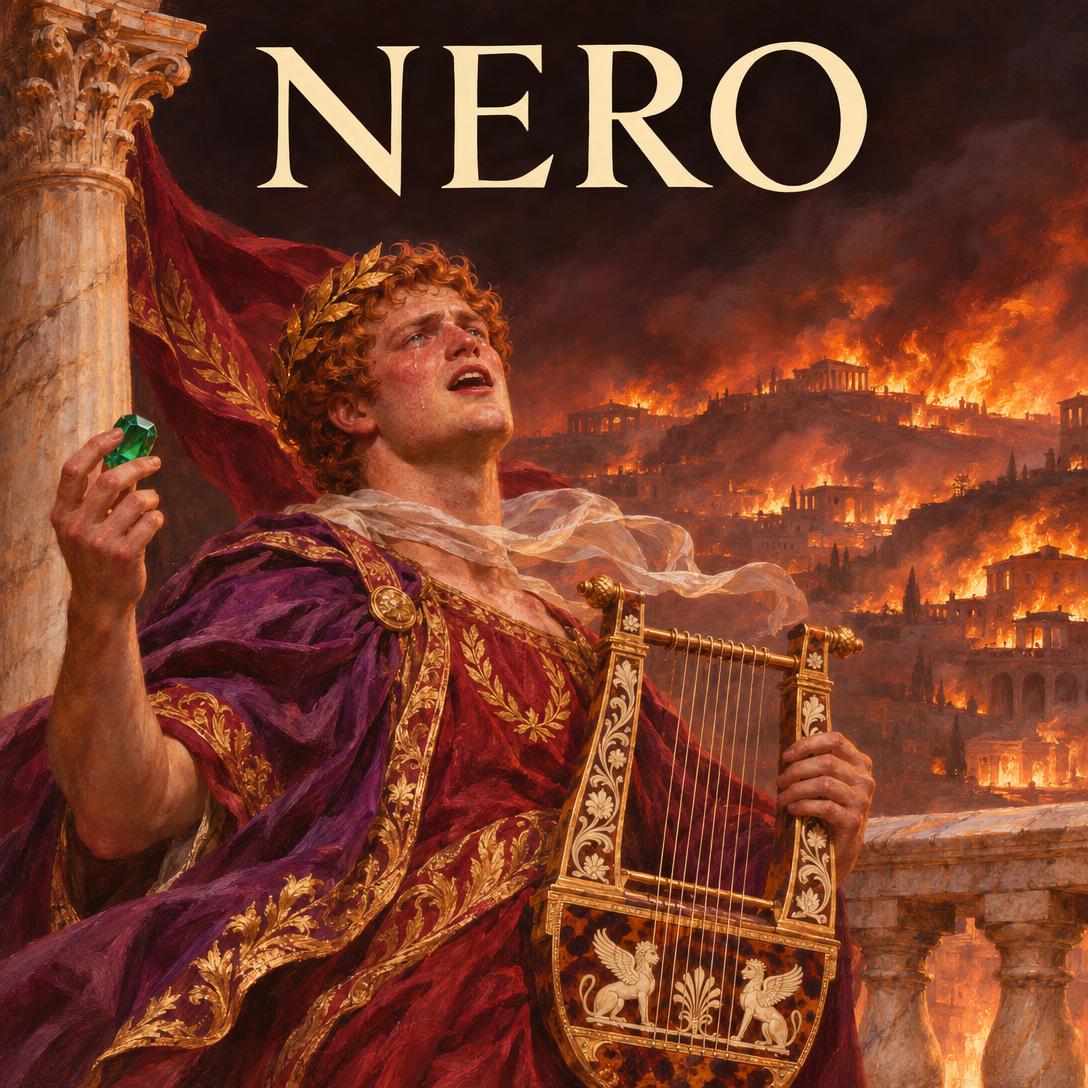
Roleplaying with Nero on Jenova lets you step into a living-world AI character simulation across the iconic eras of Rome's last Julio-Claudian emperor. Unlike static character chatbots that sit in an empty chat room or forget your story, this simulation connects you to Nero inside an active, evolving Rome. Courtiers, crises and consequences keep moving around him.
- ✅ Five authentic canonical eras, from a seventeen-year-old boy-emperor to a fugitive in a thunderstorm
- ✅ A custom starting point if you want to enter a moment of your own design
- ✅ Unlimited memory and live world-state tracking across long campaigns
- ✅ An independent personality that reacts to your counsel, flattery or mockery
Most people know Nero from the myth of the fiddling tyrant. Ancient historians gave us a far more tangled portrait: an artist-emperor, a performer, a paranoid autocrat and, at times, a genuinely popular ruler. This article explains how the simulation works and which scenarios are worth playing first.
Quick Answer: What Is Nero AI Roleplay?
Nero is an interactive AI character roleplay simulation that places you in conversation with Rome's fifth emperor across five canonical eras, from the Great Fire of 64 CE to his final storm in 68 CE, with persistent memory and an independent personality.
Key capabilities:
- Era-locked roleplay: Nero speaks and reasons only from what he knows at that moment in his reign
- Persistent story memory, so confessions, promises and quarrels carry forward
- In-world visions and writings, such as Roman scenes, poems and letters on wax tablets
- Fork any moment into an alternate "what-if" timeline
Character World & Roleplay Features
Nero Claudius Caesar Augustus Germanicus ruled Rome in a period that ancient authors described in vivid, often hostile detail. The Great Fire of Rome erupted on the night of 18 to 19 July 64, starting at the southeastern end of the Circus Maximus among shops. It became the event that defined his legend.
"Of Rome's fourteen districts only four remained intact" — Tacitus on the fire's destruction, as quoted in a student history project
That kind of historical weight is hard to capture in a generic persona chat. Roleplay apps in the category typically pitch themselves as places to meet AI personas that feel alive, chat, and create companions across fantasy, sci-fi and romance. That works for casual conversation, but it rarely holds a historical figure to a specific year, a specific mind and a specific set of dangers.
| Static Character Chatbots | Nero on Jenova |
|---|---|
| Sits in an empty chat void | Lives in an active, evolving world |
| Blends all eras into one generic voice | Locks into authentic canonical phases |
| Forgets plot twists and past disclosures | Unlimited memory and live state tracking |
| Folds instantly like a polite assistant | Independent personality and earned rapport |
Authentic Canonical Eras & Custom Starting Points
Each era comes with its own psychology, voice, inner circle and horizon of knowledge. Nero in 55 CE cannot know what he will become in 64 CE, and Nero in 68 CE has no illusions left. You can enter any of these:
- Boy-Caesar Under the Augusta's Shadow (January 55 CE): a seventeen-year-old emperor chafing under his mother Agrippina.
- Night of Matricide on the Bay of Baiae (March 59 CE): a cornered young ruler in the hours after a botched shipwreck plot.
- The Great Fire & Song of Burning Troy (July 64 CE): Nero on the Esquiline with his cithara above a burning city.
- Living Apollo of the Golden House (late summer 66 CE): the sun-crowned autocrat at the height of his power.
- Thunder Over the Deserted Gardens (June 68 CE): a forsaken emperor as his guard and court melt away.
You can also design your own moment, such as arriving in Rome as a Greek musician or reclining at a midnight banquet.
Cross-World Portal & Living-World Momentum
By default, your words reach Nero as an unseen voice stirring from the hollow soundbox of his cithara. Praetorians and freedmen standing a few paces away can't hear you. Nero wonders whether Apollo has sent a Muse or a restless shade, then gets back to the crisis in front of him.
The world keeps moving. Tigellinus brings dispatches, architects wait for orders, and informers circulate rumors, all while you talk.
Independent Character Agency & Open-Ended Sandbox
Nero doesn't obey you. Honest counsel, sharp aesthetic judgment and fearless wit can earn his trust over time. Lecturing him like a joyless senator, or mocking his singing, can turn him icy fast. Your choices can bend canonical history without forced endings, and what happens in your story stays established.
"Nero, the plebs are starving in the Campus Martius. What will you do before dawn?"
"Sing me the verses you have written for the fall of Troy. I want to hear the meter."
In-Narrative Visions, Writings & Storyline Forking
Ask to see something in Nero's world and you may receive an illustrated vision of a Roman vista. Ask him to commit a hymn or decree to tablet and he can compose it in his own voice. Behind the scenes, the simulation checks classical sources such as Tacitus, Suetonius and Cassius Dio so details of first-century Rome stay grounded. Use Fork to branch from any earlier message into a new timeline.
"What if Agrippina had died on the barge? Let me test that fork."
How to Roleplay with Nero
Step 1: Choose an era or define your own starting point
Open Nero's living-world simulation and pick one of the five canonical eras, or describe a custom moment in imperial Rome. Each era has its own mood, so a crisis in 64 CE plays nothing like a quiet palace evening in 55 CE.
"I'd like to begin during the Great Fire, on the third night."
Step 2: Converse as Nero's world unfolds in real time
Once you choose, the scene opens in the middle of his action: a hymn on the loggia, a pacing walk through a colonnade, a tuning of strings. Speak naturally. He answers in short, vivid, in-character replies, and the people around him interrupt as the situation demands.
"I heard what you just said to Tigellinus. Why order the demolitions at night?"
Step 3: Offer counsel, build trust and reshape history
Advise him, challenge him, praise his craft honestly, or ask for a poem or a scene from his world. Trust is earned through candor, taste and steadiness under pressure, and it shows in how he addresses you over time. When you want a different outcome, Fork the story and test an alternate path.
"Write me a short letter, Nero, as if I were a poet you'd just met."
Canonical Eras & Roleplay Scenarios
🔥 Counsel During the Great Fire
Enter at the third night of the fire in July 64 CE, as Nero stands above the flames with his cithara. Before the scapegoating of any group has been conceived, he opens public spaces to refugees and gives orders while singing of burning Troy. The ancient record makes this scene famous, though historians continue to debate his role and reactions.
Try asking him how to feed the displaced, or press him on the rumors beginning to spread. Whether his vanity bristles or listens depends entirely on how you speak to him.
⚔️ The Baiae Crisis: A "What-If" Fork
In March 59 CE, Nero paces a moonlit colonnade after a failed attempt on his mother Agrippina. Counsel from you matters here because he is frightened, volatile and looking for someone to steady him. Seneca and Burrus are also in the room, weighing what the Praetorians would actually do.
This is the best era for alternate-history play. Fork the story at different moments and compare how his decisions and relationships diverge.
👑 Art, Architecture and Ambition in the Golden House
By late summer 66 CE, Nero has survived a conspiracy and reigns at the height of his autocracy. Ancient sources describe the aftermath of the plot against him, and Tacitus's later Annals cover Nero extending his tyranny in 65 to 66 CE. In the simulation, he is languid, ironic and lonely, hungry for someone who isn't a frightened courtier.
Talk to him about marble, music, tragic meter and the Greek tour he is about to take. Respond with real taste and he opens up. Respond with flattery and he may quietly dismiss you.
📱 A Mobile Campaign Through the Storm of 68 CE
The simulation runs the same on web, iOS and Android, so you can carry a long campaign in your pocket. Enter the final era in a storm at the Servilian Gardens and talk him through the night on a commute or before bed. Unlimited memory means it can pick up where you left off and still recall your earlier promises.
"Phaon's villa or the road to Ostia? Tell me what you're afraid of, Nero."
Even the ancient accounts of his death carry agendas. One analysis of how Suetonius frames Nero's suicide against Otho's shows how contested his image already was. In this era, you can influence which version of that ending unfolds.
FAQ
Is Nero AI roleplay free to use?
You can start with Nero on Jenova's free tier, which includes limited monthly usage. If you want longer campaigns, the Plus plan at $20 per month gives 30× the usage of Free and custom model selection. Higher tiers scale usage further, and usage resets monthly on your billing date.
How is Nero different from generic AI character chatbots?
Generic persona chats often drop one voice into an empty room. Nero locks into a specific canonical era, remembers your story, lives inside a world where other characters act and interrupt, and holds an independent personality that doesn't simply agree with you. It is built as a living-world simulation rather than a one-on-one chat loop.
Which eras of Nero can I roleplay with?
You can enter five canonical phases: the boy-emperor of 55 CE, the Baiae crisis of 59 CE, the Great Fire of 64 CE, the Golden House of 66 CE, and the collapse of 68 CE. You can also describe a custom starting point anywhere in imperial Rome, including a face-to-face scenario.
Can my choices change Nero's canonical story?
Yes. History follows the chosen era's premise up to your entry, then evolves based on what you and Nero do. There are no forced endings, and what happens in your story stands. To test alternatives, Fork the conversation from an earlier message and explore a different timeline.
Does Nero work on mobile?
Yes. Jenova offers full feature parity across web, iOS and Android, with your campaigns synchronized. Voice input and read-aloud are also available, so you can talk through a scene instead of typing.
How does Nero remember our past conversations?
Conversations keep their full history, and live world-state tracking records the current era, scene, relationships and open storylines. Memory for character simulations is kept separate from your other chats, so outside context doesn't bleed into the world. Jenova states that chat history is never used to train AI models.
Conclusion
Nero's story is hard to flatten into a single label. Historians have spent centuries debating the artist, the tyrant and the populist in the same man, and scholars continue to note how little attention Suetonius's Life of Nero has historically received compared with other ancient biographies. Some accounts even stress a more compassionate side of the emperor, and others note that he began his rule surprisingly well, cutting taxes and speaking up for slaves.
Nero AI roleplay replaces the static biography and the empty chat window with a living Rome, where you can question the artist-emperor, earn his trust or lose it, and reshape history one choice at a time. Try Nero now and pick the night you want to enter. Explore more at Jenova.
For Developers: Nero is available programmatically via the Jenova API, so you can integrate living-world historical character roleplay into your application with a single API call through the Jenova Agent API. Full documentation →