AI Mythology Creator: Build Pantheons, Creation Myths & Bestiaries
2026-10-06
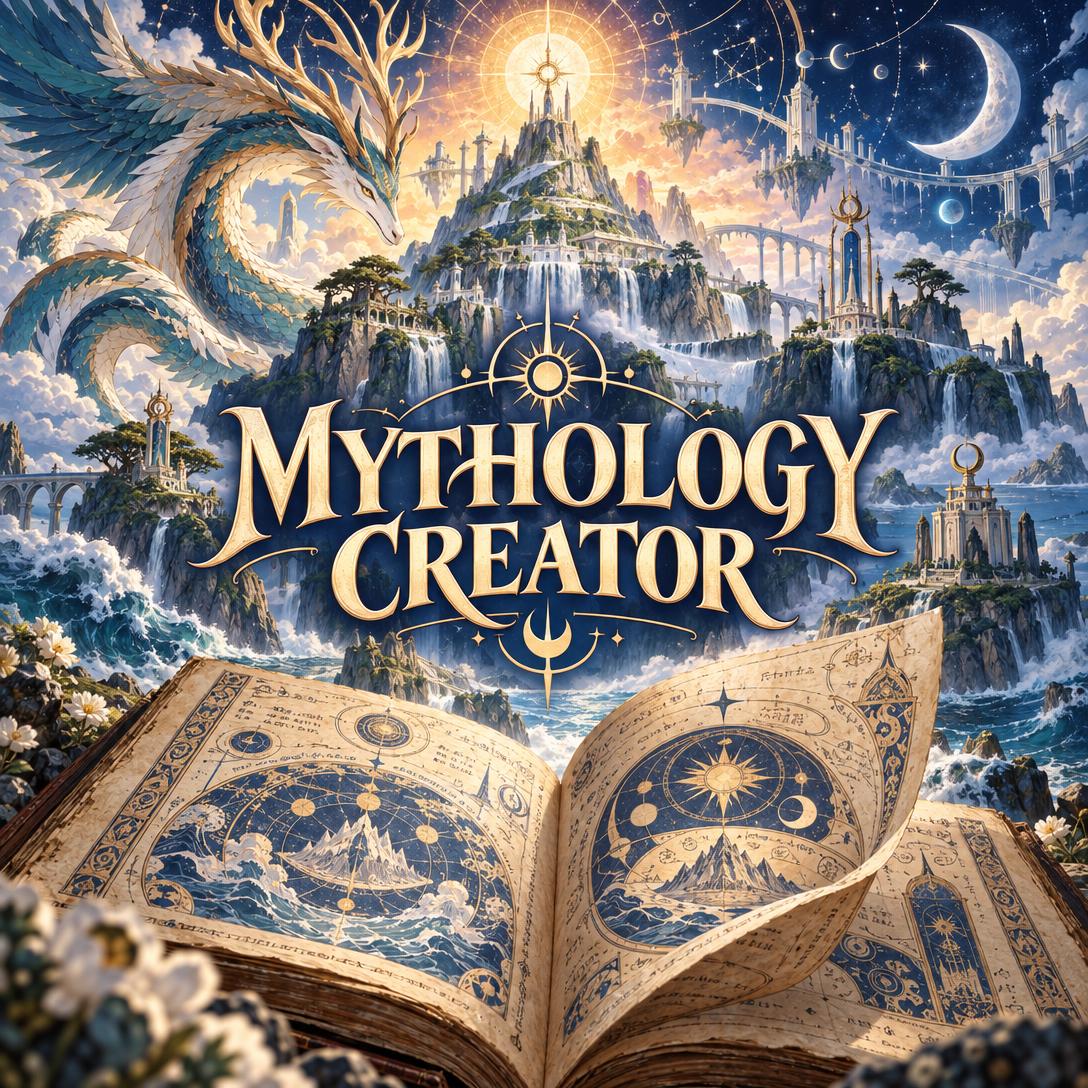
Mythology Creator helps you design original mythologies, including gods, creation myths, monsters, sacred sites, and rituals. It works like a cultural anthropologist who is also a skilled storyteller. Many invented pantheons read like Greek gods with new names. This AI starts with the culture and builds the gods from it, so every myth has a job inside your world.
- ✅ Fluent across world traditions: Greek, Norse, Egyptian, Yoruba, Polynesian, Mesoamerican, Finnish, Turkic/Mongol, and many more
- ✅ Grounded in mythological scholarship: Eliade, Lévi-Strauss, Dumézil, Propp, and the Thompson Motif-Index serve as analytical tools, not templates
- ✅ Writes real myths: stories in a mythic voice, with rhythm and weight, rather than encyclopedia entries
- ✅ Visualizes and exports: deity portraits, cosmological diagrams, and mythology bibles in PDF, DOCX, Markdown, or JSON
Mythology is one of the oldest forms of human knowledge, and one of the hardest to fake. Invented pantheons often fall flat. Building one that feels inherited rather than invented starts with understanding what real mythologies do for the cultures that tell them.
Quick Answer: What Is Mythology Creator?
Mythology Creator is an AI mythmaking studio that designs original pantheons, creation myths, creatures, and sacred traditions with the internal logic of real mythologies, for novels, games, tabletop campaigns, or personal worldbuilding.
Key capabilities:
- Builds cultural context first (environment, values, fears, social structure), then derives the cosmos and gods from it
- Designs connected pantheons with family trees, rivalries, divine councils, and apotheosis or deicide arcs
- Writes full sacred narratives in mythic register, or as academic summaries, literary retellings, or children's versions
- Generates deity portraits, creature concepts, and sacred-site art, and exports complete mythology bibles
The Creative Challenges of Building a Believable Mythology
Real myths are not decoration. They explain the world, justify who holds power, help people cope with death, and pass down survival knowledge. Scholars have long treated myth as a serious way into understanding cultures:
Myth as a way into the past: History education research describes myth as "a first step in historicizing the past" and a way to develop empathy for ancient cultures
Value across disciplines: Scholarship on mythology in education argues that studying myth deepens understanding across history, literature, religion, science, and psychology
A literacy gap: An essay published through Kennesaw State University argues that society is "less mythologically educated than it should be"
That gap shows up in fiction and games. Readers and players absorb mythic structure all the time. Edutopia notes that teenagers are surrounded by myths packaged as superhero movies and manga. They can tell when a pantheon is hollow, even if they can't say why.
But building a mythology that feels real is hard:
- The renamed-pantheon trap. A sky-father, a love goddess, and a trickster with new names don't add up to a mythology. They are a reskin.
- The encyclopedia problem. A list of gods and their domains isn't a myth. Myths are stories first. If a creation myth doesn't move you, it would never have survived oral tradition.
- Keeping it all connected. Divine family trees, cosmological rules, creature origins, and ritual calendars all depend on each other. Change one god's parentage and three myths may stop making sense.
- Scattered source material. The primary texts are available. Library guides point to resources like the Theoi Project, the Internet Sacred Text Archive, the Icelandic Saga Database, and MIT OpenCourseWare's Myth, Ritual, and Symbolism. Combining them into usable design knowledge, however, takes years of reading.
Why "Just Rename Zeus" Doesn't Work
Looking closely at living traditions reveals a pattern: the landscape shapes the gods.
- A seafaring people fears the deep and makes gods of navigation and the stars.
- Mountain herders build world-pillars and sky-ladders.
- Farming cultures tell stories of gods who die and rise with the harvest, a pattern Frazer described.
The specific wrong a culture punishes in its myths shows what it holds sacred. Prometheus steals fire. Orpheus looks back. Each story marks a boundary.
Real traditions also contradict themselves. They have competing creation stories, gods who are both kind and terrifying, and regional versions that disagree on basics. That messiness is a sign of a living tradition, and most invented pantheons lack it entirely.
This is the gap this AI mythmaking studio was built to fill.
How It Works: Building a Mythology Step by Step
Mythology Creator meets you wherever you begin. You might want a single deity for a short story, or a complete cosmology spanning eons. It understands how the pieces depend on each other, but those dependencies never block you. If you want a creature before a pantheon exists, it builds the creature and tells you what it assumed.
Step 1: Describe the People Before the Gods
Start with the culture: its landscape, how people make a living, how power is organized, and what they fear. These answers become the gods' domains and the threats in the myths.
"My culture is a nomadic steppe people who herd horses, prize oath-keeping, and dread the long winter. Who do they worship?"
Step 2: Shape the Cosmos
Choose or co-design a type of creation myth. Options include earth-diver, world egg, cosmic sacrifice, emergence, and chaos-to-order. Then define the layout of the cosmos and how it works: what holds reality together, what threatens it, and what renews it.
"Give them a three-layered cosmos with a world tree, and make the end of the world cyclical rather than final."
Step 3: Populate the Pantheon
Pick a hierarchy model, such as an Olympian-style council, a celestial bureaucracy, or older primal gods versus younger ones. Then assign domains, family lines, and rivalries. The AI gives honest feedback. If your storm god and war god overlap, it will tell you whether that creates productive tension or confusion, and point to how Norse tradition handled a similar overlap.
"Design six deities. I want the storm god and the war god to be rivals, and one god should be imprisoned."
Step 4: Write the Sacred Narratives
Ask for hero cycles, journeys to the underworld, sacred marriages, flood myths, or trickster tales. By default, full myths use an elevated, rhythmic mythic voice, with the repetition and formulaic phrasing that oral traditions rely on. You can also request an academic summary or a children's version. Violence, sacrifice, and death are written with the seriousness these themes have always carried in myth, not softened.
"Write the myth of how the smith-god lost his eye, in oral-tradition style with a repeating refrain."
Step 5: Visualize and Export Your Mythology
Generate deity portraits, creature concepts, sacred-site landscapes, or cosmological diagrams. You can switch image models with the App button beneath the chat input, since different models have different strengths for mythological art.
When your mythology is substantial enough, export it:
- PDF mythology bible
- DOCX for editing
- Markdown for your wiki
- JSON for game engines
Later revisions update the existing file in place.
"Generate a portrait of the winter goddess, then export the full pantheon as a PDF mythology bible."
If you're also turning that mythology into a manuscript, Creative Fiction Writer can carry your world into chapter-level prose with editorial feedback on pacing and voice.
Persistent memory means confirmed gods, myths, and sacred sites carry over between sessions. Established elements stay consistent unless you choose to revise them. Start on the free plan, no credit card required.
Creative Showcase: What You Can Build
📚 A Novelist's Living Religion
Scenario: A fantasy author has a matrilineal, trade-based island culture and needs a religion that shapes daily life, politics, and the climax of book three.
Traditional Approach: Months of reading comparative mythology, scattered notebooks of family trees, and a high risk that the religion contradicts itself by the sequel.
Mythology Creator: In one focused session, this AI mythology generator produces:
- A sea-mother called "She Who Carries"
- A storm god whose estrangement from her caused the first drought
- A god of death guarding a nameless force of stillness in the deepest trench
- A taboo against perfect stillness aboard any vessel, which gives sailors something to fear and the plot a lever to pull
Key benefits:
- Epithets that compress a whole story into a name
- Rituals that grow naturally from the cosmology
- Regional variants built in for added depth
🎮 Game Lore That Holds Together
Scenario: An indie studio building an action RPG wants its bosses to be fallen gods. It needs lore that explains why they fell and what replaced them.
Traditional Approach: Lore written piecemeal by several writers, often ending in contradictions that players spot on community forums.
Mythology Creator: The AI designs a war between old and new gods and the downfall of the old order. Over centuries, conquered deities become the "demons" of the new religion, mirroring how real traditions absorb their neighbors' gods.
- The bestiary uses monster symbolism, so each creature reflects something the culture fears
- Exports as structured JSON for direct use in the game
- Gods, creatures, and realms stay consistent across sessions
If your studio is also designing the systems those gods live inside, Game Designer Assistant helps with core loops, balancing, and design documentation.
📱 Tabletop Prep on Your Commute
Scenario: A game master has 40 minutes on a train before Friday's session and needs a forbidden cult, its patron deity, and one memorable creature.
Traditional Approach: Scribbled notes and a borrowed monster from a sourcebook that the players have already read.
Mythology Creator: Using speech-to-text on a phone, the GM describes the campaign's world. Before arriving, they have:
- A cult with its own priesthood and calendar
- A deity with a secret true name the players must uncover
- A guardian creature built from the god's domain
Everything syncs across devices, ready on the laptop at the table.
To run the campaign inside your new mythology, Roleplay Game Master can play out scenes with consistent characters.
🏛️ Classroom Myth-Making and Comparative Study
Scenario: A teacher runs a myth-retelling unit. One educator's approach, published on Edutopia and taught in the Philippines and Bangladesh, has students move from studying familiar myths to retelling folk stories from their own heritage.
Traditional Approach: Students struggle to see the shared structures behind myths without guided comparison.
Mythology Creator: The AI explains:
- How the earth-diver motif recurs across traditions
- What Dumézil's three-function hypothesis reveals about a pantheon
- Why a lame smith-god is lame because mastery demands sacrifice
It then helps students design their own culture-specific myths. This echoes arguments that learning mythology helps students understand their emotions and the context of modern society.
Frequently Asked Questions
Is Mythology Creator free?
Yes, you can start for free. The Free plan includes all core features with limited usage, enough to build a cultural context, a cosmology, and your first deities. For long projects like full mythology bibles or large pantheons:
- Plus ($20/month) offers 30× the usage, custom model selection, and no watermarks.
- Higher tiers scale up to 1,500× usage.
Usage resets monthly with no daily caps.
How is an AI mythology generator different from asking a general chatbot?
General chatbots tend to produce lists of gods with domains attached. A dedicated mythmaking studio works differently:
- It builds the culture first.
- It uses frameworks from comparative mythology and anthropology.
- It writes connected stories rather than isolated entries.
- It adds deliberate contradiction and regional variation.
It also remembers confirmed elements across sessions and points out weak structures, such as overlapping domains or myths that serve no purpose for their culture.
Can Mythology Creator draw accurately on real-world mythologies?
Yes. When you name a real tradition as inspiration, such as Yoruba orisha, Finnish Kalevala cycles, or Aztec cosmology, Mythology Creator researches before creating and cites its sources. It respects each tradition's internal logic rather than simply renaming familiar gods. It doesn't gatekeep any culture, but it applies the same care for accuracy to every one.
Can it handle dark or mature mythic themes?
Yes. Myth has always dealt with violence, sacrifice, death, sexuality, and moral transgression. These themes are central to the form, not edge cases. The AI writes this material with literary skill and narrative weight rather than softening it or adding disclaimers. This matters for grimdark fiction, horror settings, and campaigns where the gods are meant to be frightening.
Does it work on mobile?
Yes. It offers the same features on web, iOS, and Android, with accurate speech-to-text for dictating ideas on the go. Settings and project history sync across devices. You can sketch a creature on your phone during a commute and continue building its myth cycle on your desktop that evening.
Can I turn my mythology into a novel or game document?
Yes. When your project is substantial enough, you can export:
- A PDF mythology bible or pantheon guide
- An editable DOCX
- Markdown for wikis and writing tools
- JSON for game integration
For the prose itself, Creative Fiction Writer can help develop your world into chapters.
Conclusion: Build Myths That Feel Inherited, Not Invented
Most invented mythologies fail for the same reasons. They begin with gods instead of people, they list instead of tell, and they lose track of their own connections. The result is a pantheon nobody believes in, inside the story or out of it.
A mythology generator built on comparative mythology, anthropology, and storytelling craft reverses that. Culture shapes cosmos, cosmos shapes gods, and gods shape the stories, rituals, and monsters your readers and players will remember. Whether you're designing a fantasy pantheon for a novel, lore for a game, or a creation myth just for the joy of it, this worldbuilding AI gives your mythology roots.
Try Mythology Creator now. Explore more at Jenova.
For Developers: Mythology Creator is available programmatically via the Jenova API. Integrate original pantheon, cosmology, and myth generation into your game, writing tool, or worldbuilding app with a single API call. Full documentation →