AI Murder Mystery Party: Write Custom Suspects, Clues & Host Scripts
2026-10-17
Game Designer Assistant helps you build a complete AI murder mystery party, including suspects, motives, alibis, clue trails, and host scripts. It treats your whodunit the way a professional treats any game: as a system that has to be balanced, tested, and fun to play.
As of October 2026, most hosts still pick between rigid boxed kits that ignore their guest list and expensive custom writing. This AI gives you a third option. You get a mystery built around your friends, your theme, and your timeline, and it holds together when someone finally points a finger.
- ✅ Builds suspects, secrets, and motives around your actual RSVP list
- ✅ Designs a clue trail that makes the killer deducible, not just guessable
- ✅ Drafts round-by-round host scripts, reveal timing, and the final accusation scene
- ✅ Generates concept art for invitations, character portraits, and props
A murder mystery night lives or dies on its design. A clue that gives away too much ends the game by the appetizers. A missing clue makes the reveal feel unfair. To see why an AI game design partner changes the planning process, it helps to look first at the problems hosts run into with traditional approaches.
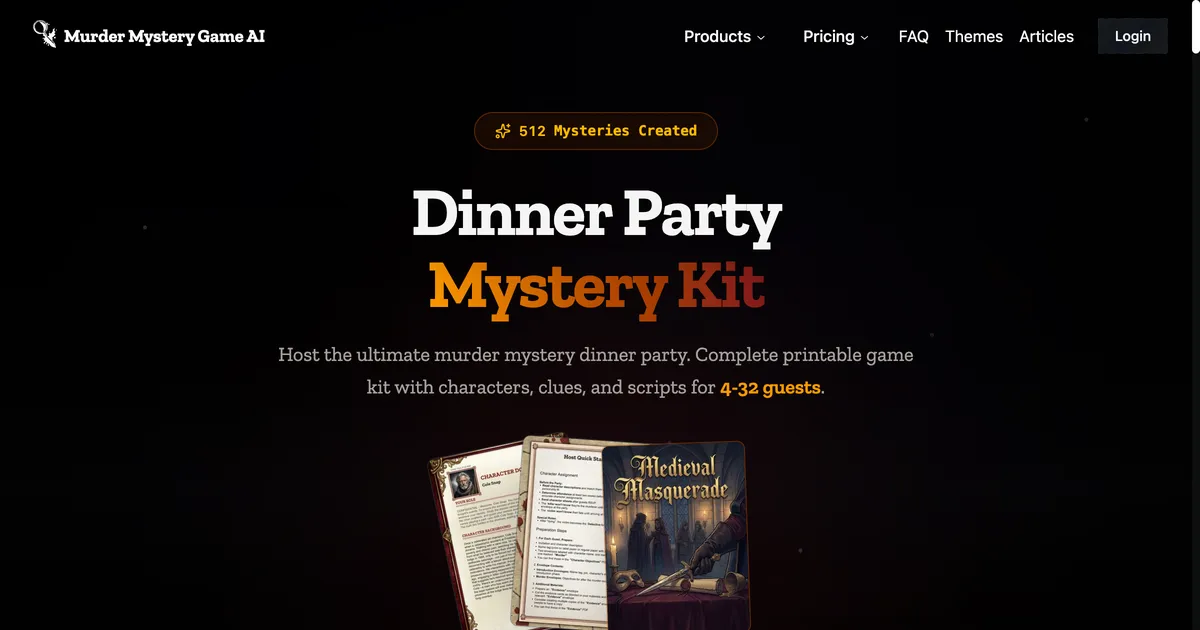
Quick Answer: What Is an AI Murder Mystery Party?
An AI murder mystery party is a hosted whodunit game where AI designs the crime, suspects, clues, and scripts around your specific guests, theme, and party length. It replaces generic boxed kits with a custom, logic-checked mystery.
Key capabilities with a dedicated AI game design partner:
- Character dossiers with secrets, motives, alibis, and conversation goals for every guest
- A clue map that makes the culprit solvable through deduction
- A host run sheet with round timing, reveal cues, and contingency plans
- Themed visuals for invitations, name cards, and evidence props
Why Hosting a Murder Mystery Party Is Harder Than It Looks
A murder mystery game is a party game where players investigate and solve a fictitious murder, and often one player is secretly the killer. The format is growing fast. Market research shows tabletop formats lead the category because of their social nature that brings people together.
USD 1.47 billion — Estimated global murder mystery games market value in 2026, projected to grow at an 8.3% CAGR through 2033
Hundreds to thousands of dollars — Quoted cost range for modifying or custom-building a murder mystery party through a professional publisher
Two weeks minimum — Recommended lead time to read the script, send invitations, and prepare a full murder mystery kit
But pulling off a great one is frustratingly difficult:
- Fixed guest counts break easily. Publishers warn that running a kit below its minimum player count means important clues may not be available and key plot points cannot advance. One cancellation can derail the whole night.
- Customization is expensive. Inside jokes, office lore, or a specific venue usually means paying for bespoke writing at the price points above.
- The host often can't play. With complex kits, the host typically must know the killer's identity in advance to keep the event running. That means sitting out the fun of solving it.
- Clue balance is hard to get right. As Wirecutter's party game testing notes, a great whodunit thrives on "a steady stream of ambiguous information." If the clues are too direct, the drama ends early. If they are too obscure, players give up.
Professional live-action companies such as The Murder Mystery Company solve some of this with trained actors, but that is a different budget and format than a dinner at home. This is exactly the gap an AI game designer was built for.
Why Game Designer Assistant Fits Murder Mystery Design
A murder mystery party is a social deduction game with an information economy. Each guest holds pieces of a puzzle, and the fun comes from trading, hiding, and revealing those pieces at the right moments. Game Designer Assistant brings that design discipline to your party. It handles brainstorming, systems analysis, documentation, and concept art in one place.
It works as a standalone design partner from first idea to final printed packet. It is not a template generator. You describe the party you want, and it builds and stress-tests the game with you.
| Traditional Approach | Game Designer Assistant |
|---|---|
| Fixed character list that breaks when RSVPs change | Cast built and rebalanced around your exact guest count |
| Custom-written mysteries quoted in the hundreds to thousands of dollars | Bespoke plot developed collaboratively in a planning session |
| Clue trails you can't audit until game night | Logic checked in advance, with the AI playing detective against its own design |
| Host usually knows the killer and sits out | Option to design host-blind structures with sealed-envelope reveals |
| Generic, one-size-fits-all themes | Any theme, including your venue, your era, and your group's inside jokes |
Engineer a Fair, Solvable Clue Trail
The most common failure in amateur mysteries is a solution that can't actually be deduced. The AI maps every clue to the suspect it implicates or clears. It then checks that the evidence points uniquely to the culprit. Red herrings are placed on purpose, so each one misleads in a way that gets resolved by the final reveal.
"Map every clue in this mystery to the suspect it implicates. Flag any point where the killer could be identified before round three, or where the solution relies on a clue players never receive."
Build a Suspect Cast Around Your Real Guests
Classic archetypes like the butler, the decorated officer, the dowager, and the flapper have lasted because each one carries an instant motive and a recognizable personality. The AI starts from those foundations and tailors them to the people at your table. The theatrical friend gets the showy red herring. The shy guest gets a role with clear, scripted conversation goals so they never feel stranded.
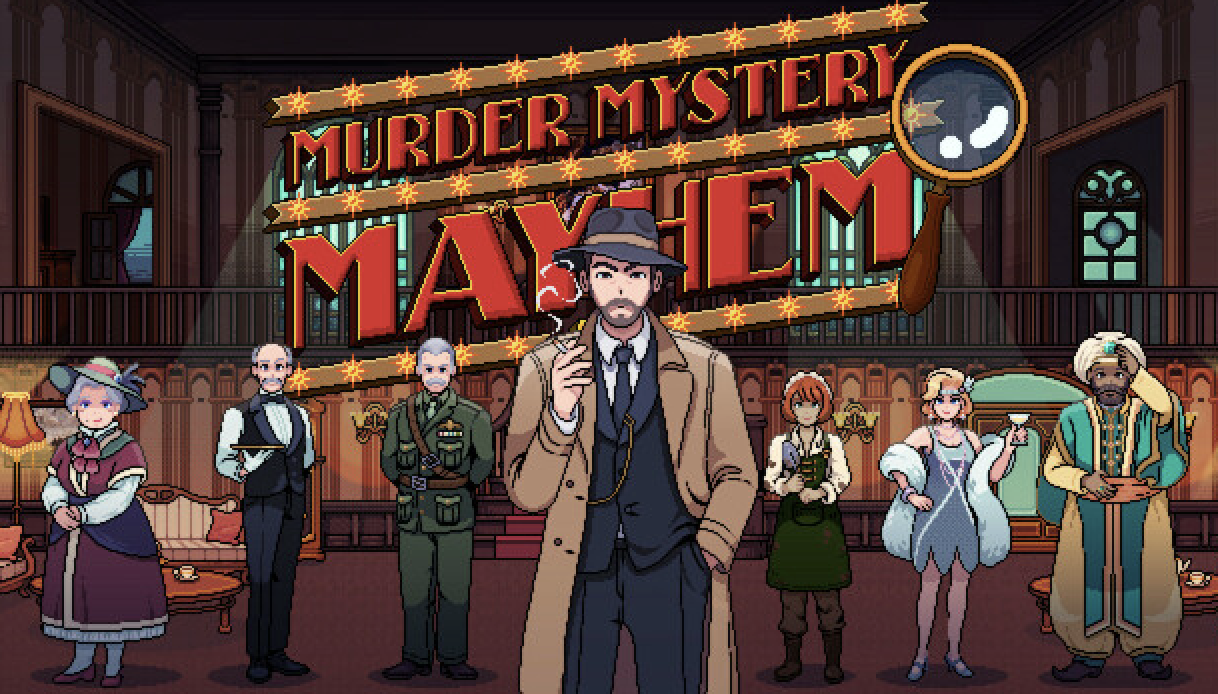
"Create 8 suspects for a 1920s speakeasy murder. Give each a secret unrelated to the murder, so everyone has something to hide, and make sure two guests are natural rivals."
Scale the Mystery to Any Guest Count
Established publishers handle large groups with techniques like non-suspect Investigator roles, paired characters, and multiple simultaneous game tables. Some companies offer five different formats for large groups. The AI can apply any of these structures to your custom plot. It can also designate which characters are essential and which are optional, so a late cancellation doesn't remove a critical clue.
Script the Host's Night From Arrival to Accusation
Kits typically run between one and a half and four hours, and pacing is the host's hardest job. The AI drafts a run sheet with round timing, the moment the body is "discovered," clue-release cues tied to dinner courses, and fallback hints if the table gets stuck.
Generate Themed Visuals and Props
Concept art makes the fiction feel real. You can request invitation designs, suspect portraits, forged letters, and torn ledger pages that guests can physically hold as evidence.
Related Agents for Planning the Full Evening
The mystery is the centerpiece of the night, but a memorable party also needs polished writing, printable materials, and a menu that fits the theme. These agents cover the rest.
Creative Fiction Writer
If you want richer backstories and atmospheric narration, Creative Fiction Writer can turn your plot skeleton into prose worth reading aloud.
- Opening monologues and dramatic "body discovery" scenes
- Period-authentic voice for 1920s, Victorian, or noir settings
- Editorial polish on character dossiers
Word Generator
Once the content is final, Word Generator formats it into professionally laid-out documents ready for printing.
- Character booklets and sealed-envelope clue sheets
- Host guides with clear section structure
- Consistent formatting across every guest's packet
Wine Connoisseur
A murder mystery dinner party deserves a menu that matches the story. Wine Connoisseur handles food pairing and themed drink recommendations.
- Pairings for each course, timed with each clue round
- Era-appropriate wine and cocktail suggestions
- Recommendations for a range of budgets
All of these agents can be tried free, with no credit card required.
How to Plan an AI Murder Mystery Party Step by Step
Step 1: Brief the AI on Your Party Open your AI game design partner and describe the essentials: guest count, setting, length, tone, and any guests who need lighter roles. The more specific your brief, the more personal the mystery.
"I'm hosting 10 adults for a 3-hour dinner. Theme: a 1930s ocean liner. Tone: playful, not gory. Two guests are first-timers who'd prefer smaller roles."
Step 2: Lock the Solution First Good mysteries are designed backward. Settle the killer, motive, means, and opportunity before writing a single clue, so every later element supports one airtight answer.
"Propose three possible solutions with different killers and motives. For each, explain the key deduction that cracks the case."
Step 3: Generate Character Packets and Clues Ask for each guest's dossier, including public persona, private secret, alibi, and what they want to learn from others. Then ask for the clue cards to be released in each round.
"Write character packets for all 10 suspects, plus 12 clue cards split across three rounds. Include two red herrings."
Step 4: Pressure-Test the Mystery Have the AI play detective against its own design. Ask it to find plot holes, early giveaways, and dead ends before your guests do.
"Play the role of a sharp guest. Using only clues from rounds one and two, who would you accuse and why? Then patch any shortcuts you find."
Step 5: Build the Run Sheet and Visuals Finish with a timed host script, fallback hints, and concept art for invitations and evidence props. Your mystery is then ready to print and play.
"Create a minute-by-minute host run sheet, three escalating hints for if guests get stuck, and an Art Deco invitation design."
Results: Real Murder Mystery Party Scenarios
🎂 A Milestone Birthday for 12 Friends
Scenario: A host is planning a 40th birthday with a Prohibition-era speakeasy theme and wants the guest of honor at the center of the plot.
Traditional Approach: Buy a boxed kit with fixed characters, then rewrite roles by hand, or pay for custom writing.
AI-Assisted Approach: A bespoke plot where the birthday guest is the "victim's" heir and prime suspect, with inside jokes worked into the clues.
- Every character is written for a specific friend
- The guest of honor stays central without being the killer
- Backstory narration is polished by the fiction-writing agent for a dramatic opening toast
💼 Corporate Team-Building for 30 Employees
Scenario: An office manager needs an interactive event for a 30-person team. Murder mysteries are increasingly popular for this, with corporate team-building driving growth in markets like Australia.
Traditional Approach: Book a professional cast or squeeze 30 people into a kit designed for 12.
AI-Assisted Approach: Three parallel tables of 10, each solving the same crime, with shared announcements and an inter-table race to accuse.
- Mixed departments at every table encourage cross-team conversation
- Workplace-safe content with no awkward roleplay demands
- Optional Investigator roles for people who prefer to observe
📱 Day-of Fixes From Your Phone
Scenario: Two hours before the party, a guest playing a key suspect cancels.
Traditional Approach: Scramble to reassign a role mid-preparation, and risk losing a critical clue.
AI-Assisted Approach: From a phone in the grocery checkout line, the host asks the AI to fold that character's clues into another suspect and update the run sheet.
- Revised clue distribution in minutes
- Logic is re-checked so the solution stays deducible
- Works the same on iOS, Android, and web
🎃 A Family-Friendly Halloween Mystery
Scenario: A parent wants a spooky but age-appropriate mystery for a mixed group of kids and adults.
Traditional Approach: Search for kits labeled "family-friendly" and hope the content and difficulty suit the group.
AI-Assisted Approach: A "who stole the cursed amulet" mystery with tiered clues: picture-based clues for younger players and logic puzzles for adults.
- No graphic violence, and the theme stays seasonal
- Difficulty is balanced so kids can solve key moments
- Printable props and illustrated clue cards
AI Murder Mystery Party FAQ
Can AI write a complete murder mystery party?
Yes. An AI can design the full game: the crime, suspects, motives, alibis, clue trail, and host script. Game Designer Assistant approaches the mystery as a game system. It maps clues to suspects, checks that the solution is deducible, and adjusts the cast to your guest count. Hosts should still read the final script before the party to confirm the tone and content suit their group.
How much does an AI murder mystery party cost?
The agent is available on a free tier with all core features and limited usage, which is enough to explore a plot. Paid plans start at $20 per month for 30× the free usage, which suits iterating on a full mystery with packets and visuals. By comparison, professional publishers quote custom-built parties in the hundreds to thousands of dollars.
How many guests can an AI-designed murder mystery handle?
AI-designed mysteries scale from small groups of four or six to large events with dozens of players. For big groups, the AI can apply proven structures like non-suspect Investigator roles, paired characters, or multiple tables solving the same crime at once. It can also mark which characters are essential, so cancellations don't break the plot.
Can the host play along and try to solve the mystery?
With many traditional kits, the host must know the killer to keep the game running. An AI can design host-blind structures where clues and reveals sit in sealed, numbered envelopes, and the run sheet tells the host only when to open each one. The host can then investigate alongside the guests without spoiling the solution.
How far in advance should I plan a murder mystery party?
Traditional kits recommend buying at least two weeks ahead to read the script and prepare. With AI, the plot, packets, and run sheet can take shape in a single focused session. You should still send invitations and assign characters about a week ahead so guests can plan costumes and read their roles.
Can I print character booklets and clue cards?
Yes. Once your mystery is finalized, Word Generator can format character dossiers, clue cards, and host guides into professionally laid-out Word documents ready for printing. Many hosts print clues on separate pages and seal them in envelopes labeled by round, which keeps reveals controlled and adds a tactile sense of real evidence.
Host a Mystery Your Guests Can Actually Solve
The hardest part of hosting a murder mystery party has always been the design: a fair clue trail, roles that fit real people, and pacing that holds a room for three hours. Boxed kits trade personalization for convenience, and custom writing trades budget for fit. An AI murder mystery party removes that trade-off. You get a bespoke, logic-checked whodunit built around your guests, theme, and timeline, whether it's a dinner for eight or a corporate mystery night for thirty.
Your next party should end with a gasp at the reveal, not confusion about how anyone was supposed to solve it. Try Game Designer Assistant now and start plotting your crime.
Explore more at Jenova.
For Developers: Game Designer Assistant is available programmatically via the Jenova API. You can integrate interactive mystery and game design into your application with a single API call. Full documentation →