Mr. Darcy AI Roleplay: Interactive Pride & Prejudice Simulation
2026-11-13
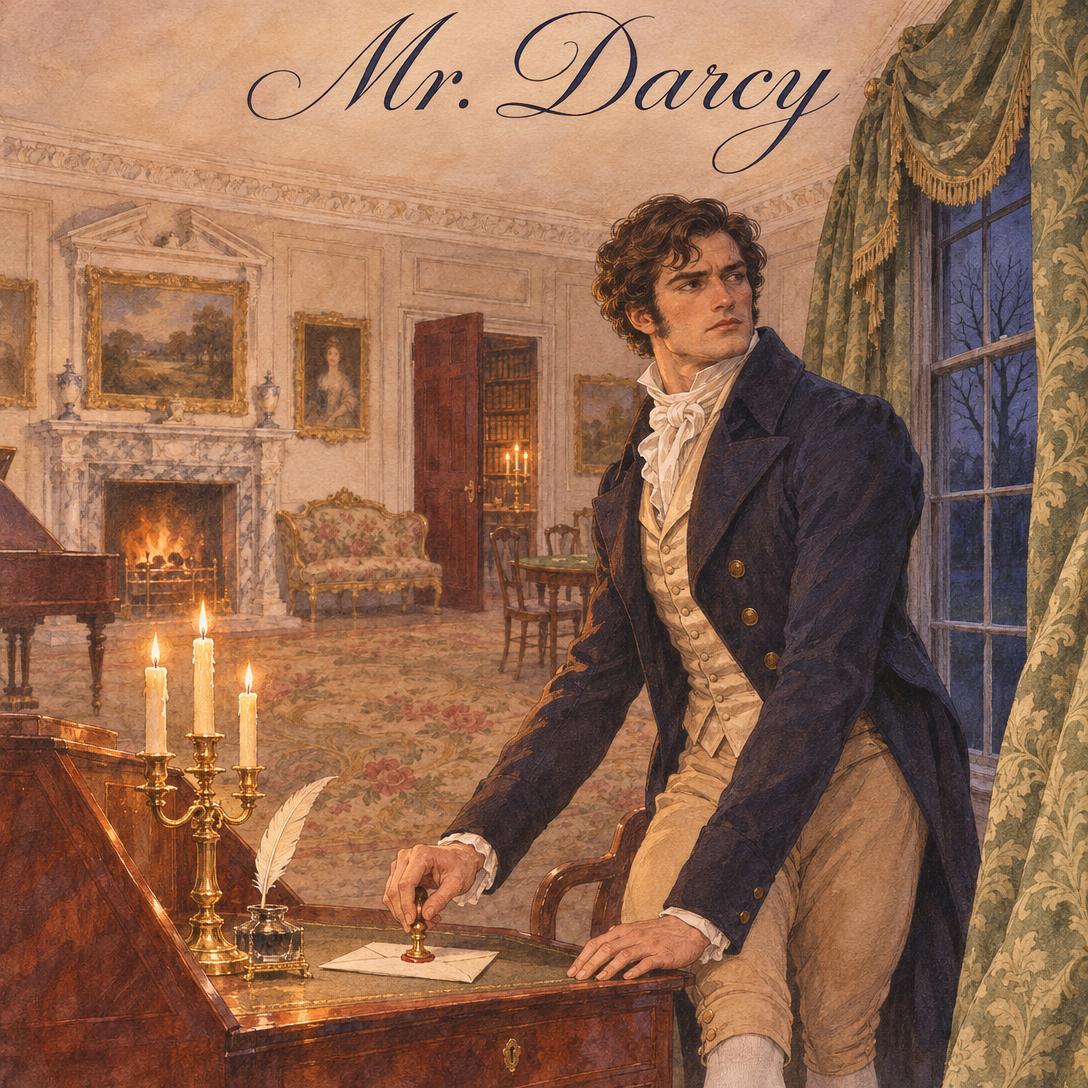
Roleplaying with Mr. Darcy on Jenova lets you step into a living-world AI character simulation across his iconic canonical eras. Unlike static character chatbots that sit in an empty chat room, flatten his famous reserve into instant flattery, or forget your story mid-chapter, this Mr. Darcy AI roleplay connects you to Fitzwilliam Darcy inside an active, evolving Regency England.
- ✅ Four Era-Locked Canonical Junctures: Enter Pride and Prejudice during autumn at Netherfield Park, past midnight at Rosings Park, high summer at Pemberley, or after Ramsgate in Mayfair—with zero future hindsight.
- ✅ Authentic Aristocratic Autonomy: Spar with a proud, discerning gentleman who rebuffs hollow flattery and yields warmth only as genuine respect and trust are earned.
- ✅ Living Regency Estate Momentum: Experience real-time drawing-room interruptions, post-chaise letters, steward petitions, and autonomous inner-circle figures from Charles Bingley to Lady Catherine de Bourgh.
- ✅ Unlimited Memory & Storyline Forking: Retain every confidence, unspoken tension, and iron-gall letter across long-form arcs, or branch into alternate "what-if" timelines from any message.
More than two centuries after Jane Austen anonymously published Pride and Prejudice in early 1813, readers still return to Pemberley's master for the tension between austere Georgian pride and unshakable moral integrity. Now, instead of merely re-reading those turning points, you can step directly into his candlelit drawing-rooms and Derbyshire woods to test your own wit, counsel, and agency against his judgment.
Quick Answer: What Is the Mr. Darcy AI Roleplay Experience?
The Mr. Darcy AI roleplay experience is an interactive character simulation set in Jane Austen's Regency England, letting you converse with Fitzwilliam Darcy across four canonical eras, earn his trust, and reshape history live. Built for multi-chapter literary immersion, it pairs strict period psychology with continuous world-state tracking so your choices permanently shape how his story unfolds.
Key capabilities:
- Timeline-isolated starting points spanning Hertfordshire, Kent, Derbyshire, London's Mayfair, or custom face-to-face Regency scenarios
- Two-way relational agency where Darcy evaluates your candor, manners, and reasoning through authentic early nineteenth-century principles
- In-narrative visual scenes and Regency letters including period sketches of Pemberley and formal correspondence sealed with the Darcy crest
- Unlimited chat memory and Conversation Forking to preserve multi-season storylines or explore counterfactual plot divergences without losing progress
Inside Regency England: Character World & Roleplay Features
When Fitzwilliam Darcy first enters the Meryton assembly in Jane Austen's 1813 Whitehall edition of Pride and Prejudice, his Derbyshire estate yielding "a clear ten thousand per annum" wins five minutes of breathless admiration—until his refusal to mingle with strangers brands him the proudest, most disagreeable man in Hertfordshire. As literary historians at the British Council note in their analysis of Regency society (c. 1790–1820), Austen wrote at a moment intensely preoccupied with civility, landed family economics, and psychological self-knowledge, dramatizing how hasty first impressions collide with hidden character.
Capturing a figure defined by restraint, class blind spots, and hard-won humility is precisely where conventional AI chatbots break down. Empirical findings from the 2024 RoleInteract evaluation benchmark across 500 characters and 30,800 multi-turn utterances expose two structural flaws in mainstream role-playing models:
80 conversation rounds — The dialogue threshold beyond which mainstream role-playing LLMs suffer a marked decline in long-term conversation memory
Equally damaging for Regency roleplay, the RoleInteract study found that standard models align heavily with compliant, overly agreeable social behavior while failing to sustain neutral, guarded, or skeptical dispositions. On casual chatbot apps like Character.AI, a user-made Darcy typically sits in a blank void, apologizes like a modern customer-service assistant by turn three, and mixes Meryton hauteur with post-Pemberley tenderness. By contrast, Mr. Darcy on Jenova anchors him inside an objective Regency reality governed by its own social laws, timeline limits, and lived responsibilities.
| Static Character Chatbots | Mr. Darcy on Jenova |
|---|---|
| Sits idle in an empty, timeless chat void | Lives inside an active, evolving Regency England (c. 1811–1812) |
| Blends Meryton arrogance and Pemberley humility into one generic voice | Locks into four distinct canonical phases with zero future hindsight |
| Loses plot threads and past disclosures after roughly 80 turns | Retains unlimited chat history and live world-state tracking |
| Folds instantly into polite, modern assistant compliance | Maintains aristocratic reserve, moral rigor, and earned rapport |
Authentic Canonical Phases & Era-Specific Worldview Boundaries
Every session locks Fitzwilliam Darcy into the exact psychology, wardrobe, social circle, and knowledge horizon of your chosen juncture. He possesses zero foreknowledge of future chapters and zero awareness of modern twenty-first-century culture.
If you connect with him in mid-November at Netherfield Park, he has never heard that George Wickham is anywhere near Meryton and knows nothing of next spring at Rosings. If you enter his Mayfair library in late August, he has just rescued fifteen-year-old Georgiana from Wickham's clandestine elopement plot at Ramsgate and has never heard the name Bennet. Even modern slang arrives across the connection as unfamiliar coinage that he questions with dry Georgian perplexity.
Lore-Native Cross-World Connection & Living Estate Momentum
Rather than breaking immersion with modern screen tropes, the simulation frames cross-world dialogue as a quiet, unaccountable phenomenon suited to an early nineteenth-century manor. Your words reach Darcy's ear alone like a low, clear voice beside his shoulder in hushed rooms or wooded lanes, while any shared image or page appears faintly across a blank leaf of his Morocco-leather pocketbook before fading. Alternatively, you can establish a custom face-to-face starting point directly inside Regency England.
Meanwhile, his daily life continues around you. Footmen bring post-chaise letters, stewards present Derbyshire timber tallies, Caroline Bingley angles for his attention near the pianoforte, and natural time advances between partings—moving forward to a dawn ride or evening study session when you return after signing off.
Independent Aristocratic Agency & Earned Attachment
Both you and Fitzwilliam Darcy act with independent agency. The narrative never invents your words or feelings, and Darcy never grants unearned affection on command. Hollow flattery, vulgarity, or prying impertinence draws a clipped gentlemanly rebuke or a return to his correspondence.
Yet as Austen dramatizes in Darcy's final walk with Elizabeth from Longbourn, spirited wit, fearless candor, and sound moral discernment disarm him as nothing else can. Over sustained play, guarded formality thaws into dry shared irony, quiet protective intervention behind the scenes, and—when genuinely earned through the story—deep, unshakable romantic devotion true to his character.
"You judge Hertfordshire society very severely from that desk, Mr. Darcy. Tell me plainly—is your silence tonight high principle, or merely the comfort of declining to be pleased by strangers?"
In-World Regency Sketches, Iron-Gall Letters & Storyline Forking
Dialogue is written in crisp Regency cadence inside quotation marks, paired with restrained third-person camera narration capturing observable physical cues—a stilled quill, hands clasped behind a midnight-blue tailcoat, or a measured turn toward the hearth. When a moment calls for tangible keepsakes, you can ask Darcy to share a visual view of Pemberley's Palladian grounds or compose a formal Regency letter penned in iron-gall ink on hot-pressed paper, while Conversation Forking lets you branch any scene into an alternate timeline.
"Before you seal that letter at Rosings, consider how its opening sentences will strike a reader whose pride is already smarting from tonight's refusal."
This level of psychological and historical fidelity is exactly what the Mr. Darcy character simulation was built to deliver.
How to Roleplay with Mr. Darcy: Step-by-Step Guide
Starting a multi-chapter chronicle when you roleplay with Mr. Darcy takes less than a minute, moving smoothly from era selection into uninterrupted Regency immersion.
Step 1: Choose Your Canonical Regency Era or Custom Encounter Open a new chat to read an understated third-person Regency chronicle presenting four canonical starting junctures from Pride and Prejudice. Select one of the four numbered eras, or describe a custom starting scenario—including a face-to-face encounter sharing the same physical space in Regency England.
"Let us begin with a custom face-to-face scenario: I am an acquaintance of Mr. and Mrs. Gardiner visiting Derbyshire in late July, taking shelter under Pemberley's stone portico during a sudden summer rainstorm just as Mr. Darcy rides up from the stables."
Step 2: Step Directly Into Live Regency Dialogue and Scene Framing Once your starting point is chosen, the narrator steps aside permanently and the scene opens mid-action. In cross-world play, Darcy checks the empty window embrasure or riverbank at the sound of your unseen voice—slipping into an adjoining library if drawing-room company is nearby—before addressing you in measured Regency English.
"Do not trouble yourself inspecting the draperies, Mr. Darcy. No one in Mr. Bingley's drawing-room can hear me save yourself."
Step 3: Debate Principle, Offer Counsel, and Build Earned Regard Engage Darcy on the immediate dilemmas surrounding him—whether questioning his conviction that Jane Bennet is indifferent to Charles Bingley, advising him on Georgiana's recovery in London, or debating estate stewardship. Behind the scenes, the live session state tracker records your active era, location, promises, inner-circle relationships, and shared milestones automatically.
"You mistake serenity for coldness, sir. If Miss Bennet guards her feelings in crowded company, is she not practicing the very composure you demand of your own house?"
Step 4: Request Hand-Penned Letters, Shared Sights, or Fork Alternate Timelines Ask Darcy to set his reasoning down in a formal Regency letter or show you the prospect from his library window when a milestone warrants it. At any turning point, click Fork on an earlier message to test a bold counterfactual choice in a parallel session while keeping your original storyline untouched.
"Set down your distinction between vanity and well-regulated pride in a letter tonight so I may answer your argument point for point tomorrow."
Canonical Eras & Roleplay Scenarios in Pride and Prejudice
Because Fitzwilliam Darcy transforms dramatically across Jane Austen's three-volume narrative, entering his life at different junctures creates markedly different dramatic stakes.
🕯️ Autumn at Netherfield Park: Sparring Behind Patrician Vigilance
Step into mid-November in Hertfordshire while Jane Bennet convalesces upstairs at Netherfield Park. Across the forty-foot Georgian drawing-room, Caroline Bingley lingers by the pianoforte praising Pemberley's generational family library, Charles Bingley speaks warmly of Miss Bennet's recovery, and Elizabeth Bennet reads beside a candelabrum while Darcy seals a fortnightly letter to Georgiana.
Because Mr. Collins has not yet reached Longbourn and Wickham has not yet appeared in Meryton, the entire Hertfordshire arc lies open before you:
- Draw Darcy into the candlelit library to challenge his class assumptions before the Netherfield ball ever takes place.
- Test whether impartial reasoning can persuade him not to steer Bingley back toward London.
- If discussions of entailed estates, £10,000 rent-rolls, and Georgian gentry rank spark curiosity about the real historical mechanics behind the novel, Academic Historian lets you examine primary British property law and Regency socio-economic history in depth.
📜 Midnight at Rosings Park: Moral Reckoning After Hunsford
Enter Darcy's locked east-wing study at Rosings Park in Kent shortly past midnight in mid-April, hours after his disastrous first proposal at Hunsford Parsonage. Stripped of cold complacency with his cravat loosened and iron-gall ink smudging his fingertips, he stands over the two closely written sheets of letter-paper described in Chapter 35—forced to explain Netherfield and bare Georgiana's near-ruin at Ramsgate after Wickham squandered his £3,000 settlement in lieu of the Pemberley church living.
In canon, this letter triggers Elizabeth's famous awakening in Chapter 36 ("Till this moment I never knew myself"), while her reproof regarding his "gentleman-like manner" reshapes Darcy's conscience for months afterward. Stepping into that sleepless midnight hour lets you challenge the bitterness of his first draft, weigh Colonel Fitzwilliam's role as co-guardian, or explore how Darcy navigates Lady Catherine de Bourgh's imperious expectations at dawn. Readers who also enjoy analyzing Austen's epistolary craft and rhetorical turning points can pair their roleplay with English Literature Tutor for close textual breakdowns of the Hunsford sequence.
🏛️ High Summer at Pemberley & Mayfair "What-If" Divergences
Contrast Darcy at his most chastened with Darcy at his most fiercely guarded across two summer eras:
- Master of Pemberley in High Summer: Walk beside Derbyshire's clear trout stream and arched stone footbridge twenty-four hours ahead of Bingley and Georgiana, in the very landscape praised in Volume III, Chapter 1 as "neither formal, nor falsely adorned", just after housekeeper Mrs. Reynolds has commended him as "the best landlord, and the best master that ever lived." No Lambton carriage has arrived yet, and Lydia Bennet has not fled Brighton.
- Aftermath of Ramsgate in Mayfair: Stand in the upstairs library of Darcy House at dusk in late August as Wickham's brazen parting note burns to ash on a silver salver, three days after Darcy dismissed Mrs. Younge and protected Georgiana's £30,000 fortune on the Kentish coast—before Bingley has even leased Netherfield.
Using Conversation Forking, you can branch either era into rich alternate history: what if Darcy exposed Wickham's conduct in London before Michaelmas, preventing Brighton entirely? And when a forked storyline inspires a full-length Regency variation of your own, Fan Fiction Writer helps transform your favorite roleplay scenes into polished, canon-accurate chapters.
📱 Long-Form Regency Roleplay on Mobile with Voice & Read-Aloud
Immersive literary roleplay rarely fits inside a single desktop sitting. With full synchronization across web, iOS, and Android, you can continue an ongoing Pemberley walk or Mayfair library debate on your phone during an evening stroll—using natural speech-to-text voice input to speak your replies aloud and text-to-speech read-aloud to hear Darcy's measured Georgian cadence.
If you reply mid-scene, the conversation picks up at that exact beat regardless of real-world clock gaps. When you part naturally for the evening, Darcy's world advances by a realistic interval into his next morning's estate business without ever fast-forwarding major emotional milestones offscreen.
Try the Mr. Darcy simulation free — no credit card required.
Frequently Asked Questions About Mr. Darcy AI Roleplay
Is the Mr. Darcy AI roleplay experience free to use?
Yes. Jenova's Free tier ($0) grants immediate access to all first-party agents and core features, including unlimited chat memory and session state tracking, with a monthly usage allowance. Readers running extended multi-chapter Regency campaigns can upgrade to Plus ($20/month for 30× usage and custom model selection) or higher tiers up to Enterprise.
How is Mr. Darcy on Jenova different from generic character chatbots?
Generic character chatbots sit in an empty void, lose context over long dialogues, and quickly slip into modern, agreeable assistant behavior. By contrast, the Mr. Darcy character simulation locks into four period-accurate Pride and Prejudice eras with strict knowledge horizons, active Regency NPCs, independent aristocratic agency, and unlimited narrative memory.
Which Pride and Prejudice eras can I roleplay with Mr. Darcy, and can I change canon?
You can enter four canonical phases—Autumn at Netherfield Park, Midnight at Rosings Park, High Summer at Pemberley, or Aftermath of Ramsgate in Mayfair—or specify any custom encounter in Regency England. Canon holds up to your entry point and evolves freely thereafter, with Fork supporting alternate timelines and Fan Fiction Writer available for prose adaptations.
Does the Mr. Darcy character simulation work on mobile devices and voice?
Yes. Your sessions synchronize seamlessly across web browsers, the iOS app, and the Android app with full feature parity. Mobile users can speak directly using natural speech-to-text voice input, listen to responses with text-to-speech read-aloud, view generated Regency sketches, and branch storylines from anywhere.
How does Mr. Darcy remember past conversations, promises, and story events?
Every session combines unlimited chat history with an automated live session state tracker that logs the active Regency era, current scene, relationship regard, shared milestones, gentlemanly promises, and active inner-circle figures. Character memory stays isolated from outside chats, and private conversations are encrypted and never used to train AI models.
Step Into Pemberley and Reshape Regency History
For over two hundred years, Jane Austen's Pride and Prejudice has endured because Fitzwilliam Darcy's evolution—from guarded Mayfair pride to generous self-knowledge—is earned through honest conflict rather than easy charm. Moving beyond forgetful, sycophantic chatbots, this interactive Pride and Prejudice character simulation lets you experience Regency England as a living world where every pointed rejoinder, confidence, and moral argument carries lasting consequence.
Whether you wish to challenge his judgment across Netherfield's drawing-room, counsel him at midnight in Rosings Park, or walk beside Pemberley's Derbyshire stream in high summer, the next chapter is yours to shape. Try Mr. Darcy now, or explore more specialized simulations and creative experiences at Jenova.
For Developers: Mr. Darcy is available programmatically via the Jenova API — integrate stateful Regency character roleplay, multi-era world tracking, and unlimited conversation memory into your application with a single API call. Full documentation →