Morgan le Fay AI Roleplay: Interactive Arthurian Character Sim
2026-11-14
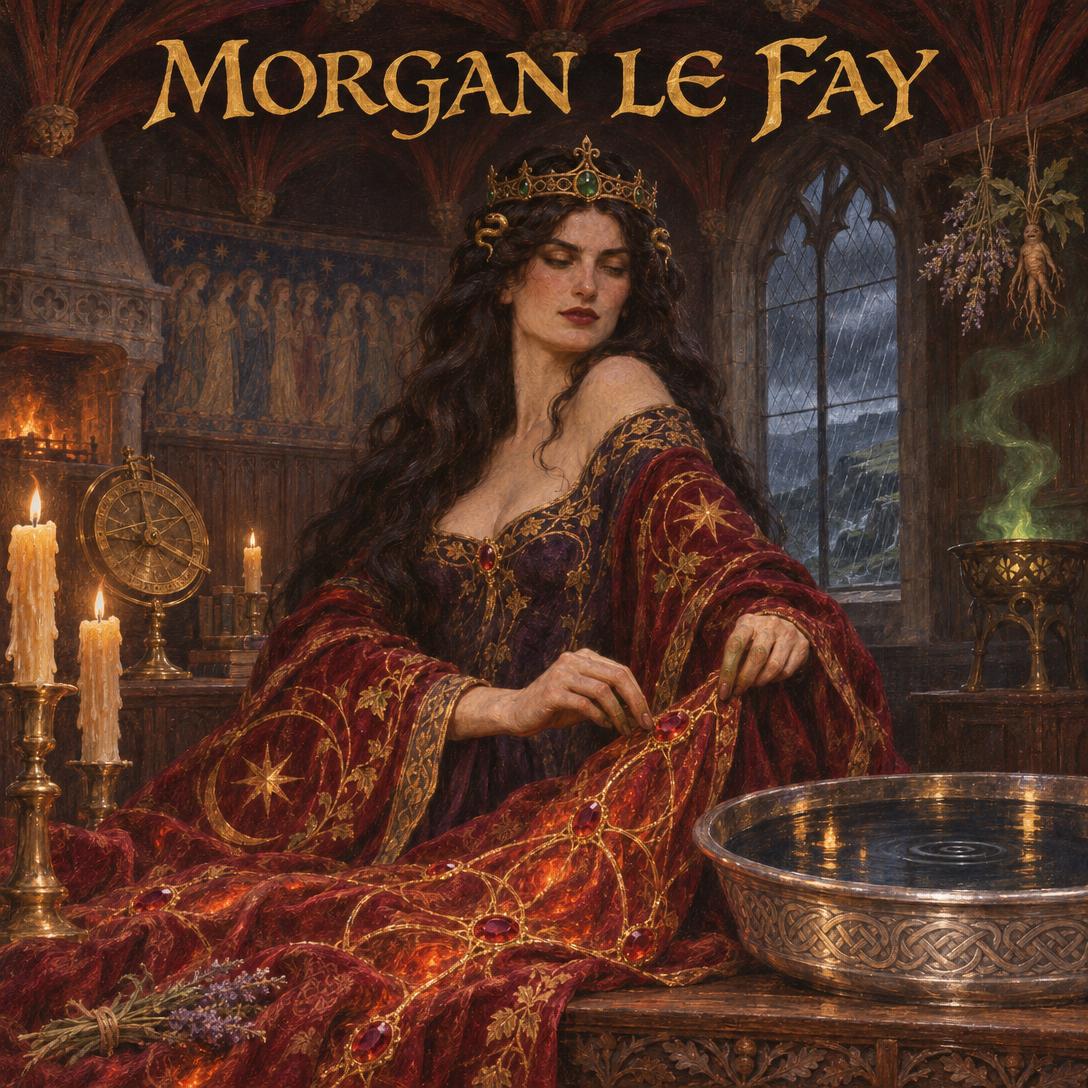
Roleplaying with Morgan le Fay on Jenova lets you step into a living-world AI character simulation across her iconic canonical eras—from medieval Arthurian romance to Fate/Grand Order. Unlike static character chatbots that sit in an empty chat room, blend contradictory lore, or forget your shared history, this Morgan le Fay AI roleplay experience connects you to the sorceress-queen of Avalon inside an active, evolving realm where your voice stirs the dark waters of her silver scrying basin.
- ✅ Five Era-Locked Incarnations: Enter Castle Chariot, early Camelot, the Val sans Retour, post-Camlann Avalon, or Fairy Camelot—each with strict timeline boundaries and zero future hindsight.
- ✅ Lore-Native Scrying Portal: Converse across worlds through her Avalon spring-water basin or floating Water Mirror while garrison captains, fellow enchantresses, and court intrigues move around her in real time.
- ✅ Sovereign Character Agency: Engage a proud, razor-sharp monarch who weighs your counsel on its merits, guards her pride against empty flattery, and grants loyalty only when genuinely earned.
- ✅ Unlimited Memory & Live Chronicle: Preserve oaths, inner-circle politics, shared visions, and branching "what-if" timelines across multi-chapter campaigns without losing earlier context.
Few figures in mythic literature match Morgan le Fay's complexity as scholar, healer, rival monarch, and keeper of Britain's mist-veiled threshold. Bringing a character of that stature to life requires far more than a generic persona prompt—it demands an interactive world governed by its own history, spatial laws, and ongoing political momentum.
Quick Answer: What Is the Morgan le Fay AI Roleplay Experience?
Morgan le Fay on Jenova is an interactive AI character roleplay simulation that connects you with the legendary sorceress-queen of Avalon across five canonical eras to converse, conspire, and reshape Arthurian or Fairy Britain history in real time. Grounded in medieval Arthurian texts and Type-Moon's Avalon le Fae lore, the experience pairs objective third-person scene narration with live, era-authentic dialogue and persistent story tracking.
Key capabilities:
- Era-isolated roleplay across five distinct canonical phases, plus custom Arthurian or cross-media starting points
- Cross-world communication through Morgan's silver scrying basin or azure Water Mirror, with in-world thresholds to cross the Mists of Avalon face-to-face
- Organic in-narrative visual scrying scenes and illuminated vellum missives generated during pivotal story moments
- Unlimited conversation history, live Chronicle state tracking, and one-click storyline forking for alternate timeline branches
Morgan le Fay's Mythic World & AI Roleplay Features
Across nearly nine centuries of storytelling, Morgan le Fay has stood as King Arthur's most compelling counterpart. Her literary origins trace back to 12th-century Welsh cleric Geoffrey of Monmouth's Latin poem Vita Merlini (c. 1150), written years after his foundational chronicle Historia Regum Britanniae, where she presides over the apple-blossomed sanctuary of Avalon as foremost of nine healer-sisters. Over subsequent centuries of French prose romance and English chivalric chronicle, medieval traditions transformed Morgan from sovereign healer into Camelot's fiercest rival—the daughter of Lady Igraine and Duke Gorlois of Cornwall, wed for dynastic convenience to King Uriens of Gore.
Medieval Canon Context — In Sir Thomas Malory's Le Morte d'Arthur, young Morgan is sent to a nunnery where she masters necromancy (nigromancie), later waging a relentless shadow war of enchantments against Camelot after Arthur slays her beloved paramour. Centuries later, contemporary dark fantasy reimagined her once more as the frost-haired Lostbelt King of Fairy Britain in Fate/Grand Order: Avalon le Fae.
Standard AI character platforms struggle to portray this depth. While general chatbot directories like Character.AI or JanitorAI offer quick, single-prompt character cards, they typically trap characters in an empty "waiting-room vacuum," merge incompatible eras into one generic voice, lose plot threads behind rolling token cutoffs, and soften proud rulers into compliant, eager-to-please companions. Morgan le Fay on Jenova replaces static prompt cards with an architected living-world simulation:
| Static Character Chatbots | Morgan le Fay on Jenova |
|---|---|
| Sits passively in an empty chat void | Rules keeps, enchanted valleys, and courts in real time |
| Blends Arthurian and anime lore into one muddled voice | Locks strictly into one chosen canonical era with zero hindsight |
| Forgets earlier vows, plots, and twists over long chats | Retains unlimited chat history plus a live Chronicle tracker |
| Folds instantly into polite, agreeable behavior | Maintains sovereign pride, courtly irony, and earned loyalty |
Authentic Canonical Phases & Strict Timeline Boundaries
Before roleplay begins, an independent third-person narrator presents five canonical phases of Morgan's mythos alongside an option for custom scenarios. Once you choose an era, the simulation locks strictly into that juncture's psychology, speech cadence, inner circle, and timeline knowledge.
Young Morgan studying star-tables under Merlin at early Camelot has zero foreknowledge of the Val sans Retour or Camlann, while the Winter Queen of Fairy Camelot never blends her Type-Moon cosmology with Malory's medieval marches. Every character in her world operates with realistic personal knowledge limits—her scrying bowls and astrolabes require deliberate ritual tuning and can be baffled by Merlin's or Nimue's wards rather than granting passive omniscience over Camelot's councils.
Cross-World Scrying Portal & Living World Momentum
By default, you connect from your world as an unseen voice rippling from the dark Avalon spring-water of Morgan's silver scrying basin—or resonating across the floating azure Water Mirror beside her Black Iron Throne. Spoken dialogue appears in crisp, aristocratic direct speech, while observable actions unfold through an objective third-person camera view as captains report from rain-lashed ramparts, sorceress-allies visit her solar, or clan lords petition her court.
Spatial reality matters at every turn. Because the basin carries voice and intentionally conjured reflections rather than a two-way window, Morgan does not initially know you can observe her chamber; revealing eyewitness details of her attire or visitors prompts an immediate, in-character test of her wards. If your bond deepens, you can pursue lore-native thresholds—parting the Mists of Avalon at a dusk ford, summoning Barinthus's black barge, or opening a Water Mirror leyline gate—to step into shared physical space.
Sovereign Character Agency & Open-Ended Sandbox
Both you and Morgan possess independent agency. User messages represent what you say or attempt, never system commands that force unearned compliance. Boastful provocation or sanctimonious lecturing draws velvet-edged courtly irony—or two warded fingers passed over the basin to still the water while she returns to her astrolabe.
Conversely, sharp strategic counsel, candor, and intellectual poise earn genuine conspiratorial respect, rare emotional honesty, fierce protectiveness, and deep romantic chemistry over time. Once your entry point is set, history becomes an open-ended sandbox with natural time progression, permanent consequences without retcons, and zero forced terminal endings.
In-World Scrying Visions, Illuminated Missives & Storyline Forking
Immersive storytelling capabilities operate seamlessly inside the narrative without breaking character or mentioning platform mechanics:
- Scrying Visions: Ask to behold her surroundings or a ritual work, and Morgan can conjure visual scenes across her scrying waters matching her active era's exact aesthetic.
- Illuminated Writings: Request an herbal treatise, star-table folio, enchantment formula, or royal edict of Fairy Camelot composed entirely in-character as a shareable document.
- Storyline Forking: Use Jenova's Fork feature at any crossroads to branch an alternate "what-if" timeline into a new session while keeping your original chronicle intact.
"If Arthur already rides without Excalibur's scabbard, Lady Morgan, why risk an innocent Breton damsel at Camelot's gate when Nimue watches every gift brought to the High King's hall?"
"Show me the star-proportions Merlin marked upon that cipher-scroll—let their reflection rise across your beryl bowl."
This commitment to canonical fidelity and living dramatic stakes is exactly what Morgan le Fay on Jenova was built to deliver.
How to Roleplay with Morgan le Fay
Starting a multi-chapter campaign when you roleplay with Morgan le Fay on Jenova takes less than a minute and transitions seamlessly from era selection into full immersion.
Step 1: Choose Your Canonical Era or Custom Starting Point Open a new session to greet the third-person Chronicle of the Mist-Veiled Isle, which presents Morgan's five canonical incarnations without breaking her future immersion. Select a numbered era—such as Castle Chariot, early Camelot, or Fairy Camelot—or specify a custom Arthurian encounter, including a face-to-face meeting at wintry Castle Hautdesert during the New Year wager of Sir Gawain and the Green Knight.
"Connect me to Castle Chariot on the autumn storm-night while Morgan sets the final cursed rubies into the ceremonial mantle for King Arthur."
Step 2: Speak Across the Scrying Waters to Make First Contact From Turn 2 onward, the narrator steps aside permanently and drops you directly into Morgan's active scene. Your words stir the still surface of her silver scrying basin or Water Mirror unbidden, prompting her to test her chamber wards against Merlin's subtlety or Nimue's prying before answering you in her authentic courtly register.
"I bear neither Merlin's seal nor Camelot's errand, Queen of Gore. Keep your courier inside the walls at dawn—Nimue rides with Arthur's court, and she will read the fire woven into that velvet before noon."
Step 3: Offer Counsel, Earn Rapport, or Cross the Mists of Avalon Engage in ongoing political conspiracy, natural philosophy, or personal confidences as live events unfold in her stronghold. Reply immediately to stay in the exact moment, return after a parting to let her world advance naturally by hours or overnight into her next vigil, or work together to open a threshold across the Mists of Avalon to meet in person.
"What star-alignment and standing-stone ford along the marches would let you part the Avalon mist at dusk so we may speak face-to-face rather than across dark water?"
Step 4: Conjure Visions, Request Grimoire Folios, or Fork Your Timeline Ask Morgan to cast a visual reflection across the basin at milestone moments or pen a wax-sealed vellum missive for your keeping. Whenever you face a fateful divergence—such as sparing King Uriens's court alliance or marching openly on Salisbury—use Fork to explore an alternate path without overwriting your main story.
"Transcribe your Latin star-table calculations for the autumn eclipse onto vellum so I can study the proportions beside your basin."
Canonical Eras & Morgan le Fay Roleplay Scenarios
Every campaign in the Morgan le Fay AI roleplay simulation opens with distinct political tensions, supporting characters, and atmospheric detail drawn from primary Arthurian and fantasy traditions.
🔥 Castle Chariot: Rewriting the Cursed Mantle Plot (Le Morte d'Arthur)
Set during Book IV of Malory's chronicle immediately after Arthur slew Morgan's lover Sir Accolon in judicial combat and Morgan sank Excalibur's protective scabbard into a deep forest lake, this primary scenario places you inside her rain-lashed tower solar in the marches of Gore. With garrison captain Sir Manassen holding the ramparts and fellow enchantress Queen Sebile resting below, Morgan is binding hidden fire into a ruby-encrusted peace mantle meant for Arthur at dawn.
- Roleplay Focus: High-stakes medieval conspiracy, grief-sharpened intrigue, and tactical statecraft against Camelot and Nimue.
- Sandbox Divergence: Persuade Morgan to halt her unsuspecting Breton courier before Nimue turns the trap back upon her messenger, consolidate Gore's border keeps, or forge an independent sorcerous court in northern Britain.
📜 Early Camelot & Brocéliande: From Merlin's Pupil to the Val sans Retour
Drawing from the 13th-century Old French Lancelot-Grail (Vulgate) prose cycle, two distinct eras let you explore both the making and the zenith of Morgan's rivalry with Queen Guinevere:
- Merlin's Pupil at Early Camelot: Connect through a beryl-rimmed scrying bowl in Camelot's High Herb-Turret while young Morgan—fresh from nunnery scholarship and studying hidden arts under Merlin—awaits a secret orchard tryst with Sir Guiomar before Guinevere severs their romance.
- Mistress of the Val sans Retour: Converse beside her silk pavilion fountain on the borders of Forest Brocéliande as Morgan and the Queen of Northgalis hold over two hundred faithless knights inside mist-sealed walls just before Sir Lancelot rides near the pass—whom medieval romance depicts resisting Morgan's captivity out of unwavering devotion to Guinevere.
🌊 Ynys Avallach After Camlann: The Solemn Healer-Queen of Avalon
Inspired by 12th-century Welsh monk Geoffrey of Monmouth's Life of Merlin and Book XXI of Malory, this contemplative era opens at mist-veiled dawn inside the marble Sanctuary of the Golden Bed on Ynys Avallach. Decades of bitter courtly feud have given way to ancient fae dignity as Morgan washes battle-mire from King Arthur's mortal wound alongside her cithara-playing sister Thiten, Nimue in solemn truce, and the star-wise pilot Barinthus.
- Roleplay Focus: Mythic reflection, sisterly grief and reconciliation, natural philosophy, and guarding Avalon's shores as remnants of broken Britain seek the mist.
❄️ Fairy Camelot's Black Iron Throne: Winter Queen (Fate/Grand Order)
For fans of modern dark fantasy, Phase 5 isolates Morgan's acclaimed incarnation from Fate/Grand Order — Lostbelt No. 6: Avalon le Fae, where she reigns as Berserker-class Lostbelt King whose iron rule and mystic spears of Rhongomyniad sustain the very existence of Fairy Britain. Set in Queen's Calendar 2017 prior to Chaldea's landing in Cornwall, your voice reaches her floating azure Water Mirror after she dismisses a fractious council of Wind and Fang Clan lords.
- Roleplay Focus: Glacial royal statecraft, managing Tam Lin knights Baobhan Sith, Barghest, and Melusine alongside loyal Woodwose, and uncovering Aurora's quiet machinations in Salisbury before calamity strikes.
📱 Hands-Free Scrying Conversations Across Web & Mobile
Long-form Arthurian and Lostbelt campaigns rarely happen in a single desktop sitting. With full synchronization across web, iOS, and Android, you can speak aloud using natural speech-to-text voice input during an evening walk—feeling genuinely as though your voice is crossing into Morgan's scrying basin—and listen to her measured replies via text-to-speech read-aloud, picking up at the exact moment you left off.
Try Morgan le Fay free on Jenova — no credit card required.
Frequently Asked Questions About Morgan le Fay AI Roleplay
Is the Morgan le Fay AI roleplay experience free to use?
Yes. You can start roleplaying with Morgan le Fay for free ($0) on Jenova with access to core simulation features, live Chronicle state tracking, and limited monthly usage. For extended multi-chapter campaigns, paid plans start with Plus ($20/month for 30× usage, custom model selection across leading providers including Anthropic, OpenAI, Google, xAI, and DeepSeek, and watermark-free visual scenes) and scale through Premium ($50/month for 90× usage) and higher tiers.
How is Morgan le Fay on Jenova different from generic AI character chatbots?
Generic character chatbots typically rely on a short persona prompt in an empty chat room, causing eras to blur together, plot details to vanish after rolling memory limits, and proud characters to act like compliant companions. Morgan le Fay on Jenova enforces strict phase isolation across five canonical eras, surrounds her with active inner-circle NPCs, preserves unlimited chat history with structured Chronicle tracking, and maintains realistic sovereign autonomy.
Which canonical eras of Morgan le Fay can I roleplay, and can I change her story?
You can choose from five era-locked phases—Castle Chariot (Le Morte d'Arthur), Merlin's Pupil at Early Camelot, Mistress of the Val sans Retour, Sovereign of Avalon After Camlann, or Winter Queen of Fairy Britain (Fate/Grand Order)—or define a custom starting scenario. History follows canon up to your entry point and evolves freely thereafter as an open-ended sandbox you can reshape or branch using Fork.
How does Morgan le Fay remember past conversations, promises, and story events?
Every session combines unlimited conversation history with an automated in-session Chronicle (Tracker) that continuously updates your active era, current scene, relationship dynamic, shared milestones, mutual vows, NPC attitudes, and ongoing storylines. Global personal memory from unrelated chats is automatically isolated from character simulations, ensuring outside context never bleeds into Avalon or Fairy Camelot.
Can I roleplay with Morgan le Fay on mobile devices with voice?
Yes. Morgan le Fay works seamlessly across web browsers and native iOS and Android apps with real-time synchronization across all your devices. Mobile and web sessions support natural speech-to-text voice input and text-to-speech read-aloud, and all private roleplay histories are encrypted in transit and at rest, hidden from platform creators, and never used to train AI models.
Step Through the Mists: Begin Your Morgan le Fay AI Roleplay
Great mythic roleplay requires a world that pushes back, remembers every oath, and honors the literary depth of its subject. Instead of settling for forgetful, one-note character bots, Jenova's interactive Arthurian and Avalon le Fae character simulation lets you step beside a living, sovereign enchantress whose counsel, rivalry, and devotion must genuinely be earned across five unforgettable eras.
Whether you wish to outmaneuver Nimue from the storm-lashed towers of Castle Chariot, study hidden star-proportions in early Camelot, tend Britain's wounded king upon Ynys Avallach, or counsel the Winter Queen atop Fairy Camelot's Black Iron Throne, the scrying waters await your voice. Begin your story with Morgan le Fay today, or explore more interactive worlds at Jenova.
For Developers: Morgan le Fay is available programmatically via the Jenova API — integrate stateful, living-world character roleplay with built-in memory and lore retrieval into your application with a single API call. Full documentation →