AI Mood Tracker: Spot Emotional Patterns and Act on Them
2026-08-15
An AI mood tracker turns scattered daily check-ins into a readable picture of your emotional life — identifying triggers, surfacing patterns across weeks, and connecting mood shifts to sleep, work, food, and relationships. Most tracking apps stop at a chart. Jenova goes further with specialized AI agents that remember your history, interpret what the data actually means, and tell you what to do about it.
✅ Persistent cross-session memory — your agent recalls entries, triggers, and patterns from months ago ✅ Specialized agents for emotional processing, mindfulness, sleep, nutrition, and personality insight ✅ Full parity across web, iOS, and Android with speech-to-text for one-tap check-ins ✅ Data never used to train public AI models — encrypted in transit and at rest
To understand why conversational AI changes mood tracking, it helps to look at what happens with conventional apps. The research shows people want this data — and that most of them quit before it becomes useful.
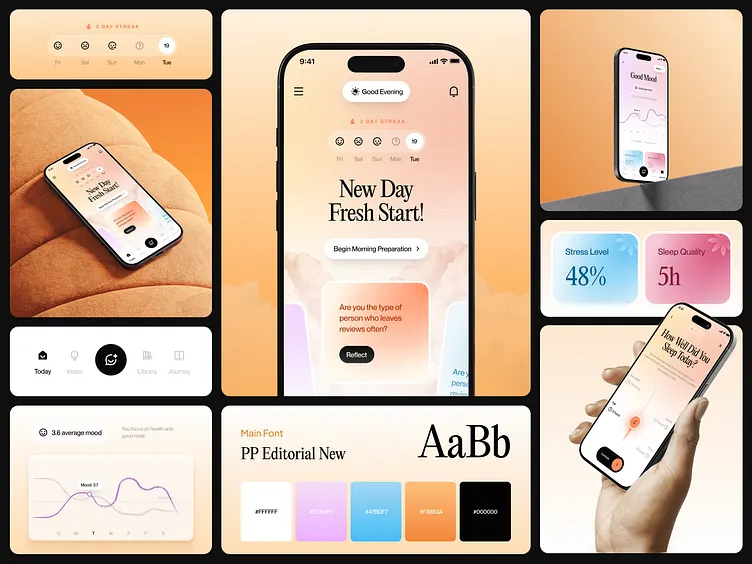
Quick Answer: What Is an AI Mood Tracker?
An AI mood tracker is a tool that logs how you feel, analyzes those entries with AI, and identifies patterns, triggers, and correlations across time — then translates that analysis into specific, actionable guidance. Unlike a simple emoji log, it interprets rather than just records.
Key capabilities:
- Contextual logging — capture mood alongside sleep, stress, workload, and events in one place
- Pattern detection — surface recurring triggers and cycles you'd never spot manually
- Cross-domain correlation — connect mood dips to sleep debt, nutrition, training load, or specific relationships
- Actionable output — convert insight into a concrete next step, not just a prettier chart
On Jenova, this isn't a single app. It's a set of expert agents you combine — a Meditation Guide for regulation practice, a Relationship Advisor for interpersonal triggers, a Personality Analyzer for the deeper structure — each with domain depth and shared memory of you.
The Problem: People Track Their Mood, Then Stop
Interest in mood tracking is not the bottleneck. Adoption is already widespread — a Bipartisan Policy Center survey found that among digital mental health users, 60% report using a mental health-specific app, while nearly 50% report using chatbots.
The market reflects that demand. Grand View Research estimates the global mental health apps market at USD 7.48 billion in 2024, expanding at a 14.6% CAGR through 2030.
But retention is brutal:
6.1% median 30-day user retention — across 22 mood-tracking apps in a 2019 study
Ninety-four percent of people are gone within a month. Here's why:
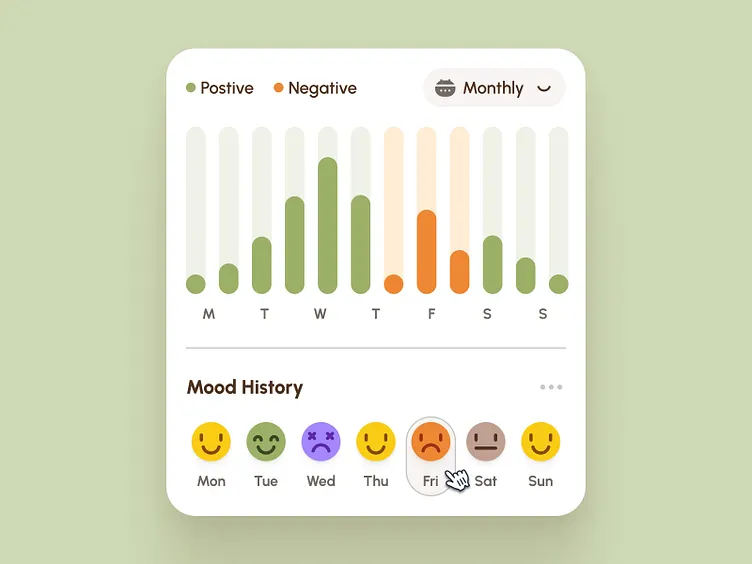
- Logging without interpretation — a bar chart that tells you Friday was bad, which you already knew
- No causal context — mood recorded in isolation from sleep, work, food, and people
- Zero memory — the app doesn't recall that this exact pattern appeared in March
- No next step — insight ends at the dashboard instead of changing anything
- Privacy uncertainty — hesitation to log honestly when data handling is unclear
📉 A Chart Is Not an Insight
The core failure is interpretive. Traditional trackers are excellent at capture and useless at meaning. Researchers examining user experience found that users of mood-tracking apps were primarily motivated by negative life events or shifts in their own mental health — people arrive when something is wrong and they want to understand it.
A colored bar for Wednesday does not deliver understanding. Without something asking why Wednesday looked like that and how it relates to the other eleven bad Wednesdays, the data stays inert.
🔗 Mood Doesn't Happen in Isolation
Emotional state is downstream of sleep, workload, physical activity, nutrition, and relationships. A systematic review published in npj Digital Medicine examining the user experience of ambulatory assessment and mood monitoring points to the gap between raw self-monitoring and clinically meaningful use.
Most apps silo mood in its own tab. You end up with a mood chart, a separate sleep chart, and a separate fitness app — and no mechanism that reads across them.
🧠 The Tool Forgets, So You Do
Harvard researchers studying digital phenotyping have examined whether mood-tracking apps actually help and how data from digital devices maps to behavior and mood. One consistent limitation of consumer tools: they treat every session as new.
You re-explain your situation, your job stress, your family dynamics. That friction compounds until logging feels like a chore with no payoff.
🔒 Honest Logging Requires Trust
Mood data is among the most sensitive information you can generate. The FTC's guidance for developers is explicit that apps helping consumers track mood, sleep, diet, or fitness fall under federal privacy scrutiny, and warns that sharing consumers' health information with third parties after telling or implying it will be kept private could violate the FTC Act.
Enforcement has followed. Legal analysts documenting the FTC's action against BetterHelp for sharing sensitive health data with third parties illustrate the category's track record. NAMI Georgia has similarly flagged serious vulnerabilities found in popular mental health apps.
If you don't trust where the data goes, you soften what you log — and softened data produces useless analysis.
This is exactly what Jenova was built for.
The Jenova Solution: Interpretation, Not Just Logging
Jenova replaces the single-app model with a gallery of expert agents, each built with deep domain knowledge, all sharing persistent memory of your history. You don't just record a mood — you talk about it, and the agent connects it to everything it already knows about you.
| Traditional Mood Tracker | Jenova AI Agents |
|---|---|
| Emoji tap, stored as a data point | Conversational check-in with follow-up questions |
| Chart with no interpretation | Analysis explaining what the pattern means |
| Mood siloed from sleep, food, training | Cross-domain correlation across life areas |
| Session starts from zero every time | Persistent memory across months of history |
| Insight ends at the dashboard | Concrete next step tied to your actual situation |
| One generic tool for everything | Specialized agents matched to each trigger domain |
🧠 Memory Is the Differentiator
Jenova agents retain unlimited chat history and persistent cross-session memory. Your agent remembers the project that wrecked your sleep in spring, the colleague who reliably triggers your worst afternoons, and the intervention that actually worked last time.
That's what enables the response no static chart can give: "This is the fourth time this quarter your mood drops hard on the Monday after a weekend on call. Want to look at that specifically?"
🔍 Reading Across Domains
Because agents share context and you can pull another agent into the same conversation with the @ mention, your mood data doesn't stay siloed:
- Chronic low mood with poor sleep → the Personal Medical Analyst learns your health history over time and provides evidence-based guidance
- Energy crashes tied to eating patterns → the Personal Nutritionist provides personalized, evidence-based guidance and accountability
- Mood dips clustering around specific people → the Relationship Advisor offers honest perspective and actionable advice
🧘 From Pattern to Practice
Recognizing a pattern is step one; regulating it is step two. The Meditation Guide is deeply trained across every major tradition, offering technique matching, structured practice programs, script generation, and expert guidance for adverse effects — an area most consumer wellness apps ignore.
"My mood log shows anxiety spiking every weekday morning before standup. Match me a technique for anticipatory anxiety and build a two-week practice program."
🪞 Understanding the Underlying Structure
Some mood patterns aren't situational — they're dispositional. The Personality Analyzer is a deep integrative personality psychologist that synthesizes Big Five, MBTI, Enneagram, attachment theory, and more to reveal patterns you haven't articulated yet.
"Based on three months of mood entries, what does my reaction pattern to unexpected schedule changes suggest about how I process uncertainty?"
🔐 Privacy as Architecture
Given the category's documented record, this matters. On Jenova, your data is never used to train public AI models, is encrypted in transit and at rest, and is not sold or shared with advertisers.
Specialized AI Agents for Mood and Emotional Wellness
A mood tracking habit rarely stays confined to mood. These are the agents worth building your practice around.
For Emotional Processing and Insight
Personality Analyzer — Deep integrative personality psychologist synthesizing Big Five, MBTI, Enneagram, and attachment theory to reveal patterns you haven't articulated yet.
- Explains dispositional drivers behind recurring emotional responses
- Multi-framework synthesis rather than a single-test label
- Connects long-run mood data to underlying temperament
Relationship Advisor — A warm, wise coach for romance, family, and friendships with honest perspective instead of reflexive validation.
- Isolates which relationships correlate with your mood dips
- Helps script the conversations you keep avoiding
- Remembers the people and dynamics already discussed
Writing Assistant — Your bespoke writing partner, adapting to any format with output that sounds like you.
- Turns raw check-ins into structured reflective entries
- Sharp editorial instincts when you want collaboration
- Handles anything from two-line logs to long-form processing
For Regulation and Physical Inputs
Meditation Guide — Deeply trained across every major tradition, with technique matching, practice programs, script generation, and troubleshooting.
- Matches practice to your documented emotional pattern
- Generates custom guided scripts, not fixed library tracks
- Expert handling of adverse effects when practice gets difficult
Fitness & Workout Coach — Custom programs, real-time session coaching, form guidance with video demos, and progress tracking.
- Correlates training load and recovery with mood readings
- Adjusts programming when your data shows depletion
- Progress tracking that pairs naturally with emotional tracking
Personal Nutritionist — Evidence-based guidance, accountability, and support tailored to your goals and lifestyle.
- Links energy and mood crashes to eating patterns
- Sustained accountability rather than one-time advice
- Adapts to your actual routine and preferences
For Health Context
Personal Medical Analyst — An AI medical analyst that learns your health history over time, analyzes symptoms, interprets results, and provides evidence-based guidance 24/7.
- Situates persistent mood changes in your broader health picture
- Remembers everything across sessions
- Evidence-based framing, available whenever the pattern shows up
Try Jenova free — no credit card required.
How an AI Mood Tracker Works
Step 1: Pick the agent that matches your trigger domain
Browse the gallery at Jenova and choose based on what's actually driving your mood. Interpersonal friction → Relationship Advisor. Regulation practice → Meditation Guide. Underlying temperament → Personality Analyzer. Bring in another agent mid-conversation with @ and it arrives with full context.
Step 2: Log the check-in — typed or spoken
Rate the day and say why in plain language. No structured form, no required fields. Voice input works when typing is too much friction, which for a bad day it usually is.
"6 out of 10 today. Slept about five hours, back-to-back meetings until three, snapped at someone I shouldn't have."
Step 3: Let the agent interrogate the entry
This is the step a chart cannot perform. The agent responds to your specific content, tests hypotheses, and pushes past surface attribution.
"Was that irritability actually about the meeting, or was it the sleep? Ask me what you'd need to know to tell the difference."
Step 4: Query your own history
Persistent memory means months of check-ins become searchable rather than archival. This is where mood tracking finally pays off.
"Across everything I've logged, what conditions show up most often before my worst days — and which ones am I actually able to control?"
Step 5: Convert the pattern into one action
Close each session with something concrete. Analysis that doesn't change behavior is just a nicer chart.
"Give me one change to test for the next two weeks, small enough that I'll actually do it, and tell me what to watch in my logs to know if it worked."
Results & Use Cases
📊 Finding the Real Trigger Behind a Recurring Dip
Scenario: Every Wednesday and Friday register low, and you have no idea why.
Traditional Approach: A colored bar chart confirming what you already noticed, with no explanation attached.
Jenova: The Personality Analyzer reads across your logged entries, tests competing explanations against your history, and identifies the actual common variable — then explains why it affects you specifically.
- Analysis across months, not a single week's chart
- Competing hypotheses tested rather than one assumed
- Explanation grounded in your documented response patterns
💼 Separating Burnout From a Bad Quarter
Scenario: Four months of declining mood entries that all mention work, and you can't tell if it's the season or the situation.
Traditional Approach: Scrolling a downward trend line and drawing whatever conclusion your current mood suggests.
Jenova: The Career Advisor applies expert frameworks to your logged history, distinguishing cyclical load from structural misfit, and researches concrete alternatives in real time.
- Turns a trend line into a defined decision
- Frameworks applied to your entries, not hypotheticals
- Real-time market research alongside emotional data
📱 Ten Seconds on the Commute
Scenario: You want a daily check-in but only have fragments of time on your phone.
Traditional Approach: An app you open three times before it becomes another unopened icon.
Jenova: Full feature parity across web, iOS, and Android with state-of-the-art speech-to-text. Speak a check-in on the bus; the agent responds with a targeted question; everything syncs across devices.
- Voice input eliminates typing friction entirely
- Memory and settings sync across every device
- Short entries still build cumulative context
🧘 Matching Regulation Practice to Actual Data
Scenario: Your logs show anxiety concentrated in specific recurring situations, and generic meditation tracks aren't touching it.
Traditional Approach: A fixed library of ten-minute sessions unrelated to what you're actually experiencing.
Jenova: The Meditation Guide matches technique to your documented pattern, builds a staged program, and troubleshoots when practice becomes difficult — including adverse effects most consumer apps never address.
- Practice selected from your real data, not a default track
- Custom scripts generated for your specific trigger
- Expert guidance when practice gets uncomfortable
🍽️ Connecting Mood Crashes to Fuel and Recovery
Scenario: Afternoon mood collapses that feel psychological but might be physiological.
Traditional Approach: Three separate apps — mood, food, sleep — with no mechanism reading across them.
Jenova: The Personal Nutritionist and Fitness & Workout Coach can be brought into the same conversation, correlating your logged crashes with eating timing and training load.
- Cross-domain analysis in a single thread
- Evidence-based adjustments with ongoing accountability
- Training programming that responds to your recovery data
Frequently Asked Questions
What is an AI mood tracker?
An AI mood tracker logs how you feel and uses AI to analyze those entries — identifying triggers, detecting patterns over time, and correlating mood with sleep, work, activity, and relationships. On Jenova, it works through specialized agents rather than one generic app, so analysis comes with real domain expertise attached.
Is an AI mood tracker free?
Jenova's free tier includes all core features with limited usage, which is enough to build a full tracking practice. Paid tiers start at $20/month for 30× the free usage plus custom model selection. Check "Subscribe" in the menu for current plan details.
Does mood tracking actually work?
Evidence is mixed but promising, and it depends heavily on sustained use. Research on mobile mood-monitoring in young people found limited evidence that it can improve mental health outcomes and therapeutic engagement. The larger obstacle is retention — one study found median 30-day retention across 22 mood apps was just 6.1%. An AI mood tracker supports self-awareness; it is not a substitute for professional mental health care.
How is this different from a regular mood tracking app?
Standard apps capture and chart. An AI mood tracker interprets. Jenova agents remember your full history, respond conversationally to each entry, correlate across sleep, nutrition, training, and relationships, and end with a concrete action — rather than leaving you with a weekly bar graph to decode alone.
Is my mood data private?
On Jenova, your data is never used to train public AI models, is encrypted in transit and at rest, and is not sold or shared with advertisers. This matters given the category's record — the FTC's enforcement action against BetterHelp over sharing sensitive health data shows what can go wrong. See "Terms and Policies" in the menu for full details.
Can it remember what I logged months ago?
Yes. Jenova agents retain unlimited chat history and persistent cross-session memory, so your agent recalls past entries, identified triggers, and interventions you've already tried. That memory is what makes genuine pattern recognition possible instead of week-by-week snapshots.
Does it work on my phone?
Yes. Jenova offers full feature parity across web, iOS, and Android, including state-of-the-art speech-to-text for spoken check-ins. Settings and memory sync across devices, so you can log on your phone and review patterns on desktop.
Start Tracking Your Mood With an AI That Actually Interprets It
Mood tracking fails for a specific reason: conventional apps are built to capture data, not to explain it. The chart shows the dip. It never tells you why, never remembers the last eleven dips, and never gives you something to do differently tomorrow.
An AI mood tracker closes that gap. Conversational check-ins replace emoji taps. Persistent memory turns months of entries into a searchable record of your patterns. Cross-domain analysis connects mood to sleep, workload, nutrition, and relationships. And privacy architecture that keeps your data out of public model training means you can log honestly enough for the analysis to be worth anything.
Build your setup around the agents that match your triggers: the Personality Analyzer for underlying patterns, the Meditation Guide for regulation practice, the Relationship Advisor for interpersonal triggers, and the Personal Medical Analyst for health context.
Explore the full agent library at Jenova and log your first check-in today.
For Developers: Every agent in this article is available programmatically via the Jenova API — build AI-powered mood analysis and emotional insight features into your application with a single integration. Full documentation →