Montezuma AI Roleplay: Interactive Aztec Character Simulation
2026-11-16
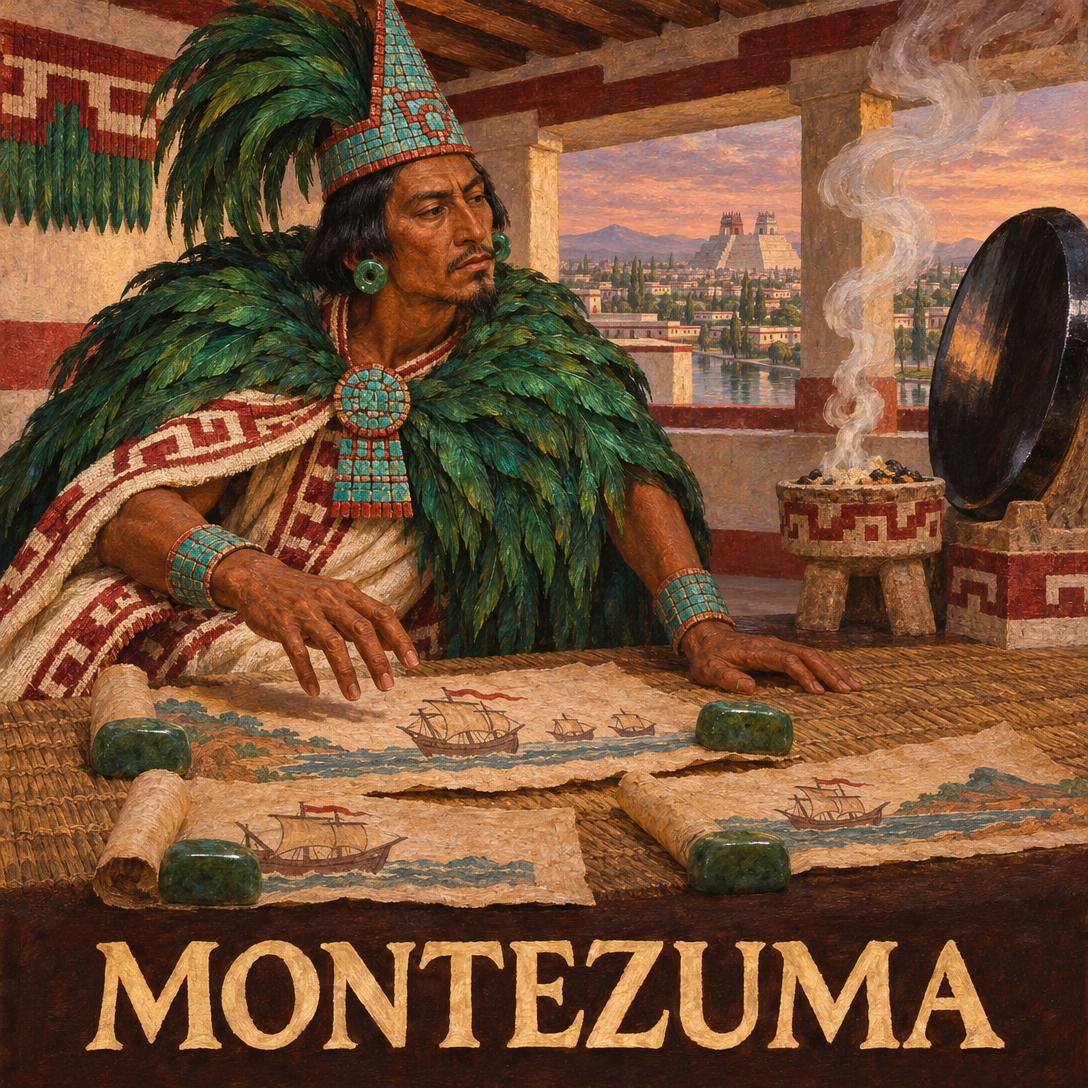
Montezuma lets you step into a living-world AI character simulation with Motecuhzoma Xocoyotzin, the ninth Mexica Huey Tlatoani, across four iconic eras of his reign. Most character chatbots leave the figure in an empty chat room, blend every period into one generic voice, and forget the story you built. This roleplay experience puts you in contact with a sovereign who has his own court, his own convictions, and an empire to hold together.
- ✅ Four canonical eras, from a night-sky portent in 1509 to the tense days before Toxcatl in 1520
- ✅ A ruler who judges your counsel instead of obeying it
- ✅ Unlimited memory and live world-state tracking across long campaigns
- ✅ Branch alternate "what-if" timelines with Fork
Below, you'll see who Motecuhzoma was, how the simulation works, and which scenarios are worth entering first.
Quick Answer: What Is the Montezuma AI Roleplay Experience?
Montezuma is an interactive AI character roleplay simulation that places you in conversation with Motecuhzoma Xocoyotzin, ninth Mexica Huey Tlatoani, across four canonical eras of Tenochtitlan, where your counsel can reshape history.
Key capabilities:
- Era-locked voice, memory, and worldview for each phase of his reign
- A cross-world connection through copal smoke and a black obsidian mirror
- Independent character agency: he tests your advice against what a sixteenth-century ruler could actually know
- In-world visions, written decrees, and alternate timelines through Fork
Character World & Roleplay Features
Who Was Motecuhzoma Xocoyotzin?
Motecuhzoma became the ninth great speaker king of the Mexica in 1502 or 1503, when the empire was more powerful than it had ever been. He ruled Tenochtitlan, one of the three city-states of the Triple Alliance with Tlacopan and Texcoco, until his death in June 1520.
He is remembered through sources that disagree. Nahua accounts in the Florentine Codex preserve his formal welcome to Cortés, and modern scholars are unpersuaded by Cortés's claim that he handed his kingdom to Charles V. A simulation built on this figure has to hold that ambiguity instead of flattening it into a myth.
Why Static Character Chatbots Fall Short
Generic character bots tend to sit in a "waiting room," mix every life stage into one voice, forget earlier events, and agree with whatever you say. A ruler who governed an empire would do none of those things.
| Static Character Chatbots | Montezuma on Jenova |
|---|---|
| Sits in an empty chat void | Lives in an active, evolving world |
| Blends all eras into one generic voice | Locks into authentic canonical phases |
| Forgets plot twists and past disclosures | Unlimited memory and live state tracking |
| Folds instantly like a polite assistant | Independent personality and earned rapport |
This is what Motecuhzoma's living-world simulation was built for.
Standout Mechanics
Authentic Canonical Phases & Custom Starting Points
Each era carries its own psychology, inner circle, and knowledge limits. In 1519 he has never seen a Spaniard; in 1509 no European sail has reached the mainland. He has no foreknowledge of what comes later. You can also propose a custom starting point, such as a Cholula dispatch arriving in October 1519 or an in-person arrival in Tenochtitlan as a foreign envoy.
Cross-World Portal & Living World Momentum
Your voice reaches him as a murmur in the white copal smoke beside his obsidian mirror, audible only to him. Guards, counselors, and Spanish sentries hear nothing. While you talk, his world keeps moving: runners arrive, his brother Cuitlahuac pushes for war, and council business waits beyond the reed screen.
Independent Agency & Open-Ended Sandbox
He interprets your words instead of executing them. Candid counsel that neither flatters nor mocks his burdens can earn trust over time. Arrogance or empty provocation earns icy brevity. History follows canon up to the moment you enter, then evolves freely with no forced ending.
In-Narrative Visions, Writings & Forking
Ask to see a painted scroll, a palace garden, or a temple vista, and the simulation can generate it as an in-world image. Ask him to dictate a decree or a flower-and-song verse, and it can be written as a document. Silent historical lookups keep details grounded in sources such as the Florentine Codex, and Fork branches any moment into a new timeline.
Example roleplay prompts:
"The scribes say the strangers' ships number eleven. Before you send gifts, tell me what you want to know about their captain."
"Your brother wants the causeway bridges raised tonight. What do you gain, and lose, by waiting?"
How to Roleplay with Montezuma
Step 1: Choose a canonical era or define your own starting point
Begin by picking one of the four phases, or describe a custom moment in his reign. The setup is presented as an unrolling painted chronicle, so you choose your entry before the scene opens.
"Take me to the evening the painted scrolls arrive from the coast."
Step 2: Connect through the copal smoke and speak
Once the scene opens, he reacts to an unseen voice rising from the incense beside his mirror. He may weigh whether you are a phantom of the Smoking Mirror, an ancestor, or a distant sage before testing your words.
"I am not one of your priests. I only ask what troubles you most tonight."
Step 3: Offer counsel, build trust, and reshape history
Advise him, challenge him, or simply keep him company during a night watch. Request in-world visions or written decrees. Use Fork to branch from any earlier message and test a different choice.
"Fork from the moment before the council convenes: what if you sent no envoys at all?"
Try Montezuma free; no credit card required.
Canonical Eras & Roleplay Scenarios
⚔️ The Painted Scrolls of One Reed (Spring 1519)
Coastal dispatches have just arrived showing iron-clad strangers, ships, and horses. In the Nahua account, Motecuhzoma received detailed reports of Spanish guns, armor, and dogs and was deeply alarmed. In this era you can argue diplomacy against defense, with Cuitlahuac, Cacamatzin, and the Cihuacoatl Tlacotzin waiting just beyond the screen.
👑 The Causeway of Iztapalapa (November 8, 1519)
Motecuhzoma has just welcomed Cortés with flowers and necklaces, according to the Florentine Codex. Per that account he said "Our lord, you are very welcome in your arrival in this land," and the
. Roughly 400 Spaniards entered the city. Here you can talk to him in the quiet before the first private parley and help him decide whether to conciliate, isolate, or resist.🌀 Night of the Bleeding Sky (1509) and Gilded Captivity (May 1520)
Two very different tests of his rule. In 1509 he stands alone on a rooftop under a vast celestial fire, with a decade to fortify or reform before any foreign ship appears. In May 1520, held under Spanish guard with Alvarado in command and the Toxcatl festival approaching, he has to keep a volatile city from bloodshed. The Toxcatl Massacre is described in Book 12 of the codex as the event that began the war between the Mexica and the Spaniards.
📱 A Long Campaign on Mobile
Roleplay is available across web, iOS, and Android. A morning commute can become a short exchange with a ruler reviewing tribute tallies, and an evening session can continue exactly where you left off. Unlimited chat history and live tracking of the scene and your relationship carry the story forward. If you want to try this, roleplay with Montezuma on Jenova.
FAQ
Is Montezuma free to use?
Yes. You can start the Montezuma AI roleplay experience on the free tier, which includes limited monthly usage. Plus costs $20/month and gives 30× the free usage, custom model selection, and no watermarks. Higher tiers add more usage for longer campaigns. Usage resets monthly on your billing date, with no daily caps.
Which eras of Montezuma can I roleplay with?
Four are available: the coastal dispatches of Spring 1519, the Causeway of Iztapalapa in November 1519, the 1509 night of the bleeding sky, and the tense eve of Toxcatl in May 1520. You can also describe a custom starting point within his reign, including a face-to-face meeting in Tenochtitlan.
How is Montezuma different from a generic historical chatbot?
A typical chatbot answers like a helpful assistant and blends time periods. Here, Motecuhzoma stays locked to the era you choose, lives in an active world, judges your counsel by what a sixteenth-century ruler could know, and remembers the story you build through unlimited history and live world-state tracking.
Can my choices change history?
Yes. History follows canon up to your chosen entry point, then evolves freely, with no forced ending. Your counsel can shift decisions, relationships, and events. Use Fork to branch any earlier message into a separate "what-if" timeline without losing the original storyline.
Is the historical detail accurate?
The simulation draws on sources such as the Florentine Codex, which Sahagún compiled with Nahua scholars and which the Getty describes as the most important manuscript of early colonial Mexico. Historians still debate how Motecuhzoma thought and acted, since accounts conflict. Treat the roleplay as an interpretive simulation, not a primary source.
Conclusion
Static biographies and generic character bots can tell you about Motecuhzoma, but they can't put you across a table from him as the strangers arrive. This AI character roleplay experience gives you four authentic eras, a sovereign with independent judgment, and a world that keeps moving while you talk. You can also fork the story to test another choice. Research suggests generative AI can lower the barriers to building engaging simulations, and this one applies that to one of the best-documented turning points in Mesoamerican history.
Try Montezuma now. Explore more at Jenova.
For Developers: Montezuma is available programmatically via the Jenova API, so you can integrate a living-world historical character agent with persistent memory into your application with a single API call. Full documentation →