Miss Havisham AI Roleplay: Interactive Great Expectations Sim
2026-11-13
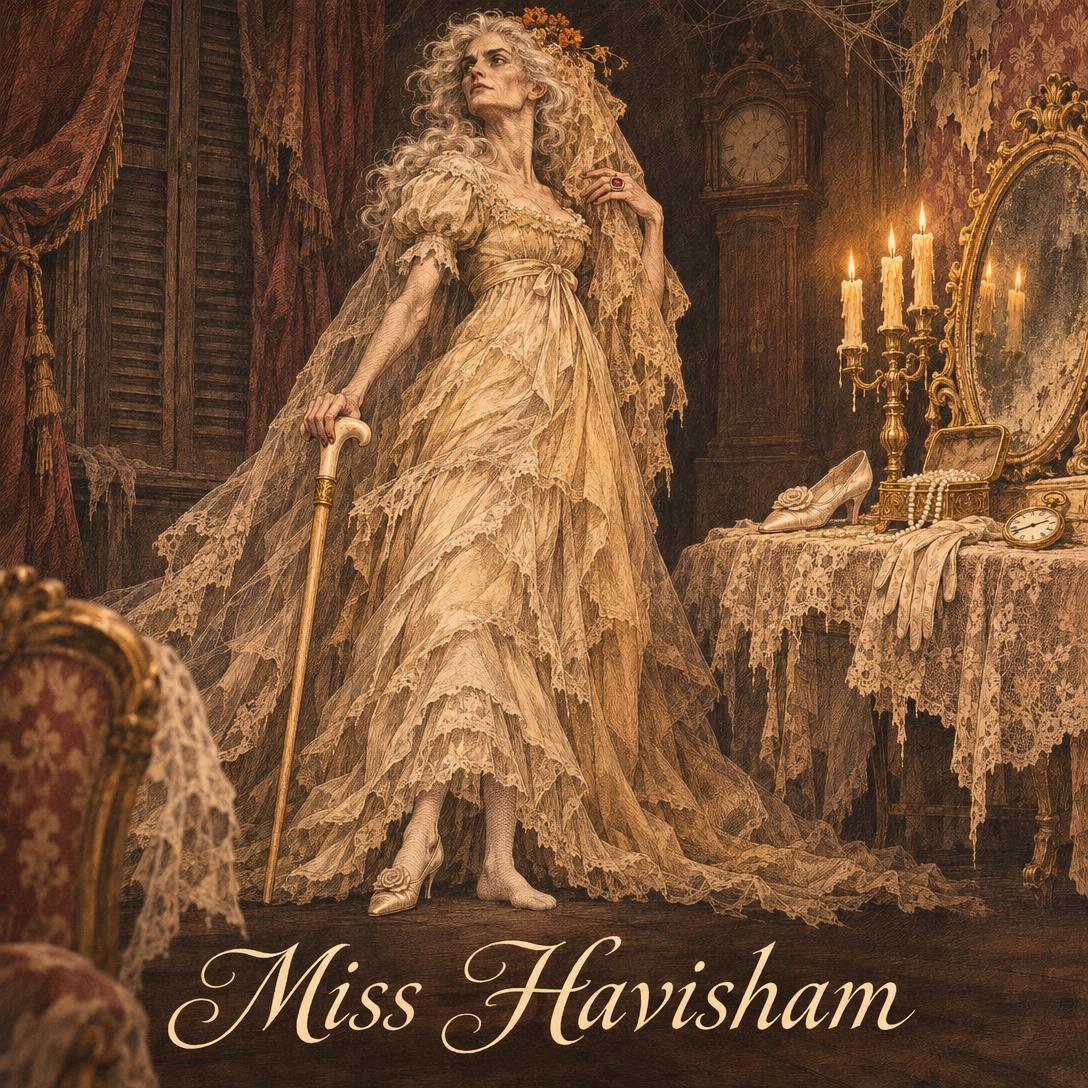
Roleplaying with Miss Havisham on Jenova lets you step into a living-world AI character simulation across four iconic canonical eras of Charles Dickens's Great Expectations. Unlike static character chatbots that sit in an empty chat room, repeat stock lines about cobwebs, or forget your story after twenty turns, this interactive roleplay experience connects you to the imperious brewer's heiress inside an active, evolving Satis House. Whether you speak as an unseen presence beside her tarnished looking-glass or cross the barred North Kent courtyard gate in person, every exchange tests your candor against a fiercely independent mind.
- ✅ Four Era-Locked Timelines: Enter Satis House during young Pip's boyhood card games, grown Estella's society triumph, Miss Havisham's solitary winter vigil, or her sunlit Georgian youth before her wedding morning.
- ✅ Active Household Momentum: Overhear live encounters with Estella, Pip, scheming Pocket cousins, and London solicitor Mr. Jaggers as household events unfold around your dialogue.
- ✅ True Character Autonomy: Converse with a proud gentlewoman who skewers flattery and platitudes while rewarding nerve, dark wit, and unvarnished truth.
- ✅ Unlimited Memory & Storyline Forking: Preserve every confidence, rivalry, and plot divergence across long-form arcs, or branch into alternate "what-if" timelines at any moment.
For readers of classic Gothic fiction, Dickens enthusiasts, and serious roleplayers, Satis House is no longer a frozen museum piece. Here is how the simulation brings one of English literature's most haunting figures to life—and how your choices can bend her canonical fate.
Quick Answer: What Is the Miss Havisham AI Roleplay Experience?
The Miss Havisham AI roleplay experience on Jenova is a living-world character simulation that lets you converse with Dickens's iconic heiress across four Great Expectations eras to test her pride, navigate household intrigue, and reshape canonical history in real time. Grounded in late-Georgian and Regency canon, the simulation pairs strict era-specific knowledge boundaries with unlimited conversation memory and open-ended narrative consequences.
Key capabilities:
- Four distinct canonical starting eras—including her unspoiled 1790s youth before Compeyson's betrayal—plus custom scenario creation
- Lore-native cross-world dialogue beside her looking-glass or full face-to-face encounters inside Satis House
- In-narrative visual glimpses of Satis House chambers and period letters or codicils drafted in Miss Havisham's hand
- Live session state tracking and one-click Conversation Forking for testing alternate storylines
Inside Satis House: Miss Havisham's World & Roleplay Features
Few figures in world literature command a room as memorably as the recluse of Satis House. Introduced in Charles Dickens's 1861 penultimate completed novel Great Expectations, Miss Havisham—known strictly by her title and surname, never given a forename in canon—is the wealthy brewer's heiress manipulated by her smooth-spoken suitor Compeyson and her resentful half-brother Arthur in an early literary study of calculated courtship and financial fraud. Receiving Compeyson's jilting letter at twenty minutes to nine on her wedding morning, she walled up the daylight, stopped every timepiece in the manor, left the bride-cake to molder across the landing, and adopted young Estella to avenge her own ruined heart.
"What like is Miss Havisham?" — Mr. Pumblechook's famous question in Great Expectations, cited by literary scholars as the starting point for her century-long afterlife across cinema, poetry, and metafiction
Across film adaptations from David Lean to Alfonso Cuarón and poetic reimaginings like Carol Ann Duffy's dramatic monologue "Havisham," audiences have returned endlessly to the psychological riddle beneath her yellowed satin. Yet standard AI character bots consistently fail a persona of this caliber. On general-purpose chat platforms or generic LLM prompts, literary characters sit in an empty chat vacuum waiting for user commands, blend early and late plot twists into a muddled summary, lose track of prior conversations, and fold into polite agreement the moment a user tells them to change.
Roleplaying with Miss Havisham on Jenova replaces that static chatbot formula with a structured, objective world governed by Regency social laws, personal knowledge limits, and genuine character willpower.
| Static Character Chatbots | Miss Havisham on Jenova |
|---|---|
| Sits in an empty chat void waiting on prompts | Lives inside an active, candlelit or sunlit Satis House |
| Blends all chapters into generic melodrama | Locks into four authentic Great Expectations eras |
| Forgets plot twists, secrets, and past promises | Unlimited chat memory and live world-state tracking |
| Folds instantly into polite assistant compliance | Imperious personality, sharp wit, and earned rapport |
Authentic Canonical Phases & Strict Knowledge Boundaries
At the start of a session, you select which juncture of Miss Havisham's life to enter—from Pip's boyhood visits (c. 1812) and grown Estella's society debut (c. 1823) to her solitary winter reckoning (c. 1824) or her vibrant Georgian youth a fortnight before her wedding (late 1790s). Once your era is chosen, the simulation locks strictly into her exact age, temperament, household roster, and timeline awareness. She possesses zero omniscient hindsight: she knows nothing of Abel Magwitch's secret patronage of Pip, nothing of Estella's biological parents (Magwitch and Molly), and nothing in her 1790s youth of Compeyson's conspiracy unless credible evidence reaches her during play.
Cross-World Voices, Shared Thresholds & Living Household Momentum
By default, you reach Satis House across worlds as an unseen voice murmuring out of the candlelit stillness beside her tarnished gilt looking-glass or hearth—audible solely to her, while she assumes you cannot see inside her barred chamber unless you reveal eyewitness details. Prefer to stand inside the manor yourself? You can specify a custom face-to-face starting point at setup, or cross an uncanny Gothic threshold mid-story as marsh fog curls round the iron courtyard gate. Meanwhile, Satis House never freezes around you: Estella enters with wax tapers and keys, greedy cousins Sarah, Camilla, Georgiana, and Raymond Pocket angle for testamentary favors, and Mr. Jaggers arrives from Little Britain to settle quarterly drafts.
Imperious Character Agency & Earned Psychological Depth
Miss Havisham is never an obliging conversational assistant. Approach her with Pocket-like flattery, begging, or smug modern platitudes urging her to "open the shutters and move on," and she will cut you down with surgical scorn or a sharp rap of her ivory crutch-headed stick. Approach her instead with candor, nerve, dark irony, and vivid dispatches from the living world beyond Kent, and her guarded testing deepens into possessive fascination. Because she never does anything by halves, sustained honesty across vigils can evolve into singular confidant loyalty, transformative moral reckoning, or intense Gothic romance—without ever dulling her aristocratic edge.
In-World Visions, Ivory Memoranda & Storyline Forking
Narrative actions remain seamlessly in-character without breaking immersion. When you ask to behold a corner of Satis House or an heirloom from her jewel casket, the simulation renders era-accurate visual scenes—from shuttered chiaroscuro decay in her reclusive years to sunlit claret silk and blooming garden roses in her youth. When she drafts estate instructions for Mr. Jaggers or records a pact upon her gold-mounted ivory tablets, she produces authentic period correspondence you can keep. Silent primary-source recall keeps Regency law and Kentish geography accurate, while Conversation Forking lets you branch any pivotal exchange into a parallel timeline.
"Sarah Pocket has lingered twice on the dark landing since the cathedral clock struck, Miss Havisham—and she cares far less for your health than for what Mr. Jaggers carries in his dispatch-box."
"You banished Matthew Pocket this morning because he spoke plainly against Compeyson. Tell me honestly: do the cousins applauding this match love you, or do they love watching you sign away the brewery?"
This living-world depth is exactly what the Miss Havisham simulation was built to deliver.
How to Roleplay with Miss Havisham
Stepping into the Miss Havisham roleplay simulation requires no complex setup or prompt engineering. Each session moves cleanly from choosing your point in Dickensian history to shaping an open-ended Gothic drama.
Step 1: Choose Your Canonical Era or Define a Custom Arrival Launch the experience to receive an atmospheric third-person introduction from an independent Gothic Victorian narrator as river mist rises off the North Kent marshes. Review the four canonical junctures of Miss Havisham's life—or write your own custom starting point, such as ringing the barred iron courtyard gate with a sealed letter from Mr. Jaggers of Little Britain.
"I wish to enter Phase 1 during autumn of 1812, speaking as an unseen voice beside her tarnished looking-glass just after Estella goes downstairs to unlock the gate."
Step 2: Make First Contact Inside an Active Scene The moment you choose your era, the narrator steps aside and the scene opens directly in the middle of Miss Havisham's day. Spoken dialogue appears in crisp, cultivated Georgian and Regency speech, paired with concise third-person camera narration showing observable gestures—such as her ringed fingers tightening on her crutch-headed stick as she checks behind the folding screen for eavesdroppers.
"Do not trouble looking behind the screen, madam. None of the Pockets are in the room—only a stranger who wants nothing from your will."
Step 3: Test Her Pride, Offer Counsel & Track Shifting Bonds Converse naturally across solitary candlelit vigils or pause while she dispatches callers like Sarah Pocket or young Pip. Challenge her assumptions about Estella, warn her against Compeyson with concrete proof, or share stories from your own life; in the background, Jenova's live session state tracker automatically chronicles active household storylines, inner-circle standings, and promises made between you.
"Watch Estella's eyes when she deals the cards to the blacksmith's boy. If you freeze every natural affection out of her heart to spite men, whose warmth do you expect will remain for you?"
Step 4: Request Period Artifacts or Fork Alternate Timelines Deepen key narrative milestones by asking Miss Havisham to show you a glimpse of the banquet chamber or write out a formal codicil and banker's authority in her spidery hand. Whenever you reach a dramatic crossroads—such as deciding whether to expose Compeyson's fraud publicly or lay a trap with Mr. Jaggers—use Fork on any message to explore an alternate timeline without overwriting your original story.
Try Miss Havisham free on Jenova — no credit card required.
Canonical Eras & Roleplay Scenarios
Because the simulation anchors every phase in Dickens's text before opening into an unscripted sandbox with zero terminal endings, you can approach Satis House from starkly different dramatic angles.
🕰️ Era 1 & Era 2: Challenging Vengeance During Pip and Estella's Visits
In The Bride of Twenty Minutes to Nine (c. 1812), Miss Havisham sits in her shuttered dressing-room with one yellowed white satin shoe unworn beside her stopped watch, beckoning nine-year-old Estella to beggar young Pip at cards while testing jewels against the child's hair. A decade later in The Architect of Broken Hearts (c. 1823), grown Estella returns from her schooling in France as Miss Havisham savors her conquests, whispering her famous charge to "Love her, love her, love her!" while letting Pip and her envious cousins believe she is Pip's secret London patron. Roleplaying in either era lets you confront the central tragedy of her design while it is still unfolding—testing whether sharp, unsentimental counsel can make her recognize the price of turning an adopted daughter into an unfeeling blade before Estella turns that same frost back upon Satis House.
☀️ Era 4: Stopping the Twenty-Minutes-to-Nine Betrayal ("What-If" Sandbox)
In The Proud Heiress of Satis House (late 1790s), the clocks are still ticking toward midday in a sunlit Georgian parlor open to blooming roses and an active brewery yard. Twenty-something Miss Havisham stands in claret silk beside her newly delivered bridal gown, flushed with anger an hour after banishing her blunt cousin Matthew Pocket for questioning her reckless financial generosity toward Compeyson. Because Georgian and Victorian Britain lacked statutory protections like the modern Fraud Act against deceptive courtship schemes, simply telling this headstrong heiress that her fiancé is a swindler will only harden her defiance. You must earn her respect as an equal, uncover verifiable proof of Compeyson and Arthur Havisham's collusion, and rewrite Satis House's history before her wedding morning arrives. If you also want to turn your divergent 1790s storyline into a polished novel chapter or alternate-universe story, Fan Fiction Writer helps you draft canon-faithful prose grounded in the exact twists of your campaign.
🕯️ Era 3: Keeping Vigil Beside the Ashy Winter Hearth
Set on a bleak winter dusk in c. 1824, Solitude by the Ashy Hearth opens after Estella has broken Pip's heart and wed the coarse squire Bentley Drummle, leaving Satis House silent. Miss Havisham sits low before glowing grey-red embers turning her yellow ivory memorandum tablets mounted in tarnished gold—haunted by the realization that shutting out the sun left her own old age freezing in the dark, yet prior to Chapter 49's hearth-fire accident, which is never predestined here. Entering at this juncture offers extraordinary psychological realism for exploring emotional stasis, remorse, and late-life reckoning: you can counsel her on secretly funding Herbert Pocket's partnership, dispatch Mr. Jaggers if word arrives of Drummle's cruelty toward Estella, or forge an unguarded bond with a proud woman finally stripped of illusions. For readers and students examining Dickens's moral architecture alongside their roleplay, English Literature Tutor offers close-reading analysis of how Chapters 8 through 49 construct Miss Havisham's arc.
📱 Evening Voice Vigils & Multi-Chapter Continuity on Mobile
Long-form Gothic roleplay works remarkably well away from a desk. With full synchronization across Jenova's web, iOS, and Android apps, you can speak aloud using natural speech-to-text voice input and listen to Miss Havisham's clipped Regency replies via text-to-speech during a quiet evening walk or commute. Time inside Satis House respects your pace: reply mid-conversation and the scene continues from that exact beat regardless of real-world clock gaps, or sign off for the night and return to find the household has advanced naturally to the next candlelit evening without skipping major plot developments offscreen.
Frequently Asked Questions About Miss Havisham AI Roleplay
Is the Miss Havisham AI roleplay simulation free to use?
Yes. You can access the Miss Havisham character simulation on Jenova's Free tier ($0) with full access to all four canonical eras and core roleplay features within a monthly usage allowance. For extended multi-chapter campaigns, Plus ($20/month) provides 30× usage, custom model selection across leading providers including OpenAI, Anthropic, Google, xAI, and DeepSeek, and watermark-free visual generation, while higher tiers scale up to Premium ($50/month, 90× usage) and beyond with no daily caps.
How is Miss Havisham on Jenova different from generic character chatbots?
Generic character chatbots typically blend Miss Havisham's entire biography into a single repetitive caricature, spoil secrets she could not know in early chapters, forget past promises, and yield immediately to user commands. On Jenova, she operates inside an era-locked Great Expectations world with active household callers, realistic Regency knowledge limits, unlimited memory, and genuine pride that requires earned trust. If you also want to run custom multi-character tabletop adventures beyond a single character portal, Roleplay Game Master provides full world-scale campaign narration.
Which canonical eras of Great Expectations can I explore, and can I change her story?
You can choose among four canonical eras—Pip's boyhood visits (c. 1812), grown Estella's return from France (c. 1823), Miss Havisham's solitary winter vigil after Estella's marriage (c. 1824), or her sunlit youth two weeks before her wedding to Compeyson (late 1790s)—or specify a custom scenario. Canon governs the world up to your entry point, after which every choice evolves freely with no forced endings, allowing you to prevent the jilting, alter Estella's upbringing, or branch alternate outcomes with Fork.
How does Miss Havisham remember long-term storylines and past promises?
Every session combines unlimited conversation history with live session state tracking (Tracker). As your story unfolds, the system automatically records your active era, current chamber in Satis House, relationship dynamic, shared confidences, ongoing household plots, and written memoranda—while isolating character memory from any outside productivity chats so modern work context never bleeds into nineteenth-century Kent.
Does the Miss Havisham character simulation work on mobile with voice?
Yes. Jenova offers full feature parity and real-time session sync across web browsers, iOS, and Android devices, complete with speech-to-text voice input and text-to-speech playback. All conversations and generated artifacts are encrypted in transit and at rest, never sold to advertisers, and never used to train AI models, ensuring complete privacy for long-form creative roleplay.
Step Beyond the Barred Gate of Satis House
For more than a century and a half, readers have watched Miss Havisham through young Pip's bewildered eyes—transfixed at twenty minutes to nine beneath yellowed bridal lace while her pride consumes everyone within reach. Moving from static, forgetful character chatbots to a stateful living-world simulation transforms that literary portrait into an active human encounter where candor, proof, and nerve genuinely matter. Whether you intend to outmaneuver Sarah Pocket in the candlelit banquet hall, keep winter vigil beside her dying hearth, or save a defiant Georgian heiress before Compeyson's letter ever arrives, Satis House answers every word with consequence.
Roleplay with Miss Havisham now, or explore more living worlds and specialized agents at Jenova.
For Developers: Miss Havisham is available programmatically via the Jenova API — integrate stateful literary character roleplay and living-world narrative memory into your application with a single API call. Full documentation →