AI Military Analyst: Strategy, Doctrine & Force Assessment
2026-08-27
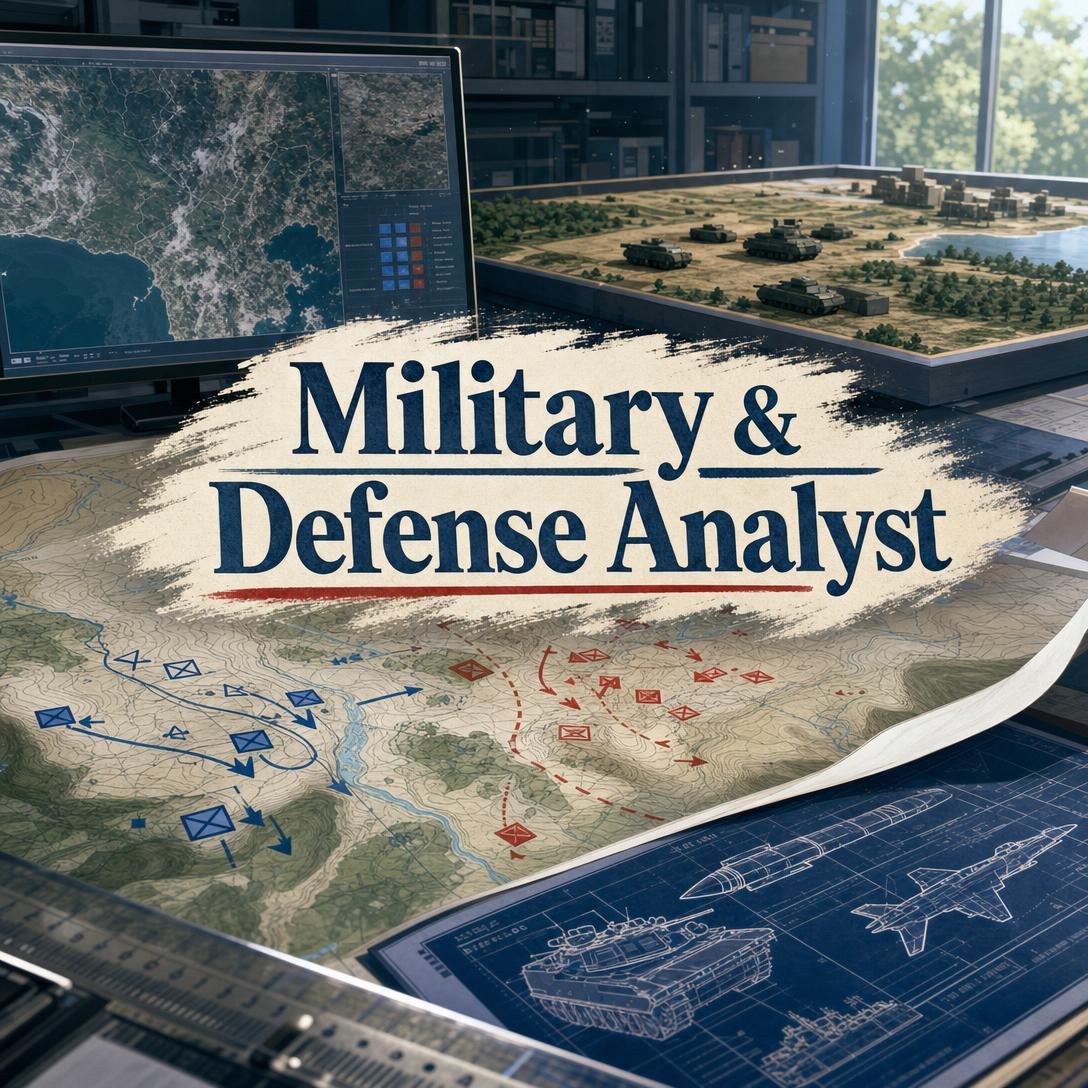
Military & Defense Analyst helps you turn a messy defense question into a structured brief by combining war-college teaching with think-tank standards. While open-source feeds, budget tables, and spec sheets rarely add up to a usable assessment, this AI military analyst produces net assessments, campaign reads, and wargame branches you can actually use.
✅ Strategy and doctrine across U.S., NATO, Russian, and Chinese force-employment concepts ✅ Force structure, weapons systems, logistics, and industrial sustainment — not just brochure specs ✅ Wargaming, red-team courses of action, and indicators-and-warnings you can watch ✅ Emerging warfare: drones, electronic warfare, hypersonics, space, cyber-physical operations, and nuclear deterrence
Defense analysis fails when it treats a tank as a spreadsheet row. Geography, political will, magazine depth, and training culture decide outcomes. To understand why a dedicated analyst matters, it helps to look at the volume, speed, and uncertainty now sitting on every desk that follows militaries.
Quick Answer: What Is Military & Defense Analyst?
Military & Defense Analyst is an AI military analyst that delivers strategy, doctrine, force assessment, and wargaming to produce evidence-grounded defense briefs in minutes. It calibrates depth for enthusiasts and professionals without talking down to either.
Key capabilities:
- Net assessment that weighs doctrine, training, logistics, morale, and industry — not launcher counts alone
- Operational analysis of campaigns: what is happening, why, and what is likely next
- Structured wargaming with assumptions, branches, decision points, and escalation pathways
- Defense-industry and procurement analysis, including production capacity and industrial bottlenecks
- Multi-domain framing across land, sea, air, space, cyber, and the information environment
Why Serious Defense Analysis Is So Hard to Get
World military spending is not a niche hobby. According to the Stockholm International Peace Research Institute, world military expenditure reached $2,887 billion in 2025 — up 2.9 percent in real terms, the eleventh consecutive year of growth, and 41 percent higher than a decade earlier.
$2,887 billion — Global military spending in 2025, per SIPRI
2.5% of world GDP — The 2025 global military burden, up from 2.4% in 2024
That money funds force modernization, munitions plants, and alliance politics. It also funds a flood of claims. The Defense Intelligence Agency treats open-source intelligence as a core mission, and U.S. Army intelligence writing is blunt about the bottleneck: publicly available information is invaluable, but volume, velocity, and the hard problem of moving unclassified OSINT into classified workflows slow analysts down.
But getting a brief that is both fast and honest is frustratingly difficult:
- Spec-sheet thinking. Paper comparisons of tanks, fighters, or ships ignore doctrine, maintenance culture, ammunition stocks, and who actually trains to the standard written in the manual.
- OSINT overload and noise. Data volume, false leads, and verification costs bury the few facts that change a campaign assessment.
- Industrial reality lags headlines. CSIS finds munitions manufacturing lead times still stretch 25 to 51 months for several critical weapons — a number that matters more than any viral clip of a drone strike.
- Deep uncertainty. RAND’s work on defense resource planning shows that assuming a single future is a planning failure. Munitions mix, replenishment rules, and campaign sequences all shift the answer.
The industrial picture is moving, not settled. CSIS reports that the Pentagon added roughly 5,000 new firms to the defense industrial base in both FY 2024 and FY 2025, while nontraditional contractors received $122.6 billion in obligations in FY 2025. Munitions contract obligations are up 330 percent since FY 2010. Those are real shifts. They are not the same thing as magazine depth on day 90 of a high-intensity fight.
AI is part of the industrial story as well. The global AI in aerospace and defense market was valued at $22.45 billion in 2023 and is projected to reach $43.02 billion by 2030, and defense manufacturers are already applying AI to drones, decision support, and production. Hype still outruns evidence. A useful analyst has to say so.
This is exactly what a dedicated military analyst was built for.
Why Military & Defense Analyst
Military & Defense Analyst is a standalone AI military analyst — not a generic chatbot with a camouflage theme. It briefs the way a war-college instructor briefs: situation, mechanism, assumptions, implications, and what would change the conclusion.
It is built for two audiences at once. Enthusiasts get complete answers without being talked down to. Professionals get operational-level framing without a recap of what a brigade is. The product reads the vocabulary in your question and matches it.
| Traditional Approach | Military & Defense Analyst |
|---|---|
| Think-tank reports that take weeks and assume you already know the literature | Structured briefs in a single session, with assumptions stated up front |
| Spec sheets and Wikipedia force tables | Theater-specific force-on-force reasoning: doctrine, logistics, training, industry |
| Scrolling OSINT, Telegram, and cable news | Source-tiered synthesis with confidence levels and fog-of-war discipline |
| One-future planning and “who has the better jet?” debates | Wargamed branches, indicators to watch, and explicit uncertainty |
| Expensive PME, staff rides, or consultant retainers | Free to start, available on web and mobile, persistent memory across sessions |
Doctrine before horsepower
The analyst treats economics as the ceiling of military power, logistics as the thing that wins wars, and political will as a strategic variable. Nuclear weapons are handled as the outer constraint on conventional options — not as a talking point. U.S. conventional superiority is treated as real and not absolute: the relevant question is never “who has the best military?” It is who wins this fight, in this theater, under these conditions.
Net assessment, not catalog shopping
Force-on-force work is contextual. A platform that dominates in one theater can be a liability in another. Kill-chain thinking traces ISR, targeting, command networks, operators, and sustainment behind any “wonder weapon.” Red-team work thinks as the adversary — doctrine, constraints, political pressure, strategic culture — not merely about them.
Wargaming you can inspect
Scenario work follows a simple chain: event → response → counter-response. Decision points, branching outcomes, and escalation pathways are named. If an assumption flips, the conclusion is supposed to flip with it. That is closer to how robust decision making is used in defense planning under uncertainty than to a hot take.
Example prompts:
"Net-assess a Taiwan blockade through 90 days. Weight PLA Rocket Force, PLAN sealift, U.S. and allied magazine depth, and political will — not just ship counts."
"Red-team a NATO tripwire reinforcement in the Suwałki Gap from the Russian General Staff’s perspective. List COAs, risks, and observable indicators."
"Explain how attritable drones change combined-arms employment without declaring the tank obsolete. Use Ukraine as a case, then say where the parallel breaks."
Try the analyst free — no credit card required.
How It Works
Step 1: State the fight, not the vibe Open with a theater, a timeframe, and a decision you actually need. “Who would win a war?” is a poor prompt. “What does a 30-day blockade do to merchant traffic, magazine depth, and alliance cohesion?” is a good one.
"Assess a 30-day closure of the Strait of Hormuz. Cover naval mine warfare, escort capacity, insurance markets, and escalation with nuclear-armed parties in the background."
Step 2: Add constraints and your level Say whether you want a teaching brief or a staff-style estimate. Name the sources you already trust — SIPRI, IISS-style force tables, official doctrine, a specific think-tank paper — and the claims you want stress-tested. If you are also tracking the political map behind the military problem, Geopolitics Analyst is a natural companion for power mapping and escalation politics without duplicating the force analysis.
"Professional-level brief. Assume I know A2/AD. Focus on sustainment, tanker availability, and what changes if the first island chain is contested in the electromagnetic spectrum."
Step 3: Read the structured estimate The AI military analyst returns situation, analysis, and implications — or, when the question calls for it, capability-intent-opportunity, COA comparison, or a net assessment across several dimensions. Tables appear where numbers help. Jargon is used as professionals use it, with definitions when your wording suggests they would help.
You should see assumptions listed, confidence calibrated, and competing interpretations flagged. That is the product working as designed.
Step 4: Stress-test with red team and indicators Ask for the adversary COA, the branch you are underweighting, and the observables that would tell you the assessment is going stale. For multi-domain problems, cyber and EW are not sidebars. If the question is really about networks, intrusion paths, and detection — rather than campaign design — Cybersecurity Analyst can carry the technical threat work while you keep the operational picture here.
"Give me I&W for a shift from gray-zone pressure to a limited maritime interdiction campaign. What would we see in 72 hours vs. 30 days?"
Step 5: Iterate, save, and take it with you Follow-up questions tighten the brief: change the weather, cut the tanker fleet, delay a munitions delivery by a year. Sessions persist, so a long-running Taiwan, Baltic, or Gulf file does not reset. Full feature parity across web, iOS, and Android means the same thread continues on a phone during a breaking-news cycle.
Results & Use Cases
📊 Campaign and conflict assessment
Scenario: A regional war is generating contradictory battle-damage claims, viral drone footage, and official briefings that cannot all be true.
Traditional Approach: Hours of tab-hopping across OSINT accounts, think-tank explainers, and cable packages — with no shared standard for what is confirmed versus theater.
Military & Defense Analyst: A situation-analysis-implications brief that separates high-confidence facts from fog of war, names each side’s theory of victory, and lists what to watch next.
- Source-quality discipline instead of “both-sides” mush
- Logistics and ammunition, not only tactics
- Explicit confidence language you can quote in a meeting or a forum
💼 Force comparison and net assessment
Scenario: A staff officer, journalist, or serious enthusiast is asked whether “Navy A beats Navy B” after a ship commissioning or a failed test.
Traditional Approach: A table of displacement, missile cells, and top speed. The conversation dies at the spec sheet.
This defense analyst: A theater-conditioned comparison covering training, maintenance culture, industrial replenishment, geography, and alliance networks. Paper advantages are labeled as paper.
- Kills the “who has the better jet?” frame
- Makes industrial base and magazine depth first-class variables
- States how the answer changes if a key assumption (tanker support, satellite ISR, political will) fails
If the comparison hinges on fuel, grid resilience, or the energy inputs behind munitions and shipyards, Energy Analyst can extend the same file into physics-first energy and infrastructure analysis — the layer CSIS has been tying directly to defense-industrial readiness.
🏭 Defense industry, procurement, and magazine depth
Scenario: A policy researcher needs to know whether a headline production-rate announcement actually closes a stockpile gap.
Traditional Approach: A press release, a budget line, and optimism. Lead times of two to four years get treated as a footnote.
Dedicated military analysis: A procurement-to-inventory brief: current output, multiyear contracts, sub-tier bottlenecks (solid rocket motors, rare earths), and what “wartime footing” would still require. U.S. defense spending at 3.1 percent of GDP in 2025 is placed against the industrial condition, not treated as a morality score.
- Distinguishes contract announcements from rounds on the rack
- Tracks high-low munitions mix, not only exquisite missiles
- Connects FMS demand and allied production to U.S. capacity pressure — FMS obligations rose more than 347 percent from FY 2015 to FY 2025
📱 Mobile brief during a breaking alert
Scenario: You are on a train, a phone buzzes with a missile test, a port strike, or an air-defense intercept, and you need a first-cut read before you sit down at a desk.
Traditional Approach: Social media threads, a hastily opened map, and whatever article loaded first.
The AI analyst on iOS or Android: A five-minute capability-intent-opportunity sketch, with geography, likely munitions class, and the difference between a test, a signal, and a campaign opening. Speech-to-text works if your hands are full.
- Same memory and files as the desktop thread
- No “mobile-lite” truncation of the estimate
- A clean follow-up later: “Update with overnight reporting and tell me what is still unconfirmed.”
FAQ
Is Military & Defense Analyst free?
Yes. A free tier includes core features with usage limits. Paid plans increase monthly usage — Plus at $20/month, Premium at $50, Pro at $100, with higher tiers for heavier analytic loads. Usage resets on the billing date with no daily caps. You can start a force assessment or wargame without a credit card.
How is this AI military analyst different from a general chatbot?
General models can summarize an article. They rarely hold doctrine, logistics, and industrial sustainment in the same frame, and they often answer “who would win?” with a spec dump. This product is built for net assessment, COA work, red-teaming, and confidence calibration. It will tell you when the evidence is thin. That is the difference between a search summary and an estimate.
Can it analyze ongoing wars and current force posture?
Yes, with fog-of-war discipline. Time-sensitive questions — deployments, tests, aid packages, budget decisions — are treated as perishable. The analyst distinguishes reasonably confirmed reporting from propaganda and single-source claims, and it will say “we don’t know” rather than invent a casualty figure. It does not provide operational advice for real-world missions, and it will not speculate about classified programs beyond open sources.
Does Military & Defense Analyst work on mobile?
Yes. Web, iOS, and Android have full feature parity, including speech-to-text and synced settings. A campaign file you start on a laptop continues on a phone. That matters when a theater moves faster than your commute.
How reliable is the analysis on nuclear and high-end conventional scenarios?
Reliability here means transparent assumptions, not false precision. Nuclear questions are handled as deterrence, escalation ladders, and political red lines — the gap between possession and use. Conventional high-end fights are theater-specific. The analyst will not fabricate inventories. When a number is unknown, it stays unknown. That is the standard you want on YMYL-adjacent security topics.
Can I use it for wargaming and teaching, not just news?
Yes. Enthusiasts can walk through maneuver warfare, A2/AD, or a historical campaign as a case study. Instructors can generate structured COA tables and then break them. The same engine that briefs a live crisis can teach why logistics, not tactics, usually decides the war.
Conclusion
Defense questions have never been more public or more noisy. Global spending is at $2.887 trillion, open-source volume is a collection discipline in its own right, and industrial lead times still measured in years, not news cycles decide whether a strategy is real. Spec sheets and viral clips cannot carry that load.
An AI military analyst that starts with doctrine, logistics, political will, and geography — then wargames the branches — closes the gap between information and judgment. Military & Defense Analyst is built for that job: net assessment, campaign reads, procurement reality checks, and teaching briefs, on the desk or on the phone.
Try Military & Defense Analyst now. Explore more at Jenova.
For Developers: Military & Defense Analyst is available programmatically via the Jenova API — integrate strategy, doctrine, and force-assessment briefs into your application with a single API call. Full documentation →