What Is the Best AI Image Generator for Meta Ads?
2026-08-27
How Do AI Meta Ad Generators Compare on Placement Specs, Product Accuracy, and Funnel Templates?
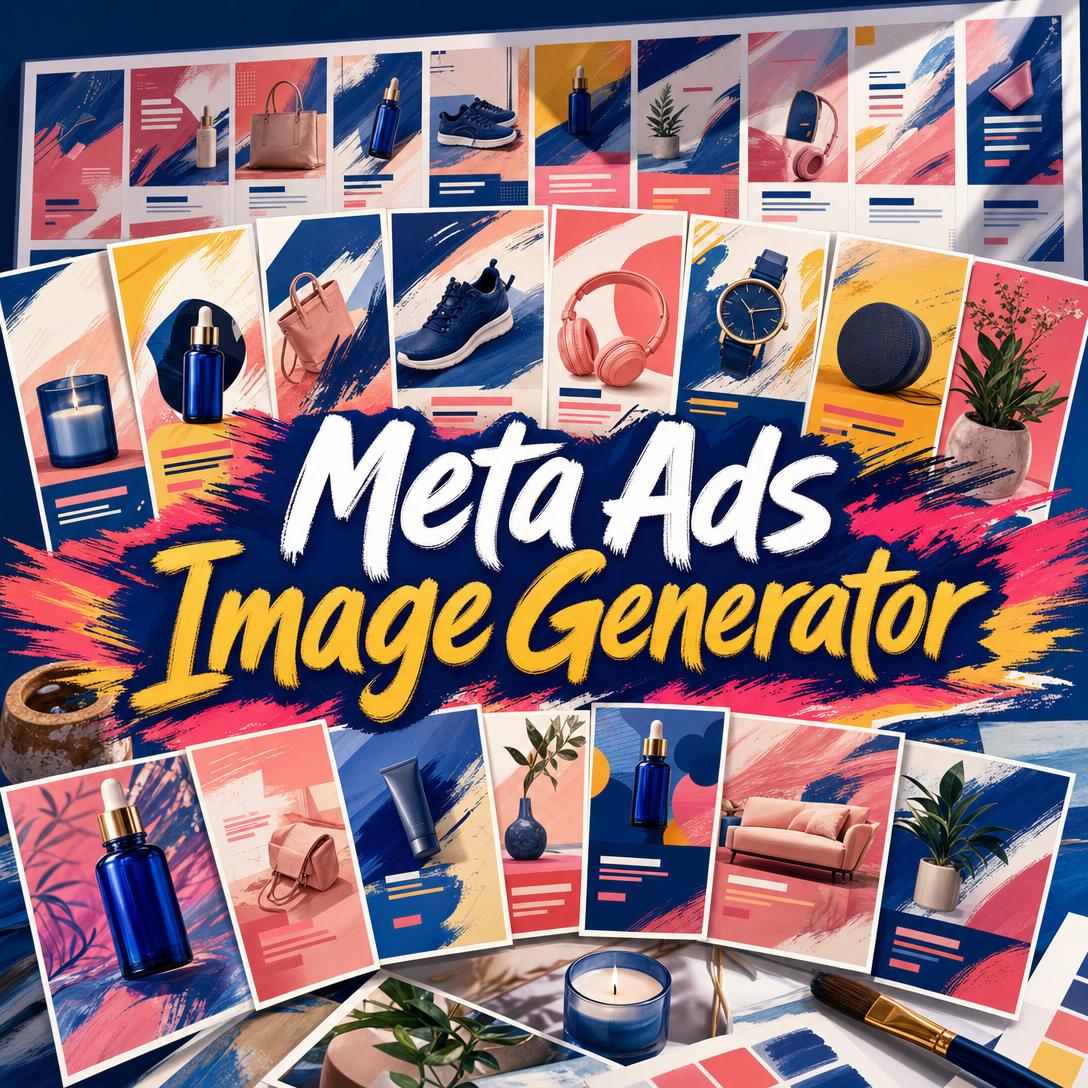
For Facebook, Instagram, and Threads image ads in 2026, the generators worth using are the ones that encode Meta placement rules, keep real product photography intact, and change layout by funnel stage — not the ones that simply emit more variants. Jenova's Meta Ads Image Generator is built around that Meta-specific brief: fifteen layout templates, mobile-first crop logic, and a rule that physical products must use uploaded or URL-extracted photos rather than invented packaging. AdCreative.ai is stronger when the job is pre-launch scoring and multi-platform volume. Predis.ai fits teams that want organic posts and paid social from one brief. Canva remains the most capable free general-purpose option when the advertiser wants manual layout control.
Key factors that separate effective AI Meta image generation from generic design output:
✅ Placement fidelity — 4:5 feed, 9:16 Stories and Reels with UI safe zones, and 1:1 for carousel, search, and Marketplace ✅ Source-image integrity — real product photos for physical goods, not AI-invented bottles, labels, or UI ✅ Funnel-mapped templates — awareness, consideration, conversion, and retargeting layouts do different jobs ✅ Copy discipline — headlines that stay readable on a phone, with Meta's documented character limits in mind ✅ Policy-aware composition — personal attributes, health before/after claims, and fabricated testimonials are common rejection triggers
To compare these tools on equal terms, it helps to score them on a Meta Creative Fit Model rather than on raw generation count or homepage conversion claims.
Why Are Marketers Replacing Static Design Workflows With AI Ad Image Generators in 2026?
Marketers are moving image production into AI because creative volume, not targeting sophistication, is now the scarce input in Meta's auction — and most of that volume has to work on a phone. Gartner's 2026 CMO Survey, as reported in a 2026 roundup, found that 78% of marketing teams use generative AI in at least one stage of ad production, up from 41% in 2024. eMarketer has projected global AI ad spend to surpass $190 billion in 2026, with performance creative and automated testing among the drivers.
The mobile constraint is not a preference. More than 98% of Meta users access the platform on mobile, which is why vertical and square formats (4:5 and 9:16) outperform desktop-era 1.91:1 landscape in most feed and Stories placements. An image that looks balanced on a laptop mockup can lose its headline under Instagram's chrome or become illegible at thumb-scroll speed.
Traditional workflows — brief a designer, wait for three concepts, export one size, then rebuild for Stories — cannot keep up with creative fatigue. AI image generators close that loop only when they understand Meta's crop, copy length, and policy surface. A pretty square that ignores safe zones or invents a product still burns spend.
That is the practical reason specialized Meta image agents exist alongside general design suites and video-first ad platforms.
What Should You Look for in an AI Image Generator for Facebook and Instagram Ads?
You should evaluate AI Meta image tools on six dimensions of creative readiness, not on how many assets they can dump into a folder. The Meta Creative Fit Model used in this comparison weights placement fidelity, funnel-mapped templates, source-image integrity, copy-character discipline, policy-aware composition, and variant diversity without brand drift.
Placement fidelity. Meta's Ads Guide documents dimensions, file sizes, and character limits by format and placement. A useful generator defaults to 4:5 for feed when placement is unspecified, treats 9:16 as a Stories/Reels crop with a center safe zone, and uses 1:1 for carousel, search, and Marketplace rather than stretching a feed asset.
Funnel-mapped templates. A product hero, an ingredient callout, a testimonial card, and an offer stack are different messages. Tools that apply one "e-commerce look" to every SKU produce recognizable ads, not testable hypotheses.
Source-image integrity. For physical products, the pack shot is the offer. Generators that replace a real bottle with an AI lookalike create catalog mismatch, review risk, and a trust gap on the landing page.
Copy-character discipline. In-image headlines compete with the caption field. The generator should compose short, phone-legible lines and keep one idea per frame.
Policy-aware composition. Meta's Advertising Standards define prohibited and restricted ad content, including personal-attribute implications, misleading claims, and restricted health and financial treatments. A generator that flags likely review triggers is more useful than one that only prettifies the frame.
Variant diversity without brand drift. After the first ad, the next asset should change one dimension — hook, template, style, or CTA — while locking palette, product photo, and type direction. Regenerating the entire scene each time confounds tests.
Pricing and publishing integrations matter, but they sit below those six. AI ad creator plans in 2026 commonly range from about €30 to more than €1,000 per month depending on volume, seats, and API access. Cheap volume that fails review or looks like a stock banner is not cheaper.
How Do Jenova, AdCreative.ai, Predis.ai, and Canva Compare for Meta Image Ads?
Jenova is the most Meta-specific image option in this set; AdCreative.ai leads on predictive scoring and downloadable volume; Predis.ai is built for social-plus-paid multiplication; Canva is the free, manual-control baseline. None of them is a full replacement for Ads Manager, and video-first platforms such as Creatify solve a different production problem.
| Feature / Dimension | Jenova Meta Ads Image Generator | AdCreative.ai | Predis.ai | Canva |
|---|---|---|---|---|
| Placement-native Meta specs | 4:5 feed default, 9:16 with Stories/Reels safe-zone logic, 1:1 carousel | Multi-platform ad formats including Meta | Auto-resize across 12+ aspect ratios | Designer-controlled export; not Meta-placement-native |
| Funnel-mapped templates | 15 Meta layouts spanning hero, proof, offer, UGC, comparison | High-volume banners and variants aimed at conversion | Social posts, carousels, and video from one brief | Large template marketplace; not funnel-mapped to Meta |
| Product visual integrity | Physical goods require uploaded or URL-extracted photos | AI product photography from simple product photos | Brief- and asset-driven social creative | User-uploaded assets; AI imagery optional |
| Copy composition | AIDA, PAS, BAB, 4U, and FAB with phone-first hierarchy | Text Generator AI using copywriting methodologies | Copy optimization against historical ad performance | Manual copy; general AI writing features unverified here |
| Policy-aware flags | Flags personal attributes, health before/after, testimonials, and similar review triggers | Unverified as a dedicated policy layer | Unverified | Unverified |
| Predictive scoring | Not included | Creative Scoring AI; vendor claims 90%+ prediction accuracy | Competitor-handle analysis and gap detection | Not included |
| Video | Image-only | Static and video in one workspace | Text-to-video and carousel generation | Broader Canva suite includes video; not evaluated here |
| Publish to ad accounts | No direct Ads Manager push | Direct integration with Meta, Google Ads, and TikTok Ads Manager | Scheduled cross-channel publishing | Publishing depends on Canva plan and integrations |
| Pricing (as of 2026) | Free tier with limited usage; Plus from $20/month | Starter from $39/month on monthly billing | Free tier; paid plans from $27/month | Free plan is a capable starting point for general ad creative |
| Best for | Meta-only image sets that need real pack shots and template diversity | Performance teams that want scores, volume, and ad-account push | SMBs running organic and paid social together | Advertisers who want full manual control and a free entry point |
Jenova Meta Ads Image Generator
Jenova behaves like a Meta art director that already knows the crop, not like a generic image model wrapped in an "ad" prompt. It selects a layout by message structure — product hero for discovery, feature-benefit or ingredient breakdown for consideration, offer stack or problem-solution for conversion, UGC-style review for retargeting — then applies an independent visual style such as studio clean, lifestyle editorial, bold graphic, premium minimal, organic, or UGC native.
The product-integrity rule is the sharpest differentiator for DTC and retail. If the item is physical, the agent will not invent the pack. It asks for a photo or a product URL, extracts the real image when possible, and composes the ad around that asset. After delivery it proposes a single-dimension variant and can plan a three-to-five-ad set with different hooks and funnel roles while locking palette and type.
Limitations are equally specific. It does not generate video. It does not score predicted CTR. It does not push into Ads Manager. AI-rendered type can still misspell or distort, especially in stylized fonts, so pixel-perfect typography may need a finish in Canva or Figma. Policy notes are flags, not legal clearance.
On Jenova, image generation sits on a multi-model stack with persistent brand memory — product photos, palette, type direction, and a visual-style lock can carry across sessions rather than being re-briefed each time.
AdCreative.ai
AdCreative.ai is a volume-and-score platform. It generates banners, ad text, product photoshoots, and video, and it asks advertisers to download from a credit pool rather than paying per render. The company states that more than 4 million marketers have used the platform and that it has generated a billion ad creatives. Instant Ads can scan a webpage and produce ads from the URL, which is useful when a catalog page already exists.
The scoring layer is the reason performance teams pick it. A 2026 comparison reports that AdCreative claims top-quartile scored ads deliver about 2.1× the conversion rate of unscored creatives. Direct ad-account integrations shorten the path from concept to live test.
The trade-off is Meta specificity. Scoring and multi-platform export do not automatically encode Instagram UI safe zones or refuse an AI-invented pack shot. Reviewers also note that costs rise quickly at higher tiers — Professional and Ultimate plans are commonly listed around $249 and $599 per month, especially if video is required. Credits are consumed on download, which changes how teams iterate.
Predis.ai
Predis.ai is a social-first generator that treats a brief as fuel for many formats at once. A 2026 roundup ranked it for small-to-mid-sized businesses that run organic and paid social together, citing one-brief multi-format render, 40-language support, competitor-handle analysis, and paid plans from $27 per month. Auto-resize across more than twelve aspect ratios is a genuine advantage when the same campaign must appear as a Reel, a feed ad, and a carousel.
It is less specialized as a Meta image engine. The product story is format multiplication and calendar publishing, not fifteen conversion layouts, Advertising Standards flags, or a hard physical-product photo rule. Teams that need a weekly content machine will feel at home; teams that need a tightly composed 4:5 offer stack with a real SKU may still rebuild the frame.
Canva
Canva is the control surface. Its free plan is frequently cited as the most capable no-cost option for general ad creative, which matters for founders who will finish type, logos, and legal lines by hand. Anything the AI generators miss — a trademarked lockup, a precise kerning fix, a retailer-mandated disclaimer — is easier to correct here.
Canva is not a Meta strategist. It will not map a brief to a funnel template, warn that "Are you struggling with debt?" implies a personal attribute, or keep critical 9:16 content out of the top and bottom UI bands unless the designer already knows those rules. It is the finishing tool and the free fallback, not the specialized generator.
Creatify, as a video-path alternative
Creatify is included because 2026 roundups increasingly treat video as the default ad unit. The company reports 18,000-plus brands, a 4.8/5 G2 rating, and a published benchmark of 2.7× more leads versus static image ads. If the brief is UGC-style or cinematic product video for Meta and TikTok, an image agent is the wrong category.
Static 4:5 still has a job. It loads immediately, holds in feed, and is cheaper to iterate when the hypothesis is headline, offer, or pack-shot angle rather than motion. Image and video are complementary tests, not substitutes.
Advertisers who also need Google, TikTok, or YouTube stills often add Digital Ad Designer for cross-platform art direction rather than forcing every placement through a Meta-only template set.
How Do Funnel-Stage Ad Templates Change What a Meta Image Needs to Communicate?
A Meta image should carry one job for one funnel stage; recycling a studio pack shot as both the prospecting ad and the retargeting ad usually wastes the second impression. Awareness assets earn a stop with product-in-context or a founder point of view. Consideration assets teach — features, ingredients, comparisons, advertorial structure. Conversion assets present an offer, a proof point, and a tap target. Retargeting assets look familiar and socially validated, which is why UGC-native frames often outperform a second hero shot.
Jenova's library is organized that way rather than by industry cliché. A supplement brand might use an ingredient breakdown for education, a testimonial card for proof, a problem-solution frame for cold traffic, or a before/after split for transformation — and the last of those may be the wrong choice if the category is health or cosmetics, because before/after imagery is restricted in those verticals under Meta's Advertising Standards. Template choice is therefore both a creative and a policy decision.
AdCreative.ai and Predis.ai generate many on-brand variants quickly, which is valuable once the message structure is settled. They are weaker at forcing the advertiser to pick a different layout grammar for each stage. Canva can reproduce any of these layouts if a human already knows the structure; it will not propose the structure from a goal such as "retargeting, social proof, 9:16."
A practical rule: if two elements compete for attention, split them into two ads. Feed context is a friend's photo and a Reel, not a landing page. Complex multi-element compositions collapse at phone scale, which is why mobile-first creative guidance emphasizes vertical or square formats and readable type on small screens.
When you already know the funnel role, say so in the brief:
"Conversion ad for first-order discount. Use an offer-stack layout, not a lifestyle hero. 4:5 feed. Keep the headline in the upper half of the frame."
When Should You Use a Real Product Photo Instead of an AI-Generated Product Shot?
Use a real product photo whenever the advertised object is a physical good the customer will receive — beauty, food packaging, hardware, apparel on a hanger, or any SKU whose label, colorway, or silhouette is part of the promise. AI-invented products create three failures: the ad does not match the landing page, reviews call out the mismatch, and the auction learns from clicks on an object that does not exist.
Jenova treats this as a hard workflow, not a style preference. Physical products must come from an upload or a URL extraction. Apps and software can use real screenshots in device frames. Services, events, and concepts may use generated scenes when no source image exists. Food is a middle case: uploaded dishes are preferred; generated food is allowed only after confirmation.
AdCreative.ai's product-photoshoot feature is the opposite bet: it turns simple product photos into studio-style e-commerce images. That is useful for lifestyle compositing and catalog variety when the source pack is already correct. It is the wrong default if the model is allowed to rebuild the label. Predis.ai and Canva will use whatever assets you feed them; neither enforces a physical-product rule.
If the source photo is weak, fix the photo first. Product Photo Editor is the adjacent step for background cleanup, color accuracy, and listing-grade retouching before the ad is composed. Generating the ad around a muddy pack shot just bakes the defect into every placement.
For URL-based catalogs, a reliable sequence is:
- Paste the product page URL or upload two angles of the SKU.
- Confirm the extracted hero image is the current listing photo, not a lifestyle crop that hides the label.
- Only then choose template, style, and offer copy.
That order prevents the most expensive error in AI Meta image production: a high-contrast, on-brief ad of the wrong object.
How Do You Brief an AI Meta Ads Image Generator for a Campaign-Ready Creative Set?
You get campaign-ready stills by supplying the product visual and the ad goal first, then locking brand constraints, then asking for one-dimension variants — not by writing a long "make me ads" prompt. Two inputs are non-negotiable: what you are selling (photo, screenshot, URL, or a clearly non-physical concept) and what the ad must cause (traffic, purchase, lead, app install). Copy, placement, palette, and inspiration images improve the first output but should not block it.
For Jenova Meta Ads Image Generator, a first session typically looks like this:
- Open the agent at jenova.ai/a/meta-ads-image-generator.
- State the product and the goal in one block:
"Vitamin C serum, physical product. Photo attached. Conversion goal: 20% off first order. Audience is women 25–40. 4:5 Instagram feed. CTA: Shop Now."
- If you have brand colors, a logo, or an ad you want to rhyme with, attach them in the same turn. If not, generate once and correct.
- After the first frame, change one variable:
"Keep the product, palette, and layout. Switch the hook from discount to visible-results social proof."
- For a test set, ask for three to five ads that differ by template and funnel stage, not by random restyling.
Experienced buyers can skip intake and specify template plus style plus verbatim copy. First-time advertisers should ask the agent to recommend a template and to place the headline in the upper 60% of the frame, where mobile UI is less likely to cover it.
For AdCreative.ai, the analogous path is import a brand kit, connect or skip ad accounts, generate from URL or asset, then download scored variants. That workflow is faster for bulk banners and weaker for a conversational edit such as "move the price badge off the product cap." Canva remains the place to fix type after either tool if a character rendered wrong.
Headline and primary-text length should be composed against the character limits published in Meta's Ads Guide, not against what looks good in a desktop preview. If you need longer persuasion than an image can hold, draft the in-image line as a hook and send body copy to Product Copywriter for the landing page or primary text field.
Jenova pricing is usage-tiered rather than credit-per-download: a free tier with limited usage, then Plus at $20/month for 30× that allowance, with higher tiers at $50, $100, $200, and above. That structure favors iteration inside a session. Credit-based tools favor generating many options and downloading few.
What Do Performance Creative Specialists Say About AI-Generated Meta Ads?
Specialists treating AI as a production system — not as a one-click designer — report that the winning pattern is locked brand assets plus aggressive single-variable testing, while the losing pattern is infinite restyling of an unclear offer. Meta has reported that advertisers using AI-assisted creative with refresh loops can see substantially higher ROAS than static production over a 90-day window, with one 2026 roundup citing Advantage+ benchmarks in the 22–34% range. Those lifts assume the underlying product, landing page, and claim are already solid.
"The operators who get durable results from AI Meta images do not ask the model to 'make an ad.' They lock a real pack shot, a palette, and a type direction, then they spend their tests on hook and layout. When every regenerate invents a new bottle and a new background, you are not A/B testing creative — you are A/B testing a different product.
"Mobile composition is still where most generated ads fail. If the headline sits in the top band of a 9:16 frame, Instagram's interface will eat it. If two messages share the frame, neither survives a one-second stop. We would rather ship five simple 4:5 ads with different jobs than one dense graphic that looks clever on a monitor.
"Scoring tools are useful for killing obvious duds before you spend. They are not a substitute for policy literacy. Personal-attribute copy, cosmetic before/after splits, and invented testimonials still go to review. An agent that warns you before generation is doing a different job than a dashboard that predicts CTR on an already non-compliant frame.
"Image-only agents also have an honest ceiling. If motion is the hypothesis, use a video tool. If the hypothesis is offer, proof, or pack-shot clarity, stills remain the cheaper, cleaner test — provided the type is verified after render and finished in a design tool when the font has to be perfect."
— Jenova Product Team, paid-social creative systems (AI agent design)
The implication for tool choice is unromantic. Use Jenova when the constraint is Meta stills, real SKUs, and template literacy. Use AdCreative.ai when the constraint is scored volume and account push. Use Predis.ai when the constraint is multi-format social cadence. Use Canva when the constraint is control. Use a video platform when the constraint is motion.
Which Meta Placements Need Different Aspect Ratios and Safe Zones?
Feed, Stories/Reels, carousel, search, and Marketplace do not share a crop, so a single master image exported everywhere will clip, hide, or shrink the selling point. Meta's Ads Guide is the canonical source for current dimensions, file sizes, and placement recommendations. As of 2026, production practice that matches those specs looks like this.
Facebook and Instagram feed. 4:5 uses the most mobile real estate; 1:1 remains widely used and is safer when the same asset must travel to square-only surfaces. Put the product and headline in the upper portion of the frame. The lower band is where comments, CTA bars, and thumbs live.
Stories and Reels (9:16). Critical content belongs in the center roughly three-quarters of the frame. The top band is username, audio, and close controls; the bottom band is CTA, caption, and navigation. A headline flush with the top edge is a common self-inflicted miss.
Carousel. 1:1 keeps slides optically consistent as users swipe. Narrative order matters more than any single slide: hook, proof or features, then offer.
Search results, Marketplace, and right column. Square is the consistent choice. Right column is desktop-only and small; it is a poor place for fine type.
Threads feed. 4:5 or 1:1, aligned with the feed strategy rather than treated as a third brand system.
Jenova defaults to 4:5 when the user does not specify a placement and will generate 9:16 with safe-zone logic for Stories and Reels. AdCreative.ai and Predis.ai export many sizes; the advertiser still has to know which size is the test, not which size is available. Canva will export any ratio a designer sets.
Advertisers are required to follow Meta Advertising Standards across these surfaces. Placement-correct type does not save a claim that implies a personal attribute or uses a restricted before/after in a health category. Check the current Advertising Standards when the brief touches finance, wellness, testimonials, or adult-adjacent fashion, because enforcement detail changes even when the layout grammar does not.
A compact production checklist before upload:
- Confirm ratio against placement, not against the original photo.
- Confirm the product is the real SKU.
- Confirm the headline is legible at phone width and sits outside UI chrome.
- Confirm the copy does not assert a personal attribute or a restricted transformation.
- If rendered text is wrong, edit the text — do not regenerate the entire ad.
That last step is where image-focused agents earn their keep, and where credit-per-download tools quietly get expensive.
References
- Chat Data — 2026 AI ad generator roundup citing Gartner CMO Survey (78% generative AI use), eMarketer AI ad spend, Predis.ai pricing and features, AdCreative.ai scoring claims, and Meta Advantage+ ROAS benchmarks
- Straight North — Meta ads creative best practices, including the finding that more than 98% of Meta users access the platform on mobile
- Meta Ads Guide — Official ad format specifications, dimensions, file sizes, and character limits
- Meta Transparency Center — Advertising Standards governing allowed and prohibited ad content
- AdCreative.ai — Product capabilities, Creative Scoring, Instant Ads, brand kits, and published user/creative volume claims
- GetHookd — AdCreative.ai pricing review covering $39, $249, and $599 monthly tiers
- adlibrary.com — 2026 survey of AI ad creator pricing ranges across tools
- Rocketium AI Studio — AdCreative.ai alternatives, including Canva's free plan as a capable general ad-creative option
- Creatify — Video ad platform positioning, G2 rating, brand count, and static-versus-video lead benchmark
- Amplify Marketing Services — Meta ads creative specifications and best practices for images, safe zones, and copy
- Meta Business Help Center — Advertiser obligation to follow Advertising Standards