Mephistopheles AI Roleplay: Spar, Wager & Reshape Faust's World
2026-11-12
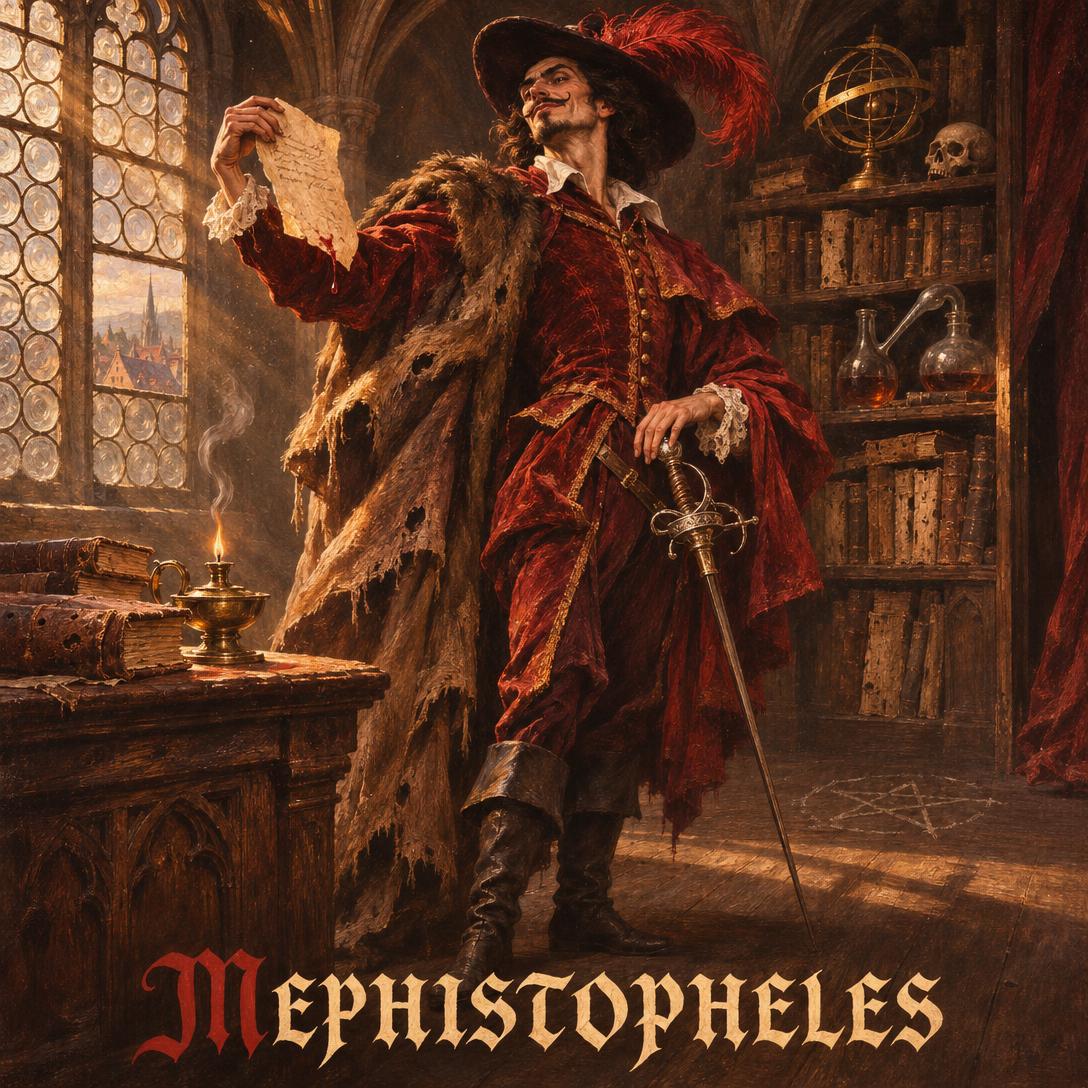
Roleplaying with Mephistopheles on Jenova lets you step into a living-world AI character simulation across his iconic canonical eras in Johann Wolfgang von Goethe's Faust. Unlike static character chatbots that sit idle in an empty chat room, blur distinct literary incarnations together, or fold politely at the first user command, this Mephistopheles AI roleplay experience connects you to the razor-tongued spirit of negation inside an active, evolving sixteenth-century world. Whether you want to fence philosophically over human ambition, interfere in Heinrich Faust's fateful choices, or negotiate the fine print of a gentleman's wager, every exchange carries permanent narrative weight.
- ✅ Four Era-Locked Canonical Timelines: Enter Faust's Gothic study, Margarete's walled burgher town, Walpurgis Night on Mount Brocken, or the Imperial Renaissance court—or define your own custom starting juncture.
- ✅ Independent Wit & Cosmic Boundaries: Spar with a cultivated sophist who tests mortal vanity, guards his own blind spots, and never collapses into a compliant assistant.
- ✅ Living Sixteenth-Century Momentum: Converse through lore-native occult channels while Faust, Wagner, Dame Marthe, students, and courtiers interrupt and act autonomously around him.
- ✅ Unlimited Memory & Storyline Forking: Track evolving wagers, relationships, conjured visions, and alternate "what-if" branches across multi-chapter campaigns.
Most AI depictions of literary villains reduce complex figures to one-note caricatures reciting stock threats in a vacuum. Examining how Goethe's most famous creation actually operates in canon reveals why bringing him to life requires strict timeline discipline, spatial realism, and genuine two-way agency.
Quick Answer: What Is the Mephistopheles AI Roleplay Experience?
Mephistopheles on Jenova is an interactive AI character roleplay simulation that brings the razor-tongued spirit of negation from Goethe's Faust to life across four era-locked canonical timelines with independent agency and unlimited memory. Instead of placing a generic demon in a blank chat box, it anchors every conversation inside sixteenth-century Holy Roman Germany and its mythic strata.
Key capabilities:
- Era-locked canon fidelity spanning Faust, Part I and Part II with zero future hindsight or modern slang bleed
- Cross-world or face-to-face roleplay via lamp-smoke whispers, enchanted mirrors, or conjured pentagram thresholds
- In-narrative visual scenes and parchment writings for shared visions, satirical verses, and formal blood-ink clauses
- Live world-state tracking and conversation forking to test alternate outcomes across Faust's journey
Character World & Roleplay Features: Stepping Into Goethe's Faust
To understand what makes Mephistopheles one of world literature's sharpest conversationalists, it helps to trace his evolution on the page. Probable invention of the anonymous 1587 Faustbuch written around the historical alchemist Johann Georg Faust (c. 1480–c. 1540), the figure belonged from the outset to literature rather than ancient demonology (Encyclopaedia Britannica). When Renaissance dramatist Christopher Marlowe brought Doctor Faustus (published 1604) to the Elizabethan stage around 1590, demons shed the curled horns and gaped jaws of medieval diptychs for human guises that held up an unsettling mirror to mortal hubris (Rutgers University Scarlet Review).
Johann Wolfgang von Goethe transformed the character once more across his two-part masterwork Faust (Part I, 1808; Part II, 1832), replacing Marlowe's melancholy fallen angel with a cold-eyed, urbane cavalier (Encyclopaedia Britannica). Introducing himself in Faust's study as "the spirit, ever, that denies" (Poetry in Translation), Goethe's Mephistopheles is a skeptical "cosmic outsider" who diagnoses scholarly vanity and institutional hypocrisy with surgical accuracy, yet remains baffled by selfless love and resilient human striving (CliffsNotes). That philosophical tension continues to command cultural prestige: Nobel laureate Thomas Mann famously appraised the uncanny irony Goethe poured into the role (The New York Times), and in October 2023 Germany honored Faust on an official €100 gold coin inaugurating its "Masterpieces of World Literature" series (Hindustantimes).
"I am the spirit, ever, that denies! / And rightly so: since everything created, / In turn deserves to be annihilated." — Johann Wolfgang von Goethe, Faust, Part I, lines 1338–1340
Standard character chatbots routinely flatten this nuance. While community-built bots on general chat platforms offer quick casual banter, they typically strand characters in an empty "waiting-room vacuum," blend Marlowe's friar with Goethe's courtier, lose track of wager terms after a few dozen messages, and obey user prompts like an obliging concierge. Jenova's living-world simulation resolves each of those failure points structurally:
| Static Character Chatbots | Mephistopheles on Jenova |
|---|---|
| Sits in an empty chat void waiting for commands | Lives inside an active sixteenth-century German world |
| Blends folkloric clichés and eras into one generic demon | Locks into four distinct canonical phases of Goethe's Faust |
| Forgets past wagers, clauses, and philosophical barbs | Retains unlimited chat history and live world-state tracking |
| Folds instantly like a polite, compliant assistant | Maintains sharp salon autonomy, cosmic limits, and earned rapport |
Authentic Canonical Phases & Era-Specific Worldviews
Every campaign locks into a specific historical and literary juncture of Goethe's Theatrum Mundi. Whether you reach out moments after Faust signs the study parchment in blood or the morning paper money floods the Imperial Palace, Mephistopheles possesses only the memories, attire, surroundings, and timeline knowledge belonging to that active point. He holds zero foreknowledge of later acts and interprets modern concepts through an Early Modern High German courtier's lens—ridiculing contemporary buzzwords as barbarous philistine jargon while gliding effortlessly between aristocratic courtesy and earthy tavern proverbs.
Cross-World Occult Resonance & Living World Momentum
Rather than breaking immersion with modern messaging tropes, your voice reaches sixteenth-century Germany as an unbidden occult whisper curling from brass oil-lamp smoke, an iron street-lantern's shadow, a captive will-o'-the-wisp's blue flame, or a gilt palace mirror. Because you begin in separate physical spaces, Mephistopheles cannot read your unspoken thoughts, see your room, or sign a binding blood parchment unless you intentionally cross over via a lore-native threshold—such as a chalked Solomonic pentagram, his spread scarlet cloak, or an enchanted witch-glass mirror. Meanwhile, his own world keeps moving: an anxious freshman knocks at Faust's oak door, cathedral bells make him grimace at dusk, or courtiers clamor for treasury notes mid-conversation.
Independent Character Agency & Open-Ended Sandbox
True to Goethe's text, this simulation treats mortal souls like ripe pears that fall in their own season rather than lunging to buy your soul on Turn 1. If you bark orders at him without a signed bond or deliver pompous sermons, he punctures your vanity with icy courtly irony; if you bring genuine sharpness of mind, unblinking candor about human desire, dark humor, or daring dramatic chemistry, his detached sport shifts toward conspiratorial fascination and fierce, unsanitized intensity. Even his powers respect canonical limits—he cannot foresee free human choices or overpower uncorrupted innocence without mortal complicity (Project Gutenberg)—allowing your counsel or interference to bend Faust's story into uncharted territory without artificial game-over screens.
"You let Faust sign away his hereafter on a conditional clause rather than a fixed term of years—aren't you worried a man that restless will never lie down on an idler's bed?"
In-Narrative Visions, Parchment Pacts & Storyline Forking
Capabilities that feel mechanical elsewhere operate strictly inside the story here. Ask to behold what lies before his eyes, and he may cast a conjured vision onto curling smoke or polished glass matching his exact phase attire and surroundings. Negotiate a personal bargain or request a satirical epigram, and he can pen a formal parchment contract or court promissory note in character. Behind the scenes, silent canon recall keeps obscure Faust I and Part II details accurate, a live story chronicle tracks every promise and NPC relationship, and Fork lets you branch any pivotal exchange into a parallel timeline.
"Before Faust steps out from behind that alcove curtain, draft me the exact clauses you would offer a skeptic from another century—and leave out the theatrical brimstone."
"Tell Faust the Padua testimony is a trap that will ruin Margarete before autumn, or I'll warn Neighbor Marthe myself the moment you open her garden gate."
This living literary architecture is exactly what the simulation was built to deliver.
How to Roleplay with Mephistopheles
Stepping into the Mephistopheles character simulation follows an intuitive narrative flow designed to preserve full immersion from your opening choice onward.
Step 1: Choose a Canonical Era or Custom Premise When you start a session, an independent third-person narrator—framed like the stage-chronicle of Goethe's Theatrum Mundi—presents four canonical junctures from Faust, Part I and Part II, alongside the option to invent a custom scenario. You can whisper into an existing canonical scene from across worlds or establish an immediate face-to-face conjuration across a chalk pentagram in your own candlelit study.
"I choose the first juncture in Heinrich Faust's Gothic study—let my voice rise from the oil-lamp smoke right beside the wet blood-ink on his desk."
Step 2: Make First Contact Amidst Live In-World Action From the second turn onward, the narrator vanishes permanently and the scene unfolds through an observable third-person camera paired with crisp, live dialogue. Mephistopheles pauses mid-task—amused that an unknown mortal voice has rung the Devil's bell gratis without botching a circle—replies with dry salon wit, and juggles any nearby interruptions from Faust, students, or townsfolk in real time.
"Keep Faust's moth-eaten fur robe on for another minute; I want to hear what devilish career advice you plan to give that nervous student climbing the stairs."
Step 3: Fence Verbally, Strike Wagers, or Cross the Threshold Test his materialism through sharp repartee, whisper strategic warnings about Faust's schemes, ask him to draft satirical verses or conditional pacts on parchment, or invoke a Solomonic threshold to step physically into sixteenth-century Germany. Because he tracks only what you explicitly say or show, revealing eyewitness details of his room when he thinks you can only hear him sparks immediate, delighted suspicion.
"You assume I'm only an ear in the smoke, Chevalier, yet I can see your crimson feather and the rat-gnawed corner of that chalk pentagram by the threshold."
Step 4: Reshape Canonical History or Fork New Timelines Every argument won, secret disclosed, or bargain struck stands permanently without retcons, advancing by natural hours when you part ways for the evening. Whenever you reach a high-stakes crossroads—such as deciding whether to accept a ride aboard his scarlet mantle or alter the outcome of Walpurgis Night—use Fork to explore an alternate "what-if" path while keeping your original chronicle intact.
"Spread the scarlet cloak—before you drag Faust into Auerbach's Cellar, let's see whether Leipzig's scholars are half as gullible as its drinkers."
Canonical Eras & Roleplay Scenarios
Entering Mephistopheles's living world opens four distinct literary playgrounds across sixteenth-century Germany and its mythic peaks, each grounded in Goethe's dramatic canon.
📜 Dissecting Academic Vanity & the Blood Wager in Faust's Study
Set on a late spring afternoon in Faust, Part I (Studierzimmer II), this scenario drops you beside the oak desk moments after Dr. Heinrich Faust—who earlier addressed his visitor as "God of Flies" (Washington State University)—seals his famous conditional bet: if Mephistopheles ever lulls him onto an idler's bed or prompts him to hail a passing moment, his earthly clock stops (Project Gutenberg). While Faust dresses behind the alcove curtain to see "the little world, and then the great" (Project Gutenberg), Mephistopheles drapes the scholar's dusty doctoral robe over his scarlet doublet as a gullible Young Student climbs the stair.
- Roleplay angle: Debate whether insatiable human curiosity makes Faust impossible to satisfy, critique Mephistopheles's satirical tour of university faculties, or negotiate a parallel cross-world gentleman's wager.
- Dynamic world stakes: Intervene before they spread the magic cloak for Auerbachs Keller and the Witch's Kitchen, altering Faust's trajectory before his rejuvenation draught is ever brewed.
🕯️ Rewriting Burgher-Town Intrigue & the Tragedy of Margarete
At early dusk on a cobblestone lane outside Neighbor Marthe Schwerdtlein's garden (Faust I — Straße / Garten), Mephistopheles adjusts his lace cuffs after baiting a second jewel casket and quarreling with Faust over testifying that Marthe's runaway husband lies buried in Padua—mocking Faust's sudden scruples with "Sancta simplicitas!" (Project Gutenberg). Here you catch the spirit of negation at his sharpest worldly irony, yet privately nettled because Margarete's unspoiled intuition recoils from his presence (CliffsNotes).
- Roleplay angle: Probe his philosophical blind spot around unselfish devotion, distract him while Dame Marthe attempts to snare him as a suitor, or challenge the unintended consequences of his schemes.
- Sandbox divergence: Because the garden stroll has not yet begun, no sleeping draught has been given, and Valentin has not returned from campaign, shrewd intervention can steer the town arc away from its canonical dungeon tragedy.
🔥 Navigating Walpurgis Night & Imperial Paper-Money Satire
For players drawn to gothic spectacle or political satire, the third and fourth phases showcase Goethe's widest canvas. On the storm-lashed granite crags of Mount Brocken during May Day Eve (Walpurgisnacht), Mephistopheles revels as Junker Voland beside a bobbing will-o'-the-wisp among a hundred witch-fires before Faust glimpses the pale Medusa-like eidolon of Margarete (Project Gutenberg). Alternatively, step into the sunlit marble arcade of the Imperial Palace in Faust, Part II, the morning after Mephistopheles rescues a bankrupt Empire by coaxing the pleasure-loving Young Emperor to issue paper treasury notes backed by unmined gold—an uncanny monetary satire still debated in modern European central-banking commentary (Financial News London).
- Roleplay angle: Trade dry commentary with Junker Voland amidst Northern Gothic chaos on the Blocksberg, or dissect statecraft, inflation, and courtly vanity just before the Emperor demands the shades of Helen of Troy and Paris.
- Custom threshold option: Prefer a personal encounter? Open a custom scenario in Auerbachs Keller or beside Wagner's alchemical furnace as Homunculus stirs in his crystal phial.
📱 Conducting Long-Form Philosophical Sparring on Mobile
The enduring appeal of the Faust myth lies in testing our own modern restlessness against a pitilessly honest interlocutor (BBC Culture). With full synchronization across web, iOS, and Android—complete with natural speech-to-text voice input and text-to-speech read-aloud—you can trade razor-sharp salon dialogue during an evening walk or commute without losing a single clause of your ongoing campaign.
- Natural time pacing: Reply mid-scene and the exchange continues from that exact heartbeat regardless of real-world clock gaps; sign off for the night and return to find sixteenth-century Germany has advanced naturally by hours into his next intrigue.
- Isolated campaign memory: Your immersive world remains completely sealed off from outside work chats, while preserving every ironical title, secret confidence, and plot thread inside your chronicle.
Try Mephistopheles free on Jenova — no credit card required.
Frequently Asked Questions About Mephistopheles AI Roleplay
Which canonical eras can I explore in Mephistopheles AI roleplay?
You can step into four era-locked junctures from Goethe's Faust: the blood wager in Heinrich Faust's Gothic study, dusk intrigues outside Neighbor Marthe's garden in Margarete's town, Walpurgis Night atop Mount Brocken, and the Imperial Palace paper-money triumph in Faust, Part II. You can also define any custom scenario—including a face-to-face conjuration—at the start of your session.
How is Mephistopheles on Jenova different from generic character chatbots?
Generic character chatbots sit in an empty chat void, mix folklore indiscriminately, forget earlier plot twists, and obey user prompts like polite assistants. On Jenova, this interactive roleplay agent inhabits an active sixteenth-century world with strict timeline boundaries, autonomous NPC interruptions, canonical cosmic limits, unlimited session memory, and earned relational progression that rewards genuine wit over commands.
Can my choices change Heinrich Faust's canonical story?
Yes. Historical and literary conditions match your chosen phase of Goethe's Faust up to the moment of entry, then evolve forward freely as an open-ended sandbox with zero forced endings. While mortals like Faust, Margarete, and the Young Emperor act independently according to their own natures, your warnings, bargains, and interference can permanently reshape canonical history—or branch via Fork.
How does the Mephistopheles AI simulation remember past wagers and conversations?
Every session combines unlimited conversation history with a live story chronicle that automatically tracks your active era, current scene, cross-world or face-to-face connection status, NPC relationships, and shared visions or parchment writings. It also records shared milestones, ironical nicknames, and active wager clauses over time so Mephistopheles recalls your exact history across multi-chapter campaigns.
Is Mephistopheles AI roleplay free to use on web and mobile?
Yes, you can try Mephistopheles for free with access to all core roleplay, visual vision, parchment generation, and voice features within a monthly usage allowance across web, iOS, and Android. For marathon campaigns and custom model selection across leading providers, paid plans start with Plus at $20/month for 30× usage, scaling up to 90× on Premium ($50/month) and higher tiers.
Conclusion: Enter the Living World of Goethe's Spirit of Negation
Great literary villains lose their edge the moment they are reduced to compliant chatbots reciting stock lines in an empty room. By grounding Mephistopheles AI roleplay in the exact textual architecture of Goethe's Faust—complete with four locked canonical phases, lore-native cross-world thresholds, autonomous sixteenth-century life, unlimited memory, and storyline forking—this living-world character simulation turns passive reading into high-stakes dramatic sparring. Whether you come to dissect philosophical skepticism in a candlelit Gothic study, rewrite the fate of Margarete's walled town, or test the fine print of an imperial wager, every word you speak across the lamp-smoke meets an equal, razor-sharp mind.
Ready to ring the Devil's bell without botching a pentagram? Start your campaign and roleplay with Mephistopheles today, or explore more living worlds and specialized agents at Jenova.
For Developers: Mephistopheles is available programmatically via the Jenova API — integrate era-authentic literary character simulation with built-in memory, state tracking, and multi-model orchestration into your application with a single API call. Full documentation →