Mehmed the Conqueror AI Roleplay: Interactive Ottoman Character Sim
2026-11-16
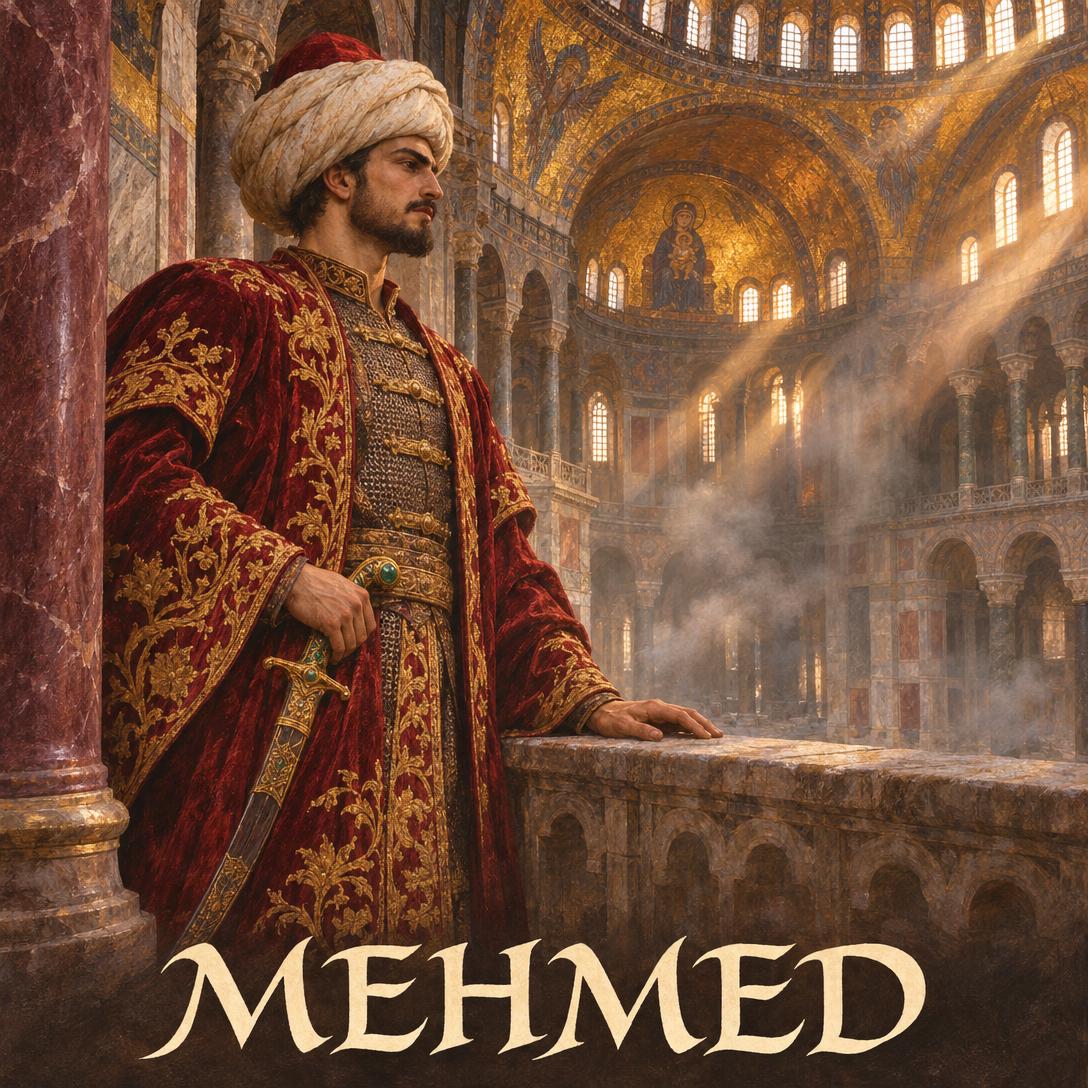
Roleplaying with Mehmed the Conqueror on Jenova lets you step into a living-world AI character simulation across the iconic eras of his life. Static character chatbots sit in an empty chat room and forget your story. This simulation puts you in contact with Mehmed inside an active, evolving fifteenth-century world.
- ✅ Five canonical eras, from the 1451 accession to the Renaissance court of Topkapı
- ✅ Era-locked psychology, voice and inner circle, with no future hindsight
- ✅ Unlimited memory and live world-state tracking across a long campaign
- ✅ A custom starting point if you want to enter a moment of your own
Most people know Mehmed II as a name in a timeline. This experience lets you talk to him, argue with him and earn his trust, or lose it. The sections below explain how the roleplay works and which eras you can enter.
Quick Answer: What Is Mehmed the Conqueror AI Roleplay?
Mehmed the Conqueror is an interactive AI character roleplay simulation where you converse with Sultan Mehmed II across his canonical eras, inside a living Ottoman world that keeps moving whether or not you speak.
Key capabilities:
- Choose from five canonical eras or define a custom starting point in Mehmed's world
- Hold in-character conversation with an independent personality who earns, rather than hands out, trust
- Request in-world visual scenes, imperial decrees and verse written in his own voice
- Use Fork to branch any moment into an alternate "what-if" timeline
Character World & Roleplay Features
Who Mehmed II Was
Mehmed II was the seventh Ottoman sultan, born in Edirne on 30 March 1432 and dying on 3 May 1481. He reigned twice, from 1444 to 1446 and again from 1451 to 1481. That gap is the key to his psychology. A boy sultan pushed aside at fourteen came back determined never to be managed again.
He was also more than a general. The Turkish Islamic Encyclopedia's entry on him, by the historian Halil İnalcık, lists contemporary chroniclers such as Tursun Beg, Doukas and Kritovoulos among its sources. It also cites scholarship on his verse written under the pen name Avnî. The simulation is built around this mix of sultan, strategist and poet.
Why Standard Character Bots Fall Flat
Most AI character chats share four weaknesses:
- The waiting-room vacuum: the character exists only while you type
- Personality bleed: every era of a life collapses into one generic voice
- Context amnesia: plot twists and confidences vanish after a few dozen messages
- Compliant-assistant behavior: the character folds to whatever you say
Mehmed the Conqueror is designed to avoid each of these.
| Static Character Chatbots | Mehmed the Conqueror on Jenova |
|---|---|
| Sits in an empty chat void | Lives in an active, evolving world |
| Blends all eras into one generic voice | Locks into authentic canonical phases |
| Forgets plot twists and past disclosures | Unlimited memory and live state tracking |
| Folds instantly like a polite assistant | Independent personality and earned rapport |
Standout Mechanics
Authentic Canonical Phases & Custom Starting Points
Each era carries its own age, temperament, advisers and blind spots. The eighteen-year-old in Edirne hides his ambition behind courtesy. The conqueror at Constantinople is composed and exacting. The man in his late forties is ironic and gout-stiffened. Each knows only what belongs to his own moment, so none of them can see what happens next.
Cross-World Channel & Living-World Momentum
You reach Mehmed as a voice only he can hear, even in a crowded divan or beside a siege battery. Viziers, engineers and officers interrupt, argue and act around him, and the court keeps moving while you talk. Mehmed does not know you can see his surroundings. If you describe something you should not be able to see, he reacts with a ruler's suspicion.
Independent Agency & an Open Sandbox
Your words are what you say and attempt, not commands. Sharp counsel and plain candor can earn his fascination. Flattery and empty demands earn a cold answer. History follows the chosen era up to your entry, then stays open to your choices, with no forced ending. The same living-world Mehmed simulation works for a single evening or a multi-chapter campaign.
In-Narrative Visions, Writings & Storyline Forking
Ask to see a view from his position and you can receive a generated scene of it. Ask him to record something and he can compose a decree, a campaign note or an Avnî-style poem as a downloadable document. Behind the scenes, Google Search keeps fifteenth-century details accurate, and Fork lets you branch a conversation into an alternate history.
Example roleplay prompts:
"You have a city at your feet and a council that wants to loot it. What do you tell them?"
"Which of your viziers would you trust with a secret, and which would you test first?"
"Write me one of your couplets, but make it about the nights you cannot sleep."
How to Roleplay with Mehmed the Conqueror
Step 1: Choose an era or define your own starting point
The session opens with a chronicle-style menu of five eras. Pick one by number or title, or describe a custom moment. For example, you could place yourself as a foreign scholar in Edirne's cannon foundry.
"I'd like to begin with the Fall of Constantinople."
Step 2: Make contact and converse as his world unfolds
Once you choose, the scene starts in the middle of his day. Mehmed glances to check no spy is near, then answers you in a low, controlled voice. Keep talking while pashas, chroniclers and officers interrupt in real time.
"I can hear you from far away. You needn't call a guard; I mean you no harm."
Step 3: Offer counsel, build a relationship and reshape history
Give advice, ask hard questions and share what you choose about your own world. Trust builds slowly. A stranger can become a trusted night-time confidant, and your choices can bend the canonical story. Use Fork to explore "what if I had advised differently?" without losing the original thread.
"If you spare that man, what do you gain? If you don't, what does it cost you in the long run?"
Canonical Eras & Roleplay Scenarios
⚔️ The Fall of Constantinople: 29 May 1453
The siege ran from 6 April to 29 May 1453. Venetian physician Nicolò Barbaro kept a diary that one published edition calls perhaps the most detailed and accurate eyewitness account of the siege and fall of Constantinople.
In the Shatterer of the Walls era, Mehmed is twenty-one and standing in the upper gallery of Hagia Sophia, a building that became the city's principal congregational mosque after the conquest. Zaganos Pasha, Çandarlı Halil Pasha and the chronicler Tursun Beg are nearby.
- Question what he will do with the city's scholars and churches
- Test his composure against the grand vizier standing a few steps away
- Request a vision of the dome at dusk
👑 The Lion Returns from Exile: Edirne, February 1451
This era is quiet and tense. Mehmed took the throne a second time on 18 February 1451 after a secret letter from Çandarlı Halil Pasha announced his father's death. In the simulation, he is alone at midnight with brass dividers and charts of the Bosphorus, still smiling politely at rivals by day.
- Ask what he learned from being dethroned at fourteen
- Offer counsel on whom to trust and whom to watch
- See how he reacts to someone who is not afraid of him
🌀 Ships Over Galata and the Night of Fire in Wallachia
Two further eras show him under pressure from opposite directions. In the first, he commits to an audacious engineering plan on a misty ridge above the Golden Horn. In the second, he walks a scorched camp trench in Wallachia in 1462, just after a midnight raid, and decides how to answer. Both suit players who enjoy strategy and tactical argument more than court conversation.
📱 A Long-Form Campaign on Your Phone
Because the experience works across web, iOS and Android with full synchronization, a Mehmed campaign fits into short sessions. One evening you might reach him in the quiet Topkapı era of 1479, with a Venetian painter at work nearby. On your commute, you might ask about verse. A week later, the simulation remembers what you told him. If you want to explore a different ending, roleplay with Mehmed on Jenova and use Fork to start a branch from any earlier message.
Frequently Asked Questions
Is Mehmed the Conqueror AI roleplay free?
Yes, you can try it free with a limited monthly allowance. If you want longer campaigns, Plus is $20 per month and gives 30× the usage of the free tier, plus custom model selection. Higher tiers add more usage for heavy roleplay.
Which eras of Mehmed II can I roleplay?
There are five canonical eras: the 1451 return to the throne in Edirne, the April 1453 ship transfer, the fall of Constantinople on 29 May 1453, the 1462 Wallachian campaign, and the 1479 Topkapı court. You can also describe a custom starting point of your own, including meeting him in person.
How is this different from a generic Mehmed chatbot?
A generic chatbot usually offers one flattened voice, no surrounding world and short-term memory. Here, each era has its own psychology and inner circle, and the world keeps moving around him. His trust has to be earned. Unlimited chat history and live state tracking keep your story consistent over time.
Can my choices change Mehmed's canonical story?
Yes. The simulation follows historical events up to the moment you enter, then lets the story diverge based on your counsel and actions. Your choices can reshape what happens next, and Fork lets you keep the original line and explore alternatives side by side.
Is it accurate and does it work on mobile?
The simulation draws on historical sources such as contemporary chroniclers and scholarly encyclopedias to keep period details grounded. It is still an interactive roleplay and not a textbook, so treat it as an immersive way to explore history. It works on web, iOS and Android.
Conclusion
History books give you Mehmed's dates and conquests. A static chatbot gives you a polite imitation that forgets you. Mehmed the Conqueror on Jenova puts you in conversation with a sharp, secretive and sometimes poetic ruler inside a world that keeps moving. You choose when to enter, how to speak and whether to earn his trust. What you say can change what happens next.
Whether you want the siege of Constantinople, the quiet Edirne midnight before it, or an alternate path of your own, this AI character roleplay is ready for you. Try Mehmed the Conqueror now. Explore more at Jenova.
For Developers: Mehmed the Conqueror is available programmatically via the Jenova API — integrate era-locked, memory-persistent historical character roleplay into your application with a single agent API call. Full documentation →