MBTI Personality Guide AI: Find Your True Type Beyond Quizzes
2026-08-27
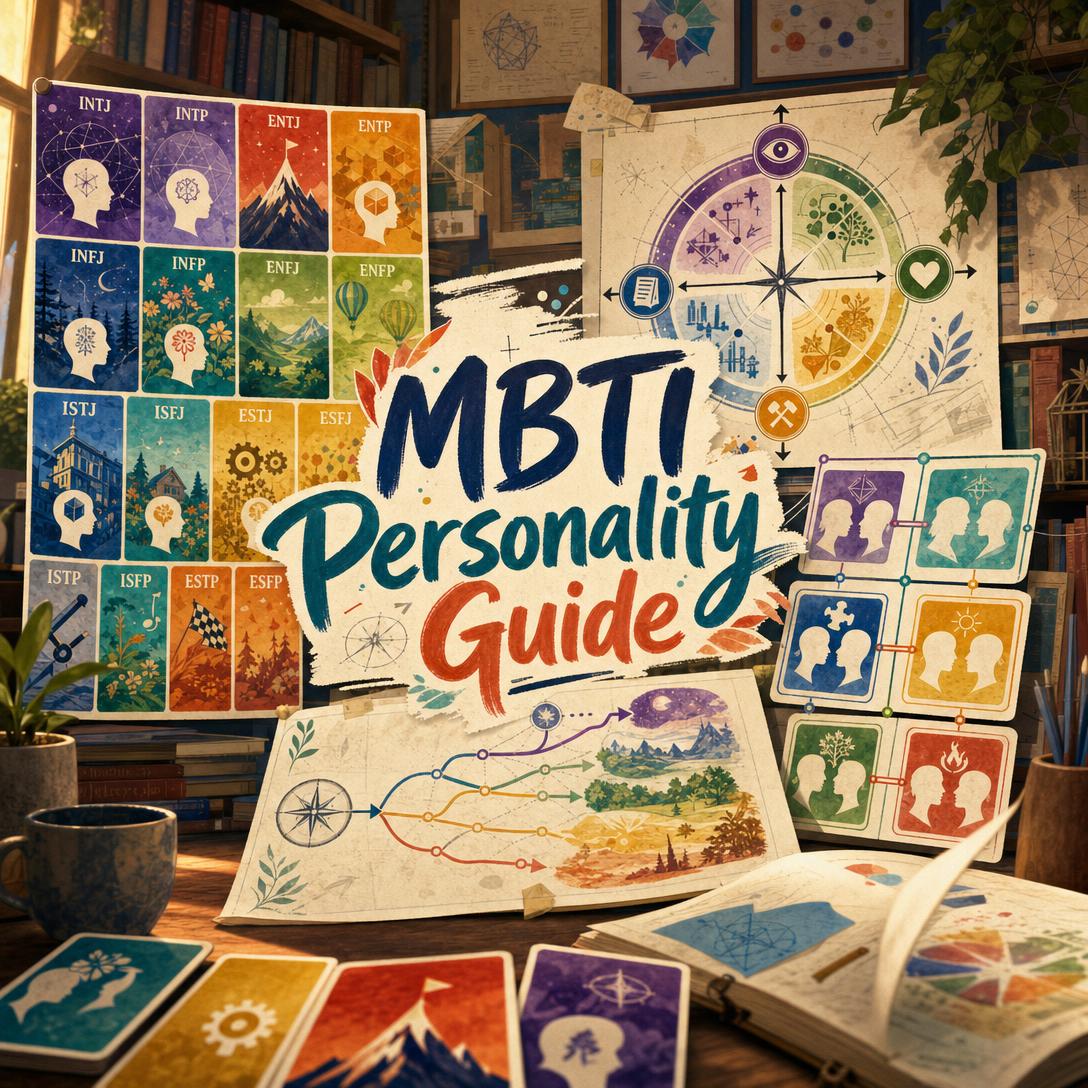
MBTI Personality Guide helps you find your true Myers-Briggs type by reading how your mind actually processes information — not by scoring four letter dichotomies. While a 12-minute quiz can hand you a four-letter code that feels almost right, this AI typologist works through cognitive functions, mistype patterns, and stress defaults so the result maps to how you think, decide, and recover.
✅ Conversational typing that targets functions, not “thinker vs. feeler” labels ✅ Mistype verification for common pairs such as INFJ/INFP and INTJ/ISTJ ✅ Full-stack analysis, including growth edges and relationship dynamics ✅ Works on web, iPhone, and Android with the same conversation memory
Most people do not need another colorful result screen. They need a thinking partner who can explain why a type fits, why a runner-up does not, and what development actually looks like for that stack. To see why that distinction matters, it helps to look at how personality typing usually fails people in practice.
Quick Answer: What Is MBTI Personality Guide?
MBTI Personality Guide is an AI typologist that identifies your Myers-Briggs type through conversational cognitive-function analysis rather than letter-code quizzes. It treats typing as pattern recognition across a function stack, then uses that stack to explain relationships, growth, and work style.
Key capabilities:
- Adaptive scenario questions that map to Ni, Ne, Si, Se, Ti, Te, Fi, and Fe
- Mistype checks that challenge self-reported and quiz-assigned types
- Confidence-scored results with evidence from your own answers
- Relationship, career, and development analysis grounded in function interplay
Why Most MBTI Quizzes Leave You Half-Typed
The Myers-Briggs Type Indicator is designed to help people understand how they take in information and make decisions — perception and judgment in ordinary, healthy behavior. That is a useful aim. The way most people encounter “MBTI” online is not that process. It is a short questionnaire, a four-letter badge, and a description generic enough to feel true.
Population data makes the mismatch easier to see. Type is not evenly spread, and quiz culture does not mirror the base rate.
73.3% — Estimated share of people who prefer Sensing rather than Intuition
46.5% — Share of the U.S. population represented by just four types: ISFJ, ESFJ, ISTJ, and ISFP
13.8% — Approximate global share of ISFJ, often cited as the most common type
Online communities, by contrast, overflow with intuitive (N) identifications. That gap is not proof that the internet is full of rare types. It is a warning about how tests and self-image interact: people type as who they want to be, quizzes reward abstract language, and “intuitive” sounds more interesting than “sensor.”
But getting a usable type from a letter-code quiz is frustratingly difficult:
- Dichotomy questions collapse different mental processes into the same checkbox (“planner vs. spontaneous” is not the same as Judging vs. Perceiving).
- Popular tests overlay MBTI letters on trait models that do not measure Jungian functions, so the code can be a loose nickname rather than a stack.
- Stress, age, and growth change which functions show up in answers — a well-developed tertiary can look like a mistype.
- Relationship and career advice built on stereotypes (“INTJs and ENFPs are soulmates”) skips the function mechanics that actually create friction or ease.
Companies still reach for Myers-Briggs language because teams want a shared vocabulary for communication. Workplace interest in type is well documented, and practitioners often use the 16 types to talk about how colleagues take in information and decide. That does not mean the instrument is a hiring oracle. Research has not established MBTI type as a reliable predictor of job performance, and empirical support for using it to forecast leadership behavior is limited.
The honest use case is self-understanding and communication — not selection, diagnosis, or destiny. Type dynamics describe a dominant, auxiliary, tertiary, and inferior process that develop across a lifetime. A quiz that never touches that order cannot tell you why you loop under pressure, why a partner’s “logic” feels like an attack, or why your mid-thirties suddenly feel like a different personality.
This is exactly what a function-first typologist is built for.
How MBTI Personality Guide Identifies Your Cognitive Stack
MBTI Personality Guide starts by asking what you actually want: discover a type, verify one you already use, understand someone else, or go deeper on a stack you already trust. It does not open with “Are you a thinker or a feeler?” It opens with situations — disagreement in a group, a decision you cannot postpone, the first thing that kicks in when you are exhausted.
Step 1: Name the job you want the session to do
Tell the guide whether you are hunting a first type, stress-testing a 16Personalities result, or mapping a relationship. That choice changes the question path. Verification is not the same as discovery, and typing a partner from secondhand stories is treated as speculative, not certain.
"I tested as INFJ-T last year, but the description only fits when I'm at work. I want to know if I'm mistyped."
Step 2: Answer adaptive, function-targeted scenarios
Questions are multiple choice, but the options map to cognitive patterns you never see labeled in the moment. Early questions narrow the field from 16 types toward a small set of candidates. Later questions probe the exact pair still in doubt — Fi versus Ti after an Ne-dominant pattern, or which function leads when Ni and Fe are both visible.
"When you disagree with a group decision, what's your instinct — build a logical case, sit with a private sense that it's wrong, protect the group's harmony, or check it against something you personally value?"
If your answers pull in two directions, the guide flags the contradiction instead of averaging it away. “Both” is allowed once; then you get a forced default: what remains when you are tired and can only do one.
Step 3: Stress-test the leading hypothesis
A good typing should survive questions designed to disprove it. The later phase looks at grip behavior, loop patterns, and the stress default — because comfortable-state answers often show the person you have practiced being. Teens and early-twenties users tend to show dominant and auxiliary functions most clearly. In midlife, inferior-function integration can blur the picture unless the guide weights what happens when things go wrong.
"When a plan collapses and you are not at your best, what kicks in first — a tunnel-vision future take, a hunt for the one logical flaw, a mood you cannot explain, or a scramble to fix the concrete details in front of you?"
Step 4: Get a type, a stack, and the evidence
The result is not a badge. It is a type code with a confidence level, the four-function stack with position labels, the answers that supported it, and a short elimination of the closest runners-up. If confidence stays below a solid threshold, you see the top two candidates and a handful of targeted follow-ups instead of a forced call.
From there you can request the full eight-function view (hero through demon), a growth note on the inferior function, or a type-versus-type comparison built on shared, complementary, and conflicting functions — not on fan-fiction chemistry.
Try the guide free — no credit card required.
If you already know you want MBTI sitting next to Big Five traits, Enneagram motivation, or attachment patterns rather than standing alone, Personality Analyzer is the broader synthesis for that next layer. Use it when the question is “how do these models talk to each other,” not “what is my cognitive stack.”
Where Function-Based Typing Changes Real Decisions
🧭 Verifying a quiz type you only half believe
Scenario: You have been introducing yourself as an INFJ for years. The online profile fits your values, but your actual decision-making is cooler and more framework-driven than the Advocate copy suggests.
Traditional approach: Retake three quizzes, get INFJ, INFP, and INTJ, then read forums until confirmation bias wins.
MBTI Personality Guide: A verification path that treats the old result as a hypothesis. Auxiliary probes separate Ni-Fe from Ni-Te and from Fi-Ne, then explain the miss in your own language — for example, that your “insights” unfold as open-ended possibility (Ne) rather than a single converging vision (Ni).
- You leave with a confidence level, not a vibe
- Runner-up types are ruled out with evidence, not insults
- Growth advice attaches to the inferior function you actually have
💑 Decoding a relationship that keeps hitting the same wall
Scenario: You are an ISTJ dating an ENFP. Planning feels like care to you and like a cage to them. Neither of you is “bad at communication.” Your judging and perceiving processes are fighting for the steering wheel.
Traditional approach: Generic couple articles, or a four-letter compatibility chart that calls you a power couple and ignores the Tuesday-night argument.
This AI typologist: A function-by-function comparison — shared ground, complementary coverage, friction points, and a translation guide for how each of you should phrase a request so the other can hear it.
If the conversation then turns from type mechanics into what to say tonight, how to repair after a fight, or whether the pattern is personality or a boundary issue, Relationship Advisor can pick up the practical side without dropping the human context.
- Conflict stops being a moral verdict (“you don’t care”) and becomes a process clash (Si-Te closure vs. Ne-Fi openness)
- You get language that is specific enough to try in the next conversation
- Assessments of people you describe secondhand stay labeled as estimates
💼 Aligning work style without turning type into a job title
Scenario: You lead a hybrid team. Half your people want a decision in the room; the other half want a document and a night to think. You do not need MBTI as a performance score. You need a map of how information and judgment are moving.
Traditional approach: A one-off workshop and a poster of 16 cartoons. Personality assessment is a live 2025 talent topic, including how AI shows up in people decisions, but type still gets misused as a ranking tool.
The guide: Career and team analysis that stays inside communication, load-bearing strengths, and predictable stress behavior — and stays out of “this type cannot manage” claims the research does not support.
When the question shifts from “how my mind works” to “what role, market, or transition actually fits my constraints,” Career Advisor is the better partner for labor-market strategy, while type remains the vocabulary for how you process the work.
- Leadership style is described as a function pattern, not a destiny
- Team friction gets a translation layer instead of a personality blame
- You keep the useful map without pretending type predicts sales quota
📱 Rechecking a mistype on your phone between meetings
Scenario: You are on a commute, not at a desk. A colleague’s comment (“you’re such an ENTJ”) does not match the INFJ stack you have been using, and you want a tight disambiguation, not a 60-question restart.
Traditional approach: Bookmark five articles you will not read.
On mobile: The same adaptive engine on iOS or Android. Five to eight focused questions aimed at Fe vs. Te, extraverted versus introverted energy source, and the stress default — then a confidence update you can continue later because the conversation is remembered.
- No need to re-explain your history each session
- Short sessions still produce a usable hypothesis
- You can screenshot or export an analysis when you want a copy to keep
FAQ: MBTI Personality Guide, Tests, and Accuracy
Is MBTI Personality Guide free?
Yes. You can use MBTI Personality Guide on the free tier with full core features and limited monthly usage — no credit card required to start. If you run long typing sessions, deep-dive stacks, or frequent relationship comparisons, paid plans raise the usage ceiling. Pricing is a platform subscription, not a per-quiz fee, and the same conversation continues on web and mobile.
How is this different from 16Personalities or other online MBTI tests?
Most viral quizzes score traits and then print Myers-Briggs letters. Some, including widely used online tests, are closer to a Big Five-style model with type codes overlaid. The official MBTI framework is about preference pairs and type dynamics, not a trait thermometer. This guide types through cognitive functions, challenges the result, and explains the stack. It will use a quiz code as a starting hypothesis, not as a verdict.
Can an AI MBTI test tell me if I am mistyped?
It can test the claim. Common mix-ups — INFJ with INFP, INTJ with ISTJ, ENTP with ENFP, ISFJ with INFJ — are distinguished by auxiliary and stress patterns, not by which description you like more. You should expect a confidence percentage and an alternative when the evidence is split. No typologist, human or AI, should claim certainty from a single chat, especially when typing someone you know only through stories.
How accurate is MBTI compared with other personality models?
Critics and defenders have argued for years about reliability, validity, and how MBTI compares with trait models. Independent psychometric reviews have also flagged limitations. Big Five and related trait models generally have stronger standing in academic selection research. MBTI remains widely used as a language for self-understanding. This product works inside that language and does not treat type as a clinical diagnosis or a hiring score.
Does MBTI Personality Guide work on mobile?
Yes. Sessions run with full feature parity on the web, iPhone, and Android, including speech-to-text if you would rather talk through scenarios than type them. History and preferences persist, so a typing sequence started on a laptop can finish on your phone without resetting the candidate list.
Can it help with relationship compatibility and cognitive functions?
Yes — as function analysis, not as a soulmate rating. The guide compares how two stacks take in information, decide, and behave under stress, then offers a communication translation. Compatibility is described as mechanics: where you overlap, where you cover each other’s blind spots, and where priorities collide. It will not tell you to stay or leave, and it will not pretend a celebrity pairing proves your relationship.
Find a Type You Can Actually Use
A four-letter code is easy to collect and hard to trust. Function-based typing is slower in the best way: it asks better questions, keeps a running hypothesis, and is willing to be wrong out loud. The Myers-Briggs system has more than seventy years of practice behind it as a map of perception and judgment. Used that way — as a map, not a cage — it still earns its keep in self-knowledge, relationships, and how you work with other minds.
If you want a type that survives scrutiny, start a session with MBTI Personality Guide and bring the quiz result you only half believe. Explore more at Jenova.
For Developers: MBTI Personality Guide is available programmatically via the Jenova API — integrate conversational cognitive-function typing and mistype analysis into your application with a single API call. Full documentation →