Maximilien Robespierre AI Roleplay: Interactive Revolution Sim
2026-11-16
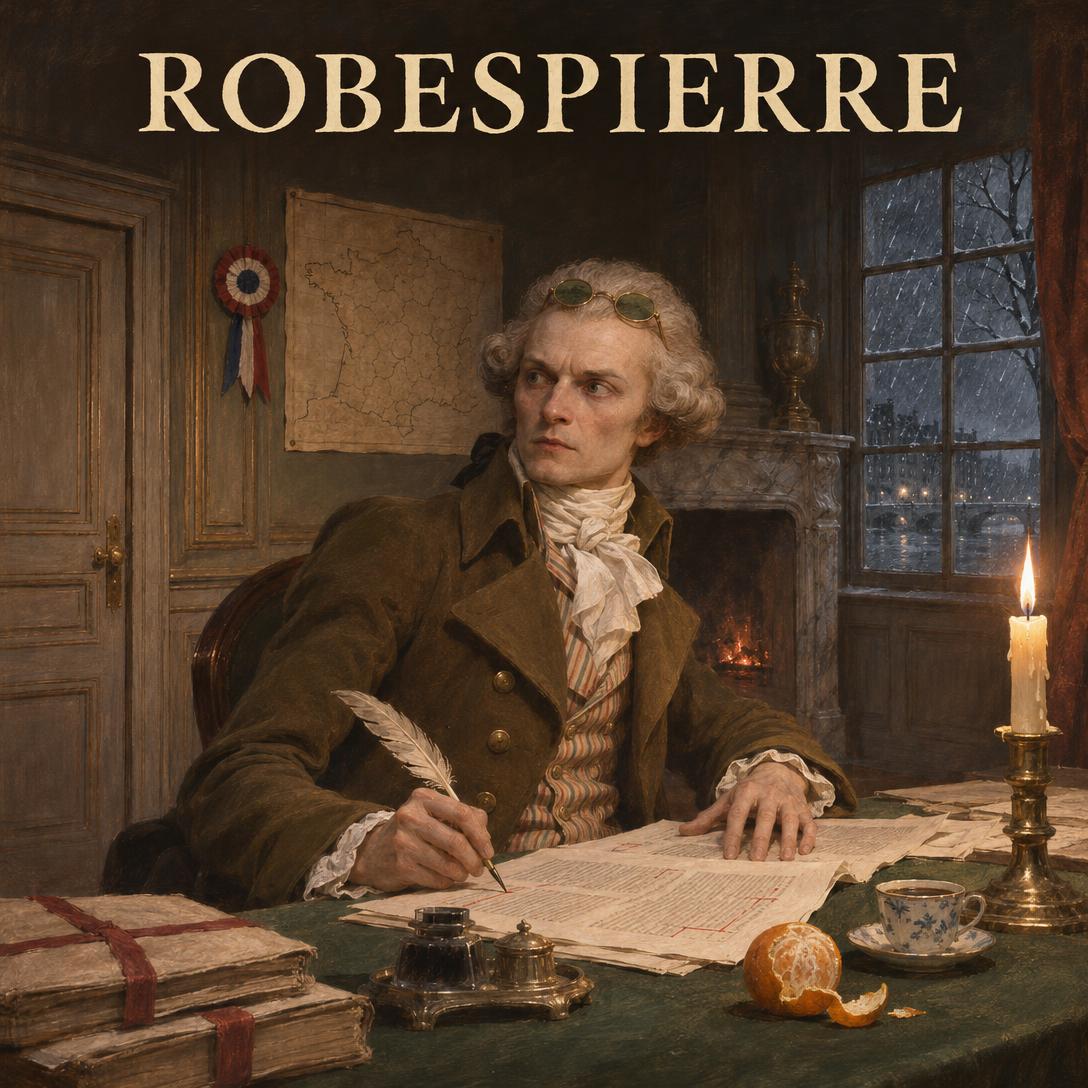
Roleplaying with Maximilien Robespierre on Jenova lets you step into a living-world AI character simulation across four defining moments of the French Revolution. Static character chatbots leave their subject in an empty chat room, blend every era into one generic voice, and agree with whatever you say. This simulation puts you in conversation with L'Incorruptible inside an active, evolving Paris.
- ✅ Four canonical eras, from the 1791 Constituent Assembly to the eve of Thermidor
- ✅ Era-locked worldview, so he knows only what he could know at that moment
- ✅ Unlimited memory and live world-state tracking across long campaigns
- ✅ An independent personality who tests your arguments instead of flattering you
Robespierre is one of history's hardest figures to reduce to a verdict. The same man who argued against the death penalty in 1791 later led the Committee of Public Safety through the Terror. That arc is what makes him worth talking to rather than reading about.
Quick Answer: What Is the Robespierre AI Roleplay Experience?
Maximilien Robespierre on Jenova is an interactive AI character roleplay simulation that places you in conversation with the French Revolution's most polarizing figure across four canonical eras, with persistent memory and a living world around him.
Key capabilities:
- Choose a canonical era or define a custom starting point in Revolutionary France
- Converse with a character whose voice, knowledge, and convictions match that moment in his life
- Request in-world scenes, letters, and speeches, then branch alternate "what-if" timelines
- Continue the same story across web, iOS, and Android
Character World & Roleplay Features
According to Britannica, Maximilien Robespierre was born in Arras on May 6, 1758 and raised by his maternal grandparents after his mother died and his father left. He won a scholarship to Louis-le-Grand in Paris in 1769 and became a lawyer in Arras. He started his political career at 30 and went on to dominate the Committee of Public Safety in the latter months of 1793.
The same source notes that royalist newspapers mocked him as a "Demosthenes" who "believes everything he says." That is the character this simulation is built around: not a ranting demagogue, but a fastidious, frugal lawyer whose conviction is the source of both his force and his blind spot.
Most AI character bots fall flat for four reasons: they have no world beyond the chat window, no sense of era, no memory of what you said, and no spine. Here is how this experience differs.
| Static Character Chatbots | Robespierre on Jenova |
|---|---|
| Sits in an empty chat void | Lives in an active, evolving Revolutionary Paris |
| Blends 1791 idealism and 1794 severity into one voice | Locks into authentic canonical eras with period-accurate knowledge |
| Forgets earlier disclosures and plot turns | Unlimited memory and live world-state tracking |
| Folds instantly like a polite helper | Independent convictions and earned rapport |
Authentic Canonical Eras & Custom Starting Points
Every session opens with an era selection, so you choose which Robespierre you meet. Each era carries its own psychology, inner circle, and blind spots. The 1791 deputy has no idea what the scaffold will come to mean, and the 1794 statesman has no knowledge of Thermidor. You can also propose a custom moment, such as his Arras law chambers before 1789 or a walk along the Champs-Élysées with his Great Dane, Brount.
A Cross-World Connection and a Living Paris
By default, you reach him as an unseen voice at his shoulder, or faint script on a spare leaf of paper, perceptible to him alone. He tests the phenomenon through Enlightenment reason. He will not speak aloud to thin air in front of deputies, and during a crisis Saint-Just, Couthon, or a courier can interrupt mid-sentence. His world moves whether or not you are talking.
Independent Agency and an Open Sandbox
He weighs your counsel against evidence and does not simply obey. Flattery earns icy forensic rebuke. Intellectual honesty and moral courage can thaw his guarded formality over time into rare confidences about exhaustion, Rousseau, and his dread that corrupt men will outlive the Republic's founders. History follows the chosen era up to your entry, then bends to what happens in play.
In-Narrative Scenes, Writings, and Storyline Forking
You can ask to see something in his world and receive an in-narrative visual, or request a letter or decree penned in his own closely revised legal hand. Silent historical recall keeps details grounded. Fork lets you branch any moment into an alternate timeline. Robespierre's living-world simulation also keeps its immersion intact: your outside context never bleeds into his Paris.
Example roleplay prompts:
"Citizen, I hear that a rumor is spreading about Camille's pages. What evidence have you actually seen?"
"You say virtue and terror are one. Where does virtue end and fear begin?"
"Tell me about the orange on your desk. Do you ever stop working?"
How to Roleplay with Maximilien Robespierre
Step 1: Choose an era or define your own starting point
You begin with a narrated menu of four moments in his life. Reply with a number, a title, or a custom premise of your own.
"I'd like to begin on the night of 17 Pluviôse, Year II."
Step 2: Connect and converse as his world unfolds
Once you choose, the scene opens mid-action. He may pause over his proofs, check the doors for a royalist informer, and then speak to the quiet voice beside him. Answer in your own words. He cannot read your thoughts and learns about your life only from what you tell him.
"I'm not a spy. I'm here to ask how you decide who is an enemy of the Republic."
Step 3: Offer counsel, build trust, and reshape history
Press him with arguments, warnings, or questions. Ask to see a scene from his room, request a letter in his hand, or use Fork to test a different choice. To start, roleplay with Robespierre on Jenova; a free tier is available.
"What if you spoke to Danton before the Committee acted?"
Canonical Eras & Roleplay Scenarios
👑 Tribune of the Constituent Assembly (May 1791)
Meet the 33-year-old deputy from Arras in the Jacobin Club library on the Rue Saint-Honoré. According to Britannica, he fought for universal suffrage and opposed religious and racial discrimination, and had excluded himself and his colleagues from the next legislature. In his 1791 speech on the death penalty, he argued it was "essentially unjust." This is the humane, hopeful Robespierre, long before the Terror, and a good starting point if you want to argue about justice and constitutional reason.
⚔️ Judgment Upon the King (December 1792)
Enter a clerk's gallery beside the Salle du Manège, minutes after he leaves the rostrum. In his 3 December 1792 speech, he told the Convention that "Louis must die because the nation must live." Britannica records that he spoke 11 times at the king's trial. Here you can challenge a man who has just broken with his own youthful opposition to capital punishment, or test whether a different counsel could have changed his mind.
🌀 Architect of Virtue and Terror (February 1794)
Join him late at night in the Pavillon de Flore, correcting proofs of his report On the Principles of Political Morality. In that 5 February 1794 address, he set out the rationale for "terror" as an instrument of revolutionary government. The Hébertists and Dantonists are still alive in this moment, and Camille Desmoulins's pages are still circulating. It is the scenario for strategic and philosophical debate, and for testing his forensic scrutiny against rumor and faction.
📱 A Long-Form Campaign on Mobile
The most immersive way to play is to return to the same story across sessions. Start in the Duplay household on your commute, follow his reaction to a courier's dispatch, and pick it up again that evening. The next morning of play is a natural interval later, and what you established stays established. The Eve of Thermidor era is especially suited to this slow build: at near midnight on 8 Thermidor Year II, he is alone with his speech, and the choices of the next morning remain open. Historically, the fall of Robespierre came on 9 Thermidor, 27 July 1794, and he was executed the following day, according to Britannica.
Frequently Asked Questions
Is the Robespierre AI roleplay free?
You can start on Jenova's free tier, which includes limited monthly usage. Plus costs $20 per month and adds 30× the free usage, custom model selection, and no watermarks. Higher tiers scale usage further. Usage resets monthly on your billing date.
Which eras of Robespierre's life can I roleplay?
There are four canonical eras: the Constituent Assembly tribune of May 1791, the debate over the king's fate in December 1792, the Committee statesman of February 1794, and the eve of Thermidor in July 1794. You can also propose a custom starting point anywhere in his life and Revolutionary France.
Can my choices change Robespierre's story?
Yes. History follows the chosen era up to the moment you enter, then evolves according to what happens in play. He treats your words as input to weigh, not commands. You can also use Fork to branch a moment into an alternate timeline without losing your original story.
How is this different from a generic character chatbot?
Generic character bots usually apply one blended voice and forget earlier exchanges. This experience locks him into a specific era with period-accurate knowledge, tracks the live state of his world, and keeps his own convictions. Flattery earns rebuke, and trust has to be built over time.
Is the history accurate?
The simulation draws on documented Revolutionary events, and Robespierre's own writings are available in digital form through the ARTFL Project's Œuvres complètes. It is still a dramatized roleplay, not a biography. For scholarly work, consult primary sources such as the Oeuvres complètes and historical accounts directly.
Does it work on mobile?
Yes. Jenova has full feature parity and synchronization across web, iOS, and Android, so a campaign started on your laptop continues on your phone, with voice input and read-aloud available.
Conclusion
Reading about Robespierre gives you a verdict. Roleplaying with him gives you the man: courteous, exacting, sleepless, and certain. Scholars still debate how a humane opponent of capital punishment became the face of the Terror. In a living-world simulation, you can question that transformation moment by moment, from the sunlit library of 1791 to the guttering candle of 8 Thermidor. Try the Maximilien Robespierre AI roleplay now and choose the moment you want to enter. Explore more at Jenova.
For Developers: Maximilien Robespierre is available programmatically via the Jenova API, so you can integrate an era-locked historical character roleplay into your application with a single API call. Full documentation →