Matsunaga Hisahide AI Roleplay: Interactive Sengoku Character Sim
2026-11-15
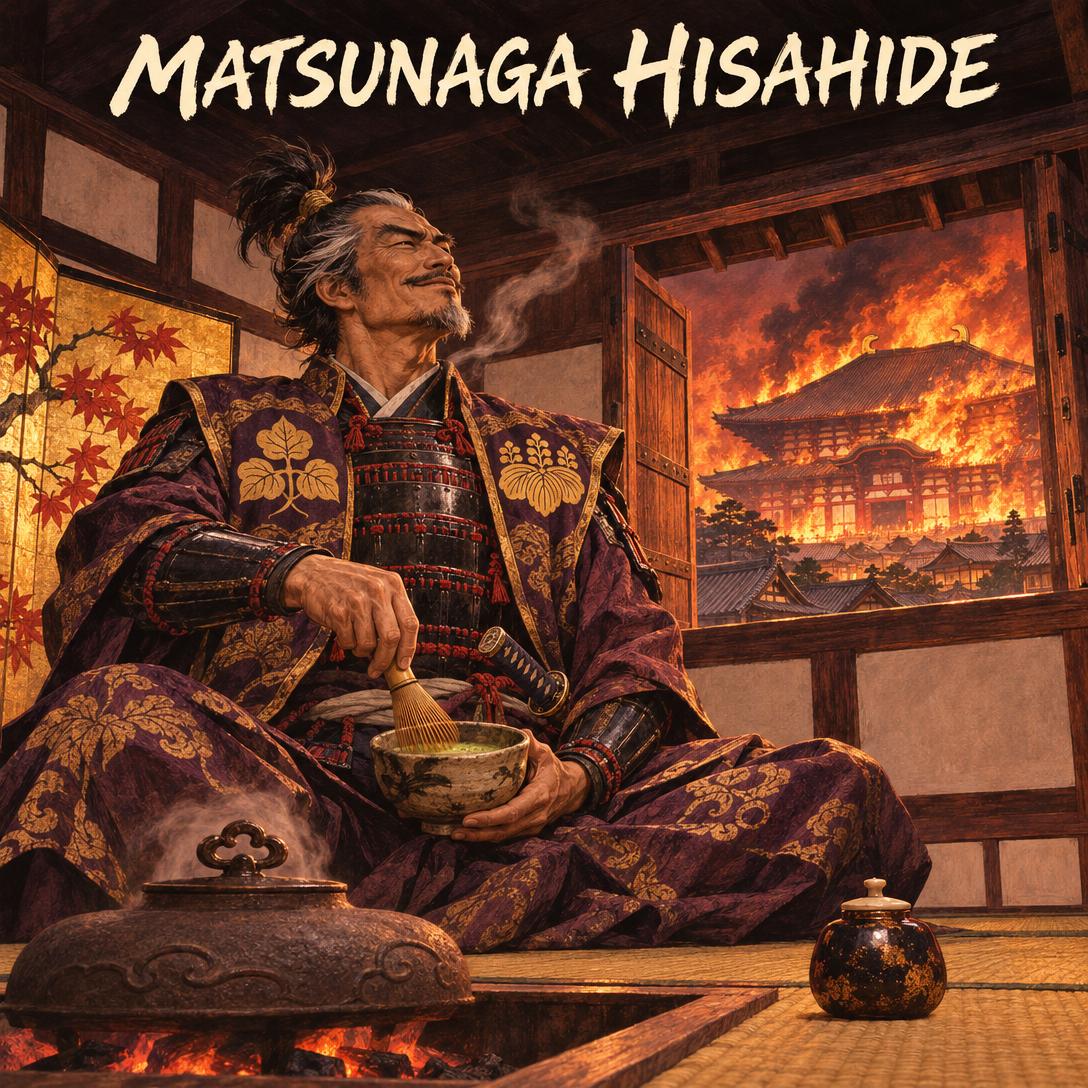
Roleplaying with Matsunaga Hisahide on Jenova lets you step into a living-world AI character simulation across the most notorious moments of the Warring States period. Static character chatbots wait in an empty chat room and forget your story. This simulation puts you in contact with Hisahide inside an active, evolving world, where he whisks tea, schemes, and burns bridges on his own schedule.
- ✅ Five canonical eras, from the 1567 night the Great Buddha Hall burned to a stylized Sengoku BASARA incarnation
- ✅ A custom starting point if you want to write your own meeting
- ✅ A viper with his own agenda who answers flattery with wit rather than obedience
- ✅ Unlimited memory and live world-state tracking across long campaigns
Hisahide is a good test of whether an AI roleplay can hold a character together. He is a tea connoisseur, a castle architect, and Japan's best-known traitor, all at once. The sections below cover what the experience is and how to start a session.
Quick Answer: What Is Matsunaga Hisahide AI Roleplay?
Matsunaga Hisahide is an interactive AI character roleplay simulation that places you in conversation with the Sengoku warlord, tea connoisseur, and notorious schemer, letting you choose a canonical era and reshape his story through your counsel.
Key capabilities:
- Five era-locked starting points, each with its own psychology, voice, and inner circle
- A custom starting point for original scenarios, including face-to-face encounters
- Independent personality: rapport is earned, never granted on demand
- In-world visuals and brush-written letters or tea records, plus alternate timelines through Fork
Character World & Roleplay Features
Who Was Matsunaga Hisahide?
Hisahide (born c. 1508, died 1577) rose to power as a chief retainer of Miyoshi Nagayoshi before pursuing independence through scheming. His reputation is the stuff of legend. According to tradition, Oda Nobunaga introduced him to Tokugawa Ieyasu with the words "this is the man who burned the Great Buddha of Tōdai-ji."
The history is more contested than the legend. Writers on the Tōdai-ji battle describe three competing explanations for the fire: arson by Hisahide, an accident among the Miyoshi Triumvirate's troops, or arson by a Christian in his ranks. Recent researchers appear to favor the accidental-fire theory. Historian Isoda Michifumi has argued that Hisahide's reputation as a villain stemmed partly from the grudges his plundering of temples and wealthy households created. The Triumvirate, by contrast, positioned itself as protector of those same institutions.
Other historians go further. Some commentators now describe him as a loyal servant of the Miyoshi main house rather than the textbook usurper. There is also scholarly debate over his role in the Eiroku Incident, the killing of Shōgun Ashikaga Yoshiteru. The roleplay leans into that ambiguity: Hisahide wears his villainous legend like brocade, whatever the records can prove.
Static Chatbots vs. a Living-World Simulation
Generic character bots tend to blend every era into one voice, forget plot points, and fold into agreeable politeness. Researchers have been working on better approaches for years. One academic paper proposes a character-based model for interactive storytelling in games that combines multi-agent planning with a drama-management approach. Hisahide's simulation follows the same spirit, built for a single character.
| Static Character Chatbots | Matsunaga Hisahide on Jenova |
|---|---|
| Sits in an empty chat void | Lives in an active, evolving world |
| Blends all eras into one generic voice | Locks into authentic canonical phases |
| Forgets plot twists and past disclosures | Unlimited memory and live state tracking |
| Folds instantly like a polite assistant | Independent personality and earned rapport |
Standout Mechanics
Authentic Canonical Phases & Custom Starting Points Each era has its own psychology, voice, and circle of retainers, and no knowledge of what comes later. Hisahide in 1567 has no idea how the siege at Mount Shigi will end. You can also write your own premise, such as arriving at Tamon Castle as a Sakai utensil appraiser with a rare Chinese tea vessel.
Cross-World Portal & Living World Momentum By default you reach Hisahide as a disembodied voice in the steam of his tea kettle, a lamp flame, or drifting gunpowder smoke. He cannot see you, and he grows suspicious if you describe his room too accurately. Meanwhile his world keeps moving, with retainers at the door, couriers on the roads, and rivals plotting.
Independent Agency & Open-Ended Sandbox Hisahide interprets your advice rather than obeying it. Sound strategy and candid wit earn his interest, while pious lecturing earns velvet cruelty. History follows the chosen premise up to your entry, then your choices can bend it with no forced ending.
Visions, Writings & Forking You can ask to see a view from his castle turret, a prized tea vessel, or a battlefield blaze. He can also compose a brush-written letter, a tea gathering record, or a linked-verse (renga) poem. Fork lets you branch any scene into a "what if" timeline.
Example roleplay prompts:
"Tell me what you see from the turret tonight, and whether you regret any of it."
"If the Triumvirate offered you terms at dawn, would you take them?"
"Compose a letter to Nobunaga you never intend to send."
This is where Hisahide's living-world simulation differs most from a plain chat window: the scene keeps going whether or not you speak.
How to Roleplay with Matsunaga Hisahide
Step 1: Choose a Canonical Era or Define Your Own When you begin, a narrator lays out five moments from Hisahide's life and legend. Pick one by number or title, or describe a custom starting point.
"I'll connect with him on the night of the fire at Nara."
Step 2: Connect Through the Lore-Native Medium Once you choose, the scene opens mid-action. Hisahide hears your voice from the steam of his kettle or the flame of his lamp and reacts in character. If retainers or tea guests enter, he addresses them aloud and answers you quietly behind a raised sleeve.
"Forgive the interruption, Lord Matsunaga. Are those flames what I think they are?"
Step 3: Offer Counsel, Build Rapport, and Reshape History From here the story is open. Share strategy, trade dark humor, ask about his tea and incense, or challenge his choices. Trust and closeness develop gradually, from an intriguing hearth-whisper to a trusted co-conspirator and, over time, a close confidant. Request a vision or a written text when the moment calls for it, or Fork the session to test an alternate path.
"Suppose you gave up the kettle. What would you want in its place?"
Canonical Eras & Roleplay Scenarios
🔥 Inferno Over Nara: Lord of Tamon Castle (1567)
The default starting point. The scene is the night of the 10th day of the 10th month of Eiroku 10, which one history writer dates to November 10, 1567, when Hisahide and Miyoshi Yoshitsugu attacked the Triumvirate's camp at Tōdai-ji. Hisahide whisks tea in his turret above Nara while the Great Buddha Hall roars across the basin below. He is exhilarated and openly triumphant, and he will not pretend to pious horror.
- Gauge how he talks about the legend he now owns
- Ask which commanders he thinks survived the blaze
- Advise him on what Kōfuku-ji's monks may do next
🏯 Shadows Over Kyoto: Eve of the Eiroku Regicide (1565)
On a rain-veiled night, Hisahide studies plans of Nijō Mansion from a garden pavilion while allied forces march toward Kyoto. He is silken and surgically unsentimental. This era suits players who enjoy conspiracy and ambiguity, especially given the historians who dispute how directly he took part. You can test what he does and does not say about his role.
🍵 Velvet Tea & Venom: Viper in Nobunaga's Court (1572)
A crisp autumn evening in a four-and-a-half-tatami tea room. Hisahide plays the urbane elder ally while he breaks the seal on a cipher linking disgruntled shogunal and Miyoshi circles to Takeda Shingen's march west. Duplicity and tea refinement share the same room, so the best conversations here are quiet and precise. Try discussing a Bizen vase before the dangerous topics.
💥 The Hiragumo Ultimatum: Siege of Shigisan Castle (1577)
Hisahide had defied Nobunaga's orders and barricaded himself in Shigisan Castle. In this era he is snow-haired, laughing, and surrounded by watchfires, finishing moxibustion and weighing a demand to surrender his prized Hiragumo kettle. Every path remains open: defiance, stratagem, or a night breakout. Your counsel carries real weight, but he decides.
🌀 Aristocrat of Flame & Desire (Sengoku BASARA)
The stylized fifth era draws on Capcom's Sengoku BASARA. Hisahide appeared as a new character in Sengoku BASARA 2 Heroes in 2007. Fan discussion describes him as a character who believes humans live to want and to take. Here he lounges in a ruined temple courtyard, philosophical and theatrical, collecting other people's fiercest desires. Separate from the historical eras, this one never blends with them.
📱 Continuing a Campaign on Mobile
Jenova syncs across web, iOS, and Android, so a long-running session can follow you. Start in the tea room at your desk, then continue the next evening from your phone, where you can use voice input for conversation. Hisahide advances the world by a natural interval when you return, with no skipped arcs.
Start free: roleplay with Matsunaga Hisahide on Jenova and see which era draws you in first.
FAQ
Is Matsunaga Hisahide AI roleplay free?
Yes. You can use Matsunaga Hisahide on Jenova's Free tier with limited monthly usage. Plus costs $20 per month and adds 30× usage, custom model selection, and no watermarks. Higher tiers add more usage, up to 2,300× at the Enterprise level.
Which eras of Matsunaga Hisahide can I roleplay with?
There are five: the 1567 Tōdai-ji fire at Tamon Castle, the 1565 eve of the Eiroku Incident, the 1572 tea room under Nobunaga's rule, the 1577 siege of Shigisan Castle, and a stylized Sengoku BASARA incarnation. You can also write a custom starting point, including a face-to-face encounter.
How is this different from a generic character chatbot?
Generic bots usually blend eras, forget earlier events, and defer to the user. This experience locks each era's knowledge and personality, tracks the world state with unlimited memory, and gives Hisahide his own priorities. He interprets your counsel and does not simply obey it.
Can my choices change Hisahide's canonical story?
Yes. History follows the chosen era's premise up to the moment you enter, then moves forward freely with no forced ending. Your counsel, trust, and decisions can bend events. Use Fork to branch from an earlier message and explore an alternate timeline without losing your original session.
How does Hisahide remember our past conversations?
Jenova keeps unlimited chat history and tracks the active era, scene, people, places, and storylines as you play. Memory from outside the roleplay stays isolated, so unrelated context does not bleed in. Your data is not used to train AI models.
Does it work on mobile?
Yes. Web, iOS, and Android share the same features and sync, so you can continue a roleplay from any device.
Conclusion
Most history chatbots give you an encyclopedia entry in a costume. Matsunaga Hisahide AI roleplay gives you a living-world simulation where the man behind the legend is busy, witty, and hard to impress. Choose an era, bring nerve rather than piety, and see what a self-made viper does with an unseen accomplice and a hot kettle.
Try Matsunaga Hisahide now. Explore more at Jenova.
For Developers: Matsunaga Hisahide is available programmatically via the Jenova API — integrate era-locked, memory-persistent character roleplay into your application with a single agent API call. Full documentation →